After Claude Galle
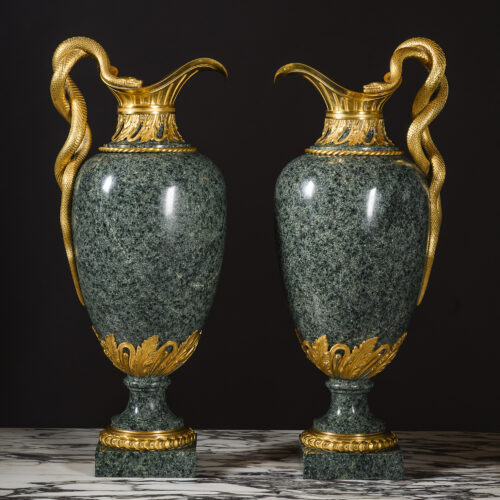
A Pair of Empire-Style Gilt-Bronze-Mounted Levanto Rouge Marble Urns, Mounted As Lamps
£22,000
A pair of Empire-style gilt-bronze-mounted Levanto Rouge marble urns, mounted as lamps, After the model by Claude Galle (1759–1815).Each of elongated...
Dimensions
Height: 58 cm (23 in)Width: 12.5 cm (5 in)
Depth: 11 cm (5 in)
Weight: 6 kg

 Print
PrintDescription
A pair of Empire-style gilt-bronze-mounted Levanto Rouge marble urns, mounted as lamps, After the model by Claude Galle (1759–1815).
Each of elongated ovoid loutrophoros form, flanked by winged naiads forming handles, finely cast with entwined tails and sounding trumpets; the marble bodies with gilt-bronze knurled banding, raised on palmette and anthemion-mounted bases, set on spreading gilt-bronze feet and square-section green marble plinths.
France, Circa 1890.
Inspired by celebrated First Empire models associated with the maitre-fondeur Claude Galle, these fine late 19th century urns embody the sophistication and disciplined ornament of the Empire aesthetic, executed with a confident understanding of classical form and decorative balance.
A pair of gilt-bronze urns of this model by Claude Galle is illustrated in H. Ottomeyer and P. Pröschel et al., Vergoldete Bronzen, vol. I, Munich, 1986, p. 365, fig. 5.12.8.

H. Ottomeyer, P. Pröschel et al., Vergoldete Bronzen, vol. I, Munich, 1986, p. 365, fig. 5.12.8
A pair mounted as candelabra, originally forming part of the furnishings supplied to the First Consul for Saint-Cloud in 1802–1803, was recorded in Madame Bonaparte’s private apartments and later moved to the Trianon in 1838 (illustrated in D. Ledoux-Lebard, Le Grand Trianon, Paris, 1975, p. 62).
A further comparable pair of gilt-bronze urns by Galle is in the collection of the Villa Masséna, Nice, (L. Mézin, La Villa Masséna du Premier Empire à la Belle Époque, Éditions d’art Somogy, 2010, pp. 54–55, cat. no. 10).

The fireplace mantel in the dining room at La Villa Masséna, with a pair of gilded bronze candelabra by Claude Galle of this model flanking a clock depicting Bacchus attributed to Pierre-Philippe Thomire. Source Wikipedia – CC Villa Masséna (Nice), Finoskov.
Date
Circa 1890
Origin
France
Medium
Gilt-Bronze and Marble
Claude Galle (1759–1815) was one of the foremost Parisian bronziers and fondeur-ciseleurs of the late Louis XVI and Empire periods. Born at Villepreux near Versailles, he served his apprenticeship in Paris under the fondeur Pierre Foy, and in 1784 married Foy’s daughter. He was received as a maître-fondeur in 1786, and following the death of his father-in-law in 1788, assumed control of the workshop, which he developed into one of the largest and most productive bronze manufactories of the period, employing approximately 400 craftsmen.
Galle established successive workshops, first at the Quai de la Monnaie (later Quai de l’Unité), and from 1805 at 60 Rue Vivienne. He obtained numerous commissions from the Garde-Meuble de la Couronne under Jean Hauré, and is known to have collaborated with leading bronziers of the day, including Pierre-Philippe Thomire. Under the Empire, he became one of the principal suppliers of bronzes d’ameublement to Napoleon’s residences, particularly the Château de Fontainebleau, where his output formed a significant part of the furnishing programme.
His Imperial commissions extended to the palaces of Saint-Cloud, the Tuileries, Compiègne, Rambouillet, and the Trianons, as well as important Italian residences including Monte Cavallo in Rome and Stupinigi near Turin. His production encompassed a wide range of luxurious objects—urns, vases, lighting furniture, and elaborate clock cases—frequently enriched with finely chased mythological figures such as winged maidens, naiads, and other classical motifs.
The quality and refinement of Galle’s work was widely admired and collected throughout Europe, notably by aristocratic patrons and the Russian Imperial family, with significant examples still preserved in the palaces and museums of St Petersburg. Despite his success, Galle often suffered financial difficulties, exacerbated by the scale of his workshop and the failure of major clients, including Prince Joseph Napoleon, to settle accounts. He ultimately died in poverty in 1815.
Following his death, the workshop was re-established and continued by his son, Gérard-Jean Galle (1788–1846). Today, Claude Galle’s work is represented in many of the world’s leading museum collections, testifying to his importance as one of the great masters of Empire bronze.
L. Mézin, La Villa Masséna du Premier Empire à la Belle Époque, Éditions d’art Somogy, 2010, pp. 54–55.
D. Ledoux-Lebard, Le Grand Trianon, Paris, 1975, p. 62.
H. Ottomeyer and P. Pröschel et al., Vergoldete Bronzen, vol. I, Munich, 1986, p. 365.