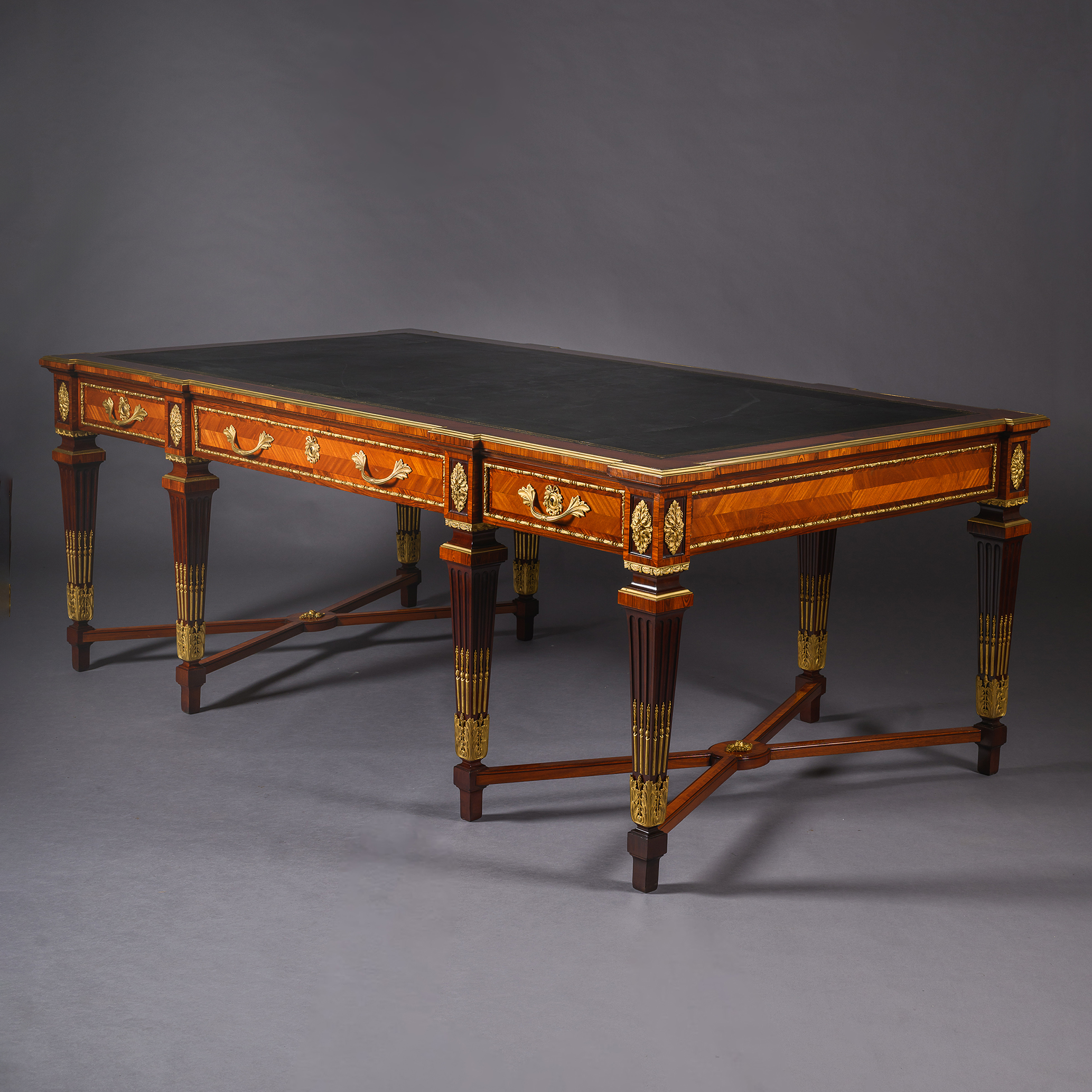
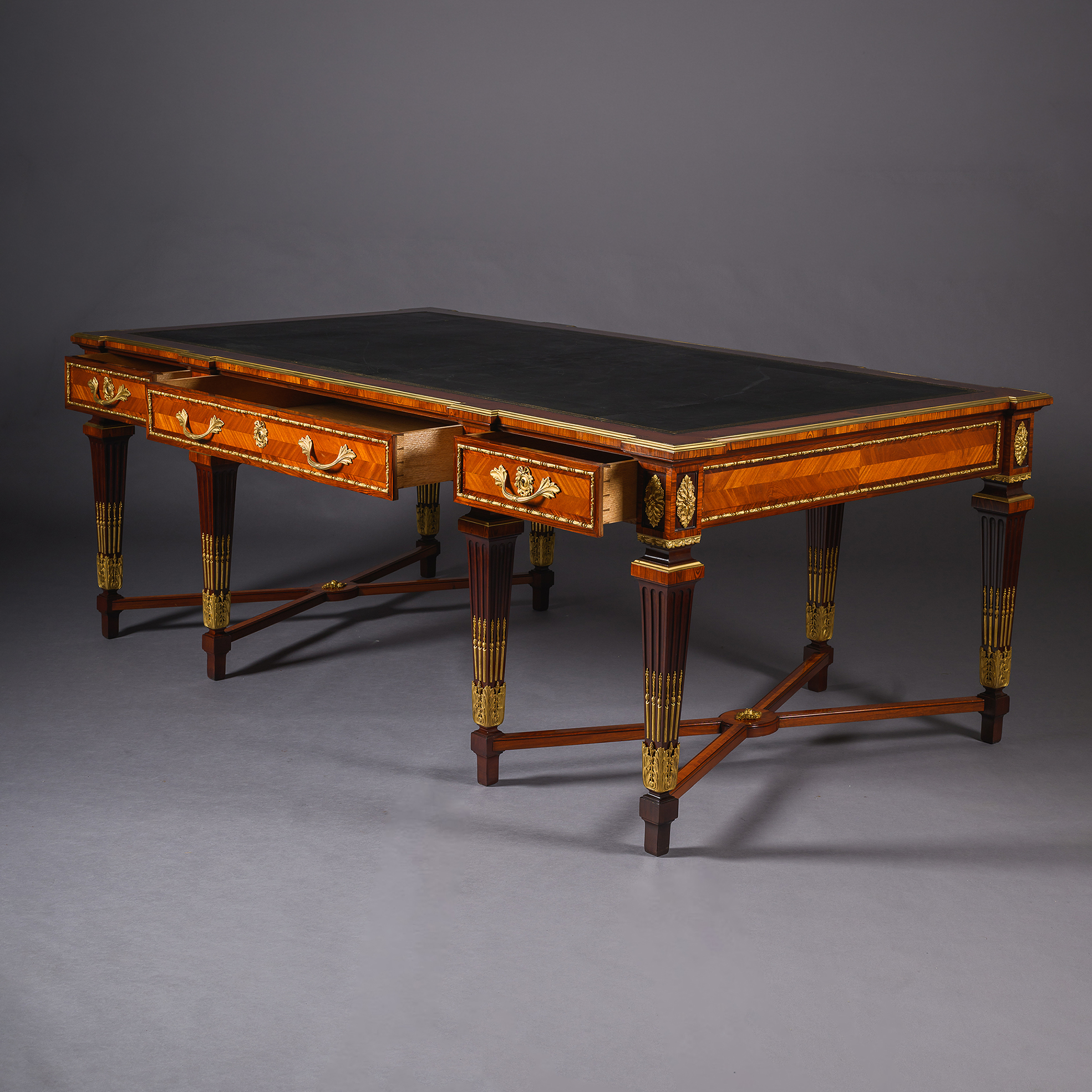
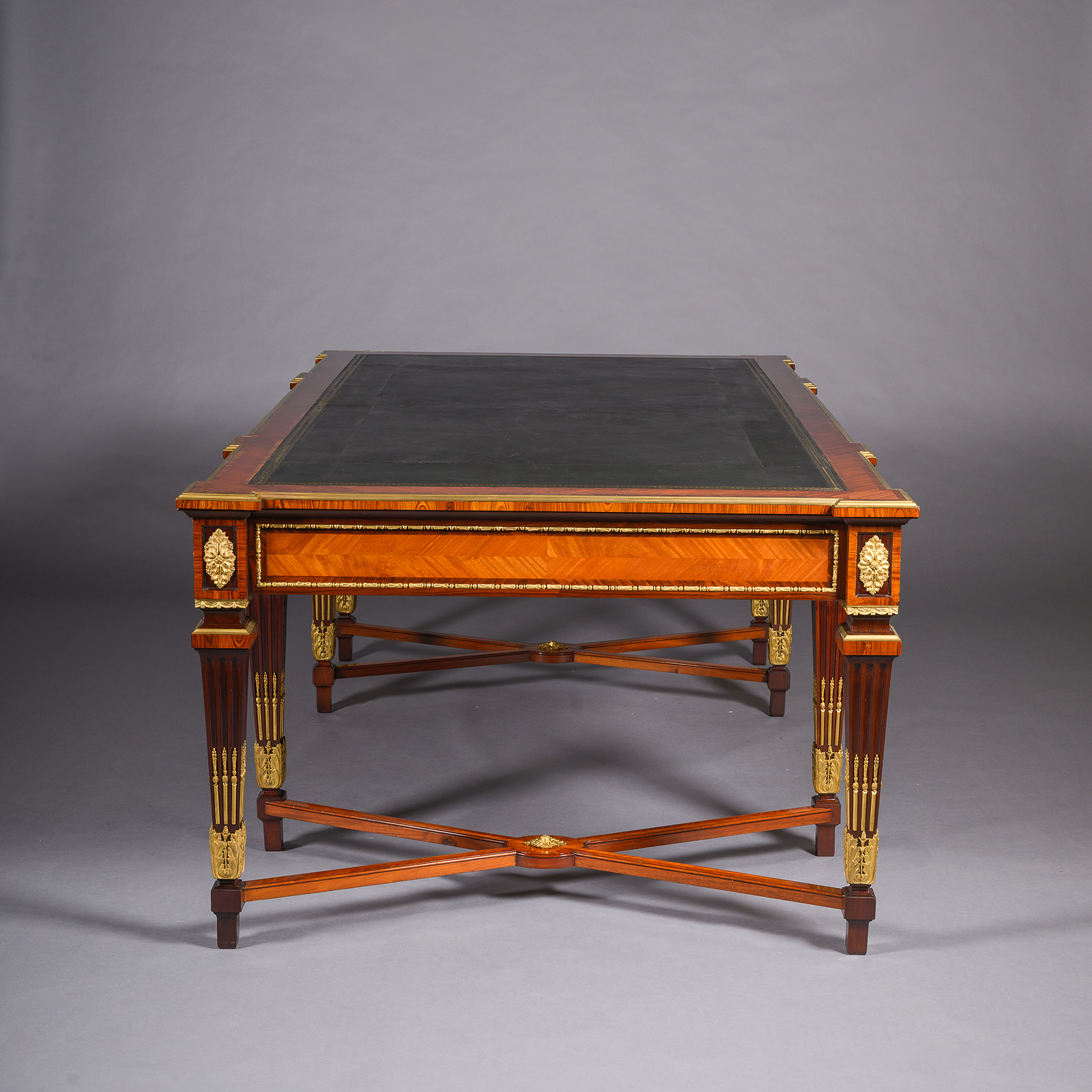
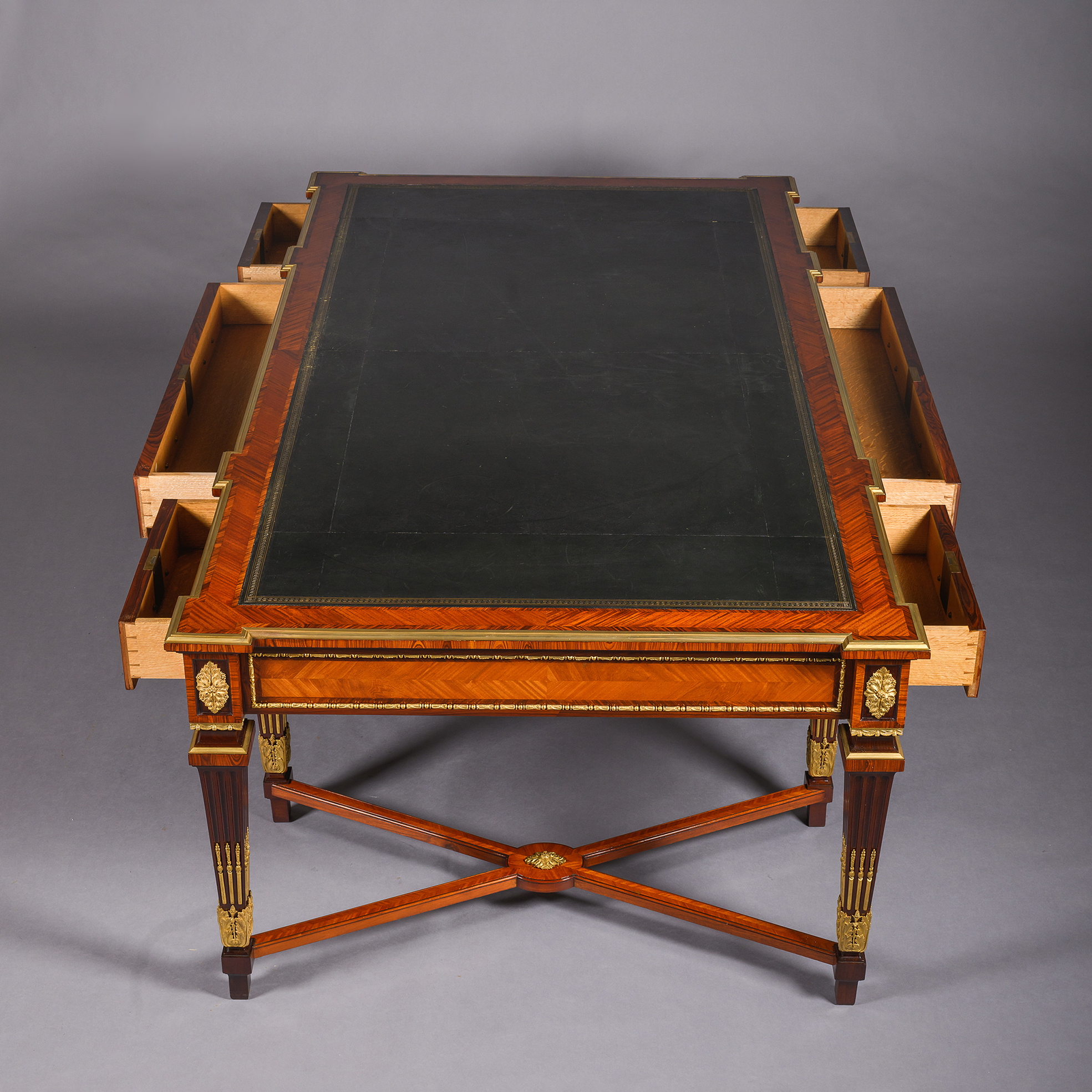
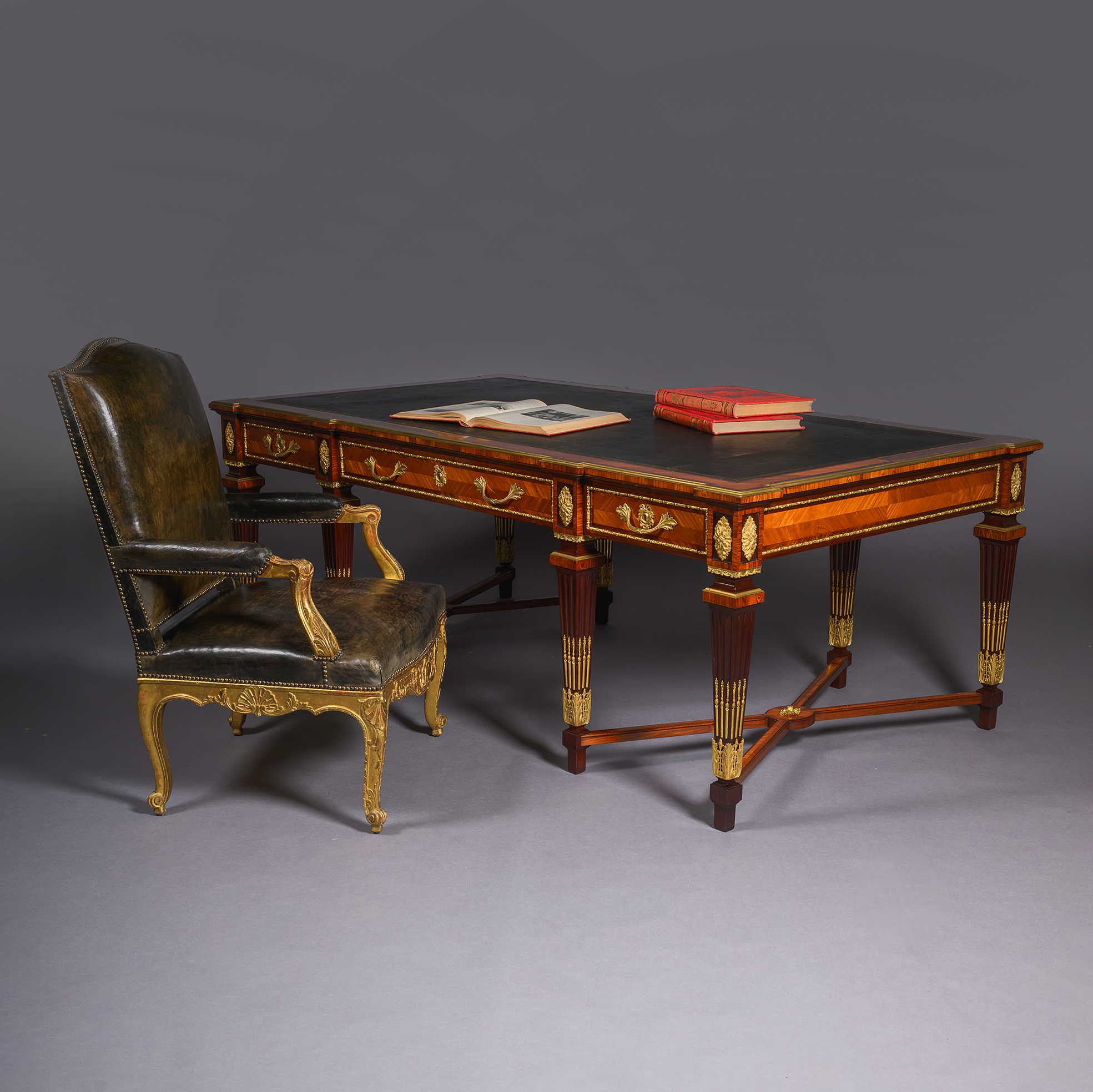
The Luton Hoo Library Table
£85,000
The Luton Hoo Library TableA Monumental Louis XVI Style Gilt-Bronze Mounted Mahogany and Bois Satiné Library or Centre Table, Supplied by Mewès &...
Dimensions
Height: 83 cm (33 in)Width: 221 cm (88 in)
Depth: 123 cm (49 in)
Weight: 130 kg

 Print
PrintDescription
The Luton Hoo Library Table
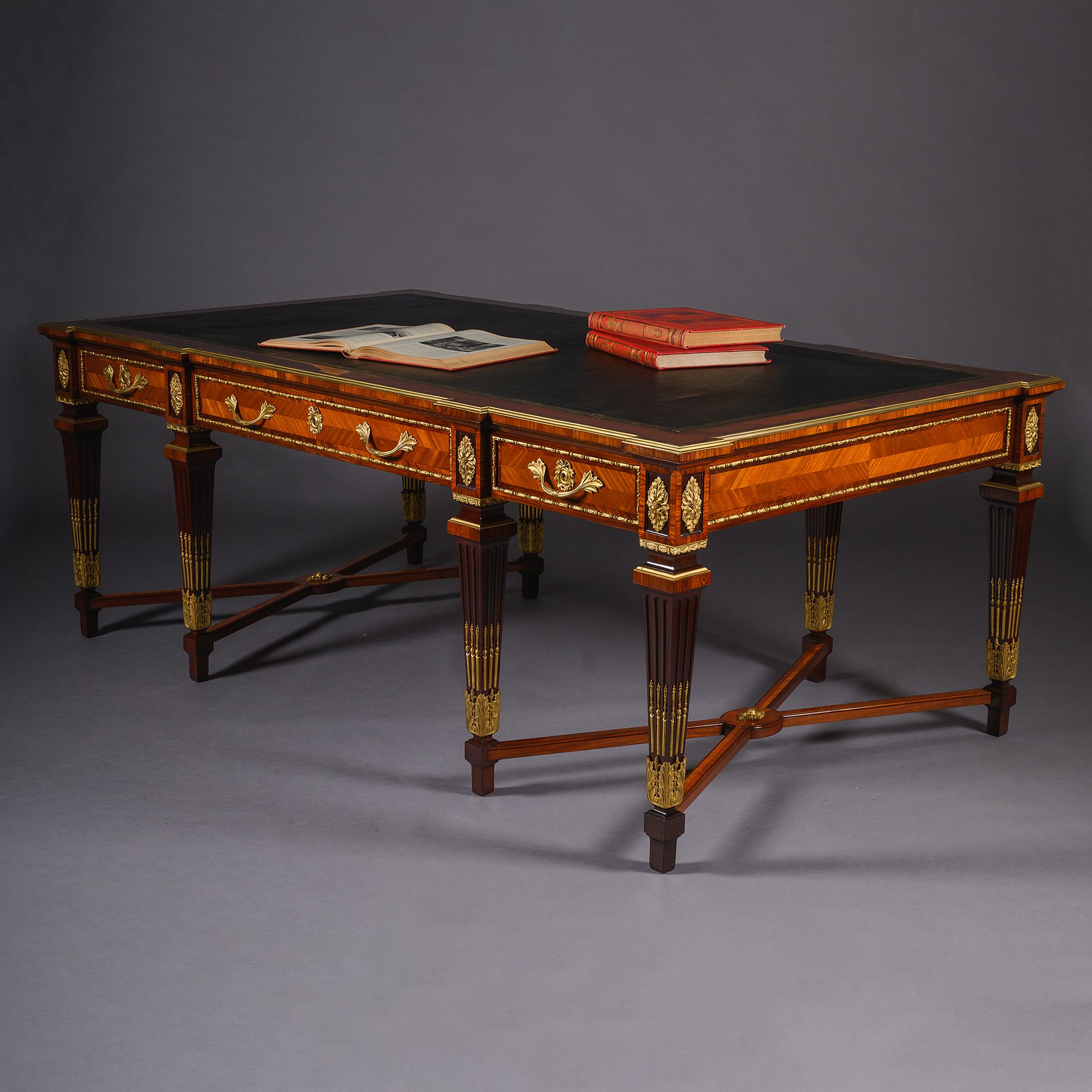
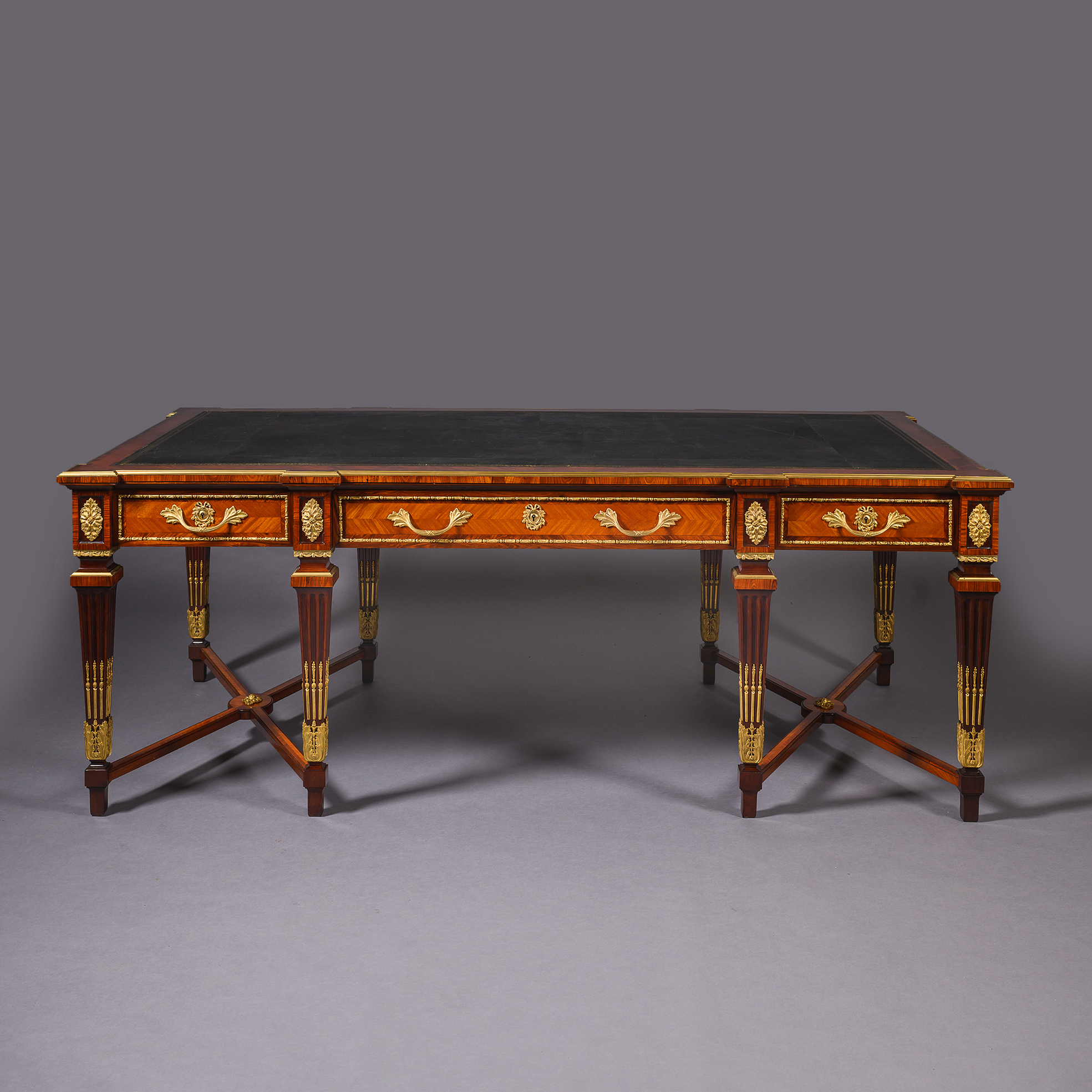
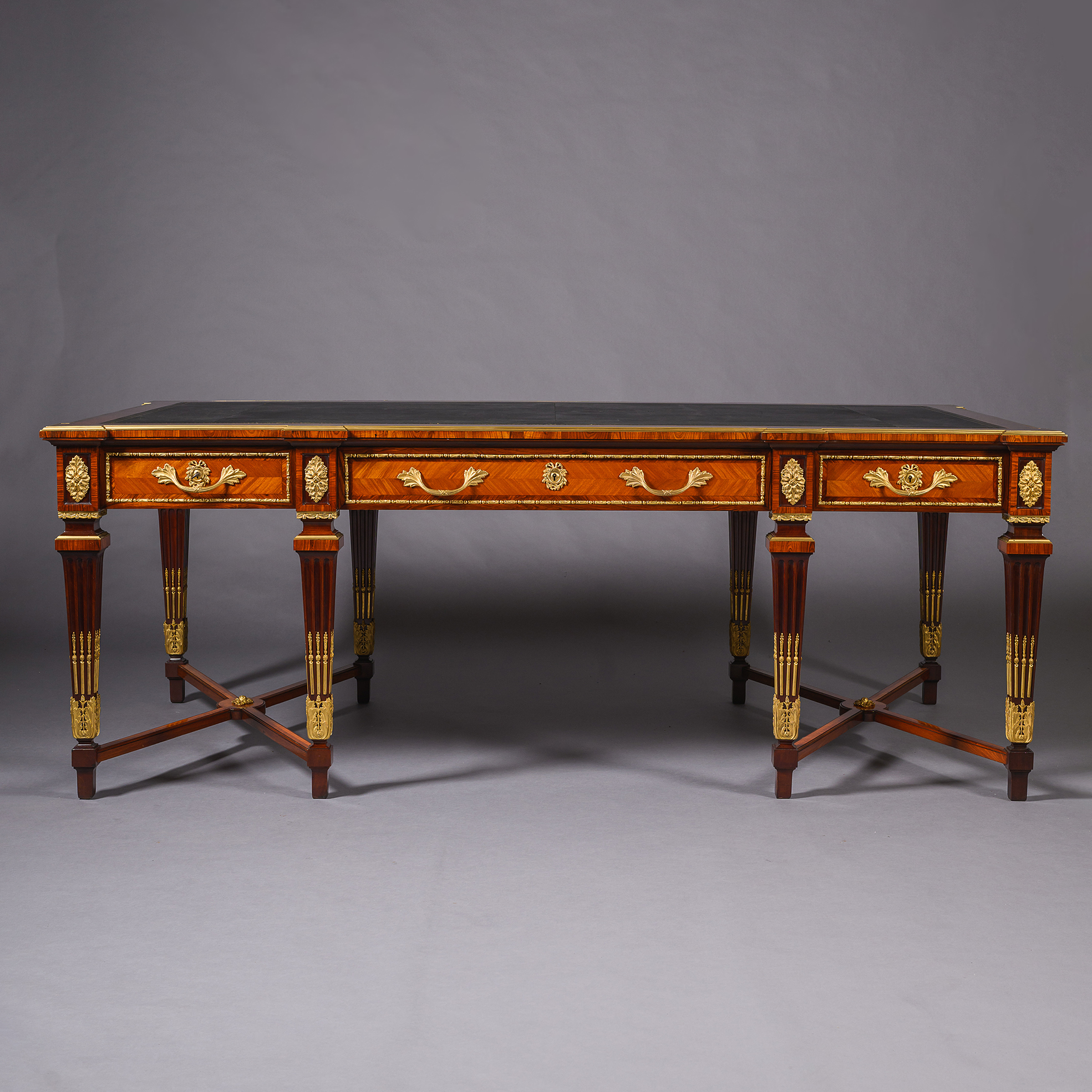
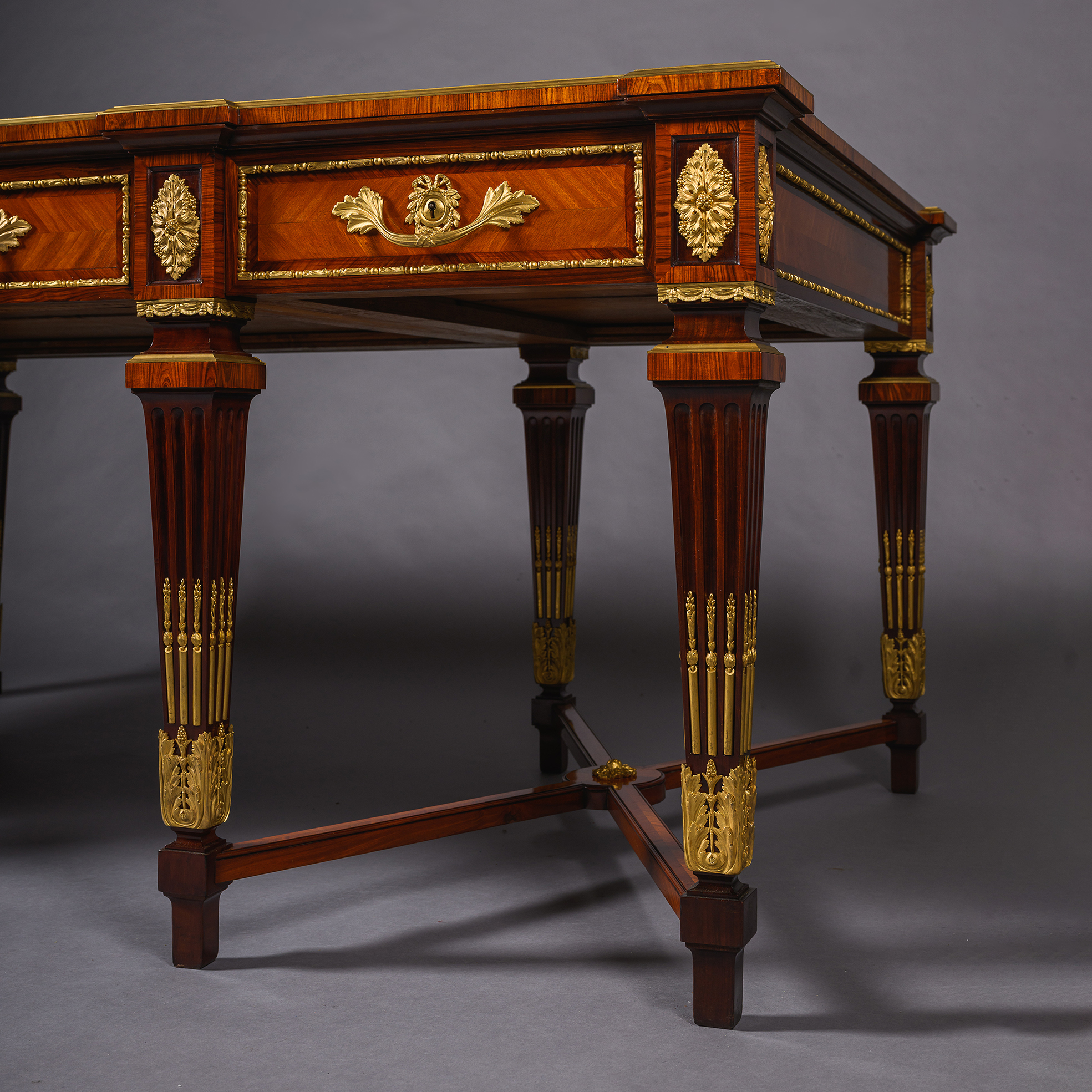
A Monumental Louis XVI Style Gilt-Bronze Mounted Mahogany and Bois Satiné Library or Centre Table, Supplied by Mewès & Davis for Luton Hoo, Bedfordshire.
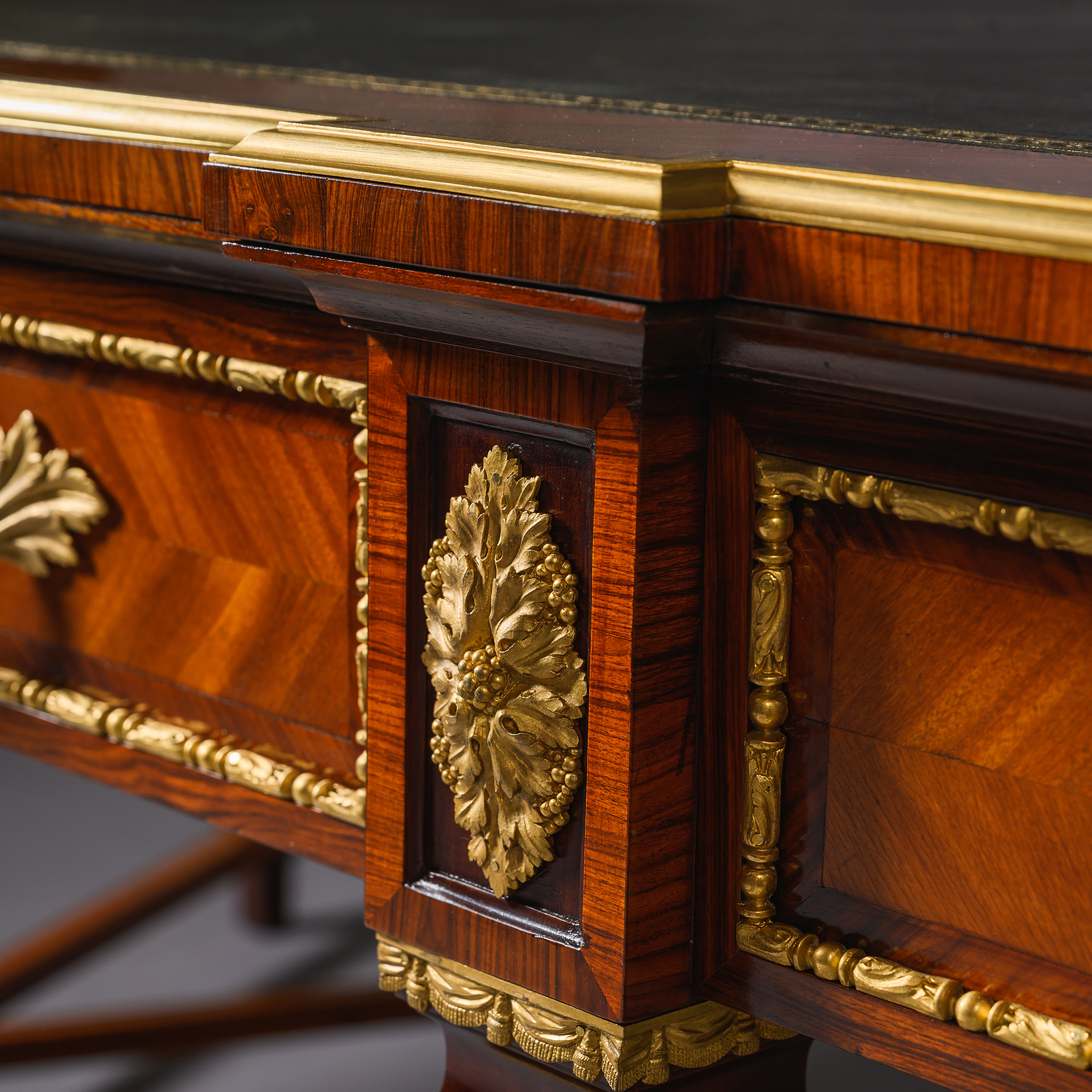
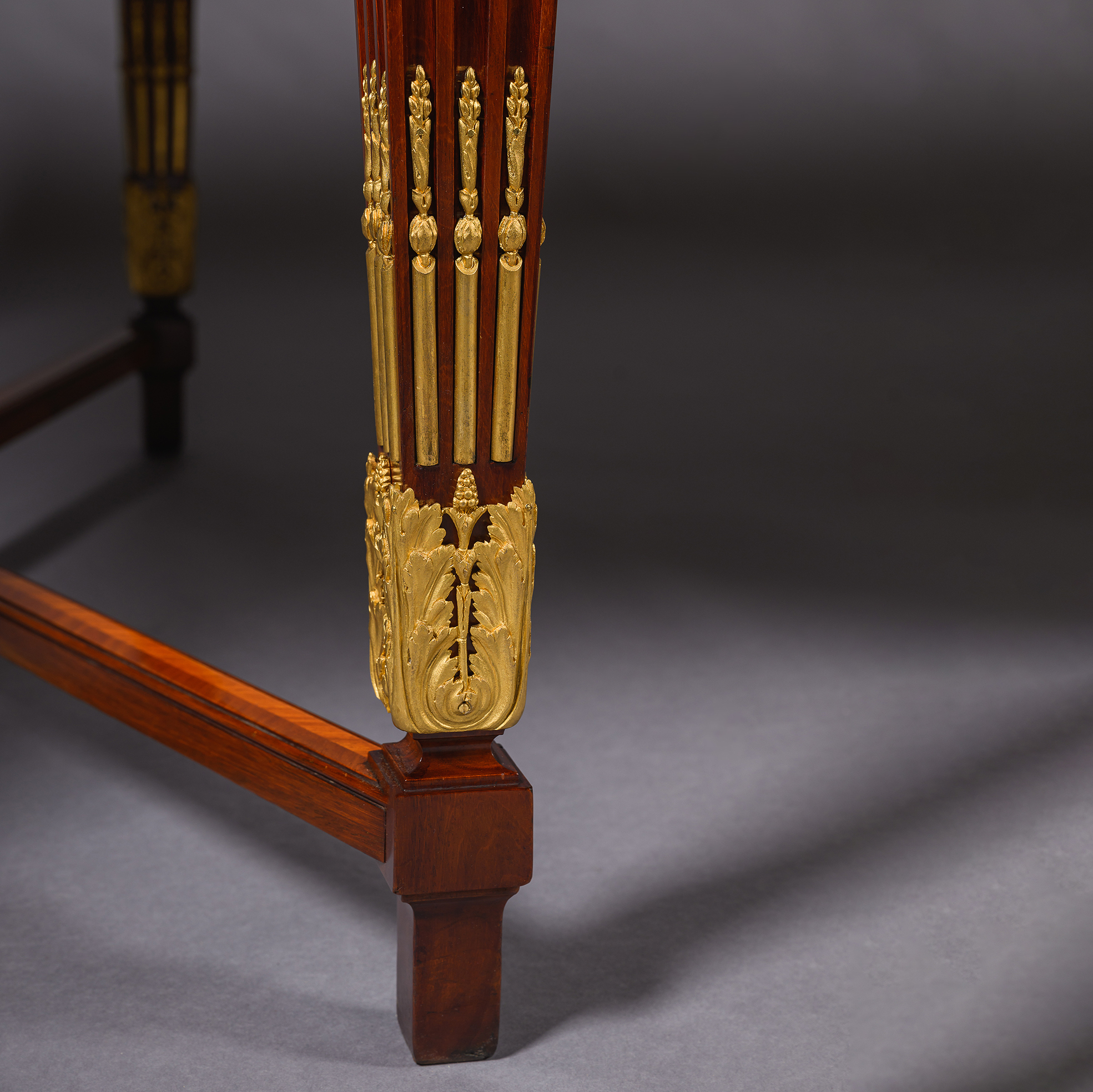
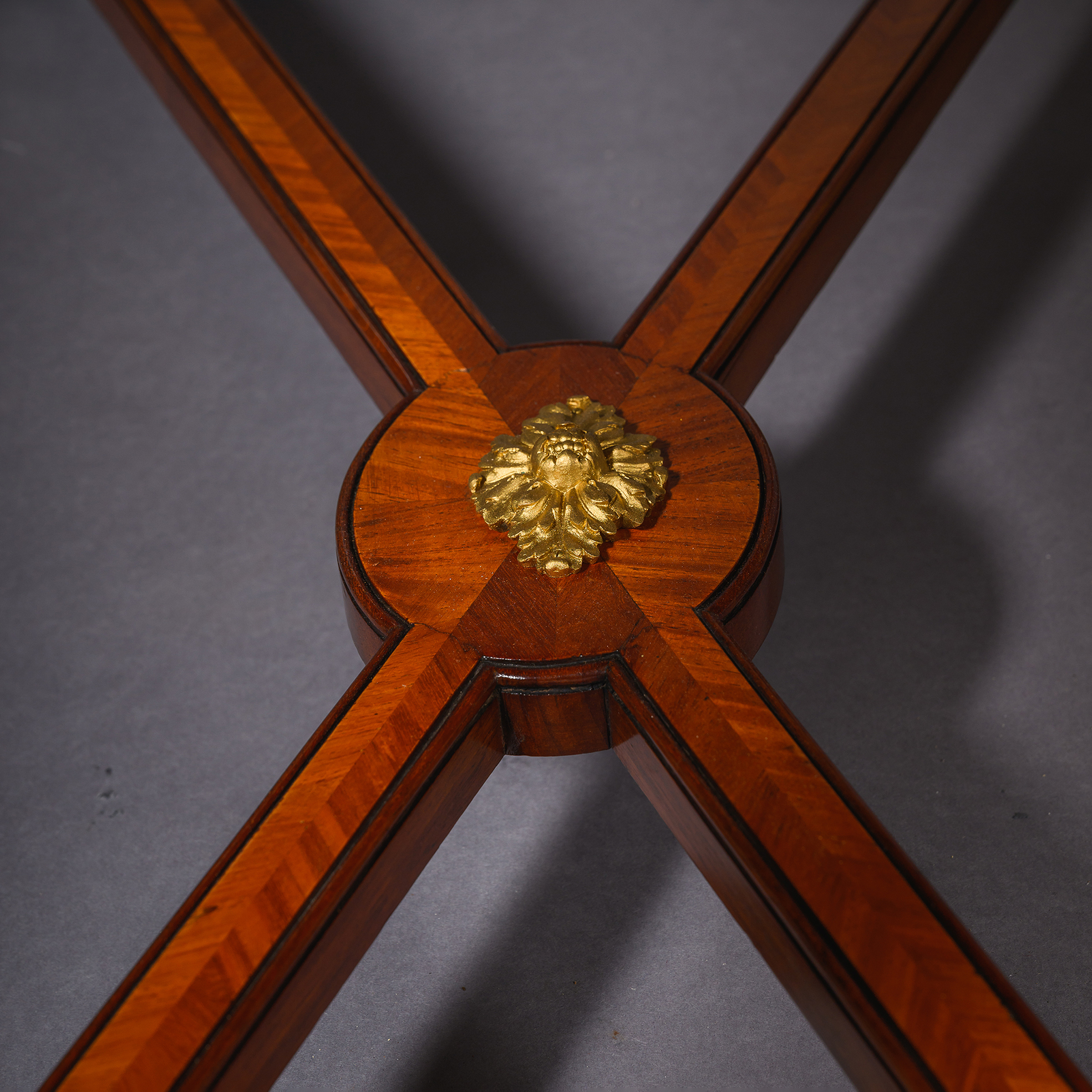
The rectangular top of recessed outline with a moulded brass edge and crossbanded surround inset with gilt-tooled green leather. The frieze to front and back set with three drawers faced in quarter-veneer with gilt-bronze laurel escutcheons and foliate handles. On eight tapering and fluted legs headed by berried-patera and joined by two ‘X’-shaped stretchers.
Bronze mounts incised casting marks to reverse ‘A’ or ‘V’.
The lockplates stamped ‘A*V Paris’.
France, Circa 1900.
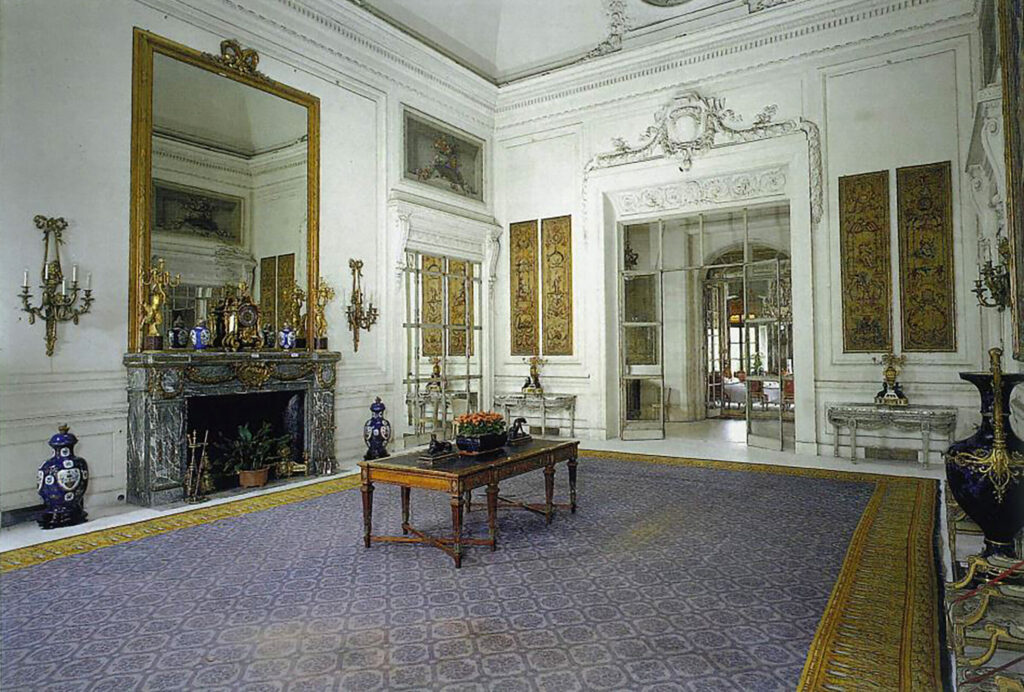
This table in the Blue Hall at Luton Hoo, Bedfordshire, circa 1990s (© James Kerr).
Date
Circa 1900
Origin
France
Medium
Mahogany and Gilt-Bronze
Sir Julius Wernher, 1st Bt. (1850-1912) and Alice, Lady Wernher, subsequently Lady Ludlow (1862-1945), to their son Sir Harold Wernher, 3rd Bt., G.C.V.O. (1893-1973), Luton Hoo, Bedfordshire, in the Blue Hall, and by descent until sold.
Sir Julius Wernher, 1st Bt. (1850-1912)
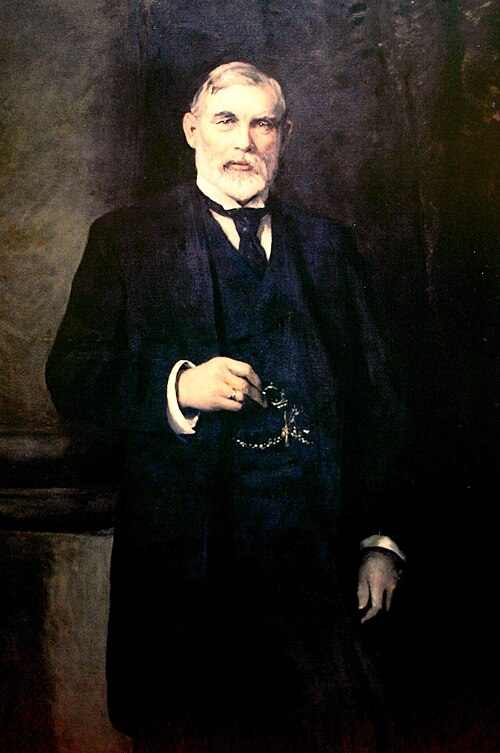
Portrait of Sir Julius Charles Wernher, 1st Baronet (9 April 1850 – 21 May 1912).
Wernher was one of a handful of so called ‘Randlords’ who controlled the diamond and gold mining industries in South Africa from the 1870s to the First World War. Born in Darmstadt in Germany he moved to London at the age of 21 where his talent for business was spotted by a diamond dealer named Jules Porgès (1839-1921). He recognised early the significance of the diamond finds in South Africa and in 1873 sent two of his younger staff, Julis Wernher and Alfred Beit (1853-1906) as his agents to the diamond mines of Kimberley, South Africa, to buy and export diamonds. The three of them founded what would become Wernher, Beit & Co, which acquired a controlling interest in De Beers Consolidated Mines together with Cecil Rhodes. As becoming of his wealth, Wernher gave generously to charitable causes and was an avid art collector keeping his collection at his London mansion, Bath House in Piccadilly, and his country house at Luton Hoo. His collection included exceptional Old Master paintings, Renaissance sculpture and silver kunstkammer which was subsequently dispersed by museum bequests and sales including at Sotheby’s in 1995 and Christie’s in 2000. The majority of the records detailing Julius’ art acquisitions were lost when a bomb destroyed the offices of De Beers at No 1. London Wall during the Second World War. A large part of the Wernher Collection, one of the greatest private art collections ever assembled, has been preserved and is on display at Ranger’s House in Greenwich Park, London.
Luton Hoo
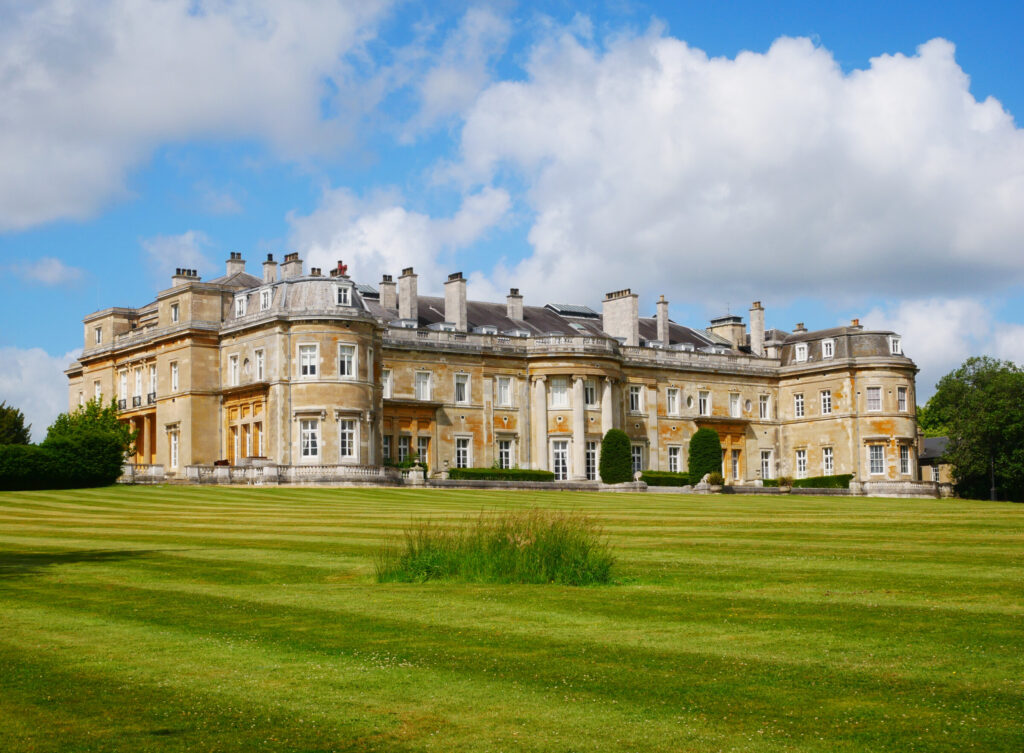
The southeast façade of Luton Hoo – probably the finest Edwardian house built in England (Wikipedia).
In 1899 Julius Wernher took the lease on Luton Hoo, a stately home in Bedfordshire. The exquisite country seat had been designed by Robert Adam for Lord Bute, with gardens by Capability Brown. Having bought Luton Hoo in 1903, it was restyled by the architectural partnership founded in 1900 by Charles Frédéric Mewès (1860- 1914) and Arthur Joseph Davis (1878-1951) in the Louis XVI manner. As an Edwardian country house, it may be the finest ever realised.
Mewès & Davis
Julius Wernher and Alfred Beit had been part of the syndicate which financed César Ritz to open the Ritz hotel in Paris in 1898. It has been designed by the Frenchman Charles Mewès and his English partner Arthur Davis. The opening of the Ritz Paris was attended by Jules Porgès who was so impressed that he commissioned Mewès & Davis to build him the enormous château of Rochefort-en-Yvelines, outside of Paris (1899-1904). After seeing the plans for Porgès’ château, the Wernhers determined on Mewès & Davis to restyle Luton Hoo.
The architectural partnership was founded in 1900 by Charles Mewès and Arthur Davis played an important role in the artistic reconstruction of the French Ancien Régime and fully encapsulated the late 19th and early 20th century taste for Louis XV and XVI style interiors. Both studied at the Ecole des Beaux-Arts in Paris and became famous for their skilful reinterpretation of 18th century French interiors. They built a large practice working for rich financiers and industrialists both in France and Britain. Essentially, they gave the same ambience that American society architects like Richard Morris Hunt and Stanford White gave to the mansions of the Gilded Age. Luton Hoo was their first major commission in England and was followed by the Ritz Hotel in London, both with interiors in the Louis XVI style.
Some of the furniture at Luton Hoo was at the Werner’s London mansion, Bath House, and supplied through the agency of Georges Hoentschel, dealer and proprietor of the Maison Leys, a successful decorating business, located at the Place de la Madeleine in Paris. These include furniture in revival styles made in Paris by Henry Dasson and Emmanuel Zwiener. This library or centre table, given its monumental scale and placement in the centre of the Blue Hall at Luton Hoo, was most probably designed and commissioned by Mewès & Davis specifically for Luton Hoo as part of their restyle. Mewès & Davis capacity as furniture designers is evidenced by their drawings for furniture and interior fittings held at the MET museum New York and the V&A London. It is not known which Paris firms Mewès & Davis engaged to make their furniture. The reverse of the bronze mounts to this table are all marked with letters to look like both an ‘A’ and a ‘V’. Similarly, the lockplates are marked ‘A*V Paris’. These marks could suggest a firm well known to have supplied interior decorators, namely Alavoine & Cie who subsumed the workshops of Roudillon in 1890 and Allard in 1909.
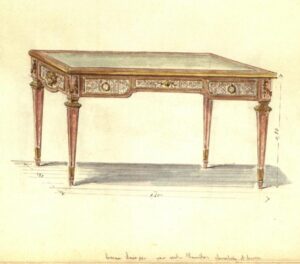
Watercolour design for ‘A Louis XVI Period Style Desk’ by Charles Mewès, circa 1900-14 (Metropolitan Museum of Art New York, Object Number: 1976.502.1.3(10)).
A. Gregory, Families of Fortune: Life in the Gilded Age, New York, 1993, p.122-124.
R. Trevelyan, Grand Dukes and Diamonds, The Wernhers at Luton Hoo, London, 1991.
B. Lasic, ‘Dignity and Graciousness’: Mewès & Davis and the Creation of Tous Les Louis Period Rooms’, Furniture History, Vol. 48,, 2012, pp. 193-210.
YOU MAY ALSO LIKE
- POA Read more
 Alessandro Lazzerini
A Pair of Large Carrara Marble Figural Groups Of Children on Swings
- £68,000 Add to cart
 Kahn, Paris
A Louis XVI Style Gilt-Bronze Mounted Marquetry and Parquetry Commode
- £45,000 Add to cart
 Henry Dasson
A Pair of Louis XVI Style Gilt-Bronze Mounted Green Granite Ewers