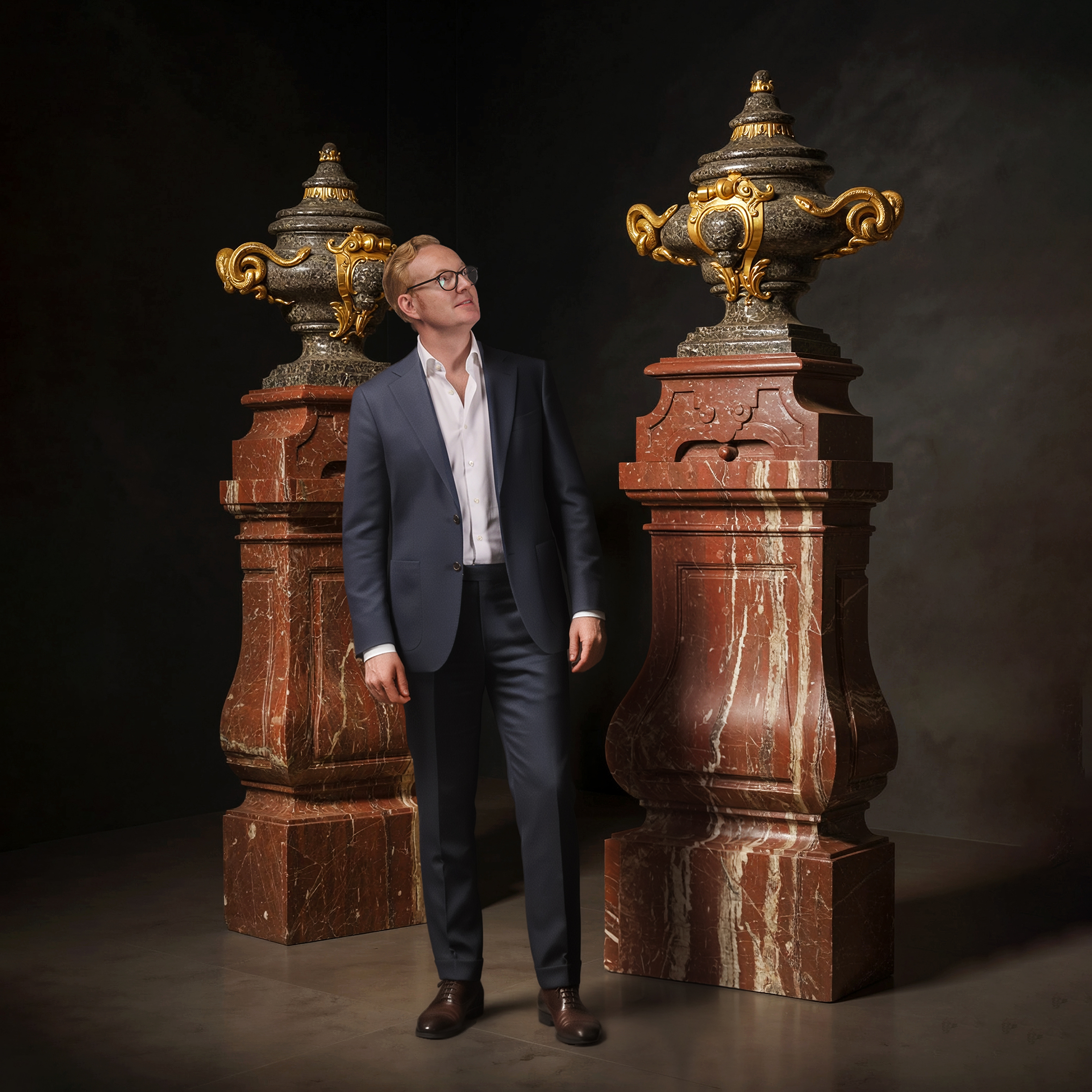
Attributed to Jules Allard
A Pair of Magnificent and Palatial Louis XIV Style Marble Urns on Pedestals
POA
A Pair of Magnificent and Palatial Louis XIV Style Gilt-Bronze Mounted Marble Urns on Plinths and Monumental Red Marble Pedestals.Attributed to Jules...
Dimensions
Height: 226 cm (89 in)Width: 76 cm (30 in)
Depth: 40 cm (16 in)
Weight: 740 kg

 Print
Description
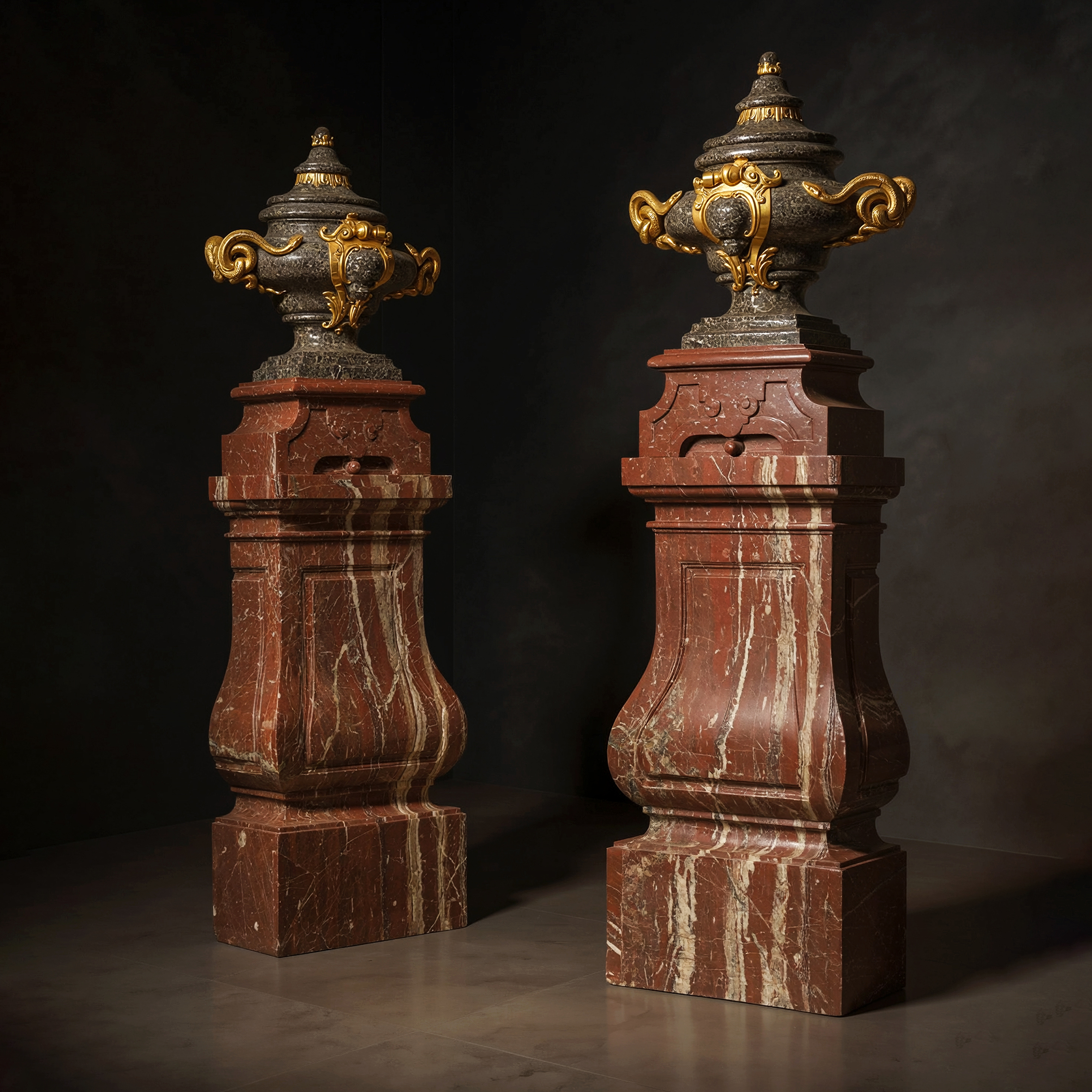
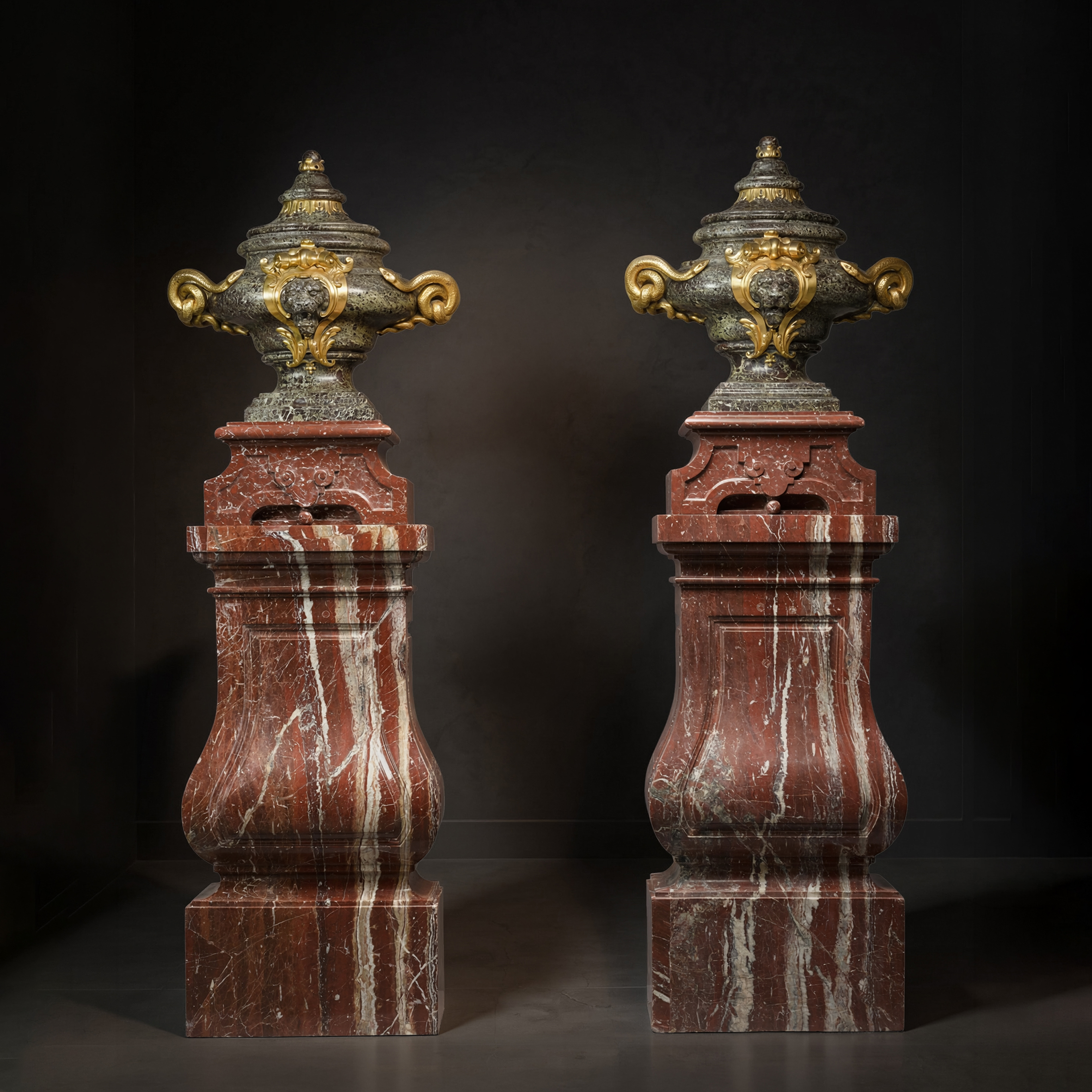
A Pair of Magnificent and Palatial Louis XIV Style Gilt-Bronze Mounted Marble Urns on Plinths and Monumental Red Marble Pedestals.
Attributed to Jules Allard et Fils.
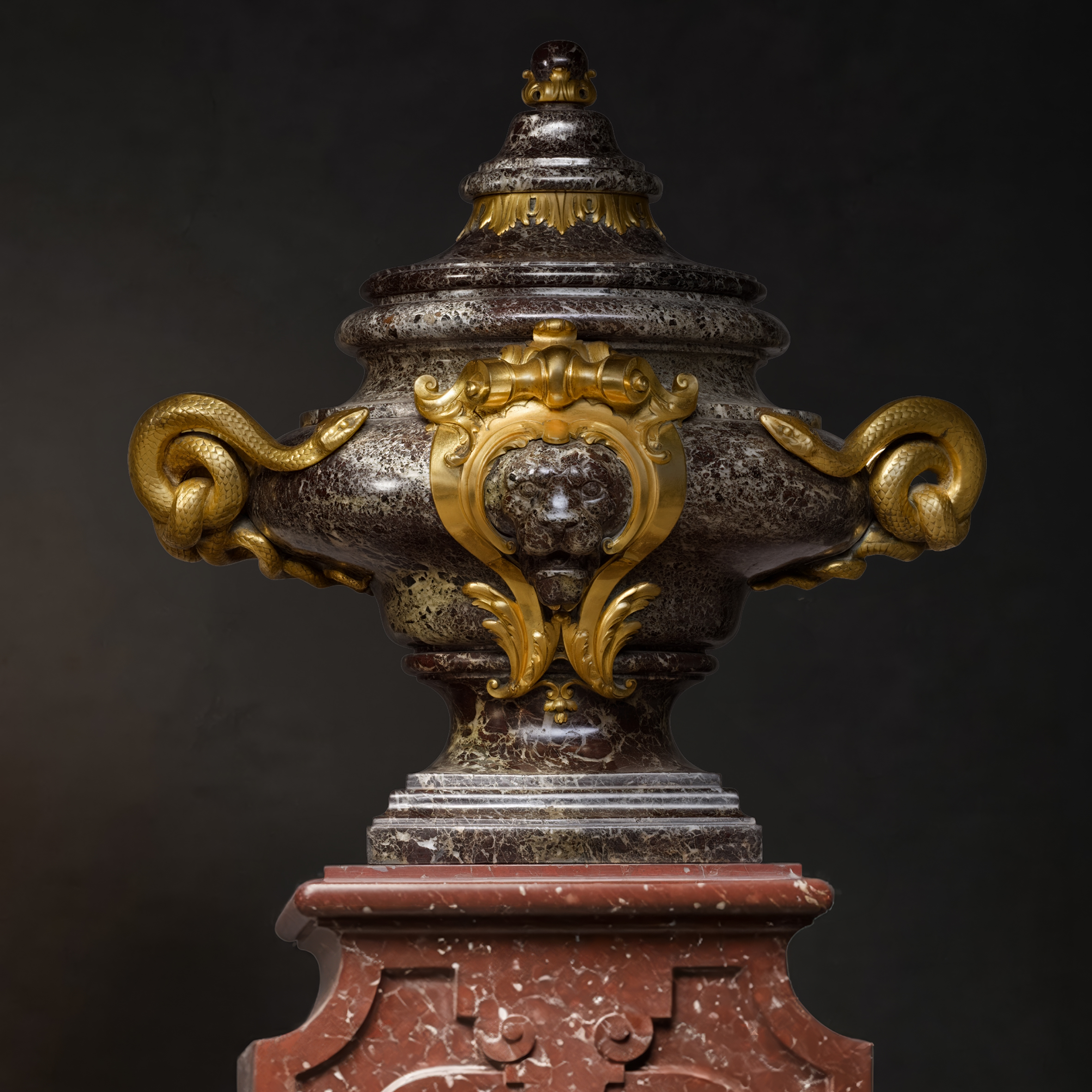
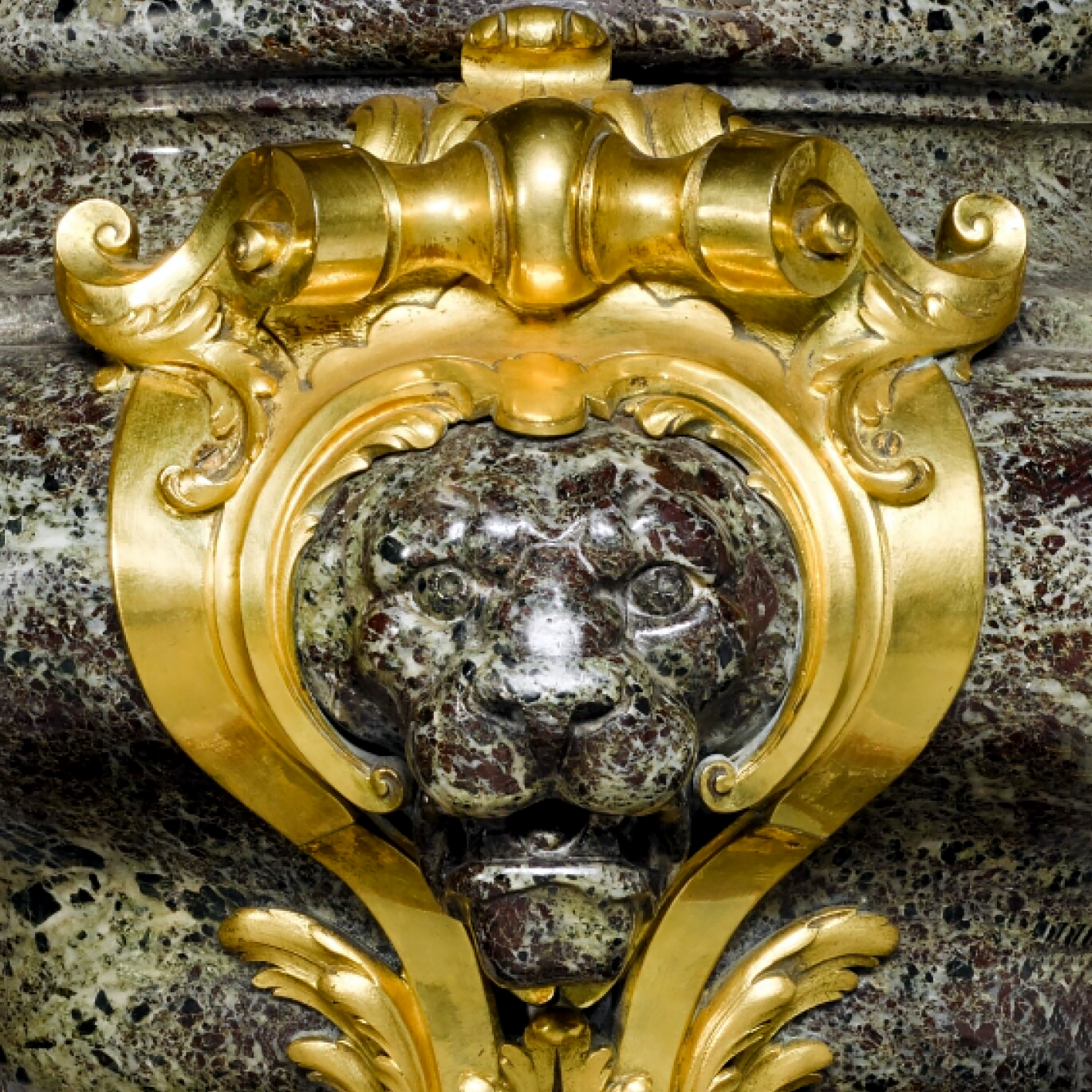
The urns of a mottled green and red marble with stepped covers above bulbous bodies carved to the front with a lion’s mask inside a gilt-bronze cartouche. Flanked by impressively sculpted entwined serpent handles. The circular socle and square base atop a tapering white-flecked red marble plinth. The marble bodies of the urns are green and red with veins of white calcite and identifiable as a marble called ‘Grand Mix Campan’ quarried at Espiadet, Campan, Hautes-Pyrénées, France.
The monumental pedestals of panelled crystalline red marble with threads of white calcite. Each with oblong pediment top above a volute-shaped column carved with panelled mouldings and plain foot.
France, Circa 1890.
These magnificent urns and pedestals are characteristic of the grand Beaux Arts style of interior decoration which defined France’s Belle Époque and America’s Gilded Age. Similar objects of grand decoration were created for César Ritz’s spectacular hotels and the Vanderbilt’s Newport Mansions.
These urns should be compared to monumental ornamentation in marble and bronze at The Breakers, the Newport Mansion of Mr. and Mrs. Cornelius Vanderbilt II, built between 1893 and 1895. Under the direction of interior decorator Jules Allard & Fils, Maison Beurdeley of Paris, executed numerous bronze and marble vases, pedestals and fireplaces for The Breakers.1
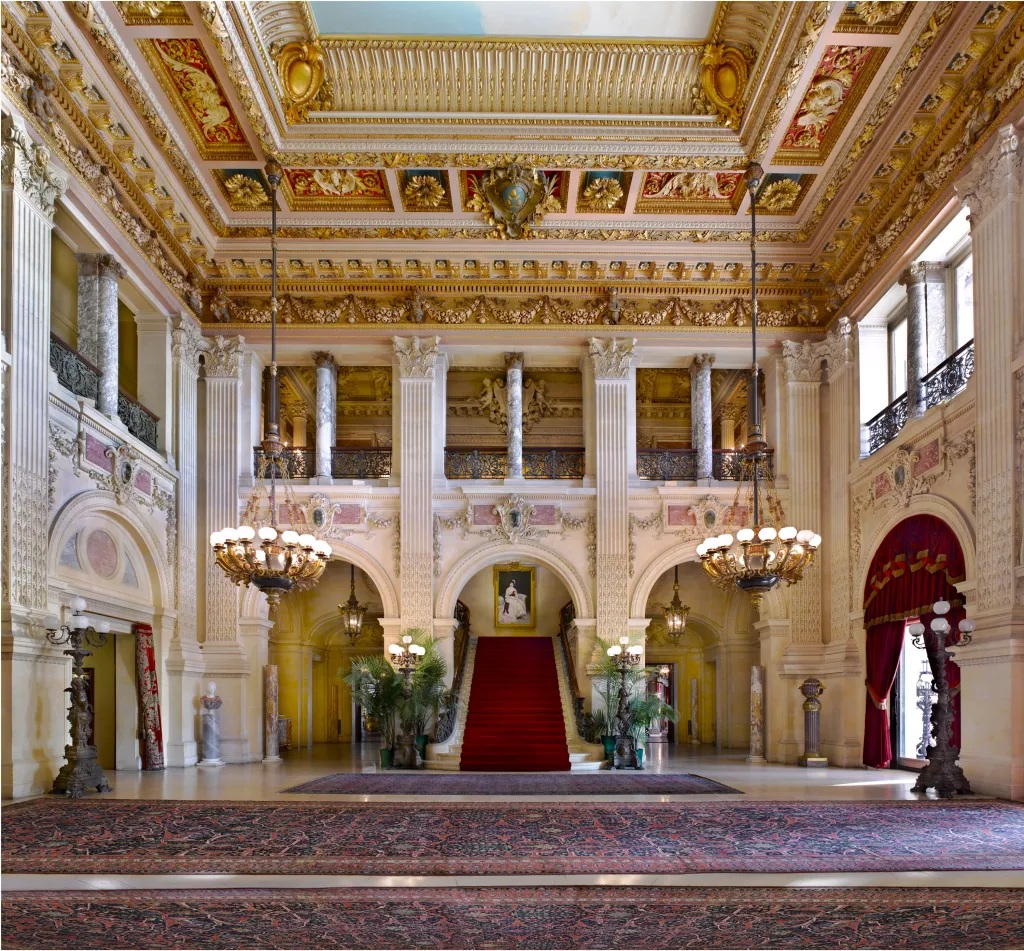
The Great Hall at The Breakers. The decorating firm Jules Allard et Fils supplied monumental marble and bronze architectural fittings for The Breakers, Newport, ca. 1893/5.
For a comparison with the present urns of particular relevance are a pair of gilt-bronze mounted porphyry vases in the Great Hall at The Breakers, which were supplied by Beurdeley and replicate a 17th century vase in the Louvre Museum. 2
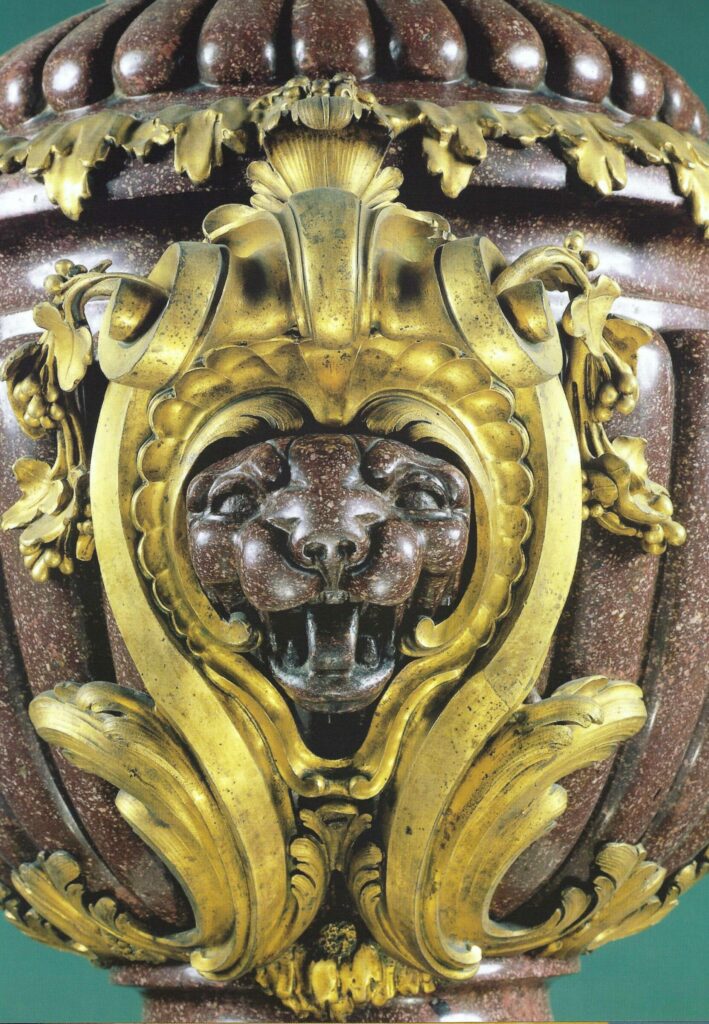
The design antecedent for the lion mask is from a porphyry vase in the Louvre (MR 2818).
The present vases share the same lion mask surround by gilt-bronze cartouche. These vases are inspired by Roman and Greek models from antiquity. Another classical reference on the present pair of urns are the coiled serpent handles. Snakes were associated with the earth, the soil and the underworld. Greeks and Romans regarded them as guardians of sacred places, houses, and tombs.
Mounting monumental marble vases with gilt-bronze was especially fashionable during the mid-18th century when the Marquis de Marigny, Madame de Pompadour’s brother, and director of the Bâtiments du Roi during Louis XV’s reign, owned at least three such large porphyry vases.3
Footnotes:
1. Camille Mestdagh, L’ameublement d’art français, 1850-1900, Les Ed. de l’Amateur, Paris, 2010, p. 130.
2. https://collections.louvre.fr/en/ark:/53355/cl010114450
3. D. Alcouffe et al., Gilt Bronzes in the Louvre, Paris, 2004, pp. 96-97. cat. 44.
Date
Circa 1890
Origin
France
Medium
Marble and Gilt-Bronze
The Urns:
Height : 98 cm | 39 inches
Width : 76 cm | 30 inches
Depth : 40 cm | 16 inches
The Pedestals:
Height : 128 cm | 50 inches
Width : 64 cm | 25 inches
Depth : 34 cm | 13 inches
Height Overall : 226 cm | 89 inches
Weight Overall : 740 kg | 1631 lbs
Jules Allard et Fils
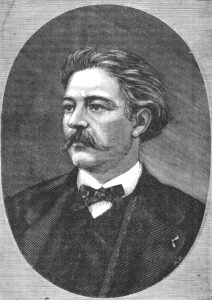
Portrait of Jules Allard (Panthéon de l’industrie, 1879. Source Wikipedia – Public Domain
Jules Allard et Fils was a leading French design firm, recognized for their luxurious and ornate interior designs during the late 19th and early 20th centuries. The firm is celebrated for its exceptional craftsmanship, steeped in classical French styles, and for its pioneering role in shaping the opulent interiors of the Belle Époque and the American Gilded Age. By masterfully blending traditional styles with innovative techniques, Jules Allard et Fils created some of the most iconic interiors of the period, leaving a lasting legacy in both Europe and the United States.
Jules Allard was the most significant figure in the “Maison Allard” family business. His father, Célestin Allard, had established himself as a cabinetmaker and upholsterer in 1832, and by the time of his death in 1854, he had built a thriving business in Paris, with an additional branch in Brussels. While Célestin primarily produced furniture, he also offered interior decoration services. He participated in major national exhibitions from 1844 to 1849, receiving an honorable mention at the 1849 exhibition.
After Célestin’s death, his widow, Marguerite-Victoire Lefèvre, took control of the family business, renaming it “Mme Veuve Allard” and running it until 1860. At that point, she passed the business on to her son, Jules Allard. Under Jules’ leadership, the company rapidly expanded, developing an international clientele and earning critical acclaim.
Allard’s background in traditional French craftsmanship informed the firm’s distinctive style, rooted in the elaborate design traditions of Louis XIV, Louis XV, and Louis XVI. Upon joining forces with his son Jean-Baptiste, the firm expanded its influence, becoming Jules Allard et Fils. The company took on increasingly prestigious commissions, becoming a leading force in high-end interior decoration during the Belle Époque.
At its core, the firm specialized in crafting cohesive, elegant interiors that harmonized every element within a space. Their work encompassed everything from intricate wood panelling and ceilings to custom-made furniture, gilded ornamentation, and luxurious textiles. The firm’s approach, which combined artistry with precise craftsmanship, allowed them to transform any space into an opulent showcase of French classical design.
Though rooted in Paris, Jules Allard et Fils expanded beyond France, particularly finding success in the United States during the Gilded Age. This period, marked by the immense wealth accumulated by American industrialists, created a fertile market for the firm’s luxurious and detailed designs. Affluent American families, keen to emulate European aristocratic traditions, sought out the firm to furnish their homes with the same grandeur they had witnessed in European estates.
The firm’s first significant breakthrough in the United States came through its work for the Vanderbilt family, one of the wealthiest and most influential families of the time. Jules Allard et Fils was commissioned to design the interiors of several Vanderbilt estates, including The Breakers and Marble House in Newport, Rhode Island. These lavish homes, designed in collaboration with renowned architect Richard Morris Hunt, showcased the firm’s unparalleled ability to execute grand Renaissance and Baroque designs. The interiors of The Breakers, for example, featured gilded rooms, elaborate plasterwork, and intricately carved paneling, all reflecting the height of Belle Époque elegance.
In addition to these Newport estates, the firm worked on other prestigious American homes, such as Marble House I Newport, the Biltmore Estate in North Carolina, the largest privately owned home in the United States and Elstowe Manor, Elkins Estate Pennsylvania. These commissions solidified Jules Allard et Fils’ status as the premier decorators for America’s elite.
While deeply rooted in traditional French design, Jules Allard et Fils were also innovators within these frameworks. Their ability to blend classical motifs with modern influences allowed them to create interiors that were both timeless and current. The firm’s versatility was one of its key strengths, allowing them to create bespoke interiors tailored to the specific tastes of their clients, whether they preferred the opulence of the Baroque, the delicate elegance of Rococo, or the restrained grandeur of Neoclassicism.
One of the firm’s most impressive innovations was its ability to transport entire room interiors across the Atlantic. For instance, at The Breakers, the firm constructed the Music Room and State Dining Room in its Paris workshops, then shipped the components to Newport for assembly. This logistical feat demonstrated the firm’s meticulous attention to detail and its ability to meet the demands of large-scale international projects.
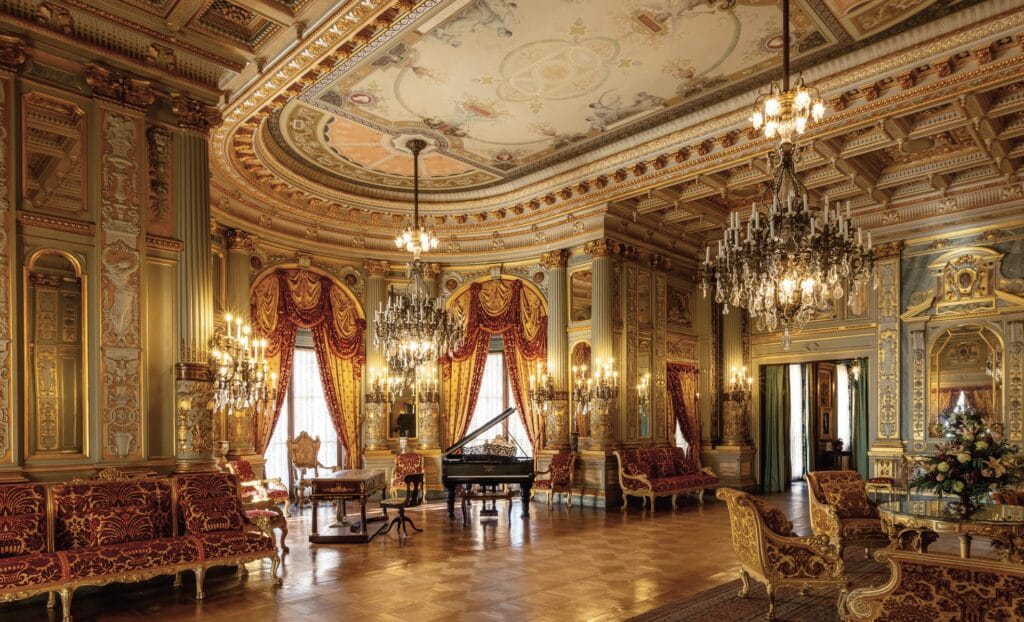
The Music Room at The Breakers., Newport Rhode Island. Designed by R. Hunt, built between 1893 and 1895. Jules Allard furnished the room with the decorator Codman. The Breakers was the summer house of Cornelius Vanderbilt II and his wife Alice. (© The Preservation Society of Newport County)
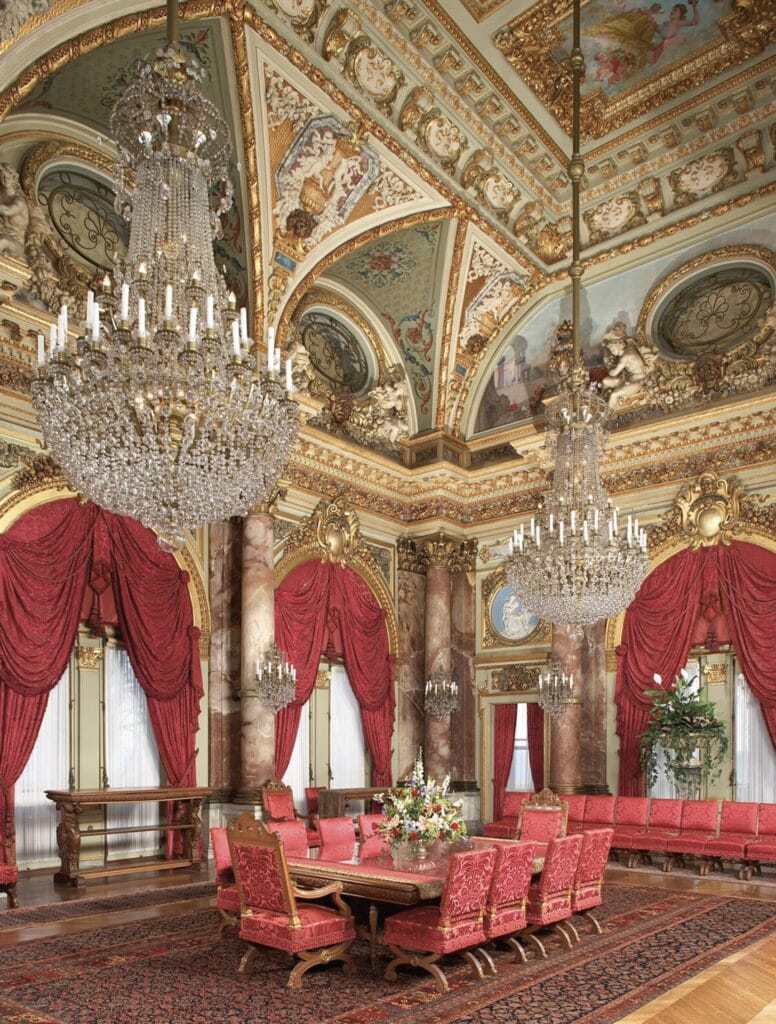
The State Dining Room is the most lavish room inside The Breakers (Courtesy of The Preservation Society of Newport County)
Another hallmark of the firm’s work was their close collaboration with architects and designers, including notable figures such as Richard Morris Hunt and Ogden Codman Jr. These collaborations often resulted in a seamless integration of architecture and interior design, with Allard’s decorative elements complementing the structural features of the homes. In many cases, the firm also provided architectural elements such as chimneypieces, boiseries, and ornamental plasterwork, which were crafted to fit within the broader design scheme of the home.
The international acclaim of Jules Allard et Fils was further solidified by their participation in various World’s Fairs and exhibitions. The firm regularly presented their work at these prestigious events, gaining recognition for their high level of craftsmanship and artistic innovation.
Jules Allard’s rise to prominence was accelerated by his participation in the 1878 Paris Exposition Universelle, where he was awarded a gold medal for his work and was knighted into the Légion d’Honneur. His success at the 1878 exposition led to further commissions and cemented his reputation as one of France’s leading interior designers. By this time, the firm was producing everything from furniture and cabinetry to sculpture, tapestries, and complete room interiors, all of which were praised for their elegance and craftsmanship.
In the United States, the firm’s work for the Vanderbilt family—particularly their stunning Salon at William K. Vanderbilt’s mansion in New York—further bolstered their reputation. This room became one of the most iconic examples of the firm’s work, demonstrating their ability to recreate European aristocratic grandeur in an American setting.
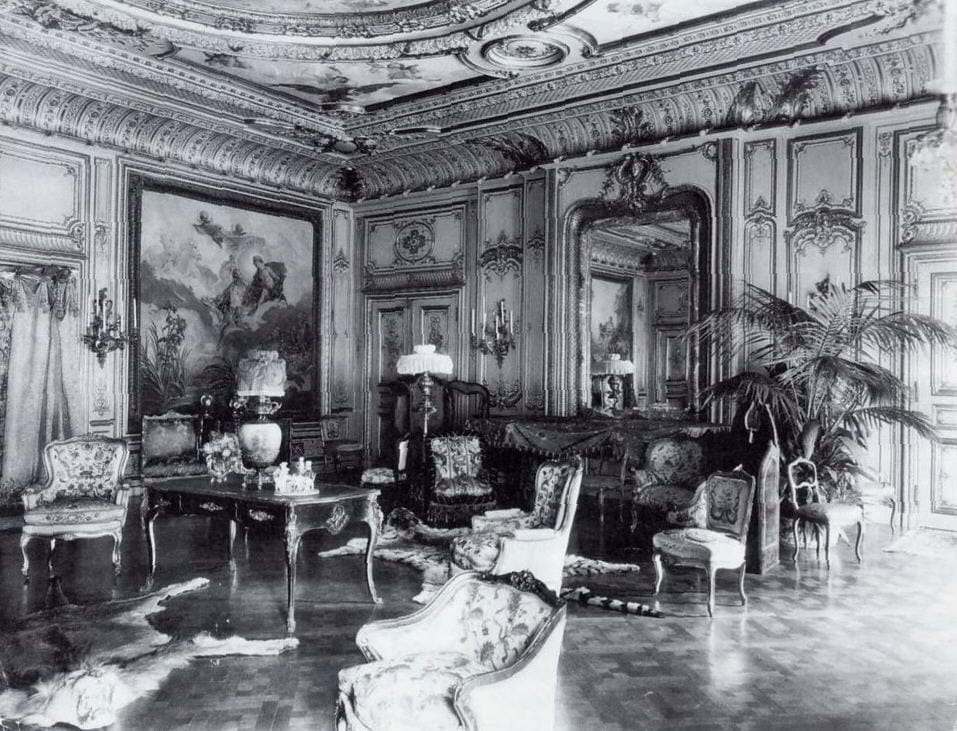
The salon, in the William K. Vanderbilt House, also known as the Petit Chateau, 660 Fifth Avenue, New York. The Louis Quinze-style salon, designed and built in Paris by Jules Allard helped launch the taste in New York for French 18th century-style interiors.
After the death of Jules Allard in 1907, the firm continued under the leadership of his sons, notably Fernand Allard. However, the firm’s prominence gradually declined, and by the early 20th century, it had been absorbed by Lucien Alavoine & Company. Despite this, the legacy of Jules Allard et Fils lives on in the homes and interiors they designed, some of the most iconic interiors of the Belle Époque and Gilded Age many of which have since been preserved as historic landmarks.
Camille Mestdagh, L’ameublement d’art français, 1850-1900, Les Ed. de l’Amateur, Paris, 2010, p. 130.
D. Alcouffe et al., Gilt Bronzes in the Louvre, Paris, 2004, pp. 96-97. cat. 44.