Salviati & Co.
A Gilt-Bronze and Venetian Zanfirico Glass Tazza
£5,200
A Gilt-Bronze and Venetian Zanfirico Glass Tazza, Attributed to Salviati & Co. Murano.The blue and white spiral pattern dish of ‘Zanfirico’...
Dimensions
Height: 12 cm (5 in)Width: 24 cm (10 in)
Depth: 22 cm (9 in)

 Print
PrintDescription
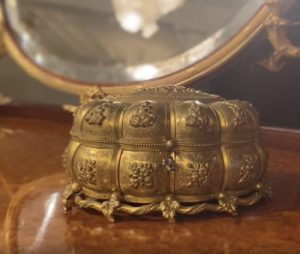
A Gilt-Bronze and Venetian Zanfirico Glass Tazza, Attributed to Salviati & Co. Murano.
The blue and white spiral pattern dish of ‘Zanfirico’ glass. The gilt-bronze stand modelled with flowers and Renaissance Revival strapwork on a figural support.
‘Vetro a retorti’ glass is made by bundling rods of different colours, which is heated and drawn to produce a spiral pattern. It is synonymous with Zanfirico glass, which takes its name from the Venetian dealer Antonio Sanquirico, who, in the 1830s, encouraged the revival in Murano of this and other traditional techniques. Salviati is principally cited as the master of Murano’s glass industry in the late 19th century and produced all-manner of revival ornaments and glassware including ‘Vetro a retorti’ glass. Gilt-bronze mounted glass objects, such as this, rank amongst Salviati’s finest wares.
Italy, Circa 1860.
Date
Circa 1860
Origin
Italy
Medium
Gilt-Bronze

Photograph of Dr. Antonio Salviati. Source – Salviati Venice. “The Glass and mosaic industries of Venice.” Treviso: R. Officine di Arti Grafiche Soc. An. LONGO & ZOPPELLI, undated (circa 1922). p. 3.
By the mid-19th century Venice as a centuries old centre of glass making was close to extinction. Pivotal to its revival was Dr. Antonio Salviati (1816-1890) who mounted a huge effort and succeeded in saving the city’s glass industry. Salviati was a lawyer by training but was appalled by the devastation that years of neglect had caused to the antique mosaic decoration of St.Mark’s Basillica. Encourage by Antonio Colleoni, the mayor of Murano, and a local priest, Abbot Vincenzo Zanetti, Salviati gave up his legal career and founded in Murano in 1859 a glassworks as the Laboratorio d’Arte Musivas Salviati Dott. In 1866 in collaboration with Antonio Barovier, Salviati opened a new glassworks that in 1872, with British sponsorship, took the name Venice & Murano Glass & Mosaic Company. It received numerous commissions from Great Britain (Memorial Chapel at Windsor Castle, altar at Westminster Abbey, 1867) and from Germany (Aache, Palatine Chapel, 1870-75).
Salviati exhibited at the world fairs and became one of the most prestigious manufacturers of Venetian glass production. As well as mosaics, Salviati & Co. produced ornamental tableware in coloured, enamelled, gilt and coated glass, reviving Renaissance, 18th century, and even Roman, specimens. Salviati collaborated with the visionary glass technician Lorenzo Radi (1803-1874) who rediscovered how to make Calcedonio glass imitating semi-precious agate quartz. Such creations were mounted in gilt-bronze. Salviati and Radi were awarded a gold medal at London’s International Exhibition of 1862. The South Kensington Museum, now the V&A, bought a superb metal-mounted chalcedony vase from Salviati at the exhibition, see https://collections.vam.ac.uk/item/O1861/vase-radi-lorenzo/.
Literature:
Sheldon Barr, Venetian Glass – Confection in Glass 1855-1914, New York, 1998.