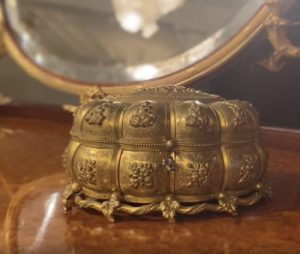
Maison Millet
A Fine Louis XV Style Parquetry Writing Desk or ‘Bureau en Rognon’
£75,000
A Fine Louis XV Style Gilt-Bronze Mounted Walnut and Bois Satiné Parquetry Writing Desk, ‘Bureau en Rognon’, By Maison Millet, Paris.The curved...
Dimensions
Height: 140 cm (56 in)Width: 116 cm (46 in)
Depth: 70 cm (28 in)

 Print
PrintDescription
A Fine Louis XV Style Gilt-Bronze Mounted Walnut and Bois Satiné Parquetry Writing Desk, ‘Bureau en Rognon’, By Maison Millet, Paris.
The curved cartonnier with five drawers around a pigeon hold and surmounted by a cherubic figure holding a sword and seated on a lion-pelt. The clock with Roman numerals and brass hands, striking the hours and half hours on a bell. Flanked by scrolled foliate candelabra held by cherubs. The pull-out leather writing surface above three frieze drawers. The convex-shaped back and sides with trellis-parquetry and centred by foliate gilt-bronze mounts. On cabriole legs fronted by busts.
Signed ‘MILLET A PARIS’.
France, Circa 1900.
This writing desk by Maison Millet is designed in the Louis XV style. It is sometimes called a bureau en rognon, meaning kidney-shaped desk. The model is enduringly popular and highly prized because the attractive neo-rococo design incorporates rich figural and foliate gilt-bronze mounts around a curvaceous body veneered in trellis parquetry. An extra delight is the integral cartonnier which encircles the sitter and is fitted with drawers and a central clock. Another reason for the popularity of this model is the delicate overall proportions, which make it placeable in modern interiors and it is perfectly at home in either a drawing room or bedroom.
The whole is executed in the fine quality as becoming of Maison Millet’s fin de siècle production. Especially admired by collectors is the gilt-bronze cherub above the clock, modelled as an ‘enfant guerrier’, holding a sword and lion-pelt, representing love conquering all. Furniture historians note that this cherub compares to the figural gilt-bronzes designed by the sculptor Léon Messagé for François Linke. Indeed, Léon Messagé is known to have designed for other furniture makers including Zwiener and Roux et Brunet, and with reference to this desk, he is attributed to working for Millet.
The Louis XV style, with accents of rococo, aligns particularly well with Messagé’s decorative vocabulary.
Millet produced variations of this model, notably examples with different candelabra. The present bureau is an especially fine example, distinguished by the candelabra supported by cherubs, a feature absent in lesser examples. Mestdagh notes that Théodore Millet exhibited a very similar bureau en rognon at the 1905 Paris Salon des Industries du Mobilier.

A related version of this bureau, by Millet, illustrated in C. Mestdagh, L’ameublement d’art français (1850-1900), p.212.
Date
Circa 1900.
Origin
France
Medium
Parquetry and Gilt-Bronze
Signature
Signed ‘MILLET A PARIS’.
MAISON MILLET
Millet, Blaise (1829 – 1906)
Millet, Théodore (1856 – ?)

Blaise Millet founded Maison Millet in 1853 with workshops in the ancient Saint-Pierre-Amelot Passage in the 11th arrondissement of Paris. He began his career modestly, fitting bronzes to furniture and became a member of the trade association the Réunion des fabricants de bronzes in 1867. As the firm expanded, he was joined in his trade by his son Théodore and their workshops moved to rue saint Sabin.
Millet produced fine quality meubles de luxe, specialising in meubles et bronzes d’art, genre ancien et moderne, with an accent on the Louis XV and XVI styles. The firm’s work covered a wide range of furniture, including authorised copies of eighteenth-century styles.
Mm. Millet Père et Fils were awarded a gold medal at the 1889 Paris Exposition universelle, where the jury noted that although their first creations were copies from the past, they should now be complimented for making modern work inspired by the past. Especially admired was a four-sided display case in gilded bronze based on Jacques Caffieri’s famous astronomical clock made for King Louis XV at Versailles. Several of Millet’s craftsmen were also honoured at the exhibition led by H. Brion, foreman of the all-important bronze workshop.

The extraordinary Caffieri-inspired four-side vitrine in solid gilt-bronze shown by Millet at the 1889 Paris Exhibition.
By the time of the 1900 Paris Exposition universelle, Blaise Millet had retired, the workshops employed one hundred and fifty people and had relocated to larger premises at 23 boulevard Beaumarchais. At that exhibition Millet won a grand prix for an Art Nouveau bedroom suite which incorporated a dressing mirror with gilt-bronze figures modelled by Claudius Maroton.

The Art Nouveau bedroom suite shown by Millet at the 1900 Exhibition and 1905 Salon des industries du mobilier.
The suite was shown again at the 1905 Salon des industries du Mobilier. The Gazette du mobilier noted that Mr. Millet was observed in deep conversation with the King of the Belgium at the exhibition. In 1902 the firm was authorised by the director of the Palace of Versailles to replicate Marie-Antoinette’s celebrated Grand cabinet à bijoux. That same year, Théodore Millet agreed to join the French Committee for Exhibitions Abroad, and having already participated in the Chicago World’s Fair in 1893, attended the St. Louis World’s Fair, an exhibitor and member of the jury.
Around the time of Blaise Millet’s death, in 1905 and 1906 auctions were held at Hotel Drouot of Millet’s furniture and bronzes, as well as modern and antique paintings and furniture, ‘provenant de la Maison Millet’. However, the firm continued trading and Théodore Millet was made a chevalier de la Légion d’honneur, showing at the 1905 and 1908 Paris Salon des industries du Mobilier.
François Linke had made furniture for the Millet in 1890s, and the two firms were compatriots exhibiting in St. Louis. With the gradual cessation of business, Millet turned to François Linke who bought amongst other pieces, the master model for the Caffieri’s astronomical clock which Millet had exhibited in St. Louis in 1904. By 1907, Millet’s still had showrooms advertising bronzes, furniture, objets d’art and lighting equipment at 48, rue Notre-Dame-des-Victoires and carried on trading until 1918.
Bibliography:
Ledoux – Lebard, Denise. Les Ébénistes du XIXe siècle, Les Editions de L’Amateur, (Paris), 1984; pp. 484-486.
Meyer, Jonathan. Great Exhibitions – London, New York, Paris, Philadelphia, 1851-1900, Antique Collectors’ Club, (Woodbridge, UK), 2006; pps. 276, 317, 320.
Mestdagh, Camille & Lécoules, Pierre. L’Ameublement d’Art Français, 1850-1900, Les Editions de L’Amateur, (Paris), 2010.
Payne, Christopher. Paris Furniture – the luxury market of the 19th century, Éditions Monelle Hayot, (Paris), 2018; pp.469-474
C. Mestdagh & P. Lécoules, L’Ameublement d’Art Français, 1850-1900, Les Editions de L’Amateur, (Paris), 2010, Fig. 244, p. 212.
C. Payne, Paris Furniture – the luxury market of the 19th century, Éditions Monelle Hayot (Paris), 2018; p. 470.
YOU MAY ALSO LIKE
- £9,000 Add to cart
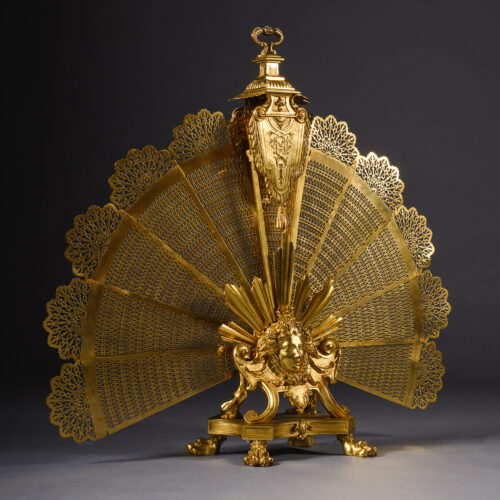
A Large Louis XVI Style Gilt-Bronze Fan Shaped Fire Screen With A Finely Cast Mask of Apollo
- £45,000 Add to cart
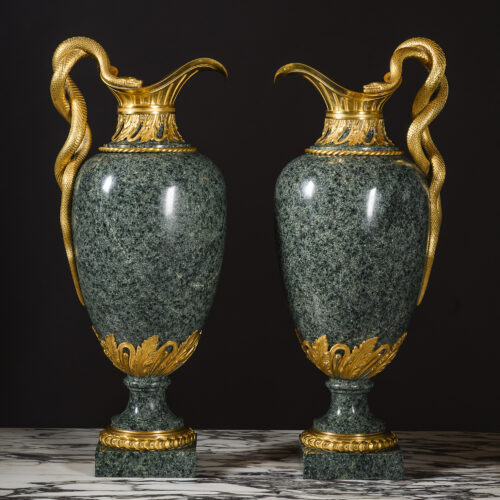 Henry Dasson
A Pair of Louis XVI Style Gilt-Bronze Mounted Green Granite Ewers
- £24,000 Add to cart
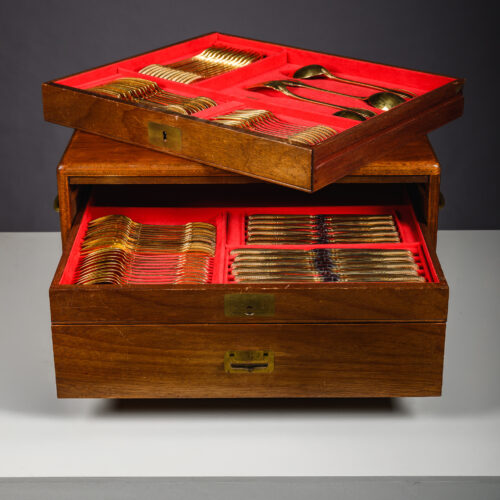 Maison Puiforcat
A Neoclassical Style ‘Percier’ Pattern Vermeil (Silver -Gilt) Canteen by Jean Puiforcat, Paris