About the Maker
Joseph-Charles Marin (1759–1834) was a celebrated French sculptor active during the late eighteenth and early nineteenth centuries.
A pupil of Claude Michel, known as Clodion, Marin initially worked in a refined Rococo manner, producing delicately modeled terracotta figures and groups that reflected the graceful, playful spirit of pre-Revolutionary France. His early oeuvre frequently depicted nymphs, satyrs, and other mythological subjects in lighthearted, animated compositions.
Marin competed several times for the Grand Prix de Sculpture (Prix de Rome) before the Revolution and ultimately secured the prize in 1801 with the bas-relief Caius Gracchus Leaving His Wife Licinia.
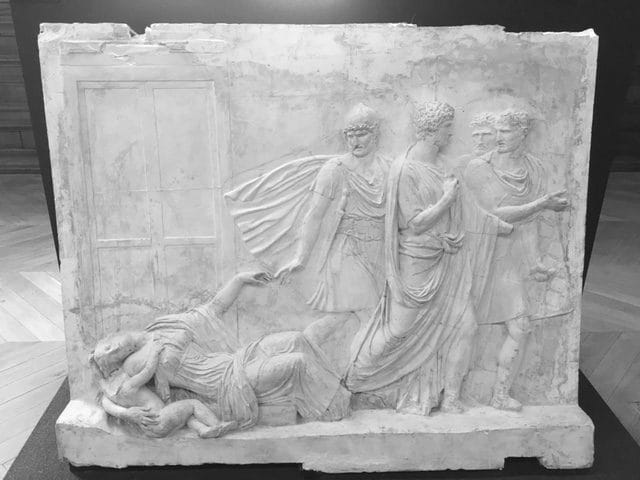
Joseph-Charles Marin, Caïus Gracchus quittant sa femme Licinia, 1801, plâtre, Paris, école nationale supérieure des Beaux-Arts, Public Domain.
Over time, his style evolved in accordance with the emerging Neoclassical aesthetic, adopting more restrained themes and a stricter formal vocabulary. In 1813, he was appointed professor at the École nationale supérieure des beaux-arts de Lyon, succeeding his former teacher Joseph Chinard. Marin’s career bridges the transition from late Rococo elegance to the moral and stylistic rigor of French Neoclassicism.