The Beurdeley Dynasty
The history of Maison Beurdeley extends across three generations.
Jean Beurdeley (1772–1853)
The founder, Jean Beurdeley, was born in Burgundy and served in the Napoleonic army. Following the end of the Napoleonic Wars, he settled in Paris and established himself in the trade in curiosities and works of art.
His business was initially situated in the rue Saint-Honoré. In 1840 the firm moved to the celebrated Pavillon de Hanovre, at the corner of the rue Louis-le-Grand and boulevard des Italiens. The location was one of the most prestigious addresses available to a Parisian dealer in luxury furniture and works of art.
The character of the business is significant. Beurdeley was not initially simply a cabinetmaker. His activities belonged to the older Parisian tradition of the marchand-mercier, the dealer and connoisseur whose knowledge of antiques, decorative arts and luxury materials could inform the creation of entirely new objects.
This antiquarian foundation remained fundamental to the Beurdeley business throughout its existence.
Louis-Auguste-Alfred Beurdeley (1808–1882)
Jean Beurdeley’s surviving son, Louis-Auguste-Alfred Beurdeley, expanded the family enterprise into one of the most important luxury furniture concerns of nineteenth-century Paris.
Under Alfred I, the firm became increasingly involved in the manufacture of furniture and decorative objects based upon historic French models. The workshop developed an especially strong reputation for gilt-bronze mounts and for the quality with which eighteenth-century furniture was reproduced.
He employed craftsmen trained in the traditions of the Ancien Régime, counting among them a metal gilder who had been apprenticed to Pierre Gouthière (1732–1813). This direct lineage helped Beurdeley create works composed of eighteenth-century motifs and executed with such care that they are often mistaken for originals today.
The firm also received important official commissions. Among these was the celebrated marriage coffer made for the marriage of Napoleon III and Eugénie in 1853. In 1855 Beurdeley provided furniture and bronzes for the Empress’s salon at the Paris Exposition universelle of that year. He was then awarded a gold medal at the 1867 Paris exhibition.
Alfred I’s career coincided with the extraordinary revival of interest in the French royal collections under the Second Empire. Furniture formerly associated with the Bourbon monarchy and the great aristocratic families became models for a new generation of collectors. His principal works, a large part of which were destroyed in the fires of the Paris Commune of 1871, are in the collections of Sir Richard Wallace, in castles in England, and in Russia (Musée Centennal, Mobilier & Décoration à l’Exposition universelle Internationale de 1900, Paris, Rapport de la Commission d’Installation, p. 35).
Beurdeley was ideally positioned to exploit this interest.
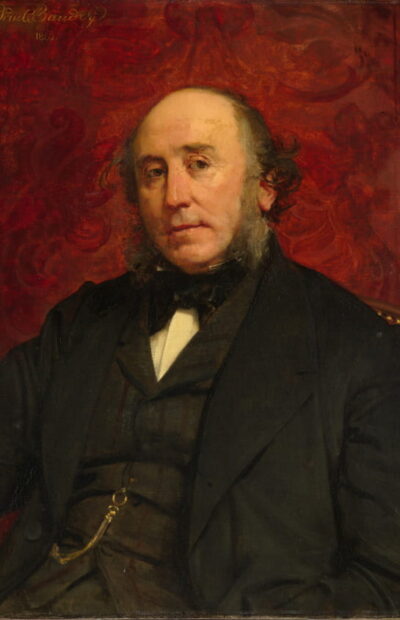
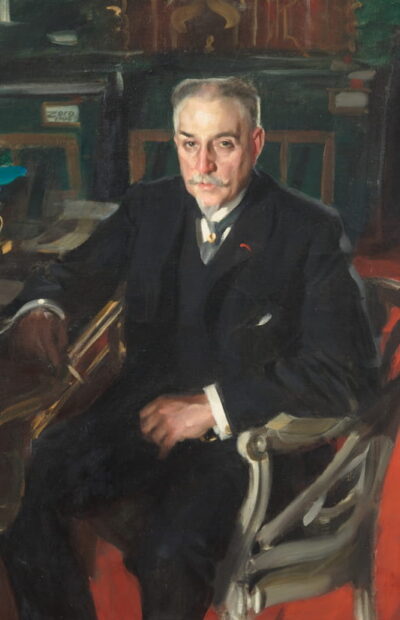
Emmanuel-Alfred Beurdeley (1847–1919)
The third generation, Emmanuel-Alfred Beurdeley, generally known as Alfred II, inherited the firm in 1875 after having worked alongside his father. Unlike his father who was not a creator himself, Alfred II is credited as a designer and the Musée d’Orsay records him as an ébéniste. He devoted the family business to the reproduction of celebrated historic furniture, including pieces from the Mobilier National.
His tenure marks the most sophisticated period of Maison Beurdeley.
Alfred II was not merely continuing his father’s business. He developed the workshops into an exceptionally accomplished producer of luxury furniture and decorative bronzes, while simultaneously becoming an important collector and connoisseur himself.
His work was recognised at the great international exhibitions. Beurdeley received a gold medal at the Paris Exposition universelle of 1878, and his participation in the Amsterdam exhibition of 1883 was followed by his appointment as a Chevalier of the Légion d’honneur. The firm’s international reputation subsequently extended into the United States.
“M. Beurdeley Jr. is an artist who combines his father’s taste and expertise with a talent—rare in the head of a firm—for composing, designing, and effectively directing his staff” (Translated from L’art moderne à l’Exposition de 1878, Paris, p. 352).
Alfred II was responsible for the breathtaking display at The World’s Columbian Exposition, Chicago, Illinois, 1893.
Alfred II retired in 1894, and the firm’s remaining stock was subsequently dispersed through a series of auctions beginning with ‘Objets d’Art et de Riche Ameublement Exécutés dans Les Ateliers et sous la direction de M. A. Beurdeley’, Galerie Georges Petit, Paris, 6-9 May 1895. Alfred II bought back many of the pieces in the 1895 sale, including the Bureau du Roi from 1889, and they can be seen in photographs of his home at his hôtel particulier in the rue de Clichy, in Paris. They were bequeathed to his children and sold by their descendants.
Alfred II was an organiser of, and loaned pieces to, the Musée Centennal at the 1900 Paris Exhibition.
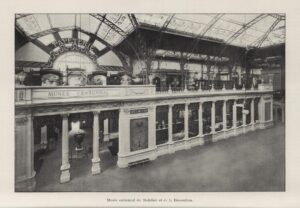
Musée centennal du Mobilier & Décoration Source:Maurice Le Corbeiller, ‘Musée Centennal des classes 66, 69, 70, 71, 97. Mobilier & Décoration à l’Exposition universelle internationale de 1900, à Paris’. Rapport de la commission d’installation (Saint-Cloud: Belin, 1902).
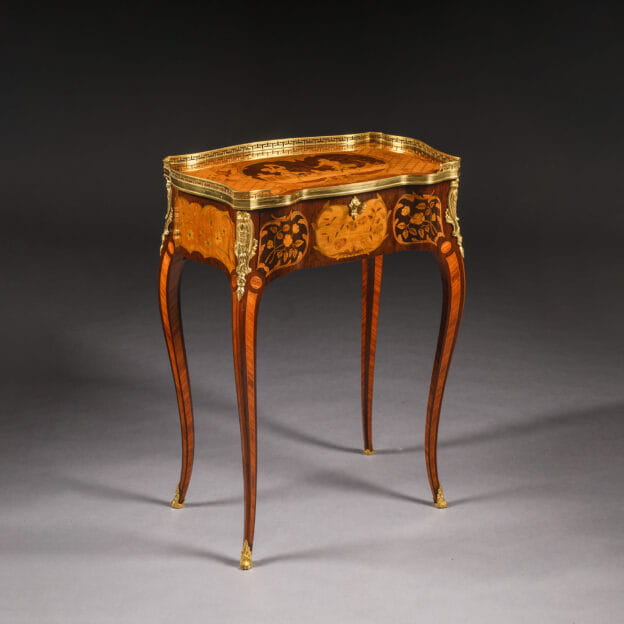
A Rare Louis XV Style Gilt-Bronze Mounted Marquetry Occasional Table
£42,000
VIEW ITEM
Beurdeley and the Art of Reproduction
To identify Beurdeley correctly, it is necessary to understand what the firm was attempting to achieve.
During the nineteenth century, the great French royal collections provided an extraordinary catalogue of models. Furniture by André-Charles Boulle, Charles Cressent, Jean-Henri Riesener, Jean-François Oeben, Adam Weisweiler, Georges Jacob and other celebrated eighteenth-century makers could be studied in royal and national collections.
Maison Beurdeley transformed this historical knowledge into a commercial and artistic enterprise.
A collector who could not acquire an original piece from the royal collections could nevertheless commission a superb reproduction. Such an object was not necessarily intended to deceive. Rather, it allowed a sophisticated nineteenth-century collector to acquire an object demonstrating an understanding of French historical furniture.
This distinction is important.
The presence of a Beurdeley signature is generally an indication that the object was produced by, or under the direction of, the firm; it should not, however, be interpreted as evidence that the object was intended to pass as an eighteenth-century original.
The firm’s achievement lay in reproducing not simply the appearance of an eighteenth-century object but its materials, proportions, construction, marquetry, bronze ornament and surface treatment.
This is why the best Beurdeley furniture can be extraordinarily difficult to distinguish visually from the eighteenth-century furniture that inspired it.
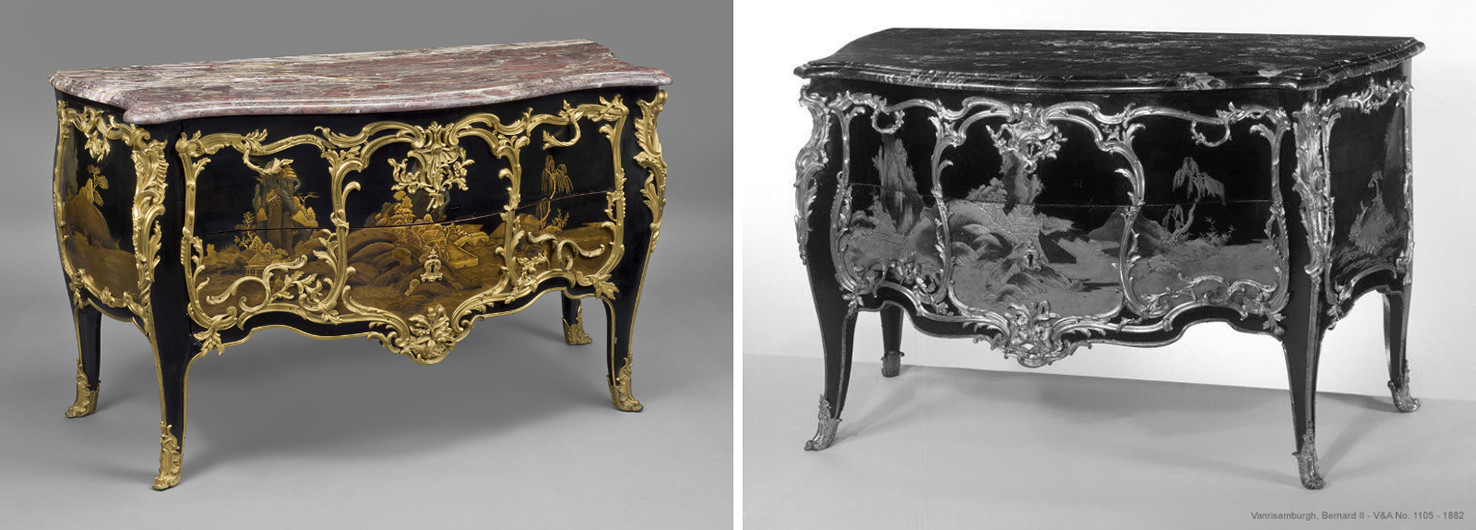
Left: A Louis XV style gilt-bronze and lacquer veneered commode, By Maison Beurdeley, Circa 1850. Right: A lacquer mounted commode circa 1760-65 by the master ébéniste Bernard Van Risamburgh, now in the Jones collection at the V&A, London. (Acc. No. 1105:1 to 5-1882)
Beurdeley as Creator Rather Than Copyist
The description of Beurdeley simply as a maker of copies, however, is inadequate.
An important contemporary assessment published in connection with the 1878 Paris exhibition specifically distinguished Beurdeley from manufacturers who merely copied old models. The contemporary writer Émile Bergerat described his furniture as being designed according to the manufacturer’s own imagination and personal interpretation of a style.
The distinction is borne out by surviving designs.
Alfred II and his designers studied eighteenth-century ornament, furniture and decorative motifs, but used these sources as a vocabulary from which new compositions could be created.
In 1880 the Gazette des Beaux-Arts records “M. Beurdeley pursues his work with unwavering zeal and the dedication of a true artist—qualities destined to establish him as one of the masters of 19th-century furniture design.” (Translated from La Gazette des Beaux-Arts, Paris, 1880, p. 435).
The recent research project Beurdeley: la curiosité aux sources de la création des objets d’art, led by Camille Mestdagh at InVisu, is particularly important in this respect. It brings together workshop drawings, historic photographs, modern photographs and earlier ornamental drawings to reconstruct the creative process of the Beurdeley workshops. The research demonstrates how the family drew upon their knowledge as dealers and collectors, reusing antique objects, ornaments and eighteenth-century design drawings as sources for new furniture and works of art.
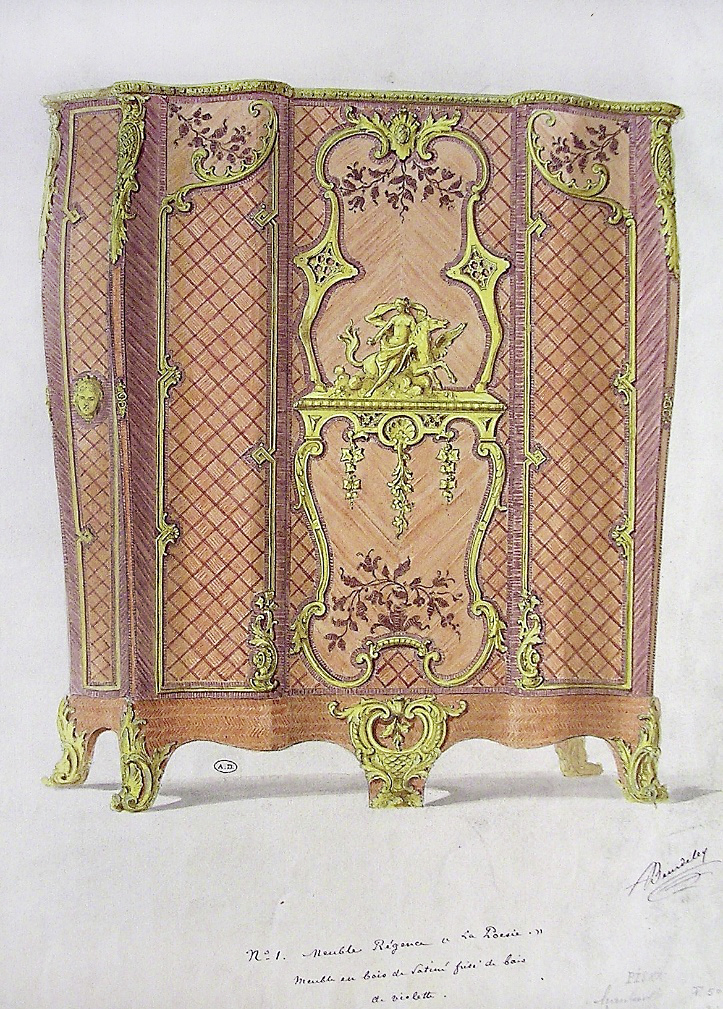
Beurdeley, design for a cabinet titled “La Poésie,”.
Musée des Arts Décoratifs (CD3063/55)
This provides a more accurate way of understanding Maison Beurdeley:
Beurdeley did not simply reproduce the eighteenth century. He understood it, collected it, studied it and transformed it.
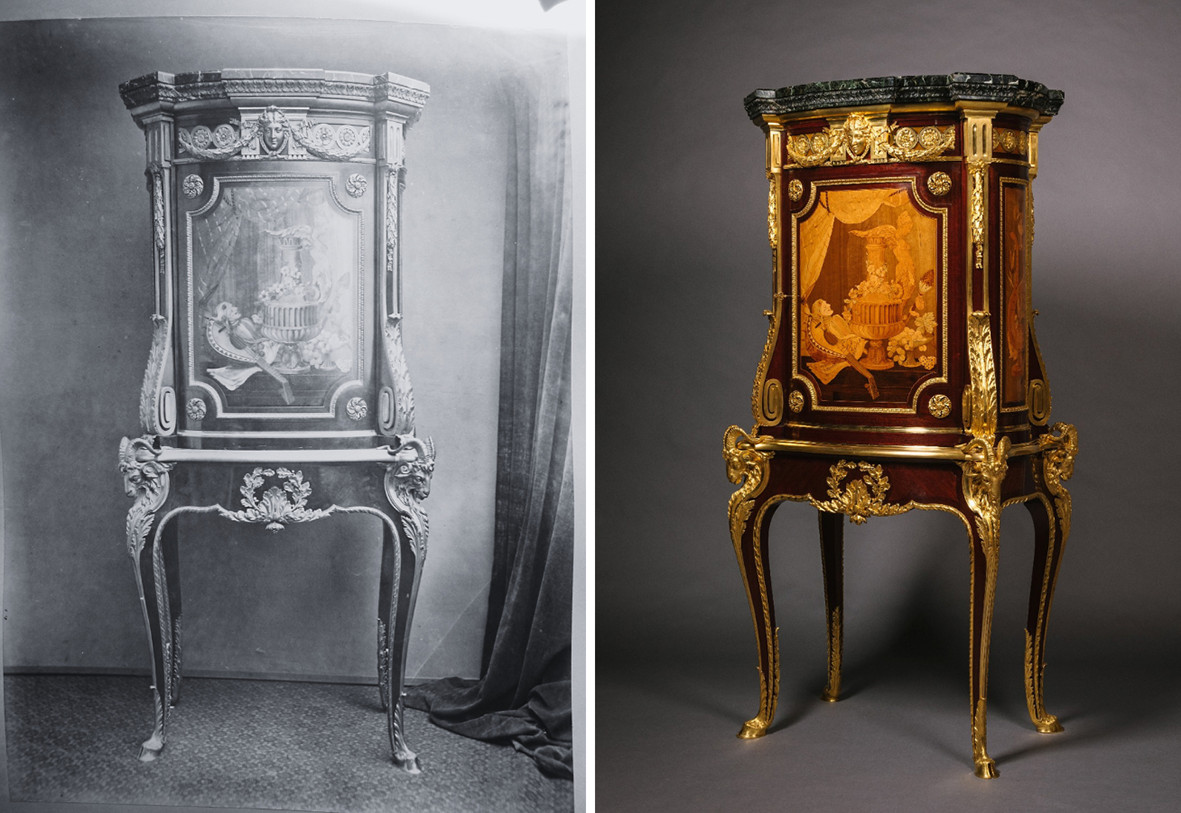
A gilt-bronze mounted marquetry cabinet on stand, By Emmanuel-Alfred (dit Alfred II) Beurdeley. This cabinet was part of Beurdeley’s gold medal winning stand at the Paris Exposition universelle of 1878. It is recorded by Falize Fils that Beurdeley himself designed this piece ‘with ram’s heads’ and although inspired by the neoclassicism of the Louis XVI period, in the 1870s it would have been considered as something entirely new and uniquely of its time. Collection Adrian Alan.
The Importance of the Gilt Bronze
The gilt bronze is one of the most important clues when identifying a Beurdeley object.
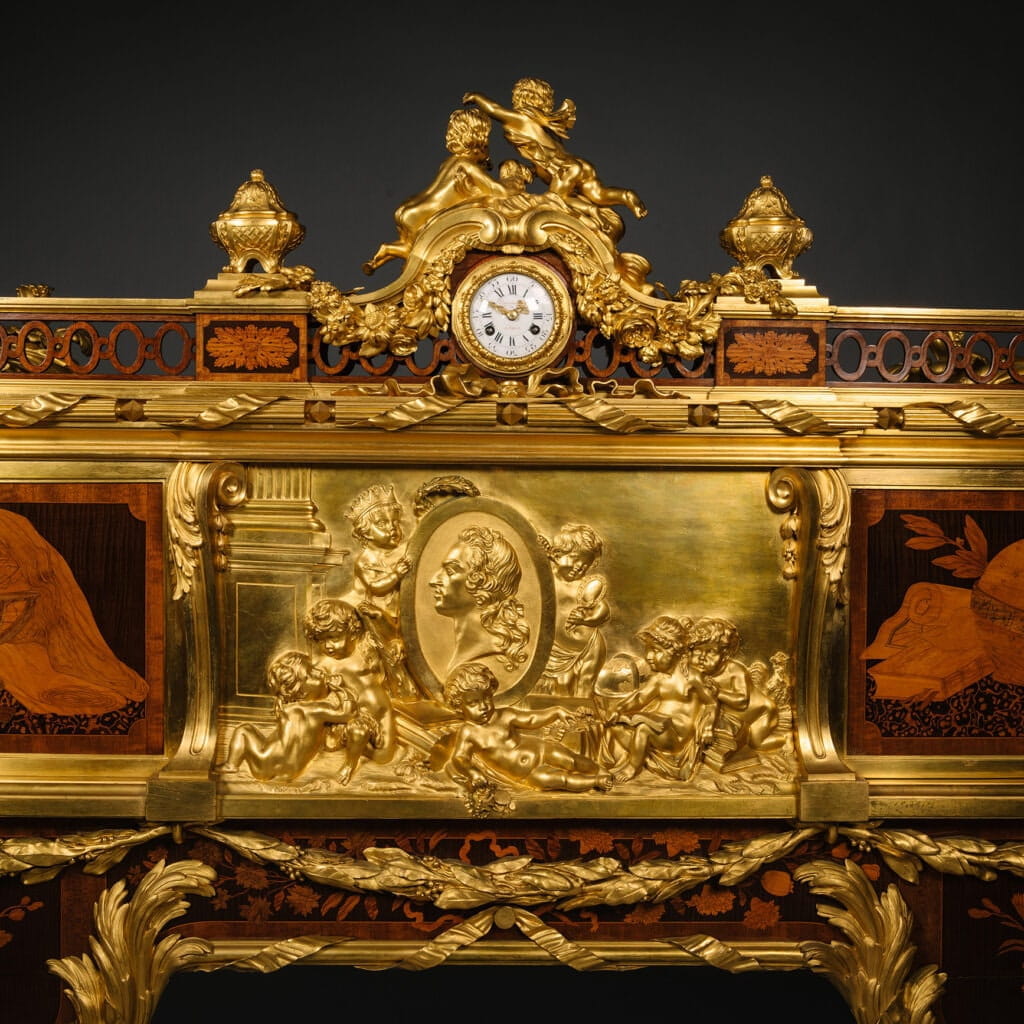
Detail of the fine gilt-bronze plaque and clock surmount on the reverse of Maison Beurdeley’s ‘Bureau du Roi’.
The finest Beurdeley bronzes share characteristics associated with the highest quality Parisian ormolu, including:
- exceptionally crisp casting
- finely chased surface detail
- carefully articulated foliage and ornament
- sophisticated contrasts between matt and burnished gilding
- highly controlled modelling
- precise integration between bronze mounts and the cabinetmaker’s work
The quality can be extraordinary.
Contemporary commentary on the firm’s 1893 Chicago exhibition specifically praised the workmanship and the exquisite chiselling of the bronzes.
The finest Beurdeley bronzes possess a crispness that can approach eighteenth-century work. The modelling is controlled rather than merely elaborate, and the chasing gives definition to details which in lesser nineteenth-century furniture can appear soft or mechanically repetitive.
For attribution, therefore, the presence of abundant ormolu is not sufficient.
It is the quality and character of the bronze that matter.
Gilding
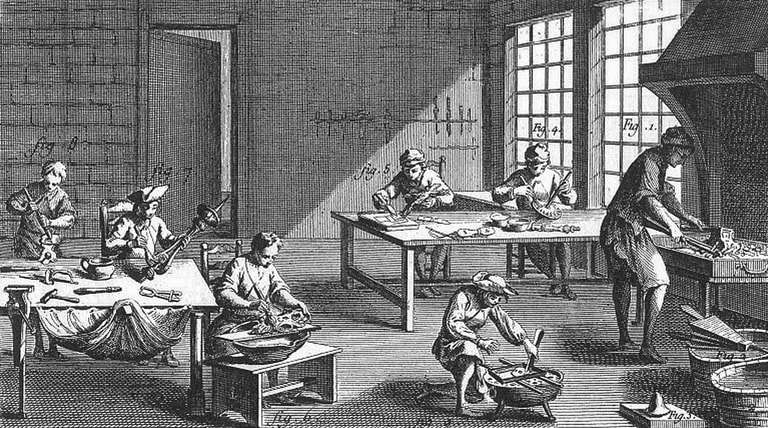
Denis Diderot and Jean le Rond d’Alembert, Encyclopédie, “Doreur, sur Métaux,” Pl. I, Paris, 1763. The plate depicts an eighteenth-century Parisian metal-gilder’s workshop, including the preparation, application and finishing of gilt metal using mercury gilding.
The Beurdeley workshops were particularly accomplished in the treatment of gilt bronze, and employed the historical technique of mercury gilding whereby gold and liquid mercury are mixed into a buttery paste which is brushed onto metal and heated so that the mercury evaporates leaving a high-purity gold layer amalgamated to the metal. The process released toxic mercury vapour and was hazardous to gilders; mercury gilding was subsequently superseded by electroplating and safer techniques. By this period electro-gilding had been developed and was being used by other furniture makers; however, Beurdeley, like Henry Dasson, continued to employ mercury gilding as it allowed hand finishing which when coupled with detailed casting and chiselling of the bronze, achieves a supreme quality.
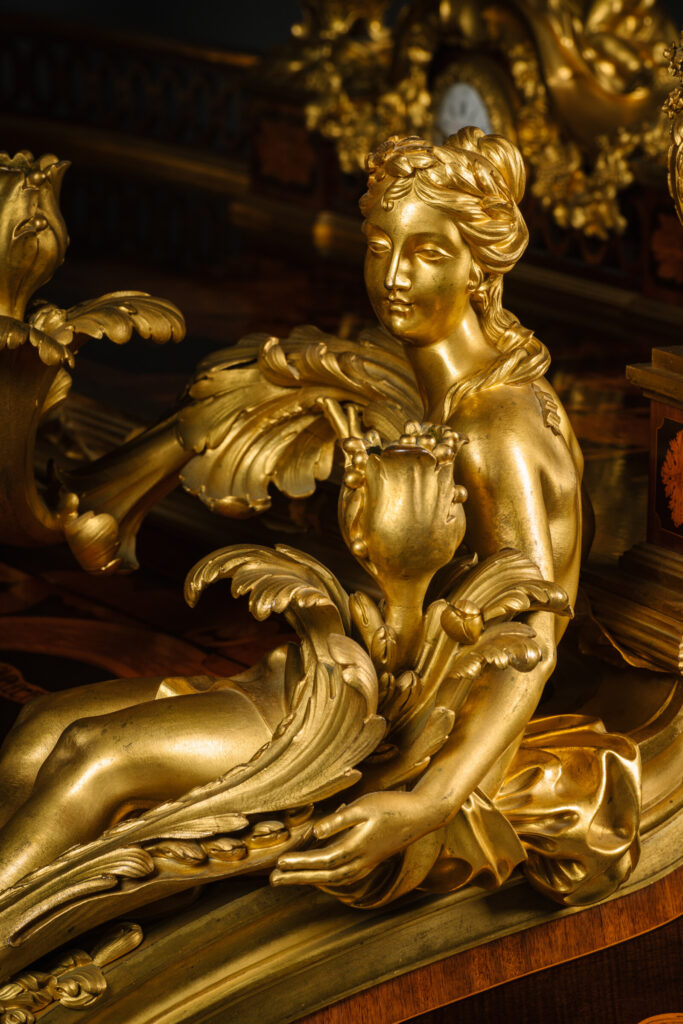
Detail of one of the gilt bronze figures on ‘Le Bureau Du Roi’ – A Magnificent Exhibition Secrétaire à Cylindre, by Alfred Beurdeley.
The combination of matt and burnished surfaces is especially important. High points may be selectively burnished to catch the light, while recessed areas retain a softer, matt appearance. This creates the subtle visual hierarchy characteristic of the finest French ormolu.
The surviving gilding should also be examined carefully. Later cleaning, re-gilding and restoration can significantly alter the appearance of nineteenth-century bronze, and an apparently bright surface should not automatically be taken as evidence against authenticity.
The important question is whether the casting, chasing and gilding belong together.
The Beurdeley Signature
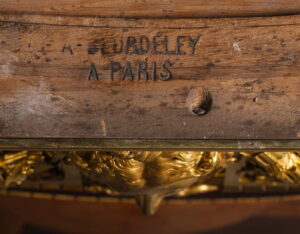
A signature is important evidence, but it should never be considered in isolation.
Known Beurdeley furniture can carry marks including:
‘A. BEURDELEY A PARIS’ – A cold-stamp to the carcass
The Beurdeley incised cypher ‘BY’ to the reverse of the bronzes
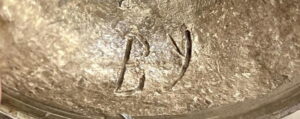
Marks can also occur on individual bronze mounts rather than on the visible cabinetmaking.
This is particularly useful evidence because it demonstrates how attribution can be established through several independent components of a single object.
A Beurdeley attribution should therefore consider:
signature + bronze + construction + design + historical prototype + provenance
rather than relying upon the stamp alone.
The Beurdeley Methodology
The Beurdeley workshops operated in a manner surprisingly close to what might now be described as an art-historical research department.
The firm had access to historic furniture, collections of ornamental drawings, antique objects and works of art.
These sources could be dismantled conceptually into their component parts:
- marquetry patterns
- gilt-bronze mounts
- feet
- masks
- cartouches
- garlands
- architectural elements
- trophies
- porcelain
- hardstones
- decorative panels
These elements could then be recombined.
This explains why some Beurdeley objects are faithful reproductions while others appear historically convincing without corresponding exactly to any eighteenth-century original.
The Musée des Arts Décoratifs holds a number of drawings thought to be by Alfred II Beurdeley, depicting extant eighteenth-century furniture and works of art alongside designs of his own conception.
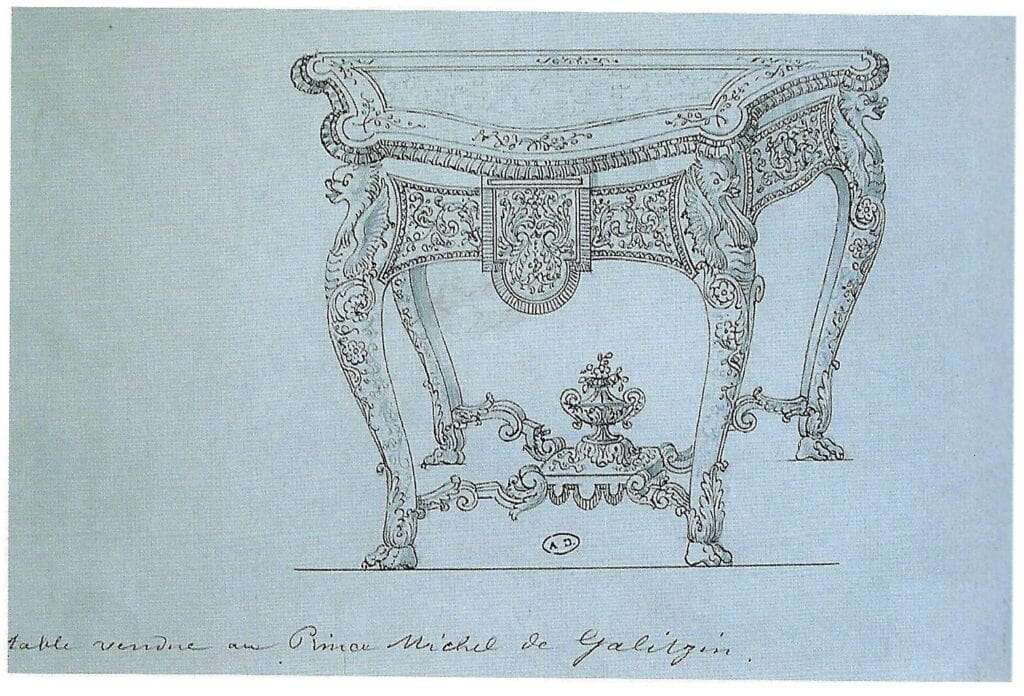
Drawing by Beurdeley of a console table in Camille Mestdagh’s book ‘L’Ameublement d’Art Français’, page 96.
Showing a connoisseurship for historical collections, Alfred II visited the Wallace Collection on 21 June 1882, his signature ‘A Beurdeley’ is entered in the Visitor’s Book in his own handwriting.
The breadth of the Beurdeley family’s connoisseurship across the arts is evidenced in their vast personal collection which encompassed a wide variety of paintings, watercolours and drawings, antique furniture, sculpture, tapestries, oriental and European porcelain. The formation of the collection is credited to Alfred I, called Beurdeley père, and was dispersed across many auction sales between the 1880s and 1920s.
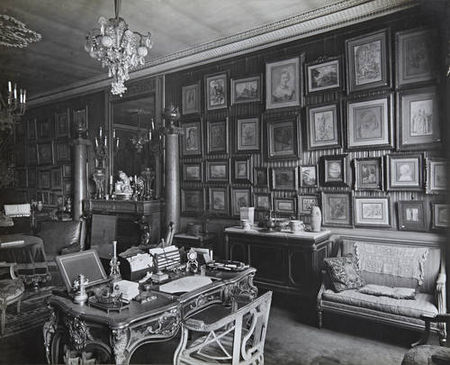
The salon des dessins at Emmanuel Alfred Beurdeley’s hôtel particulier, rue de Clichy, Paris.
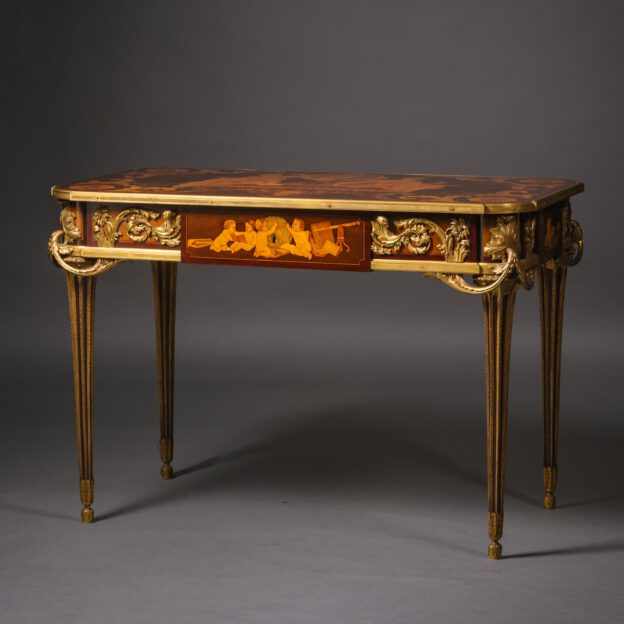
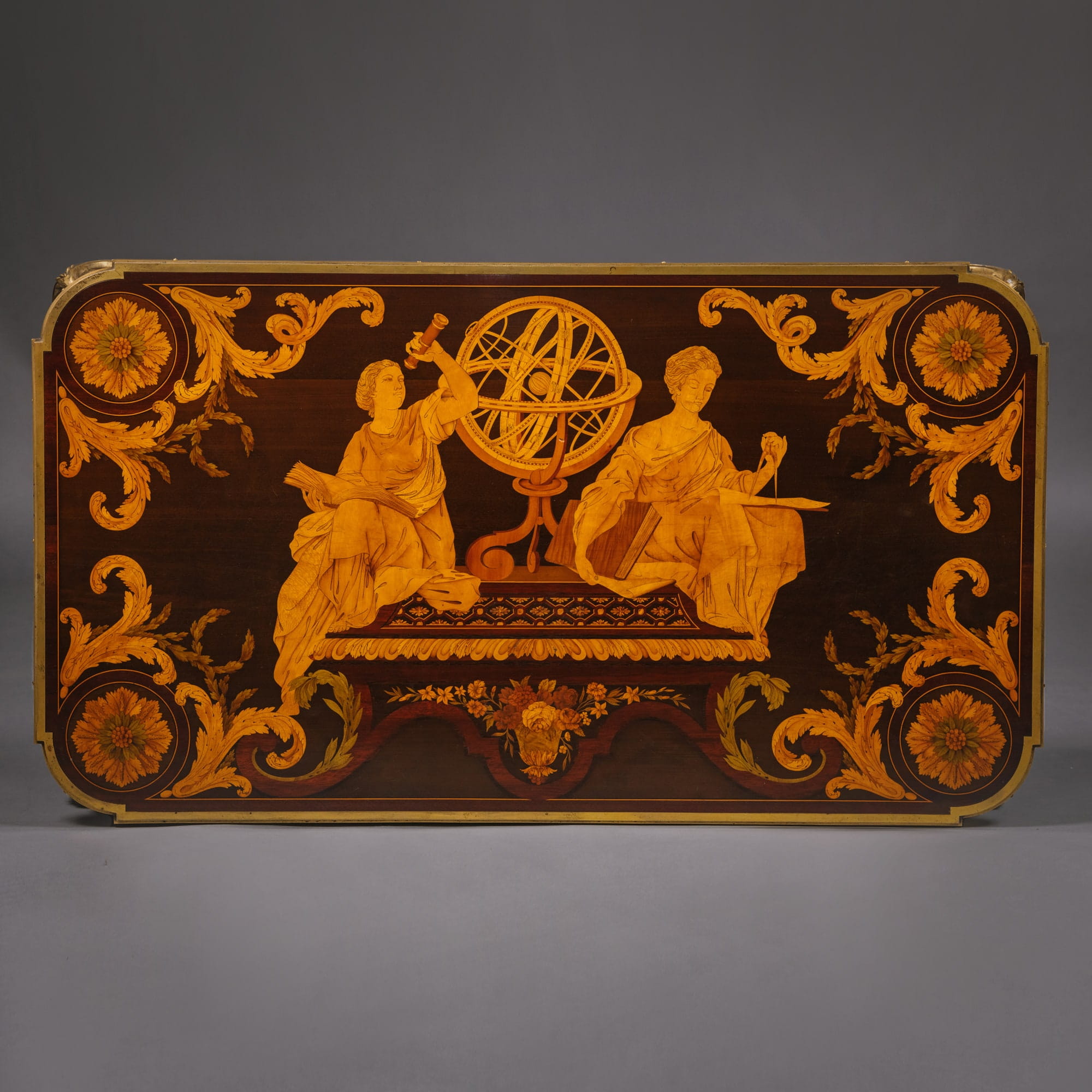
The ‘Table des Muses’
One of the finest illustrations of this approach is the ‘Table des Muses’, by Emmanuel-Alfred Beurdeley, after the celebrated model by Jean-Henri Riesener.
The original royal table was supplied by Riesener in 1771 for Louis XVI and is now at the Petit Trianon at Versailles.
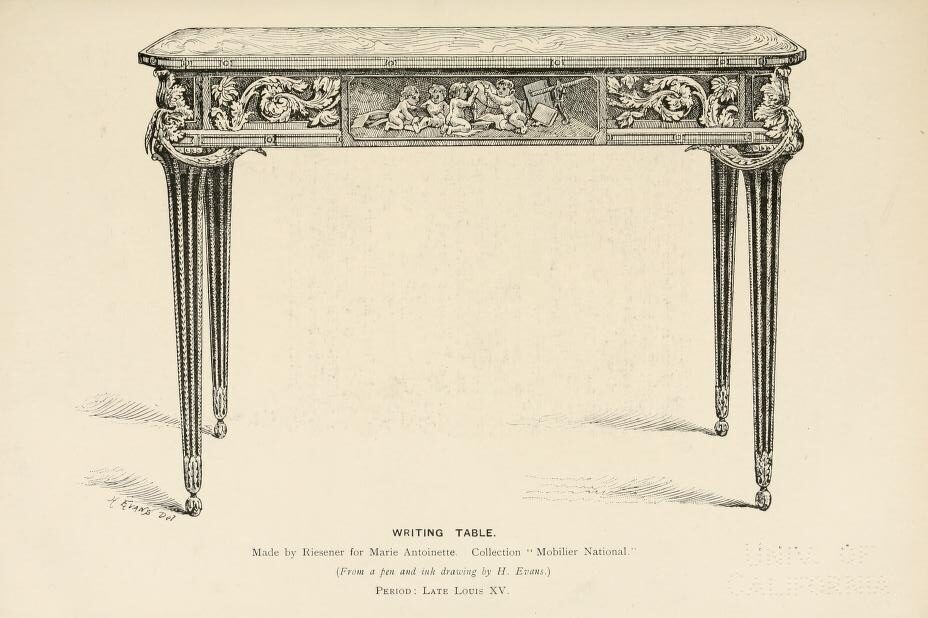
A late 19th century pen and ink drawing by H.Evans of the famous table ‘made by Riesener for Marie antoinette’. (From F. Litchfield, Illustrated History of Furniture, London 1892, p. 162.)
Maison Beurdeley exhibited a replica of the model at the Union Centrale des Beaux-Arts appliqués à l’Industrie in Paris in 1880, alongside approximately fifteen reproductions of celebrated eighteenth-century works. A Maison Beurdeley version was subsequently visible at the 1882 retrospective exhibition.


‘Le Bureau du Roi’
Perhaps the most spectacular Beurdeley object in the Adrian Alan collection is the firm’s celebrated version of the Bureau du Roi.
The Bureau du Roi or ‘King’s Desk’ is among the most celebrated pieces of furniture ever made and one of the most luxurious creations of the eighteenth century. The desk was ordered by Louis XV in 1760 from the Royal cabinet maker Jean-François Oeben for his private study and was completed circa 1769 by Oeben’s successor, Jean-Henri Riesener.
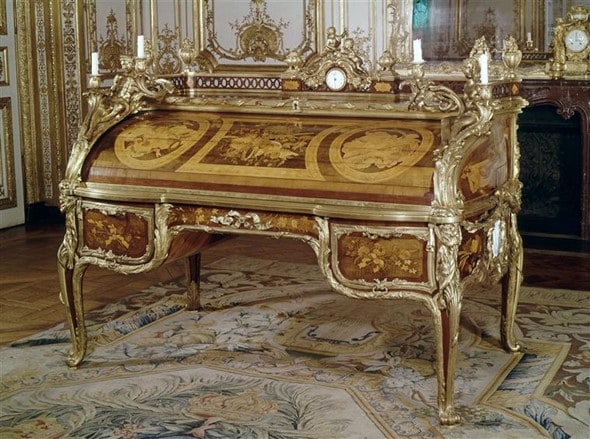
The Bureau du Roi made for King Louis XV was started in 1760 by the master cabinet make Jean-François Oeben and was finished in 1769 by his successor, Jean Henri Riesener, who had married Oeben’s widow. It was made for the new Cabinet du Roi at the Palace of Versailles where it is displayed to this day.
The first replica was made for 4th Marquess of Hertford and is now in the Wallace Collection, London (Wallace Collection Inv. no. F460), and is credited to Dasson’s forebears, Carl Dreschler and Charles-Guillaume Winckelsen. In 1875 Henry Dasson made his version which was shown at the 1878 Paris Exposition universelle.
In 1889 Emmanuel Zwiener made a version for the exhibition of that year, as did Beurdeley who inscribed it ‘Fait par Riesener à l’Arsenal en 1769, reproduit par Beurdeley en 1889. Paris.’ It was sold in the 6-9 May 1895 Beurdeley sale, Galerie Georges Petit, Paris, lot 277 and bought back by the family, as it is visible in the photograph of the picture gallery at the Beurdeley residence 79, rue de Clichy in circa 1910. This 1889 dated bureau was subsequently bought by ‘Salar Jung III’ (d. 1949) and is today in the Salar Jung Museum, Hyderabad, India.
Beurdeley made a second version which is in the collection of Adrian Alan. Marked with the Beurdeley incised cypher ‘BY’ to the reverse of the bronzes, it is almost certainly the Bureau du Roi exhibited by Beurdeley at the Chicago World’s Fair in 1893 (see Camille Mestdagh – Les copies à l’ère des premières Expositions universelles : les œuvres de Dasson et de Beurdeley, un xviiie qui continue de vivre), and subsequently in the collection of George Jay Gould (1865-1923) at Georgian Court, Lakewood, New Jersey.
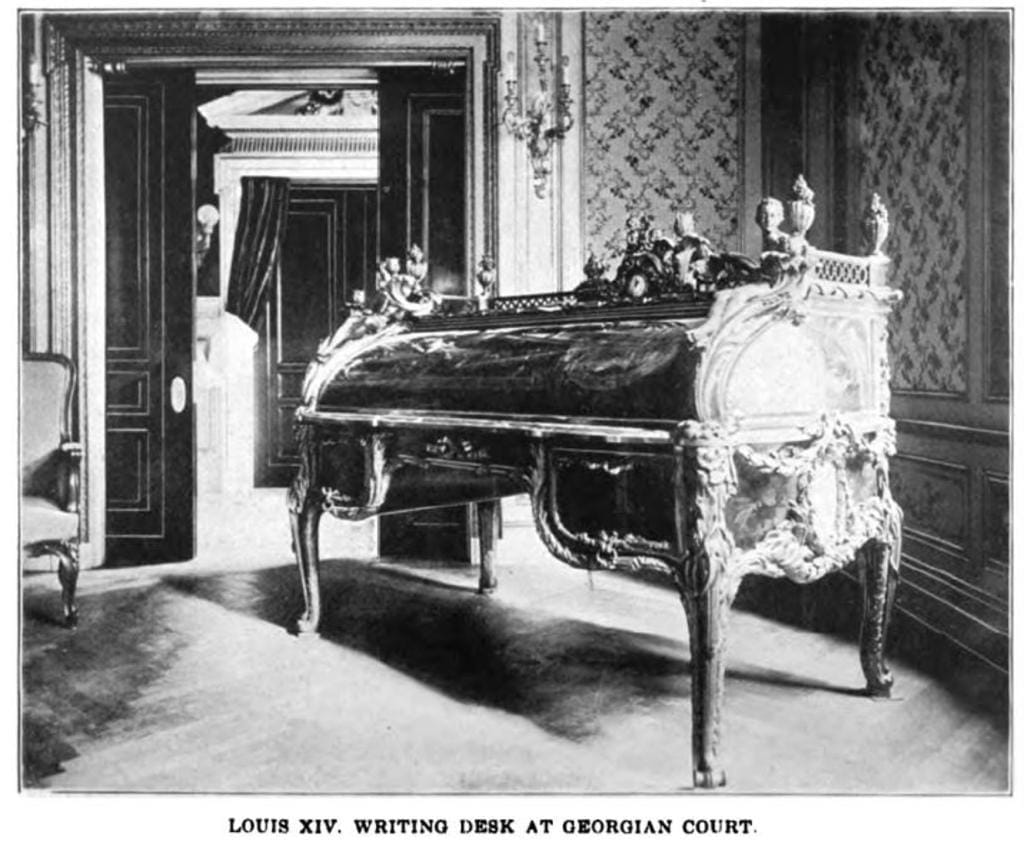
‘Le Bureau Du Roi’ photographed at Georgian Court from The Great American Architects Series, The Architectural Record, ‘The Works of Bruce Price – A Critique by Russell Sturgis’ 1899, p. 98. ‘Louis XIV writing desk at Georgian Court’
The Bureau du Roi is particularly significant because it embodies Beurdeley’s attention to historical detail. This is evident in the quality of construction, marquetry, modelling of the sculptural gilt-bronzes and double-dial clock movement. A particular detail which only Beurdeley is known to have observed is that the large gilt-bronze plaque to the back of the bureau has a bas-relief portrait of Louis XV. This is contrary to the original for which Louis XV’s portrait was supplemented with a portrait of Minerva after the French revolution.
The Beurdeley family’s reputation as collectors, and the lineage of their workshops to the Ancien Régime, has led to speculation that they acquired the original plaque with the portrait of Louis XV after the revolution and incorporated it into this copy of the Bureau du Roi. (This hypothesis is discussed at length by the ébéniste Hans Bieder writing about the Adrian Alan bureau in A.E. Amos, ‘The Desk of King Louis XV’, Fort Wayne, 1960.)
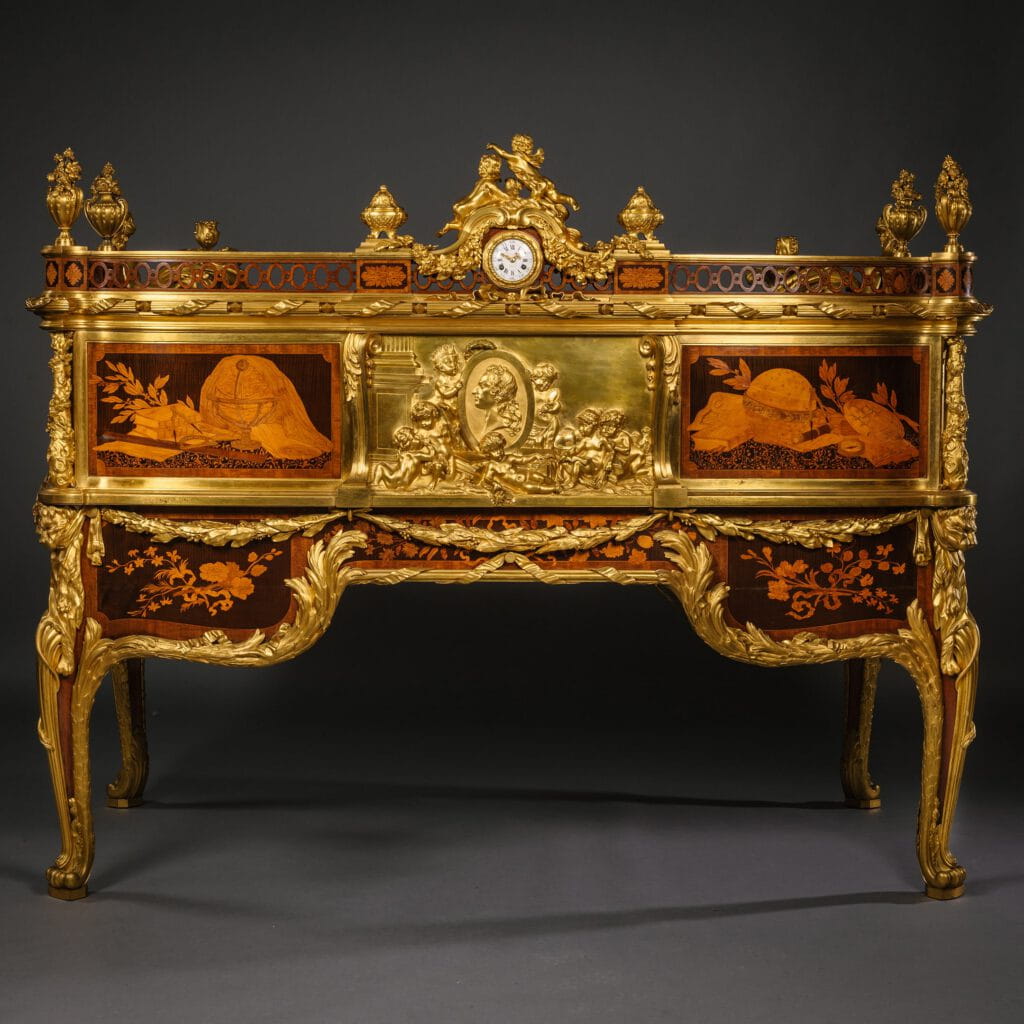
View of the bronze plaque with a portrait of Louis XV on the Bureau du Roi by Maison Beurdeley
If the earlier hypothesis were correct, the Bureau du Roi in the Adrian Alan collection would incorporate the original plaque from Oeben and Riesener’s desk for Louis XV. More recent research, however, has made this identification unlikely.
The fact that Beurdeley nevertheless reproduced the Louis XV portrait plaque, rather than simply copying the configuration of the surviving original, demonstrates the extraordinary attention paid to historical detail.
The Adrian Alan example is therefore more than an exceptionally fine piece of nineteenth-century furniture. It is an important document of the nineteenth-century revival of French royal furniture.
The original was one of the most celebrated objects in the history of French royal furniture. Beurdeley did not merely reproduce its silhouette. The firm reconstructed the complex relationship between:
marquetry + gilt bronze + porcelain + horology + historical inscription + architectural scale.
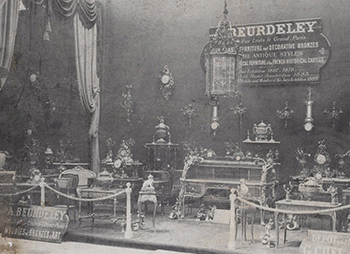
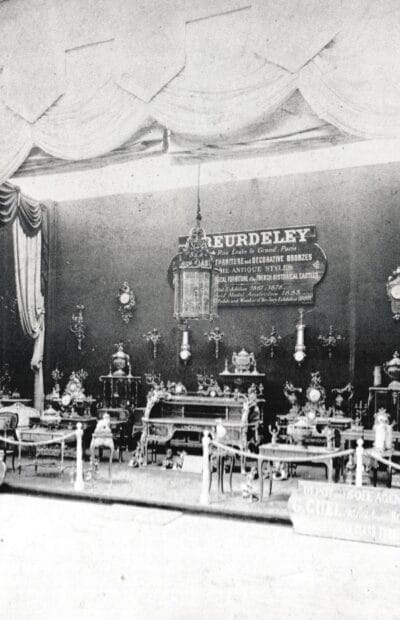
Beurdeley’s stand at the Chicago World’s Fair in 1893. The Bureau du Roi is at the centre of the display.
At the Chicago World’s Fair of 1893, the Beurdeley stand was dominated by a magnificent reproduction of the Bureau du Roi. The firm’s display presented Beurdeley as a manufacturer of furniture and decorative bronzes in the antique styles derived from French historic interiors. Contemporary commentary praised the exceptional workmanship and specifically singled out the quality of the bronze chiselling.
Beurdeley and the Gilded Age
The success of Maison Beurdeley coincided with the emergence of an extraordinarily wealthy American collecting class.
American industrialists were increasingly commissioning European architects, decorators and manufacturers to create interiors inspired by French royal and aristocratic residences.
Alfred II subsequently opened a shop in New York, extending the firm’s reach into the rapidly expanding American market.
Among the most important were the Vanderbilts.
Beurdeley supplied furniture and decorative elements for Cornelius Vanderbilt II’s New York mansion (illustrated right) and, probably under the direction of Jules Allard & Fils, executed bronze and marble objects for The Breakers in Newport. The firm’s work included a fireplace inspired by a design associated with Pierre Contant d’Ivry and copies of important French furniture.
This American market was not simply an export market.
It represented the culmination of the Beurdeley philosophy.
The American collector wanted historically informed French interiors, but also demanded the very highest standard of nineteenth-century execution.
Beurdeley was uniquely equipped to provide both.
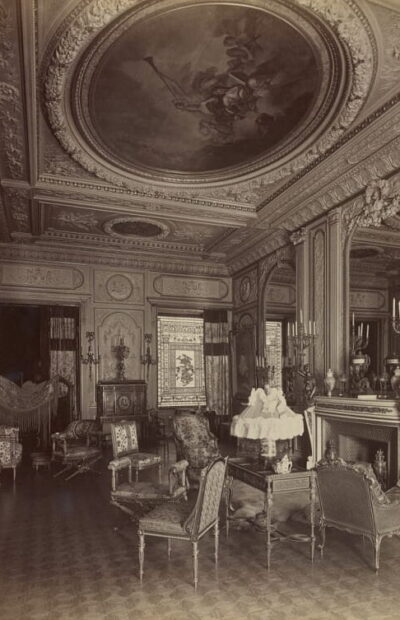
The Chicago World’s Fair, 1893
The World’s Columbian Exposition in Chicago in 1893 represented the international culmination of the Beurdeley firm’s exhibition career.
The surviving photograph of the Beurdeley stand provides valuable evidence of the firm’s presentation strategy. The Bureau du Roi occupied the centre of the display, surrounded by furniture and works of art representing the breadth of the firm’s production.
This was effectively a statement of Beurdeley’s credentials:
historical knowledge, technical mastery and international luxury.
The exhibition also reinforced Beurdeley’s connection with the rapidly expanding American market.
The Bureau du Roi now in the Adrian Alan collection is particularly significant in this context because it provides a tangible surviving example of the kind of object with which Beurdeley chose to represent the firm internationally.
Beurdeley at the Great Exhibitions
The firm’s exhibition history is fundamental to understanding its development.
1867 — Paris
Louis-Auguste-Alfred Beurdeley exhibited an exceptional cabinet at the Paris Exposition of 1867, incorporating ebony, gilt bronze, lapis, jasper and marble.
The cabinet was awarded a gold medal.
Sotheby’s has described this object as an important example of the transition between Beurdeley’s historicist reproductions and more ambitious original creations. Camille Mestdagh has also emphasised the exceptional cost and quality of such exhibition furniture.
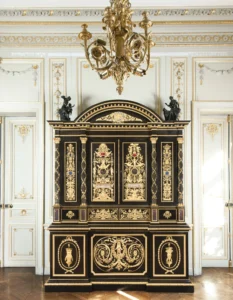
An Exceptional Napoleon III Cabinet by Beurdeley which received a gold medal at the 1867 Paris Exposition. Image – Sotheby’s.
1878 — Paris
Alfred II continued the firm’s success, winning a gold medal at the 1878 Exposition universelle.
The exhibition was particularly important because Beurdeley’s work was increasingly recognised as something more than commercial reproduction.
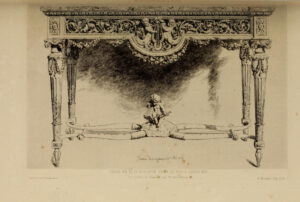
A Louis Xvi style carved giltwood table exhibited by Beurdeley at the 1878 Paris Exposition
1883 — Amsterdam
At the Amsterdam exhibition Beurdeley achieved further international recognition and was subsequently made a Chevalier of the Légion d’honneur.
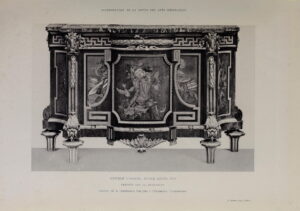
A Louis XVI style commode exhibited by Beurdeley at the 1883 Amsterdam Exhibition
1889 — Paris
Beurdeley exhibited and was a member of the jury.
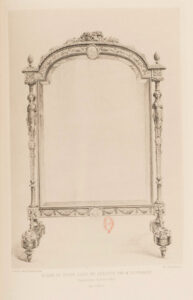
A Louis XVI style screen exhibited by Beurdeley at the 1889 Paris Exposition.
1893 — Chicago
The Chicago exhibition represented the final great international presentation of Maison Beurdeley.
The firm’s Bureau du Roi occupied the centre of the display and demonstrated the extraordinary scale of ambition reached by the workshop.
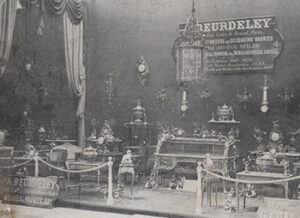
Beurdeley’s stand at the Chicago World’s Fair in 1893. The Bureau du Roi is at the centre of the display.

An Important Twelve-Light Chandelier, After The Celebrated Model By François Remond
£130,000
VIEW ITEM
Beurdeley and Historic French Models
The firm’s work frequently relates to important eighteenth-century makers.
Among the names most closely associated with Beurdeley reproductions are:
- Jean-François Oeben
- Jean-Henri Riesener
- André-Charles Boulle
- Charles Cressent
- Adam Weisweiler
- Georges Jacob
- other makers represented in the French royal collections.
The identification of a prototype can therefore be one of the strongest forms of evidence.
For example, the Adrian Alan ‘Table des Muses’ can be directly related to Riesener’s royal table, while the Bureau du Roi can be identified with the famous Oeben/Riesener masterpiece.
This is one of the great advantages in studying Beurdeley.
The firm frequently tells us what it was looking at.
The furniture of Beurdeley and his contemporary Henry Dasson is described at the 1889 Paris universelle Exposition as:
“Indeed, there is no piece from the hands of these great cabinetmakers that our craftsmen cannot reproduce, and if one wishes to carefully examine the two exhibitions of Messrs. Beurdeley and Dasson at the Champ de Mars, one can be assured that our modern artisans face no obstacles. Among these two manufacturers, one finds all the famous pieces of furniture that are the pride of our Mobilier National; those cabinets adorned with fine pewter marquetry that Boulle lovingly crafted in his grand workshop at the Louvre. Those tomb-shaped commodes with rounded sides; those side tables whose wood mosaics resemble fine brocades; those chiffoniers whose black lacquers are framed in supple bronzes; those work tables; those ladies’ desks; and those elegant pedestal tables that recall the finest days of our great cabinetmaking. All these pieces are impeccably executed; the selection and planing of the wood could not be improved. The frames are assembled with absolute care; the veneers, marquetry, casting, and chasing of the bronzes are as perfect as one could wish. One might almost say that the two salons furnished by Messrs. Beurdeley and Dasson with their finest works rival the Musée du Garde-Meuble and were it not for certain details of workmanship that reveal a modern origin, one might believe that these two skillful craftsmen had plundered our National Palaces.
Translated from: Exposition universelle de 1889,
Les Beaux-Arts et les Arts Décoratifs, Paris, p. 360).
How to Identify a Beurdeley work
When examining a possible Beurdeley, no single feature should be considered decisive.
The most reliable attribution comes from the convergence of several forms of evidence.
- Examine the bronze
Look first at the quality of the casting.
Is the ornament sharply defined?
Are the flowers, leaves, masks and architectural details properly modelled?
Is the chasing crisp?
Does the bronze have the controlled finish characteristic of high-quality Parisian ormolu?
- Examine the gilding
Look for the deliberate combination of matt and burnished surfaces.
The finest Beurdeley gilding has considerable subtlety.
- Examine the cabinetmaking
The quality of the carcass, veneers, marquetry and construction should be consistent with the bronze.
A superb mount on mediocre cabinet work should be treated cautiously.
- Identify the prototype
If the object reproduces an eighteenth-century model, identify the original.
Compare:
- dimensions;
- proportions;
- marquetry;
- bronze mounts;
- feet;
- drawer arrangement;
- architectural details.
- Examine the mark
Look for recognised Beurdeley signatures and marks.
But never attribute solely on the basis of a stamp.
- Compare with exhibition examples
The Beurdeleys exhibited extensively.
Historic photographs, exhibition catalogues and drawings can therefore provide unusually valuable comparative evidence.
- Research provenance
Provenance connecting an object to a significant nineteenth-century collection, French historic house, American Gilded Age mansion or documented Beurdeley sale can substantially strengthen an attribution.
- Consider the object as a whole
The strongest Beurdeley attribution is one in which the bronze, cabinetmaking, design, materials, prototype, signature and provenance all agree.
Beurdeley and the Musée des Arts Décoratifs
The firm’s historical importance is reflected in the surviving Beurdeley archives and objects in French collections.
The Musée des Arts Décoratifs preserves important Beurdeley furniture and documentary material, including workshop drawings which are valuable evidence for understanding how the firm’s objects were designed.
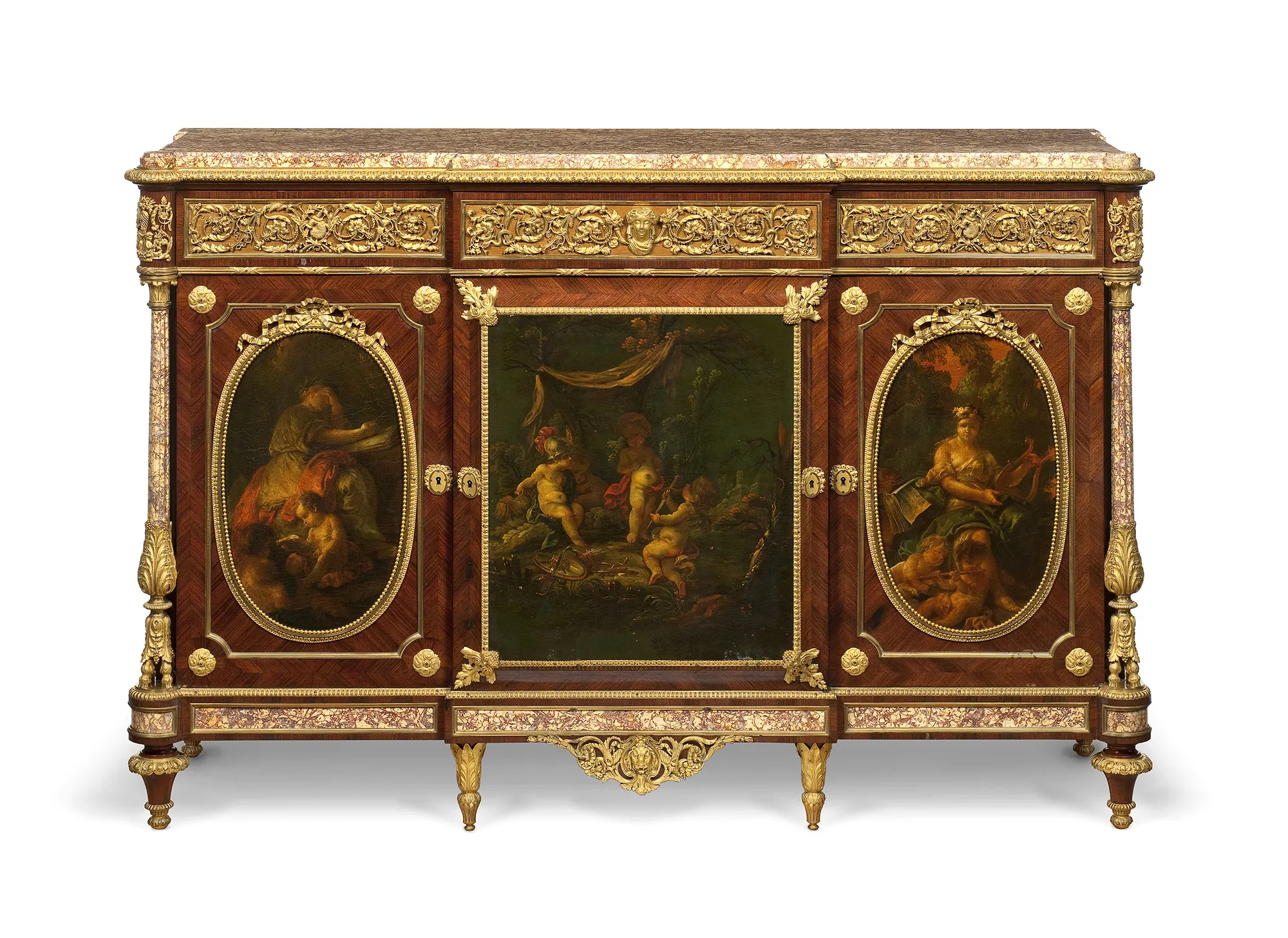
A Louis XVI style commode with painted panels to the doors, by Beurdeley.
Collection of the musée des Arts décoratifs, Paris. (N°inv. 46514).
These drawings are particularly important because they allow individual pieces to be connected with the design process rather than merely identified stylistically.
The InVisu project led by Camille Mestdagh has brought together this documentary material with photographs and objects, creating an unusually rich picture of the Beurdeley workshops.
The surviving documentation is therefore essential for distinguishing between:
an eighteenth-century original, a Beurdeley reproduction, a Beurdeley adaptation and a later nineteenth-century imitation.
The Beurdeley Collection
There is a further dimension to Alfred II’s story which is often overlooked.
He was not simply a manufacturer of historic furniture.
He was himself a major collector.
After the closure of the firm, Beurdeley devoted much of his life to collecting furniture, works of art, prints and drawings.
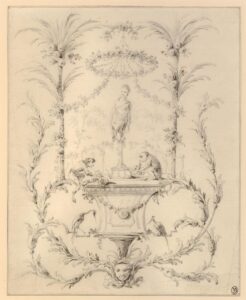
A tapestry design, by Jean-Baptiste Pillement (1728-1808), formerly in the collection Alfred Beurdeley, now in the British Museum.
His collection of architectural drawings was particularly important. A substantial collection of architectural drawings was sold to the Imperial Academy in St Petersburg in 1888 and is now associated with the Hermitage collections.
His collecting activity reinforces the importance of viewing Maison Beurdeley as an enterprise founded upon connoisseurship.
The same man who manufactured historical furniture was also collecting and studying historical art.
That relationship between collector and maker is central to understanding the quality of the firm’s work.
The Closure of Maison Beurdeley
The Beurdeley workshops finally closed in the 1890s.
The firm’s stock was dispersed through auctions, including sales conducted by Galerie Georges Petit.
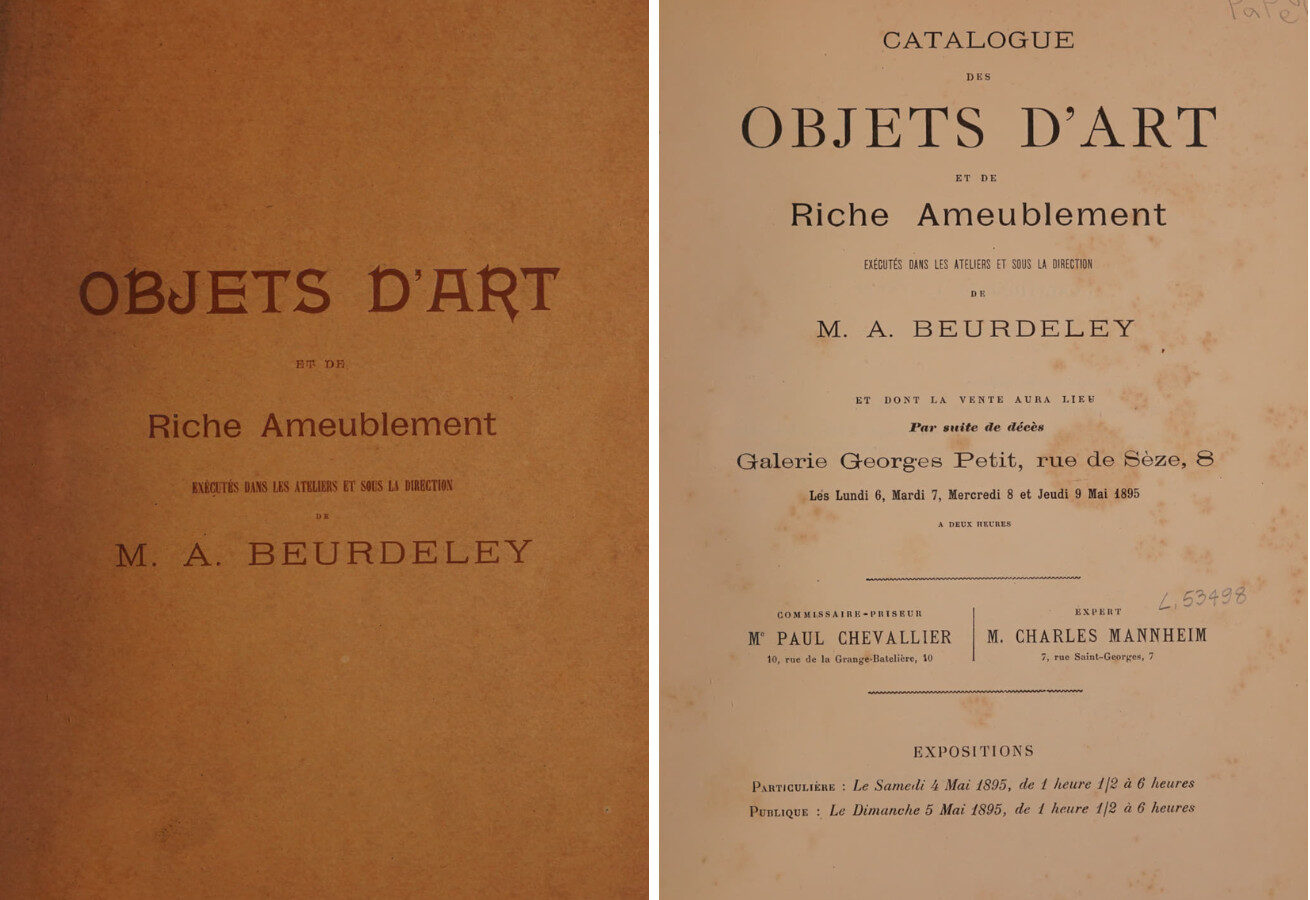
The Beurdeley Auction Catalogue – Galerie Georges Petit 1895.
Two catalogues of Beurdeley’s remaining stock were published in 1895.
The dispersal of the stock makes the survival of documented Beurdeley furniture particularly important.
Individual pieces may now be found in museums, historic houses, private collections and the international art market, often separated from the documentation that originally accompanied them.
For this reason, comparative study remains essential.
Why Beurdeley Matters
The importance of Maison Beurdeley lies in the meeting of several traditions.
The firm inherited the antiquarian knowledge of the marchand-mercier.
It developed the technical abilities of the ébéniste and bronzier.
It studied the collections of the French monarchy and aristocracy.
It participated in the international exhibitions that defined nineteenth-century decorative arts.
And it supplied the emerging international collecting elite with furniture of a quality intended to rival the historic originals.
The result was one of the most accomplished expressions of nineteenth-century French historicism.
The best Beurdeley furniture is not valuable merely because it is old, nor merely because it imitates an eighteenth-century original.
Its importance lies in the extraordinary level at which the nineteenth-century maker understood and recreated the object.
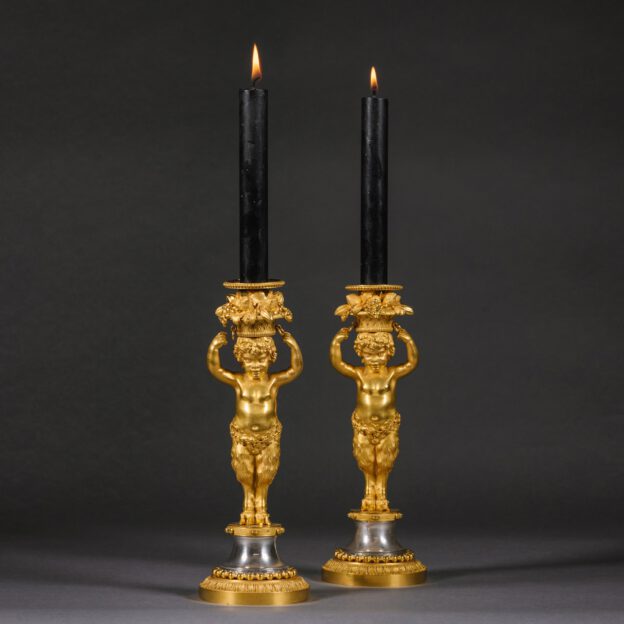
A Pair of Louis XVI Style Gilt-Bronze and Polished Steel Candlesticks
£6,500
VIEW ITEM
A Connoisseur’s Checklist
When examining a piece attributed to Maison Beurdeley, ask:
Is the design documented?
Can the eighteenth-century prototype be identified?
Does the bronze correspond to known Beurdeley work?
Is the casting exceptionally crisp?
Is the chasing of a sufficiently high standard?
Does the gilding show the appropriate combination of matt and burnished surfaces?
Is the cabinetmaking of comparable quality?
Is the marquetry technically sophisticated?
Is there a Beurdeley signature or workshop mark?
Are there marks on the reverse of the bronze mounts?
Can the piece be connected with an exhibition, drawing or historic photograph?
Is there a convincing provenance?
Does the object correspond to known Beurdeley production rather than merely nineteenth-century French historicism?
The answer should be considered cumulatively.
A genuine Beurdeley is rarely identified by one isolated characteristic.
It is identified by the convergence of evidence.
Conclusion
Maison Beurdeley occupies a distinctive position in the history of nineteenth-century French decorative arts.
Across three generations, the family transformed an antiquarian knowledge of French furniture into a highly sophisticated manufacturing enterprise. Under Alfred II in particular, the firm achieved a level of technical accomplishment in gilt bronze, marquetry and cabinetmaking that placed its work among the finest meubles de luxe produced in nineteenth-century Paris.
Its reproductions of celebrated royal furniture, among them the Bureau du Roi and Table des Muses, were not simply copies. They were products of an unusually informed culture of collecting, research and craftsmanship.
At its best, Beurdeley’s achievement was to make the historical object live again through nineteenth-century craftsmanship.
That is why the finest Beurdeley furniture continues to command the attention of serious collectors.
It represents not only the revival of the French Ancien Régime, but the nineteenth century’s sophisticated attempt to understand, preserve and reinterpret it.
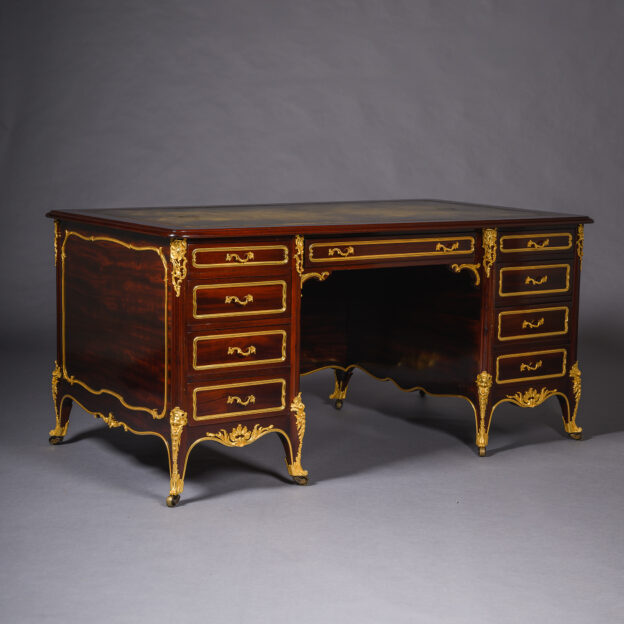
Items by Maison Beurdeley

Further Reading
Camille Mestdagh, L’Ameublement d’art français, 1850–1900, Paris, 2010.
Christopher Payne, Paris Furniture: The Luxury Market of the 19th Century, Paris, 2018.
Denise Ledoux-Lebard, Les Ébénistes du XIXe siècle, Paris, 1984.
Jonathan Meyer, Great Exhibitions: London, New York, Paris, Philadelphia, 1851–1900, Woodbridge, 2006.
Camille Mestdagh, Beurdeley: la curiosité aux sources de la création des objets d’art, InVisu / CNRS. https://invisu.cnrs.fr/project/beurdeley-la-curiosite-aux-sources-de-la-creation-des-objets-dart/
Musée d’Orsay, catalogue entry for Alfred II Beurdeley. https://www.musee-orsay.fr/en/ressources/artists-personalities-catalog/alfred-ii-beurdeley-3568
Adrian Alan
Adrian Alan has specialised in exceptional nineteenth-century furniture, sculpture and works of art for over six decades. The firm’s collection of Maison Beurdeley provides an important group of surviving examples through which the firm’s craftsmanship, historical sources and development can be studied.
For current examples by Maison Beurdeley, see the Adrian Alan Beurdeley collection.
Frequently Asked Questions About Maison Beurdeley
Who were the Beurdeleys?
The Beurdeleys were a family of Parisian dealers, ébénistes, bronziers and collectors whose activities extended across three generations: Jean Beurdeley (1772–1853), Louis-Auguste-Alfred Beurdeley (1808–1882), and Emmanuel-Alfred Beurdeley (1847–1919), known as Alfred II.
What is Maison Beurdeley famous for?
Maison Beurdeley is renowned for exceptionally fine furniture and works of art inspired by the French royal and aristocratic collections of the eighteenth century. The firm was particularly celebrated for gilt-bronze-mounted furniture, elaborate marquetry and highly accomplished reproductions of historic royal pieces.
How can you identify Beurdeley furniture?
Identification should consider several features together: the quality of the gilt bronze, chasing and gilding; cabinetmaking and marquetry; the design and its historical prototype; signatures and workshop marks; exhibition history; and provenance. A signature alone is not sufficient.
Does Beurdeley furniture have a signature?
Yes. Known marks include “A. BEURDELEY A PARIS”, while individual bronze mounts may carry separate ‘BY’ marks. The position and form of the mark can vary, making examination of the entire piece important.
Did Beurdeley make copies of eighteenth-century furniture?
Yes, but the firm should not simply be regarded as a maker of copies. Beurdeley reproduced celebrated eighteenth-century furniture while also creating new designs based upon antique furniture, ornamental drawings and historic models. Its production therefore encompasses reproduction, adaptation and original historicist design.
Did Beurdeley reproduce the Bureau du Roi?
Yes. Beurdeley is known to have produced at least two versions of the famous Bureau du Roi. The first dated 1889 is in the Salar Jung Museum, Hyderabad. The second was shown at the 1893 World’s Columbian Exposition and is in the Adrian Alan collection.
What is the Beurdeley Table des Muses?
The Table des Muses is a Louis XVI-style gilt-bronze-mounted marquetry centre table by Emmanuel-Alfred Beurdeley, after a celebrated model by Jean-Henri Riesener. The Adrian Alan collection includes an important example demonstrating the firm’s exceptional skill in marquetry and gilt bronze.
Why is Maison Beurdeley important?
Maison Beurdeley represents one of the most accomplished expressions of nineteenth-century French historicism. Its importance lies in the combination of antiquarian scholarship, exceptional craftsmanship, sophisticated gilt bronze and a close understanding of the great furniture of the French Ancien Régime. The finest surviving examples are significant works of nineteenth-century decorative art.
Selected Museum Collections & Sources
Salar Jung Museum:
https://artsandculture.google.com/search/entity?p=salar-jung-museum
Musée d’Orsay:
https://www.musee-orsay.fr/en/ressources/artists-personalities-catalog/alfred-ii-beurdeley-3568
http://beurdeley.huma-num.fr/guest-work-report/2094133a-5b38-11eb-a539-5254000ab4ec
Musée des Arts Decoratifs:
https://madparis.fr/Louis-Auguste-Alfred-Beurdeley-1808-1882-Side-cabinet-Paris-c-1870
Sotheby’s:
Wallace Collection:
Elysée Palace:
https://collection.mobilier-national.fr/objet/GML-4562-002
The Breakers, Newport:
http://beurdeley.huma-num.fr/guest-work-report/06822ee2-5b2d-11eb-a539-5254000ab4ec