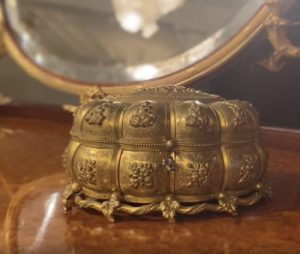
Maison Beurdeley
A Regence Style Gilt-Bronze Mounted Parquetry Veneered Bookcase
£36,000
A Regence Style Gilt-Bronze Mounted Parquetry Veneered Bookcase, By Maison Beurdeley, Paris.Incised 'BY' marks to the reverse of the mounts.The...
Dimensions
Height: 185 cm (73 in)Width: 139 cm (55 in)
Depth: 45 cm (18 in)

 Print
PrintDescription
A Regence Style Gilt-Bronze Mounted Parquetry Veneered Bookcase, By Maison Beurdeley, Paris.
Incised ‘BY’ marks to the reverse of the mounts.
The ‘S’-shaped pediment centred by a winged cartouche. The two doors with three-quarter glazed panes above panelled lower portions ornamented with opulent gilt-bronze mounts, one with fruiting vine and tools emblematic of agriculture and the other with scientific instruments emblematic of astrology, and therefore representing the earthly and the celestial spheres respectively. The interior lined in pale green silk and fitted with three shelves. Raised on a shaped apron base.
France, Circa 1860.
This bookcase is designed in the sculptural Louis XIV-XV style of the mid-18th century with overtones of Boulle, Gaudreaux and Cressent. A revival piece, dating to a century later, it is marked ‘BY’ for the Beurdeley dynasty of cabinetmakers. Stylistically, and from the construction, it can be attributed to Beurdeley’s production under the auspices of Alfred I, rather than his son, Alfred II, who favoured the later neoclassical Louis XVI style.
A cabinet of grand proportions, it is distinguished by the profusion of gilt-bronze mounts, especially the foliate clasps heading the corners and the large gilt-bronze medallions to the doors. These sculptural trophies are beautifully modelled and cast in gilt-bronze. Each medallion is suspended from a ribbon-bow. One represents agriculture, with a flower and fruit-filled pannier with garden tools, ears of wheat, and climbing vine. The other represents astrology with scientific instruments. Allegorical trophies such as these reflect the Sun King’s dominion over heaven and earth and were conceived to glorify the King by expressing France’s scientific superiority. Similar medallions were designed by the Slodtz brothers as gilt-bronze sculptural mounts for furniture, notably for a suite of bas armoires for the ‘cabinet d’angle’, Louis XIV’s room of collecting, at Versailles. The armoires are now in the dining-room at the Ministère de La Marine, Paris.

The armoires with related trophy door mounts at the Ministère de La Marine, Paris (Wikipedia / Public Domain).
Date
Circa 1860
Origin
France
Medium
Parquetry and Gilt-Bronze
Signature
Incised 'BY' marks to the reverse of the mounts.
BEURDELEY
Jean Beurdeley (1772-1853)
Louis-Auguste-Alfred (dit Alfred I) Beurdeley (1808-1882)
Emmanuel-Alfred (dit Alfred II) Beurdeley (1847-1919)
Furniture and objets d’art by Beurdeley are considered to be preserve of the most knowledgeable and refined connoisseur of the 19th century decorative arts. Such collectors are usually referencing pieces produced during Alfred II Beurdeley’s tenure of the company which are admired for their exceptional craftsmanship and exquisitely refined gilt-bronze mounts.
The Beurdeley family were a flourishing dynasty of three generations of fine quality cabinetmakers working from 1818 to 1895. The firm was particularly well known for its exceptional metalwork, most commonly basing their designs on important 18th century examples. Their mercurial gilding and hand chasing are often of such a high standard that it is difficult to distinguish them from the best 18th century work.
The founder of the dynasty, Jean Beurdeley (1772-1853), was a Burgundian craftsman conscripted into the Napoleonic army. After hostilities ended in 1815, he settled in Paris opening a shop for curiosités and working as a latter day marchand mercier. Initially based on the rue Saint-Honoré, in 1840 Beurdeley moved to the famous Hanover Pavilion situated on the corner of rue Louis-Legrand and boulevard des Italiens, and the business was run by his only surviving son, Louis-Auguste-Alfred (dit Alfred I) Beurdeley (1808-1882).

Portriat of Alfred I Beurdeley, By Paul Baudry 1862 (© RMN-Grand Palais (Musée d’Orsay) / Hervé Lewandows).
This successful business, which had numerous official commissions including in 1853 the marriage coffer for the Empress Eugénie, was continued by Alfred I’s son, Emmanuel-Alfred (dit Alfred II) Beurdeley (1847-1919).

Portrait of Alfred II Beurdeley, By Anders Zoorn 1906 (© RMN-Grand Palais (Musée d’Orsay) / Hervé Lewandowski).
The success and reputation of the firm continued under Alfred II who took over from his father in 1875 and won a gold medal at the 1878 Paris Exposition Universelle. Following on from this glory, he went on to open a shop in New York. His participation in the 1883 Amsterdam Universal Exhibition drew even further attention to his work, and possibly as a result he was awarded the Ordre National de la Légion d’Honneur, France’s highest official mark of recognition.

Photograph of the Beurdeley display at the Chicago World Fair, 1893.
Beurdeley’s most magnificent display was at the Chicago World’s Fair of 1893 when they advertised themselves as ‘makers of furniture and decorative bronzes in the antique styles’ from ‘French Historic Castles’. Centerstage, surrounded by an impressive selection of wares, was Beurdeley’s magnificent replica of the ‘Bureau du Roi’, perhaps the most famous piece of furniture ever made. The Art Journal noted that “Beurdeley & Co., Paris, have sent various excellent decorative pieces to the World’s Fair [….] The workmanship throughout is perfection, and one should notice the exquisite chiselling of the bronzes.”

The Bureau du Roi made by Beurdeley for the Chicago World Fair, 1893 (Collection Adrian Alan).
Beurdeley received substantial commissions for the American titans of the Gilded Age and his increasing popularity with America’s industrialists was underscored by his participation in the Chicago World’s Fair. Beurdeley supplied various objects and furnishings for the renovation of The Cornelius Vanderbilt II Mansion, described as an ‘early French Renaissance style château’, at the northwest corner of West 57th Street and 5th Avenue in New York, including a bronze-mounted marble fire surround which had been exhibited in Chicago. Probably under the direction of interior decorator Jules Allard & Fils, Beurdeley executed numerous bronze and marble objects for Cornelius Vanderbilt’s Newport ‘cottage’, The Breakers.

Interior with furniture by Beurdeley at the Cornelius Vanderbilt II House at 1 West 57th Street in Manhattan, New York City. Circa 1883 (Archives of American Art / The Smithsonian Institution).
Beurdeley was renowned for making exquisite reproductions of celebrated pieces by the master makers of the Ancien Régime. The quality of the firm’s reproductions is such that they are often mistaken for period originals and Beurdeley predominantly owed its considerable commercial success to supplying furniture in the ‘French Royal Styles’ for the 19th century collecting elite. A masterpiece of French furniture might remain out of reach in a noble or museum collection, but a 19th century collector visiting exhibitions such as the 1865 Musée Retrospectif could commission an exquisitely crafted replica and thus show their sophisticated taste.
In the 19th century, commissioning furniture in this way was a legitimate antiquarian interest which demonstrated an appreciation for, and understanding of, the historical importance of art, a trend notably championed by 4th Marquess of Hertford, founder of the Wallace Collection. The copies were not designed to deceive, as nearly all works were prominently marked by Beurdeley, whose genius captured the true essence of the original.
Throughout their history Beurdeley also innovated by employing their considerable technical and artistic abilities to create new designs or meld elements of those so greatly admired in the 18th century. Alfred II created new designs of his own which are inspired by and indebted to the Louis XV and Louis XVI styles, but credited as entirely his own: “all designed according to the imagination of the manufacturer, his personal vision of styles and not with the aim of imitation. You should know that Mr. Beurdeley does not copy old models as so many others do; but he creates in a given style” (Bergerat Emile, Art Industriel, L’ébénisterie, Les chefs d’œuvre d’art à l’Exposition Universelle, Paris, 1878).

Emmanuel Alfred Beurdeley, design for ‘meuble de style Régence’ (courtesy Musée des Arts Décoratifs).
The company’s workshops finally closed in 1895 and Beurdeley’s stock was sold over a number of auctions conducted by Galerie Georges Petit of Paris. Two catalogues of the collection were published in 1895 and sales were held between 6-8 March and again on 27-28 May.
The originality and the incredible quality of Beurdeley’s work make them pre-eminent amongst Parisian makers of meubles de luxe. In addition to various works held by museums and historic collections, over the past twenty years academic research and an appreciation for the superb quality of their furniture and works of art has stimulated a growth in demand for pieces by Beurdeley.

Related Reading
How to Identify Maison Beurdeley Furniture | Adrian Alan — our guide to identifying Beurdeley furniture, including its signatures, gilt-bronze mounts, historic models and the work of Alfred Beurdeley and Emmanuel-Alfred Beurdeley.
Bibliography:
Ledoux – Lebard, Denise. Les Ébénistes du XIXe siècle, Les Editions de L’Amateur, (Paris), 1984; pp. 75-82.
Meyer, Jonathan, Great Exhibitions – London, New York, Paris, Philadelphia, 1851-1900, Antique Collectors’ Club, (Woodbridge, UK), 2006.
Mestdagh, Camille & Lécoules, Pierre. L’Ameublement d’Art Français, 1850-1900, Les Editions de L’Amateur, (Paris), 2010.
Payne, Christopher, Paris Furniture – the luxury market of the 19th century, Éditions Monelle Hayot, (Paris), 2018; pp.216-275.
Southill Park, Bedfordshire, until sold in 2023.
Southill Park was begun in the 1720s for George Byng, 1st Viscount Torrington (1663-1733). It passed down in the Byng family until it was sold in 1795 to Samuel Whitbread (1720–1796), the brewer and founder of Whitbreads. The house passed to his descendants and remains in the family.