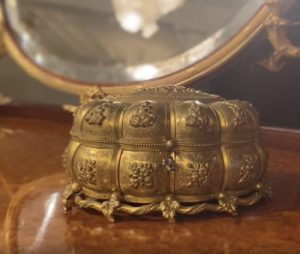
Ferdinand Barbedienne
A Pair of Rare ‘Neo-Grec’ Gilt and Patinated Bronze Torchère Stands
£16,000
A Pair of Rare 'Neo-Grec' Gilt and Patinated Bronze Torchère Stands, Attributed to Ferdinand Barbedienne.Each torchere has an inset marble top with...
Dimensions
Height: 130 cm (52 in)Width: 36 cm (15 in)
Depth: 36 cm (15 in)

 Print
PrintDescription
A Pair of Rare ‘Neo-Grec’ Gilt and Patinated Bronze Torchère Stands, Attributed to Ferdinand Barbedienne.
Each torchere has an inset marble top with suspended chains, raised on a fluted column cast with acanthus and supported by a tripod base cast with arabesque scrolls and united by a concave stretched and put down on paw-cast feet.
French, Circa 1870.
Designs in the ‘Neo-Grec’ or Greek style modelled after the antique featured prominently in Barbedienne’s submissions to the 1855 Paris Exposition Universelle and throughout the firms production. This model was exhibited at the 1867 Paris Exhibition and are typical of the high quality work Barbedienne produced at this time.
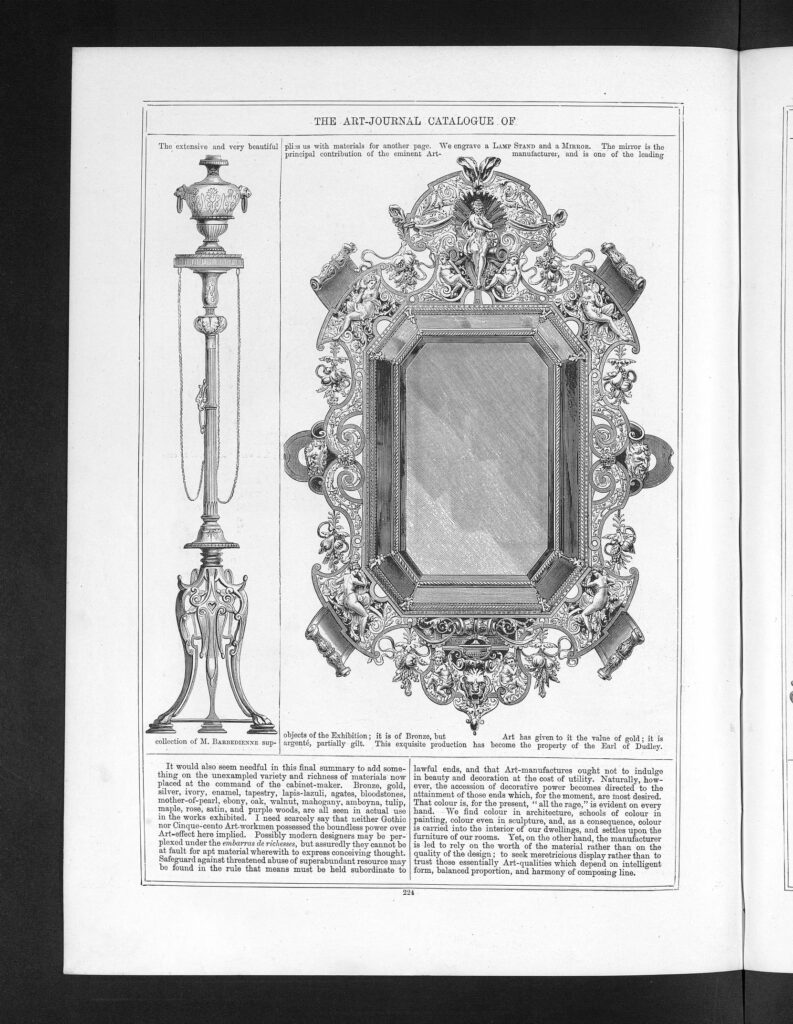
The Torchère Stands as exhibited by F. Barbedienne at the 1867 Paris Exhibition and engraved in the ‘The illustrated catalogue of the Universal exhibition : published with ‘The Art-journal’, 1867, p. 224.
Diameter of tops 24 cm / 93/8 inches
Date
1870
Origin
France
Medium
Gilt and Patinated Bronze
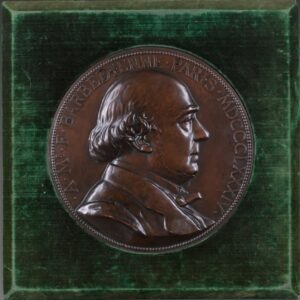
Ferdinand Barbedienne (6 August 1810 – 21 March 1892) was a French metalworker and manufacturer, who was well known as a bronze founder.
The son of a small farmer from Calvados, he started his career as a dealer in wallpaper in Paris. In 1838 he went into partnership with Achille Collas (1795-1859), who had just invented a machine to create miniature bronze replicas of statues. Together they started a business selling miniatures of antique statues from museums all over Europe, thus democratising art and making it more accessible to households. From 1843 they extended their scope by reproducing the work of living artists and also diversified by making enamelled household objects. With the outbreak of the Franco-Prussian war in 1870 the firm briefly had to switch to cannon founding owing to the shortage of metals but resumed business afterwards. Following Barbedienne’s death in 1892, he was buried in the Père-Lachaise cemetery and the firm was carried on by his nephew Gustave Leblanc until 1952.
Among the principal artists reproduced by the firm were Antoine Louis Barye and Auguste Rodin.