Henri Picard
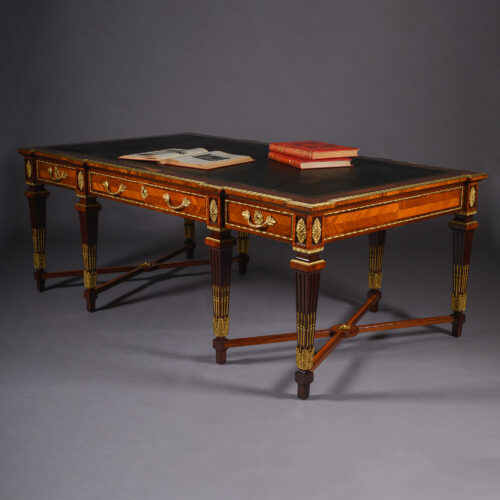
A Louis XVI Style Gilt-Bronze and Marquetry Centre Table
£55,000
A Louis XVI Style Gilt-Bronze and Marquetry Centre Table.Stamped to the reverse of the bronze mounts 'HPR' for the bronzier Henri Picard.This impressive...
Dimensions
Height: 74 cm (30 in)Width: 136 cm (54 in)
Depth: 75 cm (30 in)

 Print
PrintDescription
A Louis XVI Style Gilt-Bronze and Marquetry Centre Table.
Stamped to the reverse of the bronze mounts ‘HPR’ for the bronzier Henri Picard.
This impressive centre table is beautifully enriched with cuivre doré mounts. The top has a lozenge pattern parquetry ground encircling an oval panel with a marquetry trompe l’oeil of a flower entwined urn. The entrelac mounted frieze centred to front and back with rectangular plaques depicting playful putti cast in relief. The square tapering legs mounted with ormolu flowers and husk-chain marquetry and joined by a stretcher centred by a neoclassical urn.
France, Circa 1860.
The rounded rectangular shape of this table makes it easy to place in the centre of a room, in a window bay or behind a sofa. It can serve as an occasional table or writing table. The Louis XVI design is characteristic of the mid-19th century Napoléon III period. Compare an oblong table made by Wassmus Frères, who specialised in marquetry furniture, in Napoleon III and Empress Eugénie’s apartments at the Château de Fontainebleau.

A comparable table supplied by Wassmus Frères to the Château de Fontainebleau in 1856 (© RMN / Public Domain)
Date
Circa 1860
Origin
France
Medium
Gilt-Bronze and Marquetry
Signature
Stamped to the reverse of the bronze mounts 'HPR' for the bronzier Henri Picard.
The important fondeur and doreur Henri Picard worked in Paris from 1831 to 1884, most notably for the Emperor Napoléon III. He was based in Paris at 6 rue Jarente from 1831 to 1839, before moving to 10 rue de la Perle. The firm was active until around 1890.
Celebrated for the high quality of his production, Henri Picard supplied many important patrons, including garnitures and table pieces for the petits appartements of Emperor Napoléon III at the Louvre. An important pair of twelve-light candelabra by Picard remain in the Musée du Louvre today.
Bibliography:
Mestdagh, Camille & Lécoules, Pierre. L’Ameublement d’Art Français, 1850-1900, Les Editions de L’Amateur, (Paris), 2010; p 32.