About Thomas Johnson (1723-1799)
Thomas Johnson (1723-1799) was a skilled carver and furniture designer and one of the most successful exponents of the rococo style in England.
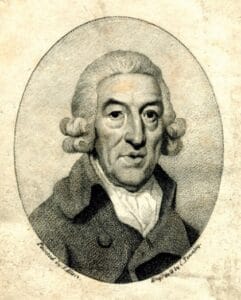
Charles Townley after Joseph Allen, Thomas Johnson, frontispiece in A Brief History of Freemasonry, 2nd ed., 1784. (Courtesy, Library and Museum of Freemasonry, London). Published in Luke Beckerdite, ‘Thomas Johnson, Hercules Courtenay, and the Dissemination of London Rococo Design’, American Furniture, 2016.
Born in London in 1723, as one of twelve children to a developer, Joel Johnson, at 13, he began working as an apprentice to his cousin, Robert Johnson, who was a carver and gilder in Frith Street, Soho. Following his apprenticeship, he became a journeyman at the workshop of the carver and gilder James Whittle, where he worked with the celebrated carver Matthias Lock, who Johnson called ‘the famous Matthias Lock, a most excellent Carver, and reputed to be the best Ornament draughtsman in Europe.’
After a scandalous affair involving the maid of his former master, Robert Johnson, he was forced to leave London and by 1746 was working in Liverpool. He continued to work in Liverpool and in Dublin until early 1755 when he returned to London settling initially in Queen Street, Seven Dials before taking premises in 1757 in Grafton Street at a workshop called ‘The Golden Boy’. Here he worked under his own account and undertook work for both James Whittle and for another carver, Thomas Vials of Great Newport Street, who had prestigious patrons including the Earls of Radnor at Longford Castle, Wiltshire, William Constable of Burton Constable, and the 3rd Duke of Dorset.
Despite success as a carver, it is for his published designs that Johnson gained fame and recognition. His first designs were produced in 1755 in a publication entitled ‘Twelve Gerandoles’, followed by a more ambitious set of designs ‘A New Book of Ornaments’ published in instalments at the rate of four sheets per month between 1756 and 1757, the fifty-three plates appeared as a single collection of designs in 1758 and 1761. The 1761 edition including one additional plate and re-titled ‘One Hundred & Fifty New Designs’.
Johnsons vigorous, picturesque designs are composed with great detail and imagination often inspired by the work of earlier French designers, transposing motifs taken from engraved ornament by Jean Bérain, Daniel Marot, William de la Cour, J. B. Toro and Francis Barlow. Recurring motifs include exotic birds, Chinoiserie and rustic figures and animals from Aesop’s fables. It is therefore ironic that he was a member of the Anti-Gallican Association, founded ‘to oppose the insidious arts of the French Nation’, even dedicating his publication ‘One Hundred and Fifty New Designs’ in 1761 to Lord Blakeney, Grand President of the society.
Following the success of these publications Johnson produced further works in 1760 exploring etching his own designs and appears to have shifted focus to teach drawing and design, publishing in August 1762 ‘A New Book of Ornaments’, ‘Designe’d for Tablets and Frizes for Chimney-Pieces Useful for Youth to draw after.’ In Mortimer’s Universal Director of 1763, he is described as a ‘Carver, Teacher of Drawing and Modelling and Author of a Book of Designs for Chimney-pieces and other ornaments and of several other pieces’. A trade card for Thos. Johnson Drawing Master at ye Golden Boy in Charlotte Streer Bloomsbury, London’ from circa 1755-1760 survives in the collection of the British Museum, London.
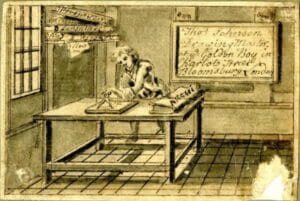
Thos. Johnson Drawing Master at ye Golden Boy in Charlotte Street Bloomsbury London, c. 1755-1760 [Heal,56.7]. © The Trustees of the British Museum
By 1766 he had become clerk of the Well Walk Chapel, Hampstead and in 1769 moved on to serve as clerk of the Bedford Chapel, Bloomsbury Street. He became a Free Mason in 1776 at the Tyrian Lodge, Tottenham Court Road and devoted the later years of his life to the society.
In 1798 Johnson was relieved of some of his Masonic duties, being in ill health, and in 1799 he died, aged 76 years.
Thomas Johnson since his death has been chiefly known through his published designs but thanks to Jacob Simon’s discovery of Johnson’s autobiography, ‘Life of the Author’, in the Library and Museum of Freemasonry, London, a much clearer picture of this important craftsman and designer has emerged.
In addition to his published designs Johnson is known to have supplied mirrors in the early 1760s to Paul Methuen at Corsham Court, Wiltshire, and the Duke of Atholl at Blair Castle.
Bibliography:
BIFMO: ‘Dictionary of British and Irish Furniture Makers’, 1600-1914; Johnson, Thomas (1723–1799); https:// https://bifmo.furniturehistorysociety.org/entry/johnson-thomas-1714-78 [Last accessed 2/November/2023].
Jacob Simon, ‘Thomas Johnson’s The Life of the Author’, Furniture History 39 (2003).
Luke Beckerdite, ‘Thomas Johnson, Hercules Courtenay, and the Dissemination of London Rococo Design’, American Furniture, 2016.
Helena Hayward, ‘Thomas Johnson and the English Rococo’, 1964.