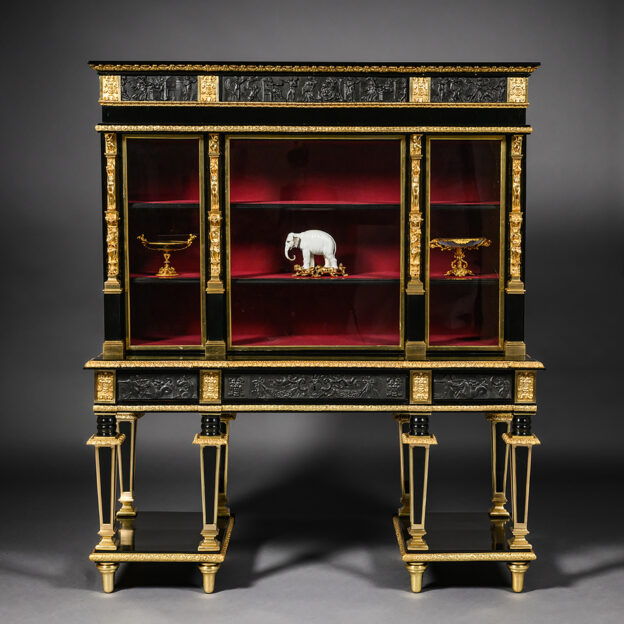
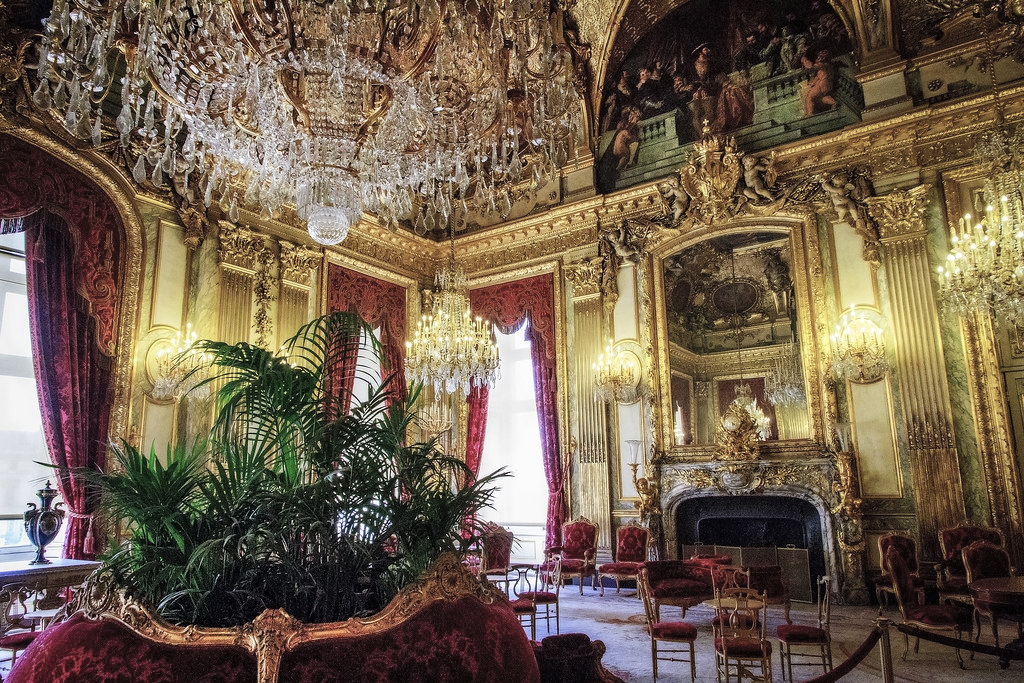
Few forms of nineteenth-century French furniture bring together the arts of collecting and interior decoration quite so successfully as the vitrine. Designed to frame and display porcelain, sculpture and works of art, it became an important feature of the fashionable interior, where the cabinet itself was as carefully considered as the treasures it contained.
Combining finely figured veneers, elaborate marquetry, glazed panels and richly modelled gilt-bronze mounts, the finest examples reflect the extraordinary skill of the Parisian furniture trade. By the Belle Époque, makers such as François Linke and Emmanuel Zwiener had elevated the vitrine into an art form in its own right, bringing together technical virtuosity and a sophisticated understanding of proportion and ornament.
Today, these cabinets remain highly sought after by collectors, valued as much for their craftsmanship and decorative presence as for the collections they were designed to showcase.
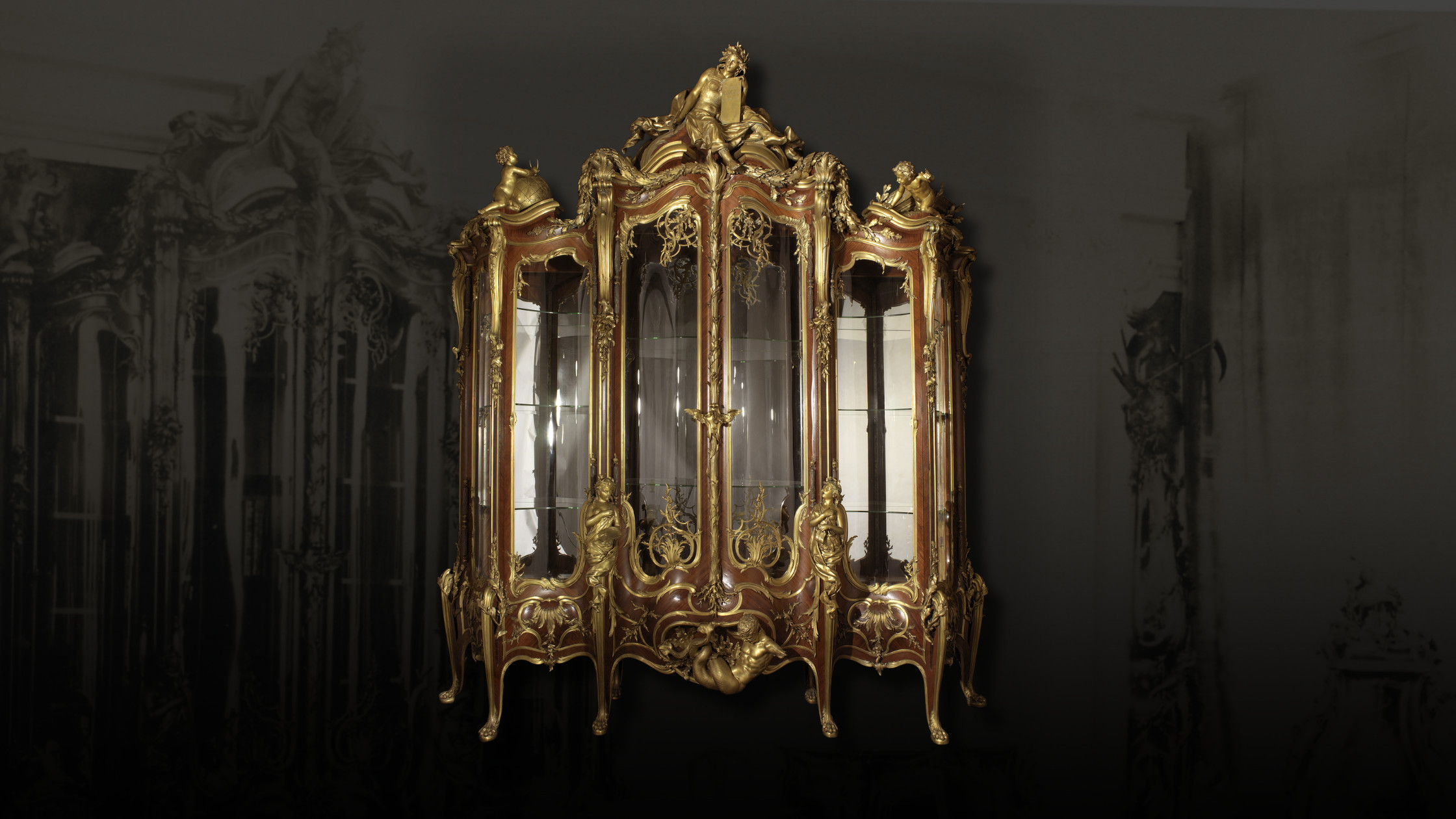
‘La Grande Bibliothèque’
A Highly Important Sculptural Vitrine For the Paris Exposition Universelle of 1900
Designed and Made by François Linke and Léon Messagé – Adrian Alan
A Tradition of Collecting
The history of the vitrine lies within a broader European tradition of collecting. During the Renaissance and seventeenth century, princes, scholars and wealthy merchants assembled collections of naturalia and artificialia: objects from the natural world alongside antiquities, scientific instruments, precious stones and works of human craftsmanship. These collections were often housed in specially furnished rooms known as Kunstkammern or Wunderkammern, in which the arrangement and presentation of objects were considered as important as their individual rarity.
The cabinets created for these collections were frequently works of considerable ingenuity. Concealed drawers, intricate compartments, elaborate marquetry and carefully arranged interiors transformed the furniture into a world of discovery. Conceived as architectural structures in miniature, they brought together objects of widely differing origins within a carefully ordered composition. The cabinet itself became an expression of its owner’s wealth, knowledge and discernment.
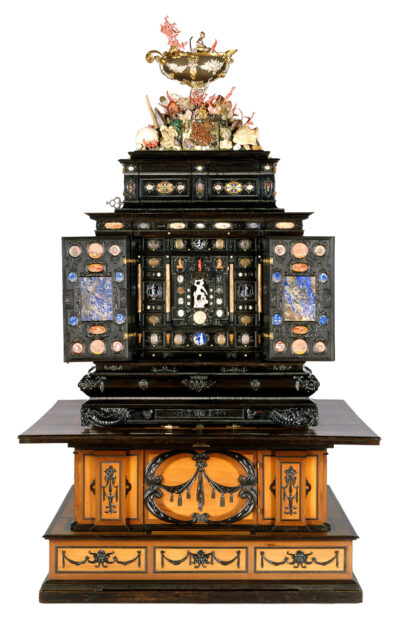
One of the most celebrated surviving examples is the Augsburg Art Cabinet, created under the direction of Philipp Hainhofer and presented by the city of Augsburg to King Gustavus Adolphus of Sweden in 1632. Containing approximately one thousand objects, it encompasses natural specimens, scientific instruments, clocks, works of art and curiosities from across the world. Preserved at the Gustavianum, Uppsala University, with its collection substantially intact, it offers an extraordinary insight into the ambitions of seventeenth-century collecting.
The Augsburg Art Cabinet, created under the direction of Philipp Hainhofer and presented to King Gustavus Adolphus of Sweden in 1632. Now housed at the Gustavianum, Uppsala University.
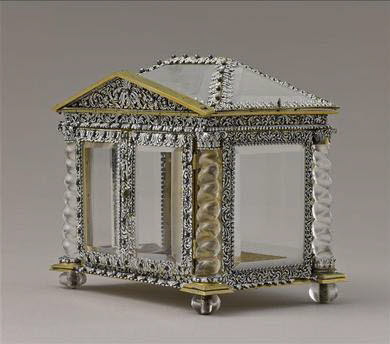
The use of glass and other transparent materials offered a different means of presenting precious objects. A remarkable cabinet of rock crystal and glass in the Louvre, dating from around 1690, provides an illustration of the relationship between precious materials and the art of display. Measuring just 14.5 centimetres in height, this small architectural casket is constructed from bevelled rock-crystal panels, glass and finely worked gilt and enamelled mounts, embellished with 102 diamonds. Formerly belonging to Cardinal Mazarin and subsequently acquired by Louis XIV, it belongs to the world of royal collecting rather than domestic furniture. Nevertheless, its architectural form and carefully considered use of transparency anticipate qualities that would become central to the later development of the vitrine.
Musée du Louvre, Cabinet en cristal de roche et verre, circa 1690, inventory OA 5379.
The French Vitrine: Elegance and Invention
During the eighteenth century, collecting became an increasingly important feature of the fashionable French interior. Porcelain, bronzes, clocks, hardstone objects and other works of art were arranged in grand salons and private apartments, displayed on commodes, consoles, tables and open shelves. Their presentation formed an integral part of the decorative scheme, reflecting both the owner’s interests and the character of the room.
Although glazed cabinets existed, the vitrine as a specialised piece of display furniture was principally a development of the nineteenth century. Its emergence reflected changing patterns of collecting and a growing desire to present objects within carefully designed interiors. Glazed doors and sides allowed collections to be viewed from different angles, while mirrored backs, coloured linings and adjustable shelves enhanced their display. The cabinet itself became an important part of the presentation, rather than simply a means of storage.
The design vocabulary for this new form of furniture was drawn largely from the great traditions of eighteenth-century French ébénisterie.
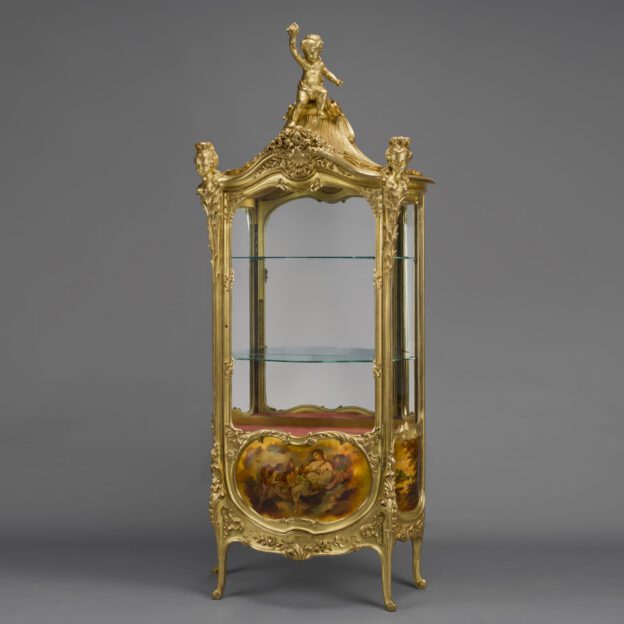
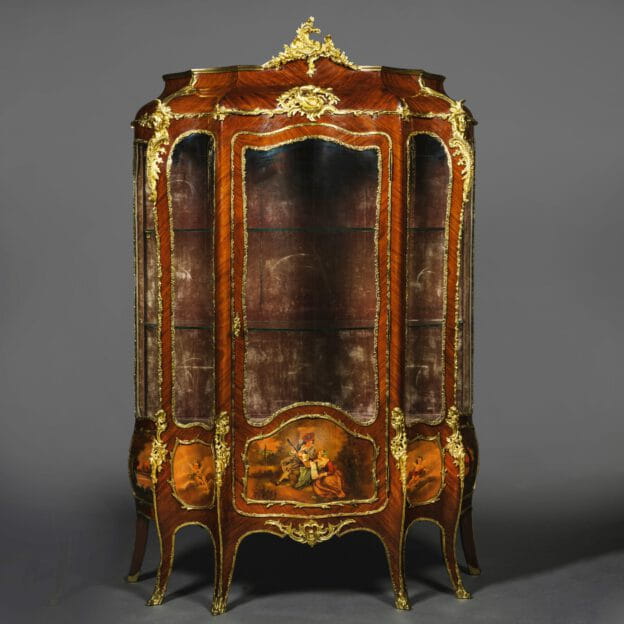
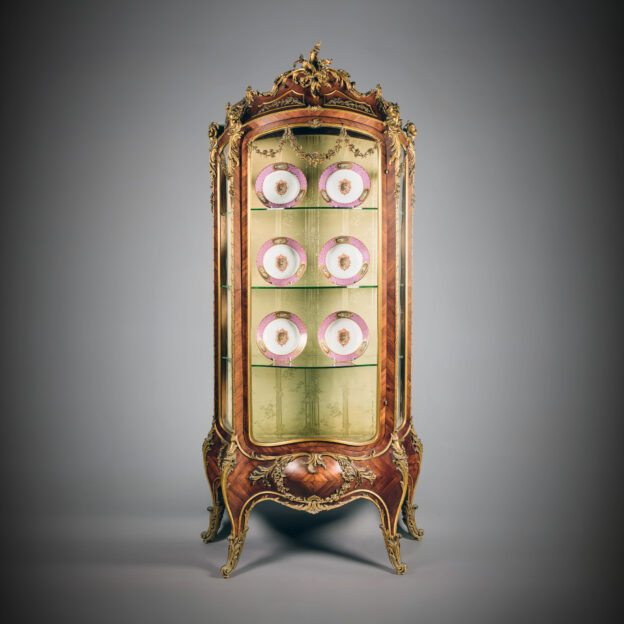
The Louis XV period had established a fluid language of curving outlines, bombé fronts, serpentine profiles and richly modelled gilt-bronze ornament. Kingwood, tulipwood and amaranth were employed in contrasting veneers and elaborate parquetry, creating surfaces of considerable richness and complexity.
Louis XV Style Vitrines
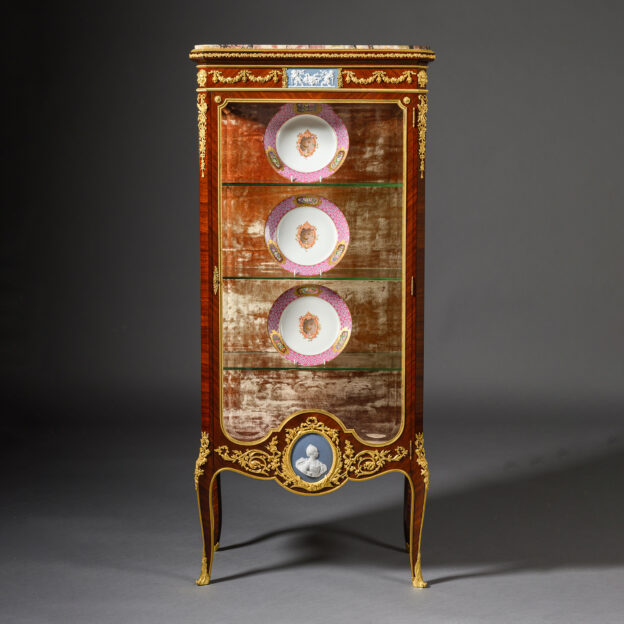
Under Louis XVI, furniture adopted a more architectural character. Straight lines, fluted uprights, tapered legs and classical ornament provided a more ordered framework, while mahogany, satinwood, tulipwood and other finely figured timbers offered cabinetmakers a varied palette of materials. Gilt-bronze mounts, porcelain plaques and intricate marquetry added further refinement.
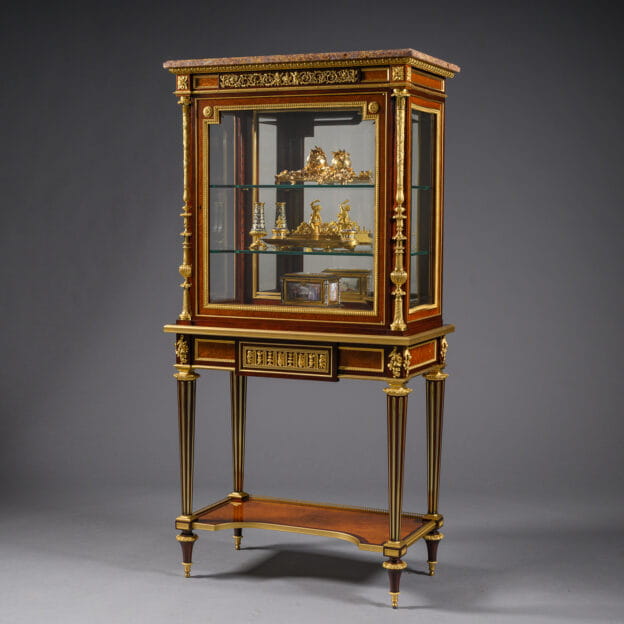
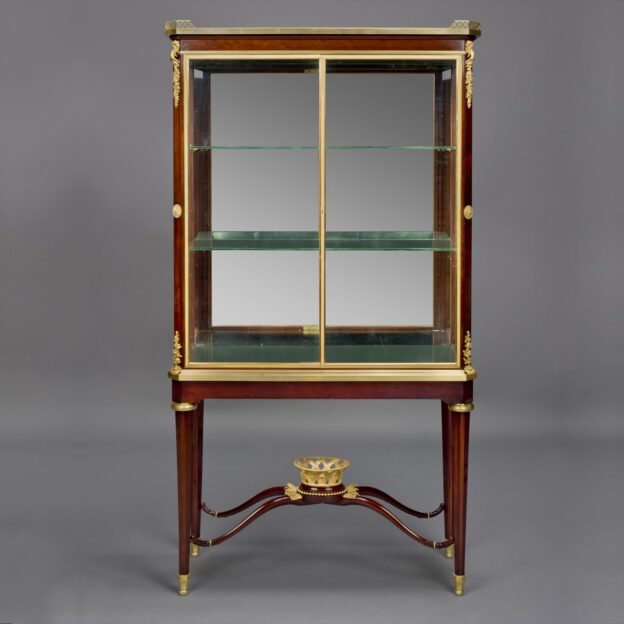
These eighteenth-century traditions provided an enduring source of inspiration for the French cabinetmakers of the following century. Rather than simply reproducing earlier designs, they adapted their proportions, ornament and craftsmanship to the possibilities of the vitrine, creating furniture that combined historical reference with contemporary innovation.
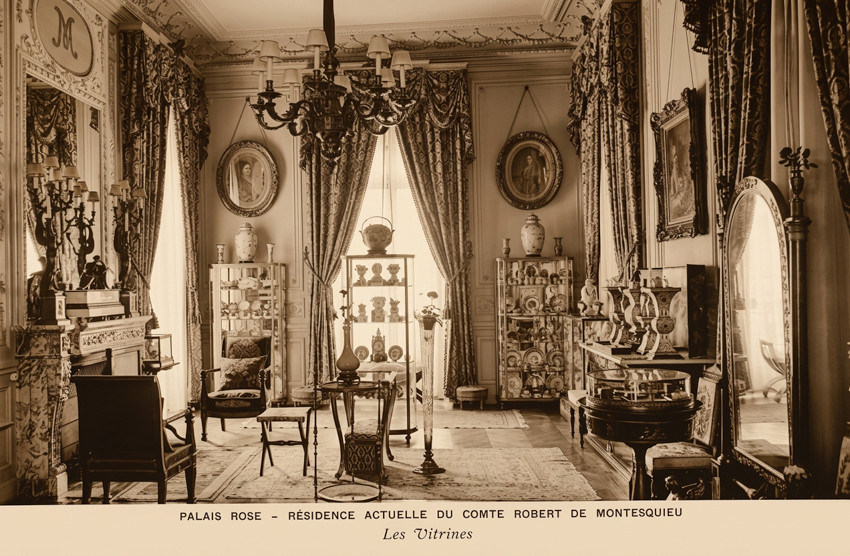
Le palais Rose, résidence du comte Robert de Montesquiou au Vésinet entre 1908 et 1921 : les vitrines du salon entre 1910 et 1913. © Musée d’Orsay, Dist. RMN-Grand Palais / Alexis Brandt
The Nineteenth Century: The Vitrine as a Work of Art
The nineteenth century witnessed the development of the vitrine into one of the most accomplished forms of French luxury furniture. The growing popularity of private collecting, together with improvements in glass manufacture and the expansion of specialist workshops, encouraged cabinetmakers to explore new forms of display furniture and increasingly sophisticated decorative treatments.
During the Second Empire, the revival of earlier French styles reached a new level of ambition. Makers drew upon the vocabularies of Louis XIV, Louis XV and Louis XVI, combining historical references with contemporary technical ingenuity. Vitrines might incorporate elaborate gilt-bronze mounts, exotic veneers, marble tops, porcelain plaques and painted panels, with the glazing itself carefully shaped to follow the contours of the cabinet.
By the final decades of the century, the Parisian luxury furniture trade had reached extraordinary levels of technical and artistic accomplishment. Leading makers supplied an international clientele of collectors, aristocratic families and industrialists, for whom furniture represented both personal taste and an appreciation of fine craftsmanship. The vitrine was particularly well suited to this market: it provided an elegant setting for collections of porcelain, glass and sculpture, while allowing the cabinetmaker to demonstrate the full range of his abilities.
The work of François Linke, Emmanuel Zwiener, Henry Dasson, Paul Sormani, Maison Beurdeley and Maison Krieger illustrates the range and ambition of this production. Each developed an individual approach, yet their work shares an interest in the reinterpretation of eighteenth-century French design through the artistic and technical possibilities of their own period. In their hands, the vitrine became far more than a receptacle for collections: it was conceived as an important work of furniture, in which cabinetmaking, sculpture, metalwork and glass were brought together in a carefully considered design.

The Language of the Vitrine
The term vitrine encompasses a considerable variety of furniture, from monumental architectural cabinets to smaller table vitrines intended for particularly precious objects. Their differing proportions and arrangements reflect the intended setting as much as the nature of the collection they were designed to accommodate.
A vitrine de milieu was conceived as a free-standing piece, intended to be appreciated from several sides rather than simply positioned against a wall. Its placement within a room allowed the cabinetmaker to give particular attention to the relationship between the glazed panels, supporting structure and decorative treatment of the exterior.
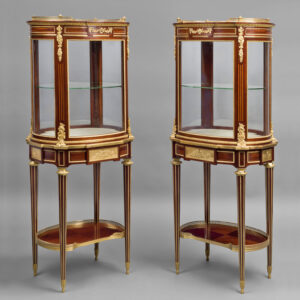
Pair of Louis XVI Style Gilt-Bronze Mounted Vitrines de Milieu, by Paul Sormani – Adrian Alan
Wall vitrines, or vitrines murales, were designed principally to be viewed from the front. Their more compact proportions made them suitable for incorporation into a larger interior scheme, providing an elegant setting for porcelain, small bronzes and other works of art.
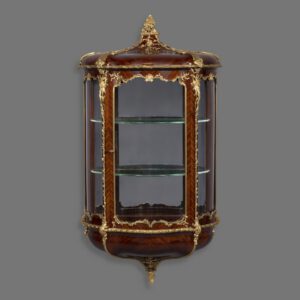
An Unusual Louis XVI Style Gilt-Bronze Mounted Wall Vitrine by Emmanuel Zwiener – Adrian Alan
Table vitrines offered a more intimate form of display. Often raised on elegant supports, they were particularly suited to miniatures, jewellery and smaller objects, allowing their contents to be appreciated from above and through the glazed sides.
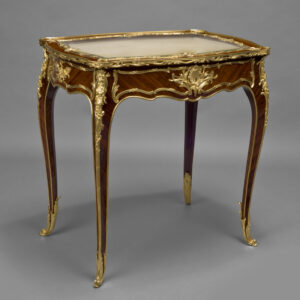
A Fine Louis XV Style Gilt-Bronze Mounted Table Vitrine by François Linke – Adrian Alan
Cabinets-on-stands represent another particularly attractive form. The elevated cabinet and its supporting structure create a more architectural composition, while the stand provides an opportunity for additional carving, marquetry and gilt-bronze ornament.
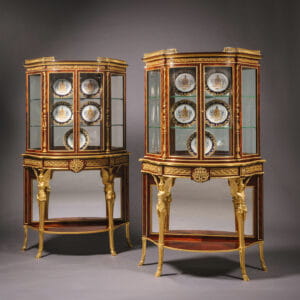
A Pair Of Louis XVI Style Gilt-Bronze Mounted Mahogany Vitrine Cabinets-On-Stands, Attributed to Henry Dasson – Adrian Alan
The diversity of these forms is particularly evident in the Adrian Alan collection, which includes examples by some of the leading makers of nineteenth-century French furniture, from refined wall cabinets and table vitrines to ambitious free-standing compositions.
The Belle Époque: The Art of Display
The Belle Époque marked a particularly distinguished chapter in the history of the French vitrine. By the turn of the twentieth century, the leading Parisian workshops had developed an extraordinary command of cabinetmaking, sculpture and the decorative arts. Historical styles remained an important point of departure, but the most ambitious makers were increasingly concerned with creating furniture that was original to their own period.
Among the foremost figures was François Linke (1855–1946), whose collaboration with the sculptor Léon Messagé (1842–1901) helped establish a new vocabulary for French luxury furniture. Their designs combined the movement and ornament of the Rococo with a more fluid, sculptural approach, bringing together the traditions of eighteenth-century furniture and the developing language of Art Nouveau.
Their achievement was particularly evident at the Paris Exposition Universelle of 1900, where Linke presented an ambitious stand that attracted international attention. Its centrepiece was La Grande Bibliothèque, a monumental vitrine cabinet designed and made by Linke and Messagé.
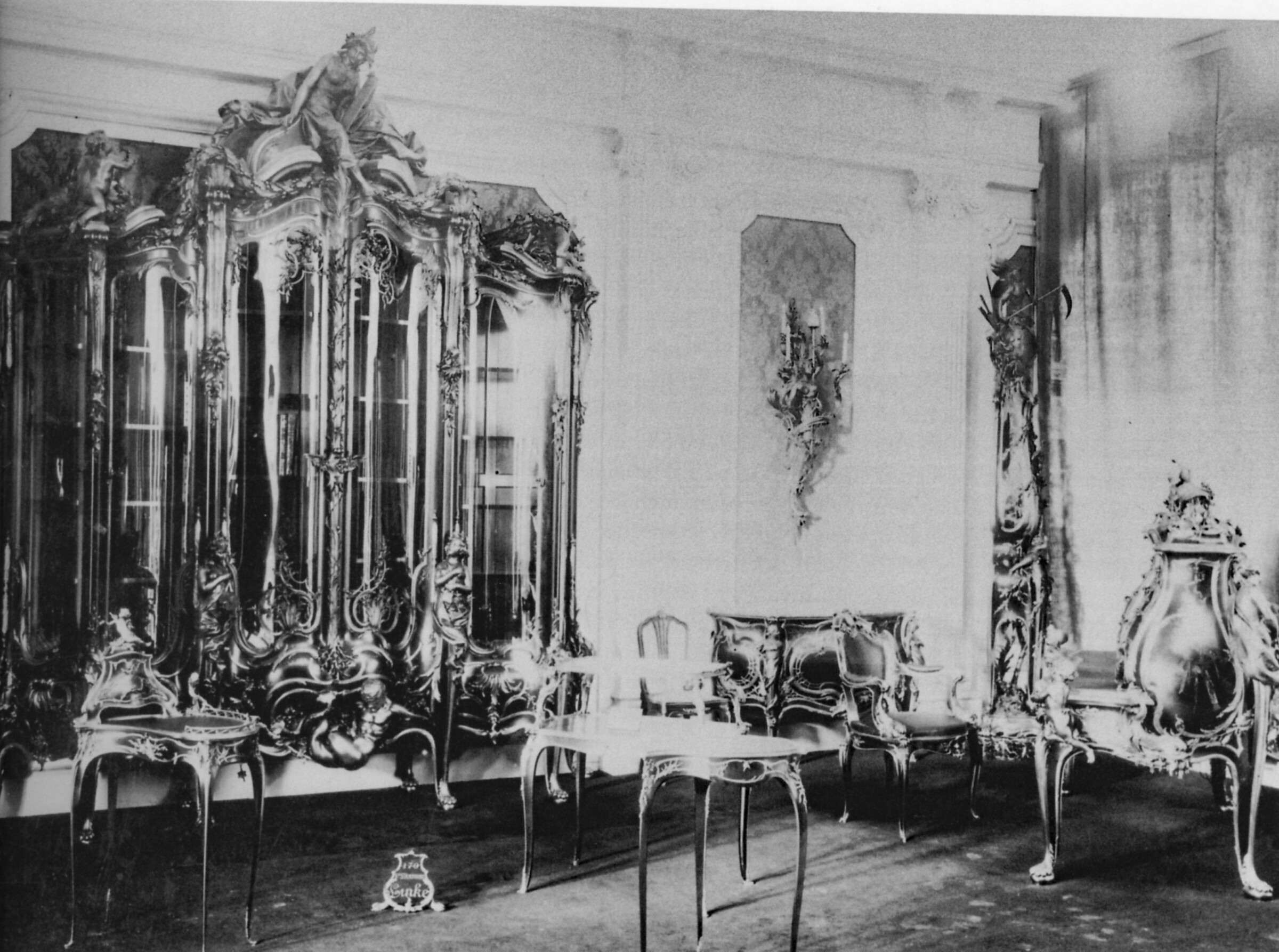
‘La Grande Bibliothèque’ was the centrepiece of François Linke’s gold medal winning stand at the 1900 Paris Exhibition (courtesy Christopher Payne / Linke Archive)
Standing approximately 3.77 metres high and extending over three metres in width, the cabinet is an extraordinary exercise in both cabinetmaking and sculpture. Its oak carcass is veneered with precious timbers and enriched with an elaborate programme of gilt-bronze mounts. The sculptural composition includes Minerva at the crest, accompanied by allegorical figures representing Geography and Architecture, while the central doors are framed by figures symbolising Art and Literature. At the base, a powerful representation of Triton, described in Linke’s own terminology as the monster of ignorance, reinforces the cabinet’s intellectual theme.
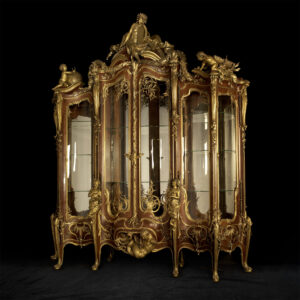
Created as the centrepiece of François Linke’s award-winning stand at the Paris Exposition Universelle of 1900, La Grande Bibliothèque became the defining work of his career and one of the great artistic triumphs of the Belle Époque – Adrian Alan
The significance of La Grande Bibliothèque lies in more than its imposing dimensions. It represents a decisive departure from straightforward historical reproduction. The familiar vocabulary of Louis XV furniture is reinterpreted through expressive figural sculpture, flowing ornament and an ambitious combination of materials. Cabinetmaking and sculpture are inseparable, each contributing to a unified architectural composition.
The surviving workshop records and designs provide an unusually detailed insight into the creative process. Messagé developed the sculptural elements through drawings and models, which were subsequently translated into full-scale patterns and bronze mounts by Linke’s workshops. The surviving records document 558 hours of work by Messagé on the bronzes, in addition to thousands of hours devoted to modelling by his team. Such figures offer a remarkable indication of the specialist skill and labour involved in producing furniture of this ambition.
Linke’s smaller vitrines reveal a different but equally accomplished aspect of his work. A fine Louis XV-style gilt-bronze-mounted Vernis Martin vitrine, dating from around 1900, demonstrates his ability to reinterpret the decorative language of the Rococo on a more intimate scale.
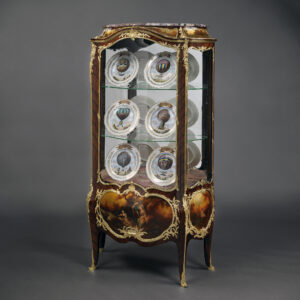
A Fine Louis XV Style gilt-bronze mounted bombé vitrine with Vernis Martin panels, by François Linke, Paris, circa 1900 – Adrian Alan
Its bombé outline, shaped brèche violette marble top and painted panels depicting fêtes galantes recall the interiors of eighteenth-century France. The mirrored interior and curved glazed sides provide an elegant setting for display, while finely modelled gilt-bronze mounts articulate the cabinet’s contours. Of particular interest is the unusual shell and acanthus mount at the base of the central panel, a design associated with Messagé and characteristic of the imaginative collaboration between the two men.
A different sensibility is evident in Linke’s Louis XVI-style vitrines. Their more restrained architectural proportions are often enriched with flower-filled gilt-bronze ornament, delicate mounts applied directly to the glass and carefully shaped glazed sides. Mirrored backs and glass shelves provide a light and adaptable interior, demonstrating how historical design could be reinterpreted with considerable technical assurance.
The Influence of Wedgwood and the Decorative Arts
Another defining characteristic of Belle Époque furniture was the imaginative combination of materials. French makers looked not only to their own eighteenth-century traditions, but also to the decorative arts of Britain and the wider European world.
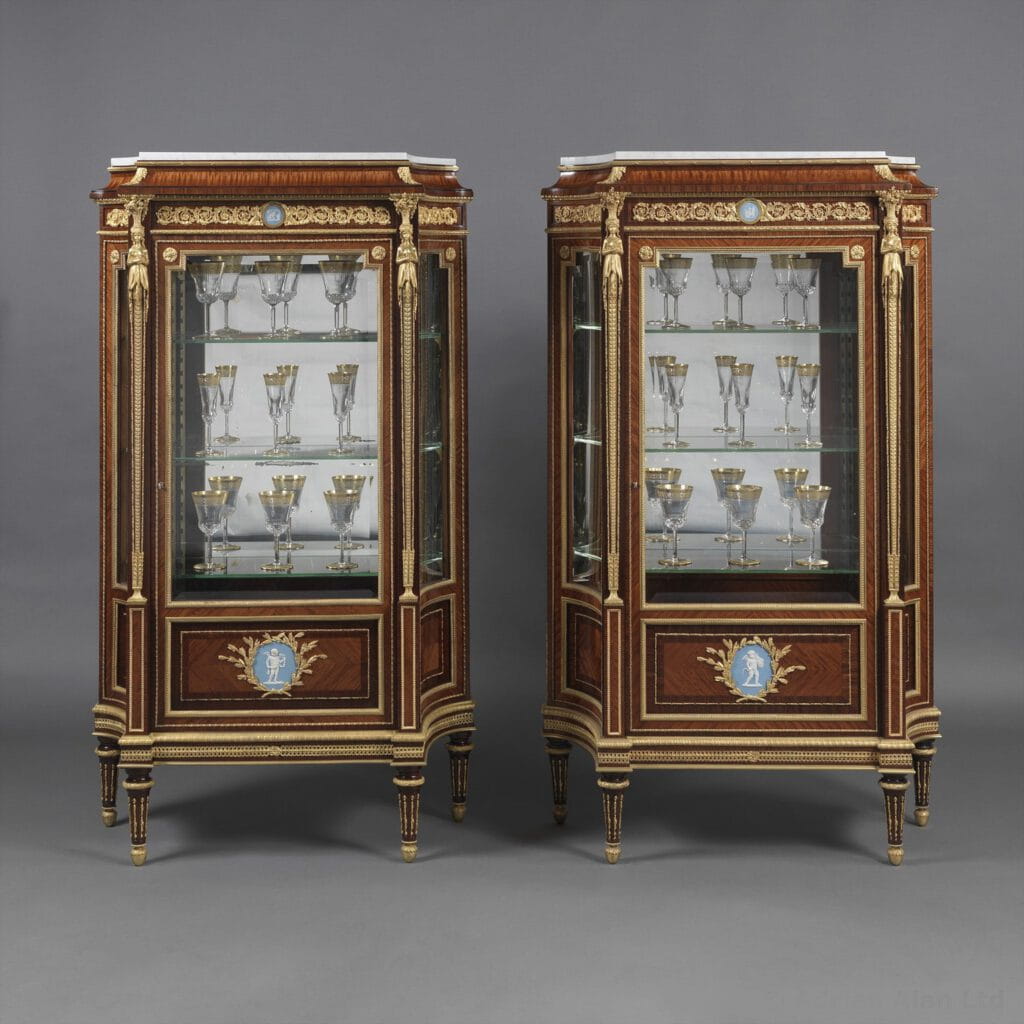
An important pair of Louis XVI-style vitrines by Emmanuel Zwiener, dating from around 1880, offers a particularly engaging example. Their gilt-bronze mounts and shaped Carrara marble tops are complemented by Wedgwood Jasperware plaques in the characteristic pale blue and white.
The classical figures and putti provide a delicate contrast to the richness of the bronze and the warmth of the cabinet structure. The plaques are integral to the composition, bringing together the English ceramic tradition, with its origins in the eighteenth century, and the French art of furniture making. Their inclusion illustrates the international character of the luxury decorative arts trade and the willingness of leading ébénistes to draw upon a wide range of artistic influences.
When Furniture Becomes Sculpture
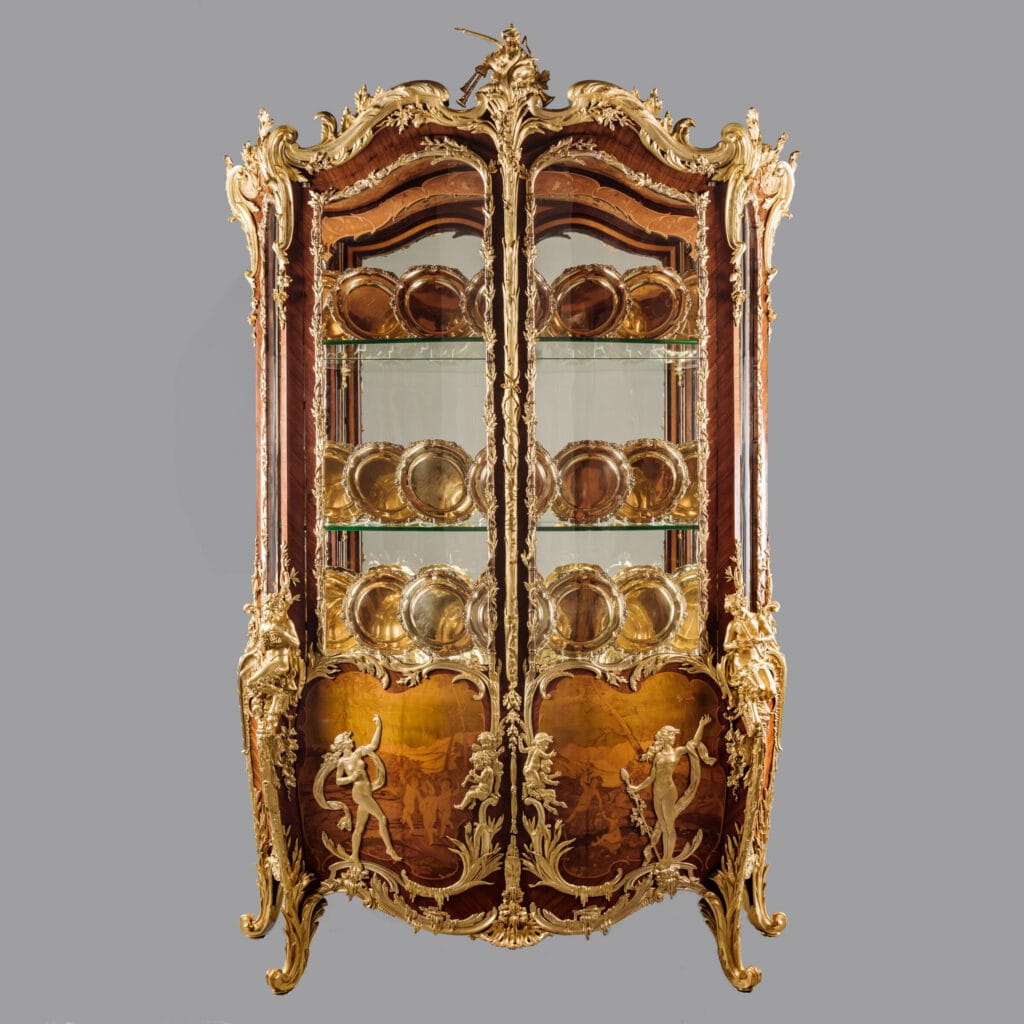
At the more exuberant end of Belle Époque furniture is La Danse des Bacchantes, a monumental vitrine attributed to Maison Roux et Brunet and dating from circa 1890. Standing 246 centimetres high, it is a particularly accomplished example of the cabinet conceived as a sculptural work of art.
Its Louis XV-style outline provides the framework for an elaborate composition of marquetry and gilt bronze. Dancing figures and putti animate the lower panels, while the sculptural figures of a faun and faunesse form striking vertical accents to the composition. The gilt-bronze mounts are attributed to Léon Messagé, whose inventive approach to figural ornament is also evident in his celebrated collaboration with Linke.
The individual bronze elements are remarkable for their modelling and variety. Bacchantes, putti and mythical figures are integrated with scrolling foliage and rocaille ornament, while the marquetry panels introduce further scenes of movement and revelry. Even the interior is carefully considered, with floral marquetry extending to the upper surfaces of the cabinet.
The vitrine demonstrates how the traditional function of display furniture could be developed into something considerably more ambitious. Its glazed doors and mirrored interior remain essential to its purpose, but the cabinet’s sculptural and decorative programme is equally central to its identity. It is a composition in which marquetry, bronze and cabinetmaking have been brought together with considerable imagination.
The art of living with a vitrine
For all their historical associations, antique vitrines remain remarkably adaptable. In a contemporary interior, the intricacy of a nineteenth-century cabinet can provide a welcome counterpoint to restrained architecture and modern furnishings. Against plain walls, polished stone or clean architectural lines, the richness of the timber and the delicacy of the gilt bronze become particularly apparent. In a more traditional setting, a vitrine can sit comfortably among paintings, mirrors and other works of art, adding another layer to the character of the room.
Their versatility is part of their appeal. A tall, architectural cabinet can lend structure and height to an interior, while a smaller vitrine or corner cabinet can bring interest to a more intimate space. A pair can create symmetry in a formal room; a single sculptural example can become a focal point in its own right.
Ultimately, the antique vitrine speaks to something enduring in the collector’s instinct: the desire not only to acquire beautiful things, but to live with them, arrange them and enjoy them. Its history encompasses the curiosity cabinets of early collectors, the refined interiors of eighteenth-century France and the extraordinary craftsmanship of the Belle Époque. Yet its appeal remains remarkably constant. It brings objects together, gives them distinction and turns the simple act of display into an art.
For the collector, an important antique vitrine offers two distinct pleasures: the opportunity to display a collection to fine effect, and the appreciation of a distinguished piece of furniture in its own right. In the hands of makers such as François Linke, Emmanuel Zwiener and their contemporaries, this familiar form was transformed into one of the most accomplished expressions of nineteenth-century French furniture design, combining technical virtuosity with an exceptional understanding of proportion, material and ornament.
Adrian Alan’s collection includes a selection of important French and European vitrines, ranging from refined Louis XVI-style cabinets to ambitious sculptural creations of the Belle Époque. Each reflects a different interpretation of the art of display, and the remarkable skill of the cabinetmakers and specialist craftsmen who produced them.
Discover our collection of antique vitrines