About Jean-Baptiste Carpeaux

Portrait of Jean Baptiste Carpeaux in his studio in Boulevard St.Jacques in Paris”.-Painting, 1875(?), by Bruno Cherier (1819-1880)
Jean-Baptiste Carpeaux (1827-1875) was born in Valenciennes on May 11, 1827, the son of a stonemason.
In 1842, Jean-Baptiste went to Paris and spent two years working in a drawing school before being admitted to the Ecole des Beaux Arts, studying under François Rude from 1844 to 1850. Though greatly influenced by Rude’s approach to naturalism in sculpture he deliberately cut adrift from his master and cynically pursued the strictly classical course which would enable him to win the Prix de Rome (1856) with his statue of Hector bearing in his arms his son Astyanax.
In Rome, however, he soon realised the sterility of the classical teaching and cut the formal classes to study the works of Donatello and Michelangelo, the latter in particular having a strong influence on his subsequent career. Something of Michelangelo’s vehement and passionate action is conveyed in Carpeaux’s group of Ugolino and his Sons which he sent to the Salon of 1863 and which immediately established his reputation as the leading Romantic sculptor in France. Thereafter, he secured many important State commissions for public statuary, and also had a prolific private practice as a portrait sculptor.
He also exhibited Pêcheur napolitain à la coquille, the Neapolitan Fisherboy, at the Salon of 1863. It was purchased for Napoléon III’s empress, Eugènie. The statue of the young smiling boy was very popular, and Carpeaux created a number of reproductions and variations in marble and bronze. There is a marble example, for instance, in the Samuel H. Kress Collection in the National Gallery of Art in Washington, D.C.
Carpeaux became the favoured portrait sculptor of Napoléon III and his court. His sensitive portraits combined anatomical and psychological realism with a lyricism reflecting the Rococo revival that permeated much of the period’s sculpture. His use of deep shadow and emphasis on chiaroscuro influenced later sculptors, including Auguste Rodin. Carpeaux also worked as a painter.
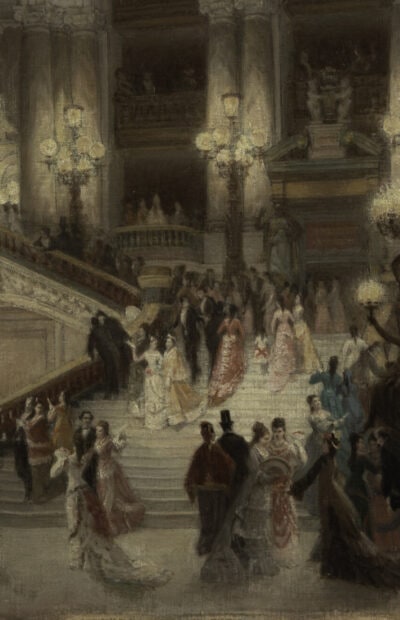
Jean-Baptiste Carpeaux’s most controversial work was The Dance (1869), one of four groups for the facade of Charles Garnier’s new Opera House, which was deemed too suggestive for a public monument but was recognised after his death as a masterpiece. Realism dominated his work, in attention to anatomical detail in his genre figures, and in the photographic likenesses of his busts of the aristocracy and celebrities in the dying years of the Second Empire. Apart from his numerous figurines and busts, many of his larger statues and groups were also cast as bronze reductions.
Makers Bibliography:
E. Chesneau, Le statuaire J.-B. Carpeaux : sa vie et son oeuvre, Paris, 1880
A. Middleton Wagner, Jean-Baptiste Carpeaux. Sculptor of the Second Empire, New Haven, 1986.
M. Poletti and A. Richarme, Jean-Baptiste Carpeaux sculpteur: Catalogue raisonné de l’oeuvre édité, Paris, 2003.
E. Papet and J.-D. Draper, The Passions of Jean-Baptiste Carpeaux, The Metropolitan Museum of Art, 2014.
E. Papet and J.-D. Draper, Carpeaux 1827-1875, un sculpteur pour l’Empire, Paris, Musée d’Orsay ; Gallimard, 2014.