About Elkington & Co.
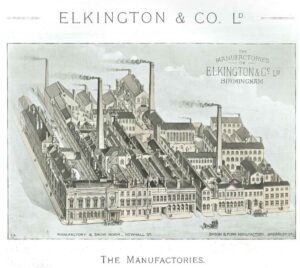
Founded in Birmingham in the 1830s by George Richard Elkington (1801-65) and his cousin Henry Elkington (1810-52), Elkington & Co became the largest and most successful silversmithing business in England in the 19th century, supplying the top end of the domestic market as well as the emerging hotel and travel trade. With the capital from other business partners, George and Henry Elkington exploited the development of the new manufacturing processes of electroplating (silver deposited on a base metal by the action of an electric current), electrogilding (gilding by use of electricity) and electrotyping (a form of electronic casting to form the whole object). By marketing electroplate as a cheaper substitute for silver and by selling the patents for all the new techniques, the Elkingtons revolutionised the silver and plating trades all over the world.
As a result of its excellence in artistic quality and fine design Elkington & Co. received the highest possible awards at all the Great International Exhibitions. Their stand at the 1851 Great Exhibition was highlighted for particular mention in the catalogue of the Exhibition, in which it is stated that,
“‘The Stall of Messrs. Elkington is another justification of our adhering to what is beautiful for its own sake, independent of all other considerations; the reproduction of Pompeian and other ancient forms in this stall, … old as they are, strike the eye with an extraordinary degree of freshness..”
The company was also awarded the Legion d’Honneur of the French Republic and the distinction and honour of holding Royal Warrants to Queen Victoria, King Edward VII, Queen Alexandra, King George V, Queen Mary and King George VI, as well as the Duke of Windsor (formerly King Edward VIII) and H.R.H. the late Princess Christian and their late majesties the King of Spain and King of Italy.
By the 1860s, Elkington & Co employed about one thousand workers at their factory in Birmingham. It was directed after 1865 by Frederick Elkington, one of George’s two sons who had entered the family business in the 1850s. The company prospered from the sale of plated goods while continuing to produce the sterling silver and objects of cloisonné and champlevé enamel work for which it was always highly respected.
Because other British firms had ceased to make silver presentation pieces to exhibit at international exhibitions, only the Elkington firm represented the art of British silversmithing in Philadelphia at the 1876 Centennial Exhibition or in Paris at the 1878 Exposition Universelle.
The company sought out distinguished artists from abroad to create exhibition masterpieces for them to enhance their prestige in the commercial sector. The choice of Renaissance and classical forms, often with repoussé embellishment, that dominated Elkington’s silver production was to some extent dictated by the firm’s French designers, including Pierre-Emile Jeannest (1813-57), who joined Elkington about 1849, Léonard Morel-Ladeuil (1820-88), hired in 1859, and Albert Willms (active before 1848-about 1900), head of the design department from the 1860s until the end of the century.
Works by Elkington & Co can be found in the Royal Collection, London, Victoria and Albert Museum, London, and the Metropolitan Museum of Art, New York.