About Édouard Lièvre
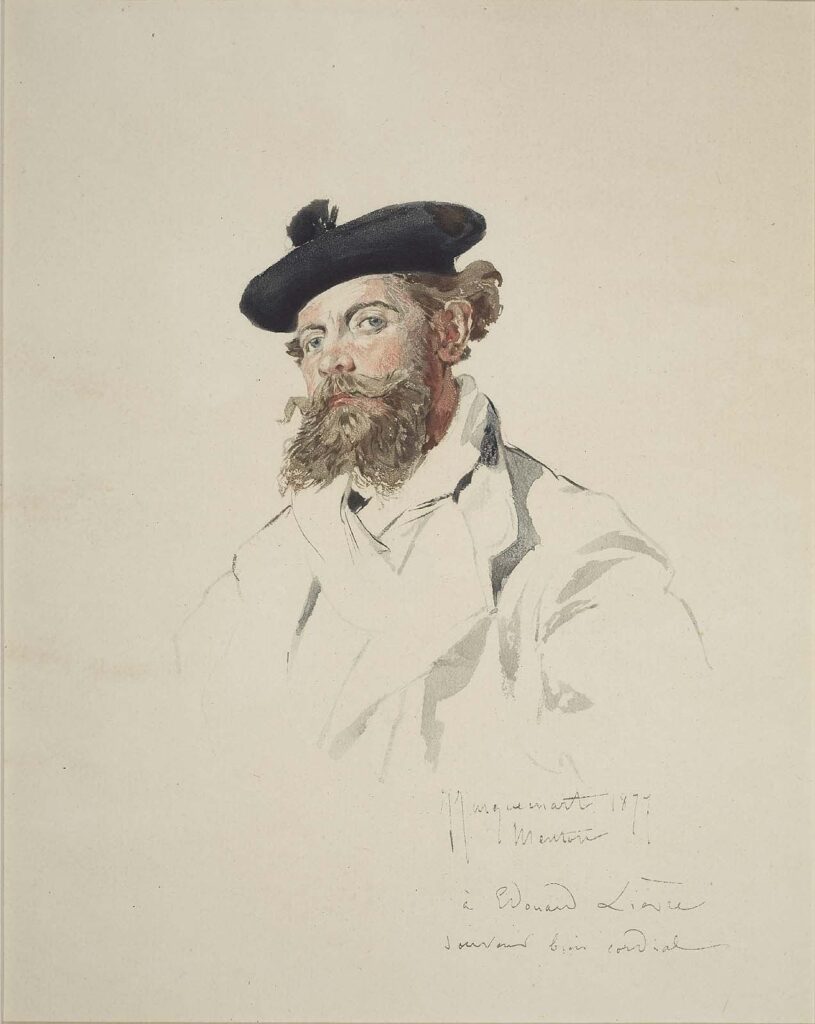
Portrait of Édouard Lièvre, Jules Ferdinand Jacquemart 1879. Watercolour on Paper, Boston Museum of Fine Arts.
Édouard Lièvre (1828-1886) was one of the most talented draughtsmen and prolific industrial designers of the second half of the 19th century. He was archetypal of a new class of artists in the 19th century who rose above the craftsmen guild system to become industrial designers, free to fully express their genius across the arts. Like his illustrious contemporaries, such as Carrier-Belleuse, Constant Sévin, Froment-Meurice and Emile Reiber, Lièvre sought to express his art through multiple mediums – he learnt printing, drawing, gouache, metalwork, sculpture and ébénisterie. Embodying the industrial aspirations of his day, he utilised the most advanced technology to realise his designs, of which his ‘sino-japonais’ and neo renaissance creations, are époque defining.
A polymath, as a child Lièvre was taught lithographic printing in Nancy before being apprenticed to a foundry where he learnt bronze casting and draughtsmanship. Arriving in Paris penniless, to earn a living he painted portraits and made models for manufacturer’s bronzes, and studied watercolour painting under Théodore Valerio (d. 1879). Trips to Belgium inspired a fascination for the Flemish baroque painter Jacob Jordaens, and further training followed in Thomas Couture’s atelier. Although Lièvre exhibited at the Salon in the 1860s, painting was not his preferred métier.
Lièvre found his vocation in producing two important publications which contributed to a reawakening of antiquarian interest in Second Empire France. The first being a catalogue for the Collection Sauvageot, with text by Alexandre Sauzay and illustrations by Édouard Lièvre, published in 1863. The Charles Sauvageot Collection of objets d’art was donated to the Musée du Louvre in 1856. The second title, ‘Les Collections célèbres d’oeuvres d’art dessinées et gravées d’apres les originaux par Edouard Lièvre’, published in 1866, was a catalogue of celebrated works of art from the Gothic to Louis XVI periods including pieces again from the Sauvageot bequest, bust also works belonging to Baron James de Rothschild, the Comte de Nieuwerkerke and the Marquess of Hertford, with ‘texts historiques’ by leading academicians including Henry Cole, Albert Jacquemart and Paul Manz. These publications show the historical breadth of Lièvre’s appreciation of ornament and the high regard in which he was held by the art elite of the day. Illustrating these publications allowed Lièvre to travel to French museums and to visit collections in England, and the experience honed his eye and furthered his learned appreciation of ornament. Such an assiduous contemplation of beautiful things inspired Lièvre to make his own designs and produce his own works of art. He saw furniture in particular as the more glorious art and of central importance to the home. Often assisted by his brother Justin, he firstly produced works of art for his own apartment, seeking out the best craftsmen to execute his designs for bronzes, ceramics, fabrics and luxury furniture of great ingenuity and taste. Lièvre was then engaged by these craftsmen to design works for their firms, including the ébéniste Paul Sormani, the silversmith Christofle, as well as marchands merciers such as Escalier de Cristal, and bronziers such as Maison Marnyhac, and France’s leading bronze fondeur, Ferdinand Barbedienne. Additionally, following in the tradition of marchands-merciers, Lièvre also began to extend his practice by designing furniture and objects for important private clients, which were then executed by these prestigious firms. These clients included Sarah Bernhardt (for whom he designed a monumental cheval mirror), the courtesan Louise-Emilie Valtesse de la Bigne (for whom he designed an impressive bed, now in the Musée des Arts Décoratifs, inv. DO 1981-19), and Édouard Detaille, the famous military artist (for whom Lièvre supplied a console d’apparat).
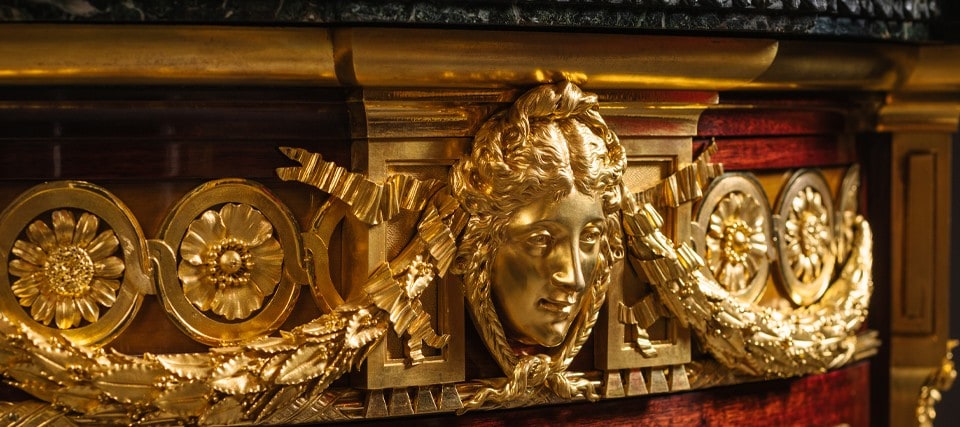
‘Dans la composition du meuble, il emprunte le point de départ aux modèles consacrés. Il songe à l’art oriental Renaissance, au style Louis XVI; mais il ne les répète point. […] il ajoute sa pensée à celle des créateurs prim pins en plus soucieux de la grâce sévère ou souriante, il parvient à exécuter des œuvres d’art qui ont un cachet meuble d’Édouard Lièvre est toujours conçu en raison de l’usage auquel il est destiné et du rôle qu’il doit jouer environnant. Bien qu’il soit d’un très riche travail, il ne reçoit que l’ornement qu’il comporte, […] Le bois y e des mains savantes, le bronze s’embellit de ciselures délicates ou fières et, si soigné qu’il soit, le détail ne parle haut dans l’ensemble. Enfin, l’exécution toujours surveillée avec un soin jaloux, a cette loyauté qu’on réclamat chef-d’œuvre que devait accomplir le compagnon ambitieux d’obtenir son brevet de maîtrise.’
P. Eudel, L’Hôtel Drouot et la Curiosité en 1886-1887, Paris, 1888, p. 118
Bibliography:
Catalogue des Meubles d’Art de la Succession de feu de M. Edouard Lièvre, 21-24 March 1887, no. 16.
P. Eudel, L’Hôtel Drouot et la Curiosité en 1886-1887, Paris, 1888.
‘Édouard Lièvre’, Connaissance des Arts, N° 228, Paris 2004.
Optima propagare Edouard Lièvre: Créateur de meuble & objets d’art, Galerie Roxane Rodriguez, Paris, 2004.
Annick et Didier Masseau, L’Escalier de Cristal Le luxe à Paris 1809-1923, Paris, 2021, p. 110-117.