The Sculpture Gallery, Chatsworth House, Derbyshire. Perhaps the definitive Sculpture Gallery, created by the 6th Duke of Devonshire (1790-1858) between 1818 and 1834 to house his extensive collection of sculptures. (© 2026 Chatsworth House Trust – Public Domain)
A Sacred Encounter with the Past
The analogy between sculpture galleries and sacred architecture is not accidental. These rooms often evoke something temple-like in their silence and scale. Looking at the faces of ancient figures, gods, rulers, and anonymous citizens, produces a sense of both proximity and distance. There is a humbling awareness of impermanence, and a fascination with the technical mastery required to render stone so lifelike, yet eternally still.
“A striking feeling for the technical brilliance of how a sculptor was able to carve something so animated, so lifelike, yet forever frozen.”

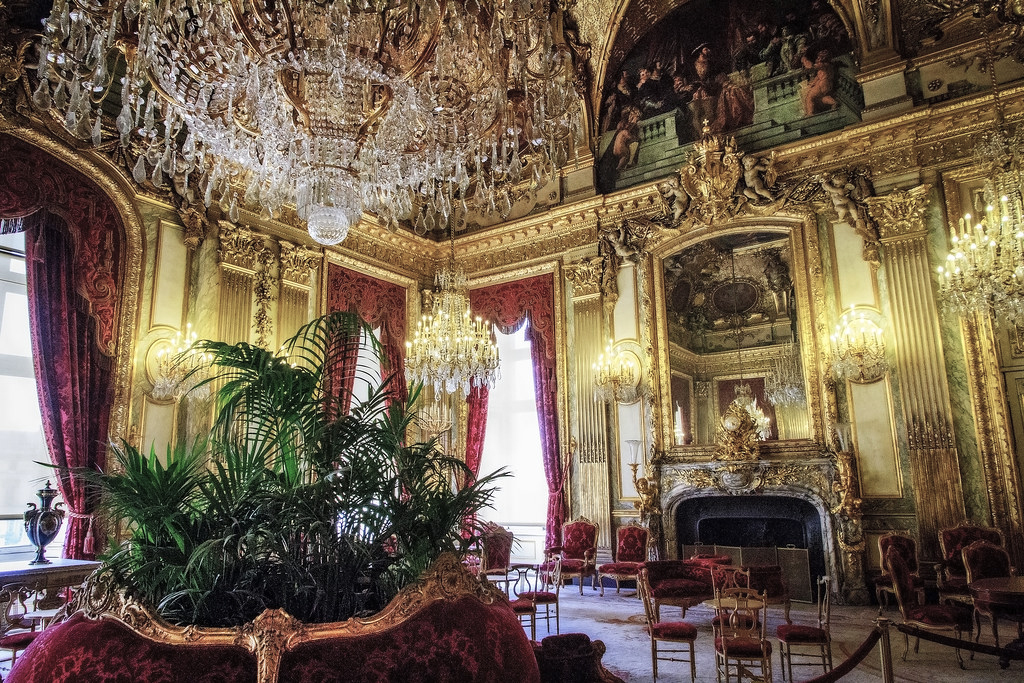
‘The Hall of Seasons at the Louvre’, 1802-1803, painted by Hubert Robert (1733 –1808) (musée du Louvre © 2025 )
The Collector and the Idea of Permanence
At the heart of the sculpture gallery lies a deeper ambition: permanence. Collectors who assembled antiquities were not only demonstrating taste, but constructing legacy.
By bringing fragments of ancient worlds into a single architectural space, the collector becomes part of the narrative of survival.
“I may not live forever, but my legacy will and I am worthy of a place amongst these hallowed effigies.”

The Gallery of Statues leading into the Hall of Busts, Museo Pio-Clementino, Vatican, Rome. The Gallery of Statues originally served as the open loggia of the Palazzetto of Innocent VIII, built between 1484 and 1492. In 1771–1772, Pope Clement XIV converted it into a museum gallery by enclosing it with walls and windows, and the Hall of Busts was later added.
From Antiquity to the Grand Tour
Collecting sculptural antiquity is not simply nostalgia, it is a form of intellectual inquiry. Ancient Egypt already practised Egyptology; Roman sculpture often replicated lost Greek originals; and Canova reimagined Napoleon as a Roman emperor.
The sculpture gallery, as a concept, was refined in Renaissance and Enlightenment Europe. François I introduced a sculptural display at Fontainebleau, while the Vatican’s Pio-Clementino Museum formalised the Gallery of Statues and the Hall of Busts.

The Tribuna of the Uffizi, Uffizi Gallery, Florence, Italy
The Tribuna was built between 1581 and 1583 by architect Bernardo Buontalenti to house the treasures of Grand Duke Francesco I de’ Medici. Designed as a showcase for the Medici family’s most prized artworks, sculptures, paintings, and precious objects, it stands as a magnificent condensate of Renaissance knowledge and beauty.
“The Uffizi is the prototype Sculpture Gallery”
The Birth of the Modern Museum Space
The eighteenth century saw sculpture collections become structured environments rather than assemblages. The Uffizi in Florence, transformed from administrative offices into gallery space, became an early model for the modern museum.
Nearby, the most admired works of antiquity, including the Medici Venus and Spinario, were placed in dialogue with Renaissance collecting culture.


Grand Tour Collecting and the English Country House
The Grand Tour transformed sculpture collecting into a cultural system. British travellers returned from Rome and Paris with antiquities or commissioned replicas in marble, plaster, and bronze.
Architects such as William Kent, Robert Adam, and James ‘Athenian’ Stuart were commissioned to create architectural settings worthy of these acquisitions.
“At the heart of these great houses was the sculpture gallery.”

The sculpture gallery at Ince Blundell Hall in Lancashire is a rotunda modelled on the pantheon in Rome.
Ince Blundell and the Classical Ideal
Henry Blundell’s collection at Ince Blundell Hall marked a defining moment in English collecting culture. After acquiring major works in Rome, he constructed a series of garden pavilions, including a rotunda inspired by the Pantheon.
The result was a private museum of antiquity, structured around light, symmetry, and classical order.
The interior of the Temple of the Three Graces at Woburn Abbey. Today Canova’s Three Graces are displayed at the Scottish National Gallery.
Woburn Abbey and the Rise of Neo-Classical Taste
At Woburn Abbey, the Dukes of Bedford assembled one of the most significant aristocratic sculpture collections in Britain. The 6th Duke’s acquisitions in Rome and Paris included both ancient marbles and contemporary works by Canova.
The inclusion of modern sculpture alongside antiquities marked a decisive shift in collecting philosophy.
“This mixing of contemporary sculpture with classical antiquities set a new pattern for the sculpture gallery.”


Perhaps the definitive Sculpture Gallery, created by the 6th Duke of Devonshire (1790-1858), at Chatworth House, Derbyshire.
Chatsworth and the Living Collection
Chatsworth House remains one of the most important surviving sculpture galleries in its original context. The 6th Duke of Devonshire assembled a major collection of nineteenth-century sculpture, including works by Canova, Gibson, Monti, Bartolini, and Thorvaldsen.
Unlike many collections dispersed in later centuries, Chatsworth preserves the original spatial logic of the sculpture gallery as an integrated architectural experience.
From Private Temple to Public Museum
By the nineteenth century, the sculpture gallery transitioned from aristocratic interior to public institution. The Hermitage Museum opened its sculpture galleries in 1852, while the Crystal Palace Exhibition of 1851 popularised monumental display on an unprecedented scale.

The Sculpture Gallery, State Hermitage Museum, St. Petersburg, Russia.
The Sculpture Gallery at the New Hermitage was officially opened in 1852 by Emperor Nicholas I to house the Romanov family’s vast collection of classical antiquities and European sculptures.
These developments directly informed institutions such as the Victoria and Albert Museum and its Cast Courts, which displayed plaster reproductions of canonical works.

The Cast Courts in the Victoria and Albert Museum. London, England, c.1899. © Victoria and Albert Museum, London
Dispersal and Legacy
In the twentieth century, many private sculpture collections were dispersed as country house fortunes declined. Works entered institutions such as the Getty Museum and the Ny Carlsberg Glyptotek, ensuring global accessibility.
Yet some original environments survive intact, continuing to shape how sculpture is experienced.

Roman Sculpture Gallery at the Getty Villa, Los Angeles, California
The Enduring Idea of the Sculpture Gallery
Despite changes in taste, ownership, and institutional structure, the sculpture gallery remains a defining museum typology. From the Louvre Abu Dhabi to the National Museum of China, it persists as a space of quiet authority and visual contemplation.
“The divinity we feel when contemplating sculpture is alive and as strong as ever.”

Creugas and Damoxenos by Antonio Canova (plaster), Louvre Abu Dhabi
Shop Our Sculpture Collection


Further Reading
https://www.metmuseum.org/departments/european-sculpture-and-decorative-arts
https://thefollyflaneuse.com/the-garden-temple-and-the-pantheon-ince-blundell-merseyside/
https://www.nationalgalleries.org/art-and-artists/38262
Bibliography:
F. Haskell, Taste and the Antique The lure of classical sculpture, 1500-1900, Yale, 1981.
E. Angelicoussis, The Woburn Abbey collection of classical antiquities, Mainz, 1992.
Duchess of Devonshire, Chatsworth : Home of the Duke and Duchess of Devonshire, Derby, 2002.
V. Coltman, Classical sculpture and the culture of collecting in Britain since 1760, Oxford, 2009.