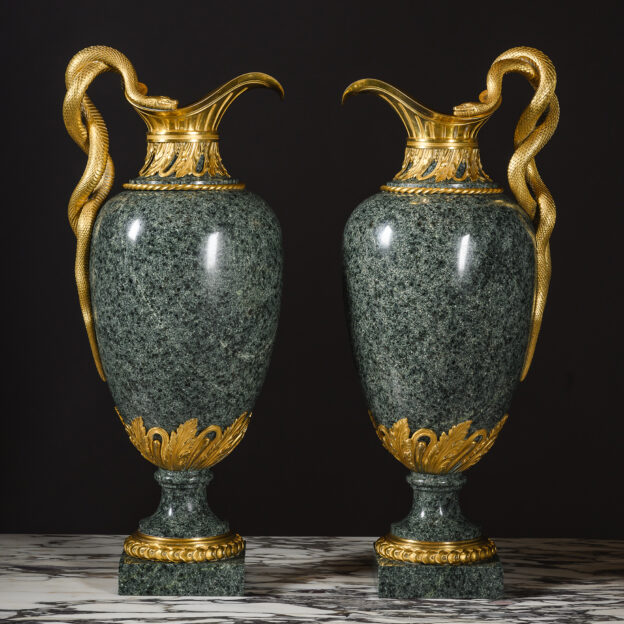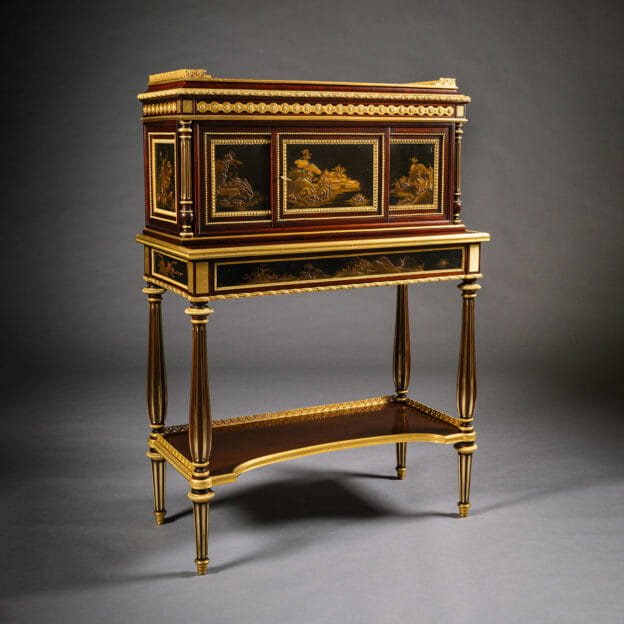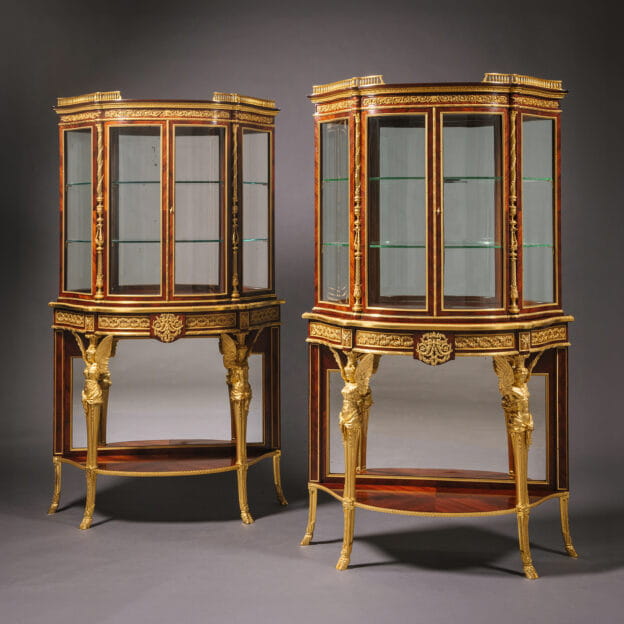
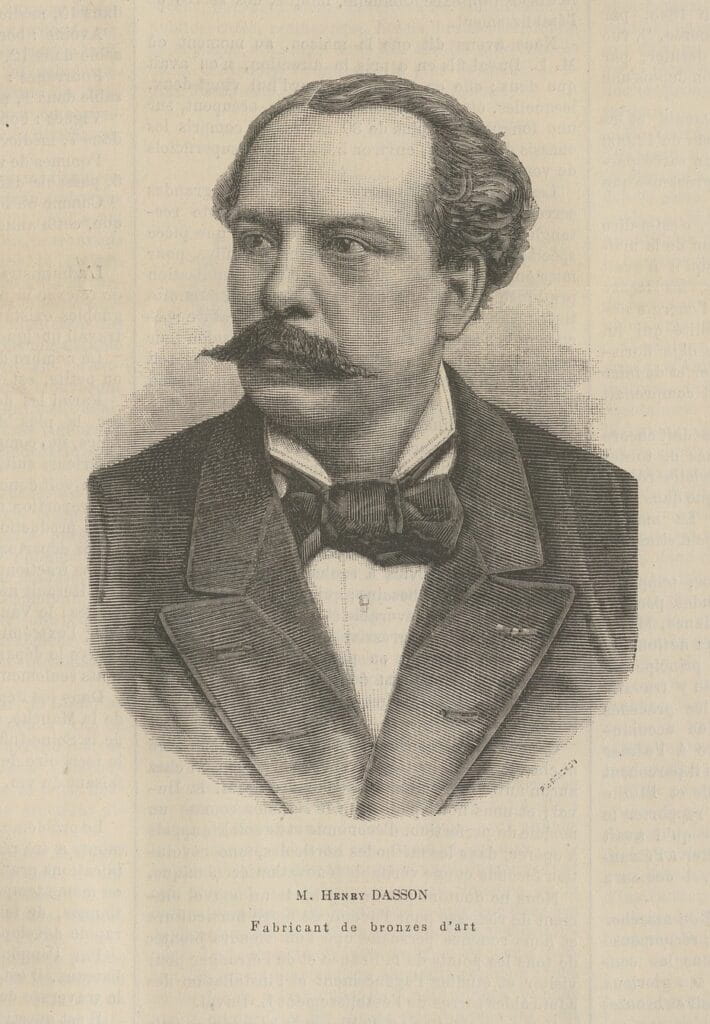
Who Was Henry Dasson?
Born the son of a shoemaker in Paris, Dasson, a gifted draftsman, studied under Justin Marie Lequien, professor at the École Superieur Turgot. Dasson began his career as an apprentice to the clockmaker Arnoux and by 1858 is listed as a clockmaker in his own right. Around 1860 Dasson partnered with Emile Godeau to manufacture clocks and bronze artifacts. He became a member of the Réunion des fabricants de bronzes in 1865. Dasson appears to be fully independent in 1867 when he purchased the workshops of the bronze maker Carl Drechsler, successor to Charles Crozatier—the founder responsible for casting the monumental figure of Napoleon atop the Vendôme Column. Dasson’s opportunity to begin making furniture began in 1871 when he purchased the business of Charles-Guillaume Winckelsen for 14,000 francs. In 1877 Dasson opened a workshop and stores in a private mansion at 106 rue Vieille-du-Temple.
The succession from Winckelsen to Dasson is direct in that some specific models of furniture are known to have been made first by Winckelsen and then by Dasson. Meaning that the models, drawings and designs, passed from Winckelsen to Dasson. As did the workshops with its specialists in the different skills involved in furniture making, such as cabinetmaking, marble-cutting and marquetry.
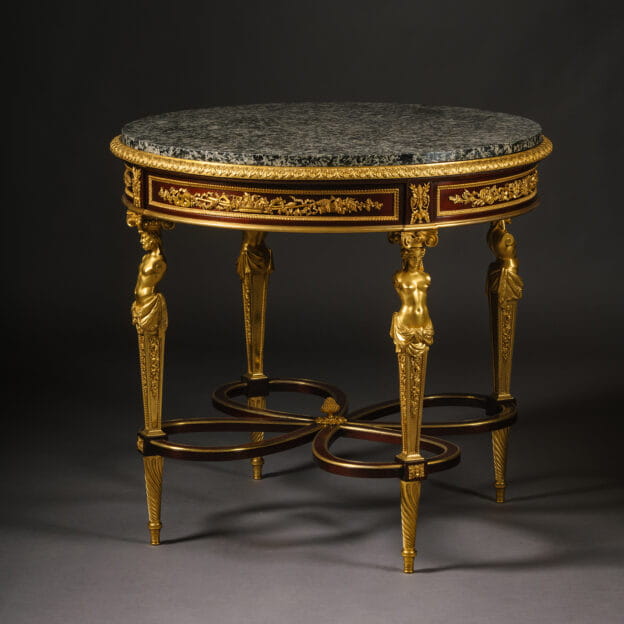
This gave Dasson complete mastery over every stage of production, from cabinetmaking and marquetry to bronze casting and clockmaking. Dasson’s background in bronze casting informed the development of Winckelsen’s furniture making business, enabling him to create his own furniture designs which were remarked upon for the sculptural finesse of their bronze work. This is evidenced by the ‘Table des Quatre Saisons’ unveiled at the 1878 Paris International Exhibition, which had four gilt-bronze legs each modelled with a female term representing a season, and its companion the ‘Tables des Arts’ with four gilt-bronze legs modelled as caryatid figures representing painting, sculpture, music and poetry.
Dasson had no family to take over his business and in 1894 held a series of auctions to sell his stock of furniture, works of art, a wide range of models and plans. Many were bought by other makers such as Beurdeley, Sormani, Durand, Kreiger and Linke. Dasson’s legacy can therefore be seen in pieces made around the turn of 20th century by other makers, which can further complicate questions around attribution.

The Gilt-Bronze Mounts
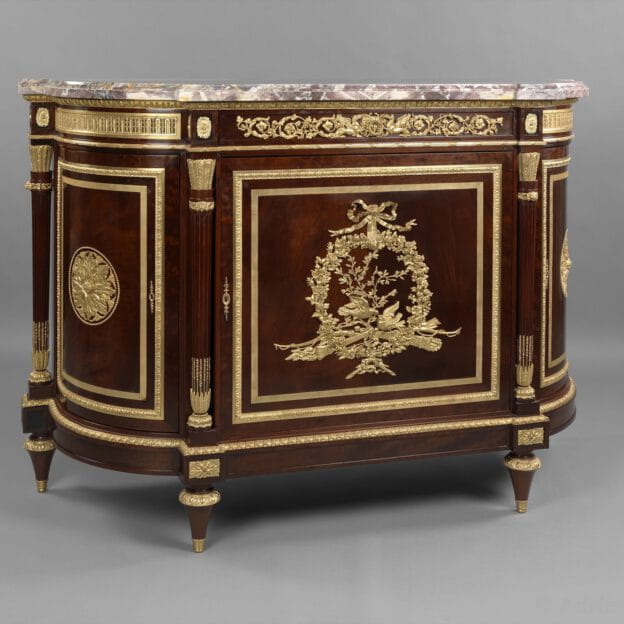
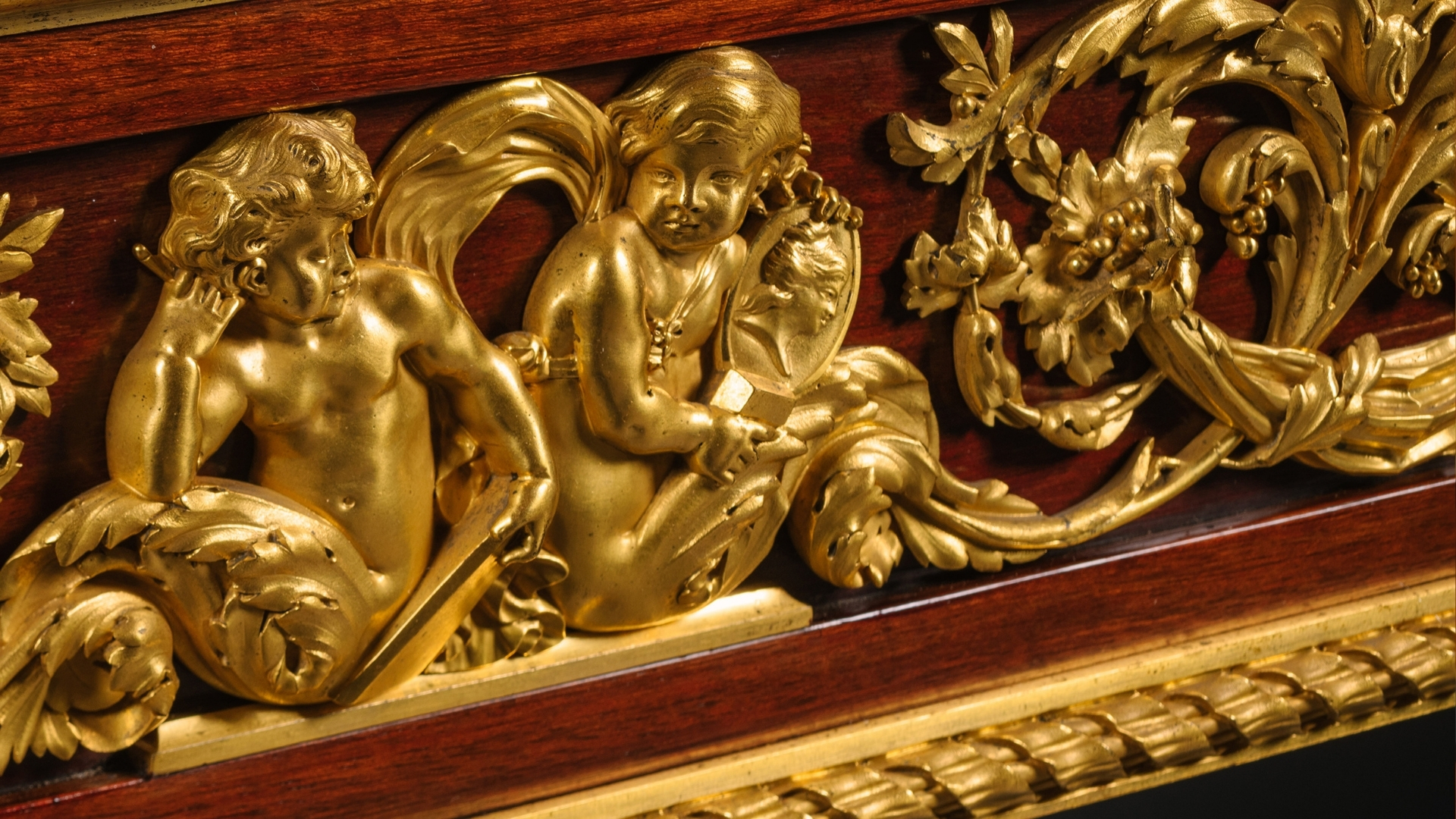
If there is one characteristic that immediately distinguishes Henry Dasson, it is the extraordinary quality of his gilt-bronze. Each piece would be modelled in clay, then cast in plaster from which a sand-cast bronze would be made. The bronze would be chased by hand chiselling, before gilding and then polished and rubbed to distinguish higher burnished and less burnished, or matte, areas.
Dasson described himself as primarily a bronze craftsman and that the bronze mounts represent the great part of the value of furniture.
Collectors often describe Dasson’s mounts as possessing a remarkable crispness and depth.
Look for:
- exceptionally sharp casting
- crisp chasing
- deeply undercut foliage
- finely modelled flowers
- beautifully defined ribbon work
- naturalistic drapery
- subtle texturing that catches the light
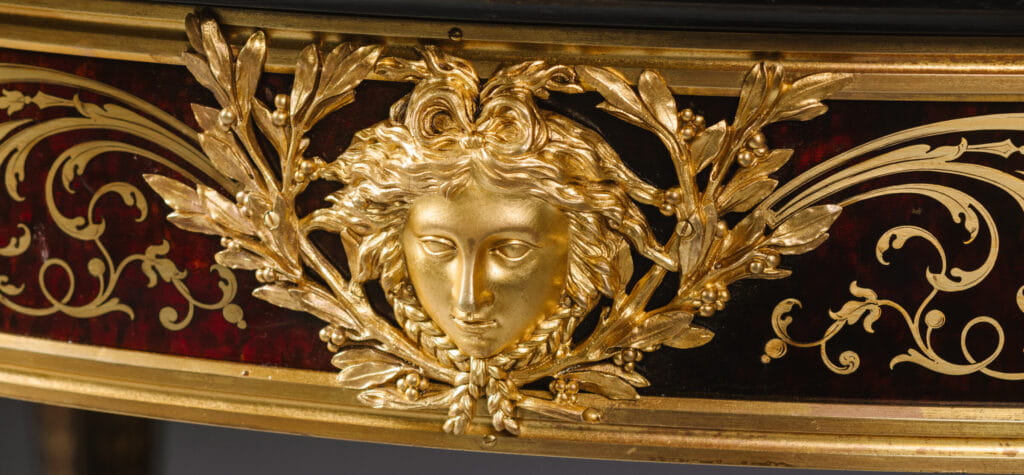
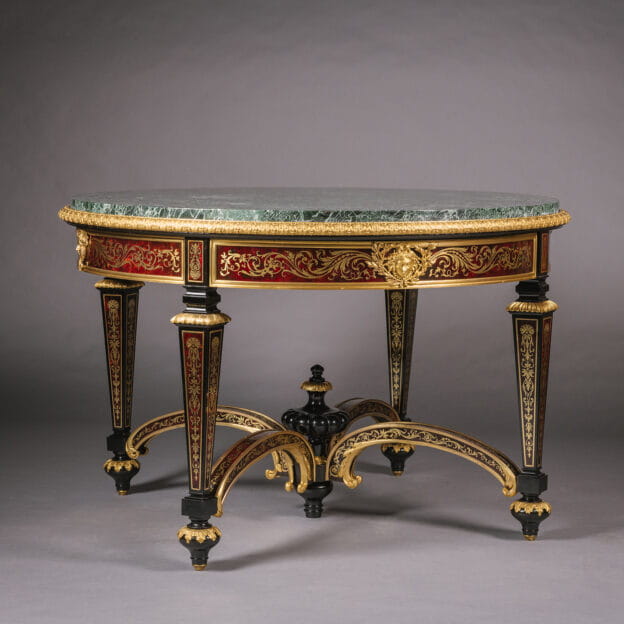
A Magnificent Louis XIV Style ‘Boulle’ Centre Table by Henry Dasson with gilt-bronze masks of Apollo wreathed in laurel leaves. View Item
Unlike mass-produced gilt-bronze mounts, Dasson’s best work feels sculpted rather than cast. The quality is immediately apparent when viewed beside lesser makers.
Christopher Payne describes Dasson’s bronzes as among the finest produced during the late 19th century.
Exceptional Mercury Gilding
Dasson expertly employed mercury gilding for all manner of gilt-bronze objects including clocks, vases and chandeliers, and for gilt-bronze furniture mounts.
Mercury gilding is a hazardous historical technique whereby gold and liquid mercury are mixed into a buttery paste which is brushed onto metal and heated so that the mercury evaporates leaving a high-purity gold layer amalgamed to the metal. The vapour released in the process is poisonous and therefore mercury gilding is not practised today.
Dasson’s continued use of mercury gilding in the late nineteenth-century is prized because, by that time, the newly invented electro-gilding was more commonly used. Dasson’s preferred mercury gilding because it is hand finished and when coupled with detailed casting and chiselling of the bronze, achieves a supreme quality. His persistence in practicing mercury gilding is an intentional continuation of exceptional eighteenth-century gilt-bronze work by the likes of Pierre Gouthière who specialised in metalwork objects and mountings for furniture supplied to the French royal court.
His original mercury gilding possesses remarkable richness.
Rather than appearing bright or yellow, authentic Dasson gilding displays:
- warm golden tones
- remarkable depth
- subtle variations in finish
- beautifully burnished highlights
- contrasting matte backgrounds
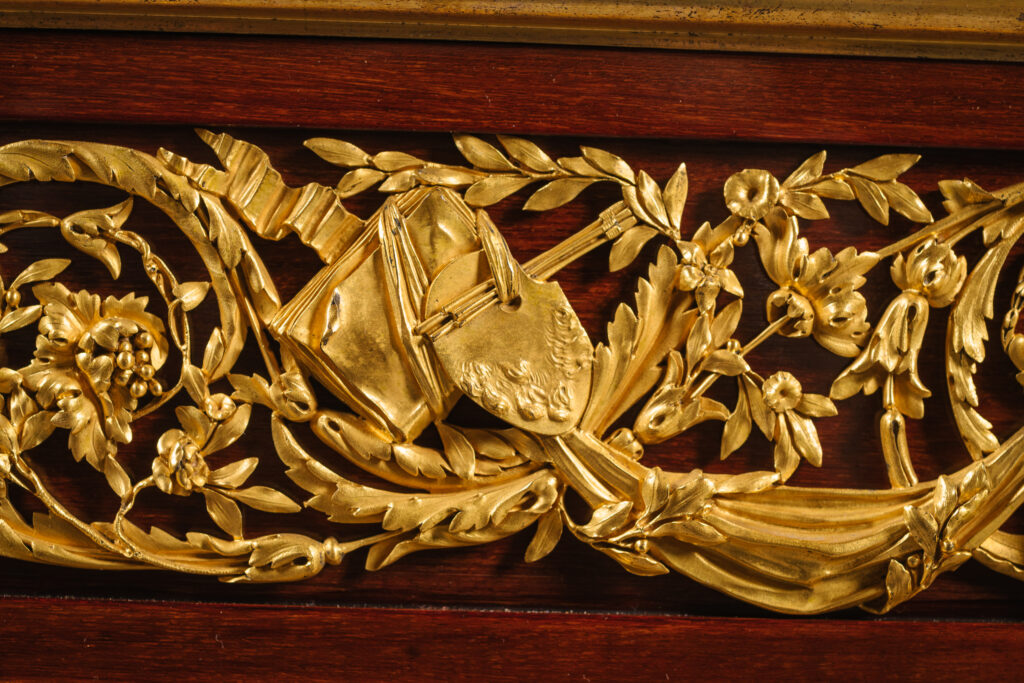
‘Table des Arts’, an exhibition gilt-bronze, mahogany and porphyry table, By Henry Dasson,dated 1889. View Details
Even after more than 130 years, the high quality of Dasson’s original gilding retains extraordinary brilliance.
This quality alone distinguishes Dasson from later reproductions.
Design and Proportion
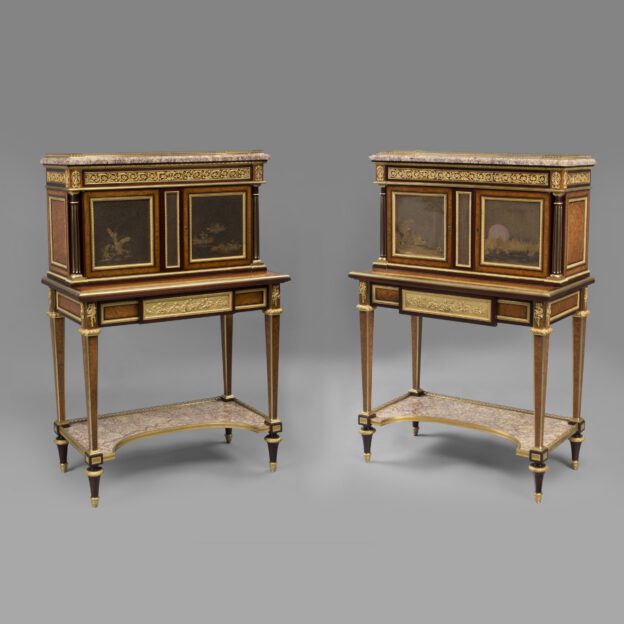
Dasson’s took his design inspiration from royal pieces made for kings Louis XIV, XV and XVI but also created his own designs informed by the eighteenth-century. For furniture, the quality of his gilt-bronzes is matched by exceptional cabinetwork, use of exotic timbers and precious materials such as rare marbles, lacquerware and porcelain.
Dasson is seen therefore as a legitimate continuation of the great royal furniture makers of the old order of the French Ancien Régime which ended with the revolution of 1789. Those makers – such as Jean-Henri Riesener (1734–1806) – made only few and phenomenally expensive works for the royal family. In the second half of the nineteenth-century, Dasson and a handful of his contemporaries, namely Beurdeley, were inspired to recreate the golden age, pre-revolution, period of gilt-bronze adorned furniture.
Dasson refined eighteenth-century furniture designs. His designs achieve a more elegant sense of proportion than his eighteenth-century predecessors. He scaled furniture to make it more liveable for modern interiors.
- Cabinets appear lighter
- Legs are more graceful
- Mounts integrate seamlessly into the overall design
- Every element feels balanced
This harmony became one of Dasson’s defining characteristics.

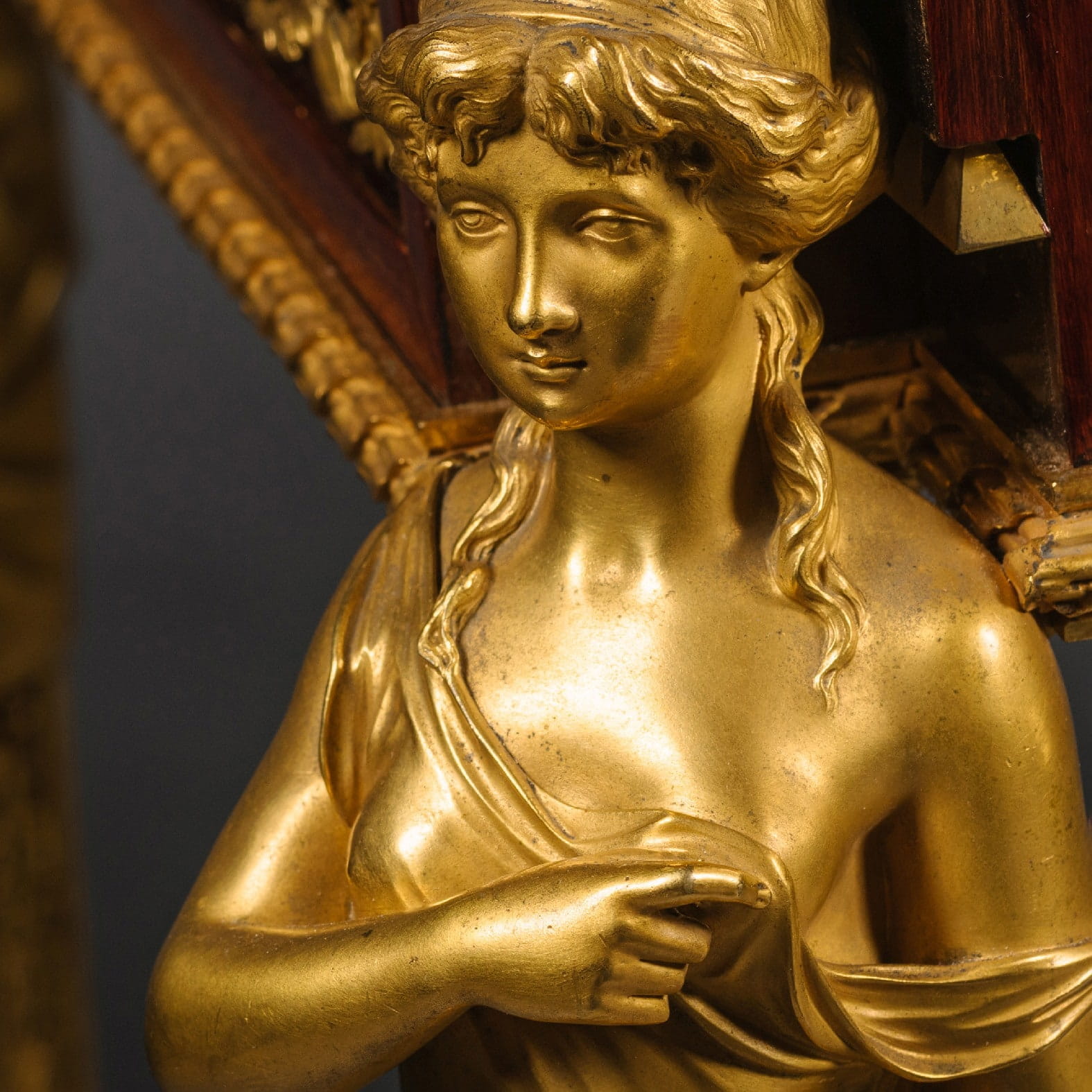
Look for the Signature
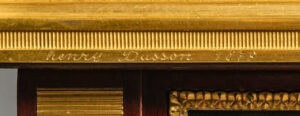
Fortunately for collectors, Dasson usually signed his work.
An etched script signature to the gilt-bronze, usually ‘henry Dasson’ with a lowercase ‘h’, invariably followed by a date between 1878 and 1890.
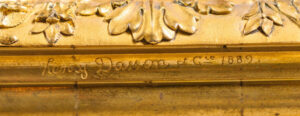
By circa 1889 ‘henry Dasson et Cie’ appears
A cold-stamp to the oak carcass or beneath the marble of ‘HENRY DASSON’ in capitals and usually followed by a date.
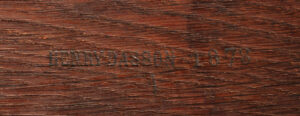
A small ‘HD’ mark stamped to the gilt-bronze.

Construction, bronze quality and provenance remain equally important.
Superb Cabinetmaking
Dasson’s furniture demonstrates cabinetmaking of exceptional precision.
Open a drawer and examine:
- oak secondary timber
- perfectly fitted dovetails
- finely finished interiors
- precise veneer matching
- invisible joints
Even concealed areas exhibit extraordinary craftsmanship.
This attention to unseen details reflects the standards expected by the world’s wealthiest collectors.
Exhibition Quality
One of the clearest indicators of Dasson’s importance is his extraordinary exhibition history.
He exhibited at:
- Exposition Universelle, Paris 1878
- Exposition des Beaux-Arts appliqués à l’industrie, Paris 1880
- Exposition retrospective de l’Union centrale des Arts Décoratifs, Paris 1882
- The International Colonial and Export Exhibition, Amsterdam 1883
- Exposition Universelle, Paris 1889
- Moscow Exhibition, 1891
His celebrated copy of Louis XV’s Bureau du Roi sold at the 1878 Paris Exhibition for the astonishing sum of 90,000 francs, while his celebrated ‘Table des Quatre Saisons’ was acquired by Lord Dudley.
In 1881, Dasson was a founding member of the Union centrale des Beaux-Arts appliqués à l’industrie.
He was made a Chevalier of the Légion d’honneur in 1883 and was awarded the Grand Prix Artistique at the 1889 Paris Exposition Universelle.
These international exhibitions established Dasson as one of the foremost luxury furniture makers of the nineteenth century.
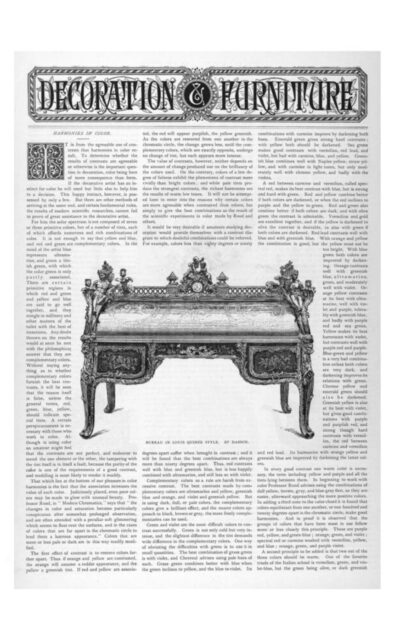
The Bureau du Roi by Henry Dasson shown at the 1878 Paris Exhibition. It was copied from the original preserved at the Louvre which is known as “the most beautiful piece of furniture in the world”. So perfect was Dasson’s replica that experts could scarcely distinguish from the original. It was bought by the Scottish art collector and philanthropist Louisa Baring, Lady Ashburton (1827-1903).
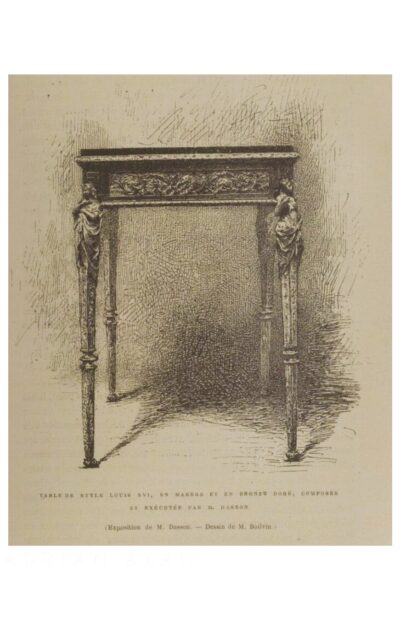
A side view of the ‘Table des Quatre Saisons’ unveiled by Dasson at the 1878 Paris Exhibition where it was described: “While he possesses a prodigious knack for copying, M. Dasson […] brings no less perfection to his own compositions; his dainty Louis XVI table is a poem of grace and wit. The slab of flowered jasper—a remarkable piece of lapidary work framed by bands of red jasper—rests on four caryatid-style legs representing the Seasons; on all four sides, plaques of lapis lazuli show through openwork friezes. All this fine bronze work is chased with superb tooling imparts charmingly rounded contours; it is yet another jewel destined for England—Lord Dudley has purchased it.”
(Translated from ‘L’art modern à l’Expostion de 1878’, Publication de la Gazette des Beaux Arts, Paris, pp. 355-356, ill. p. 359)
Museum-Level Quality
Collectors often ask:
“Why is Henry Dasson so highly regarded?”
The answer lies in consistency.
Few nineteenth-century makers achieved such uniformly exceptional quality across furniture, clocks, chandeliers, candelabra and gilt bronzes.
Unlike many contemporaries, Dasson excelled equally as:
- sculptor
- bronzier
- cabinetmaker
- clockmaker
- designer
His work combines all of these disciplines in perfect harmony.
In his time Dasson’s breadth of achievement was only arguably matched by Emmanuel-Alfred Beurdeley (1847-1919).
A major indicator of Dasson’s importance is the presence of his work in leading museums and historic collections worldwide from the V&A in London to the Hermitage in St. Petersburg.
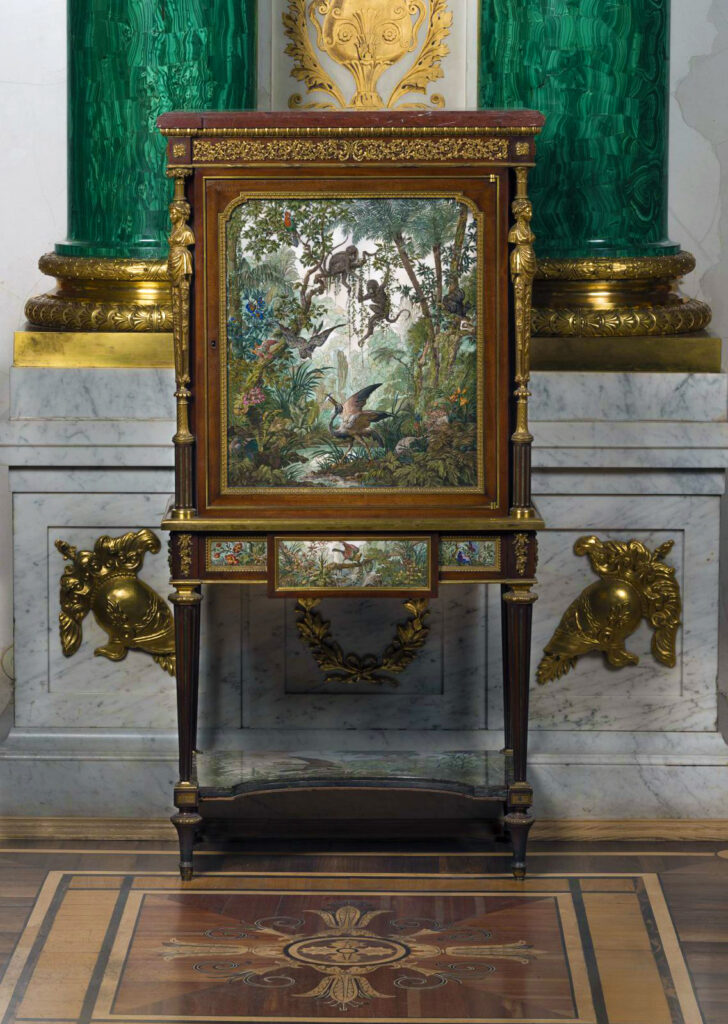
Henry Dasson (1825–1896), ‘cabinet à colonnes’, Russian Imperial Collection, The Malachite Room, The Winter Palace, St. Petersburg. © State Hermitage Museum.
Dasson’s clientele included royal and private European and British collectors, as well as wealthy American patrons of the Gilded Age. His work was commissioned for grand residences where the finest examples of French craftsmanship were displayed alongside eighteenth-century masterpieces.
Provenance Matters
Dasson’s clientele included:
British aristocracy
- King George V (1865 –1936).
- William Ward, the 1st Earl of Dudley (1817–1885).
- Louisa Caroline, Lady Ashburton (1827–1903).
- Bertram Wodehouse Currie (1827 –1896).
- Sir Henry Campbell-Bannerman (1836-1908).
- Richard Seymour-Conway, 4th Marquess of Hertford (1800–1870).
European aristocracy
- Eugénie de Montijo, Empress of France (1826 –1920).
- Maria Feodorovna, Empress of Russia (1847-1928).
- Alice Tahl, Countess de Lancey, (1851-1913).
- Baron Ferdinand de Rothschild (1839-1898).
- Jules Grévy (1807 – 1891), President of France.
- Alfred Sommier (1835–1908).
- Countess Valentine de Biencourt (1839-1929).
Titans of America’s Gilded Age
- Frederick William Vanderbilt (1856 –1938).
- William Kissam Vanderbilt I (1849 –1920)
- Egerton Winthrop (1838-1916).
- Ogden Livingston Mills (1884 –1937).
His work entered many of the great collections of the late nineteenth century and continues to appear in leading museums and distinguished private collections today.
Well-documented provenance significantly enhances both historical importance and market desirability.
Compare Before You Buy
One of the best ways to recognise authentic Dasson furniture is by comparison.
Study examples held in:
- major museum collections
- historic exhibition catalogues
- respected specialist dealers
- published reference books
The more authentic examples you examine, the easier Dasson’s distinctive style becomes to recognise.
As with fine paintings, quality becomes unmistakable once the eye has been trained.
Why Henry Dasson Remains So Collectable
Henry Dasson represents the very pinnacle of nineteenth-century French luxury furniture.
His extraordinary mastery of bronze casting, cabinetmaking and design produced objects that transcend revival furniture to become masterpieces in their own right.
Today his finest works continue to command international attention from collectors, museums and interior designers seeking the highest expressions of French decorative arts.
At Adrian Alan, we have been privileged to handle some of Dasson’s finest surviving works, including rare centre tables, monumental commodes, bureaux plats, chandeliers and important gilt-bronze mounted objets d’art. Each reflects the uncompromising craftsmanship that established Henry Dasson as one of the greatest ébénistes of the nineteenth-century.
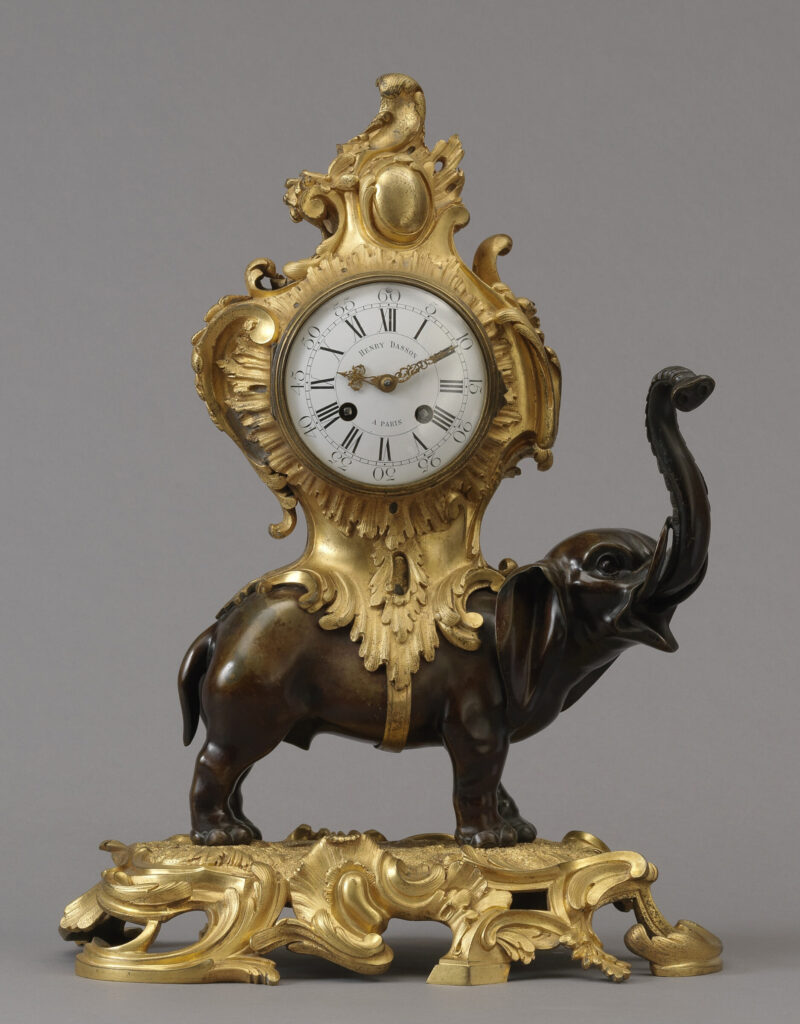
A patinated and gilt-bronze elephant mantel clock by Henry Dasson, Signed to the dial ‘Dasson à Paris’ and signed to the bronze ‘Henry Dasson et Cie, 1888’.
Further Reading
- Ledoux-Lebard, Denise. Les Ébénistes du XIXe Siècle. Les Éditions de l’Amateur, Paris, 1984.
- Meyer, Jonathan. Great Exhibitions – London, New York, Paris, Philadelphia, 1851–1900. Antique Collectors’ Club, 2006.
- Mestdagh, Camille & Lécoules, Pierre. L’Ameublement d’Art Français: 1850–1900. Les Éditions de l’Amateur, 2010.
- Payne, Christopher. Paris Furniture: The Luxury Market of the 19th Century. Éditions Monelle Hayot, 2018.
Henry Dasson in the Words of Furniture Historians
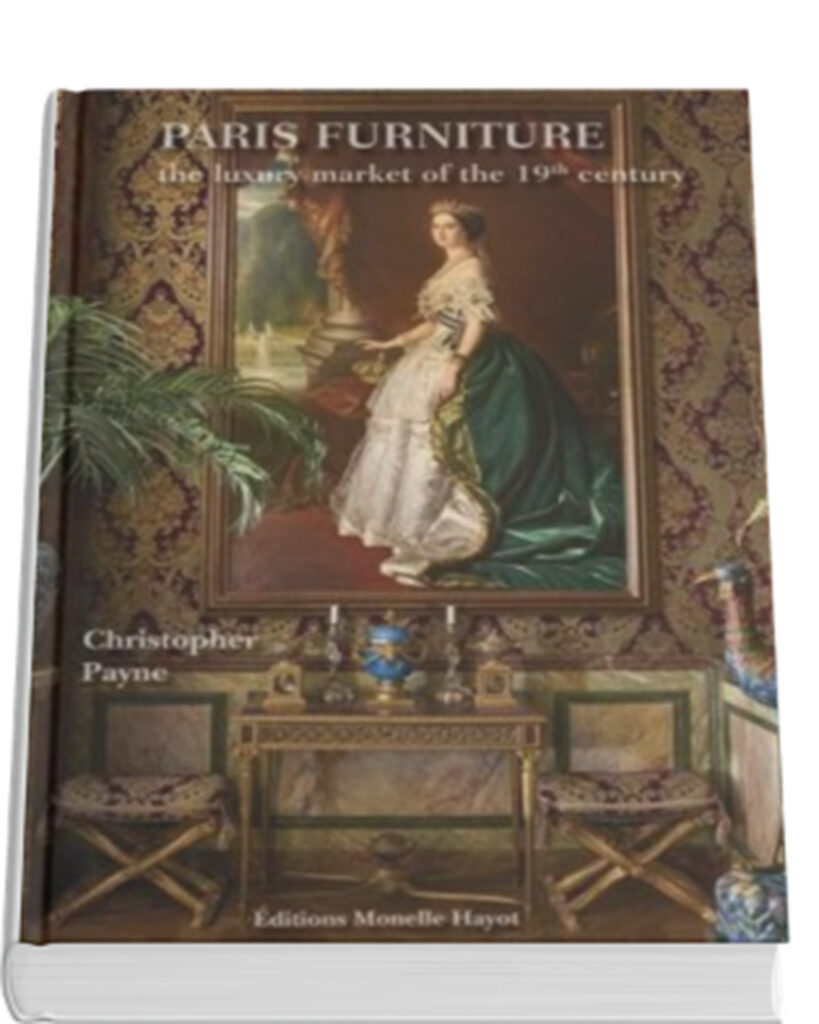 The importance of Henry Dasson has been recognised by leading scholars of nineteenth-century furniture, who have placed him among the greatest makers of the Belle Époque.
Furniture historian Christopher Payne, author of Paris Furniture: The Luxury Market of the 19th Century (2018), has described Dasson’s workshop as representing the highest achievements of the nineteenth-century French luxury furniture industry. Payne’s research places Dasson among the elite group of Parisian makers who successfully combined historic design, technical innovation and exceptional craftsmanship. In Paris Furniture: The Luxury Market of the 19th Century, Payne highlights the extraordinary scale and sophistication of the nineteenth-century Parisian furniture trade, explaining how makers such as Dasson created works intended for the international luxury market and the great exhibitions.
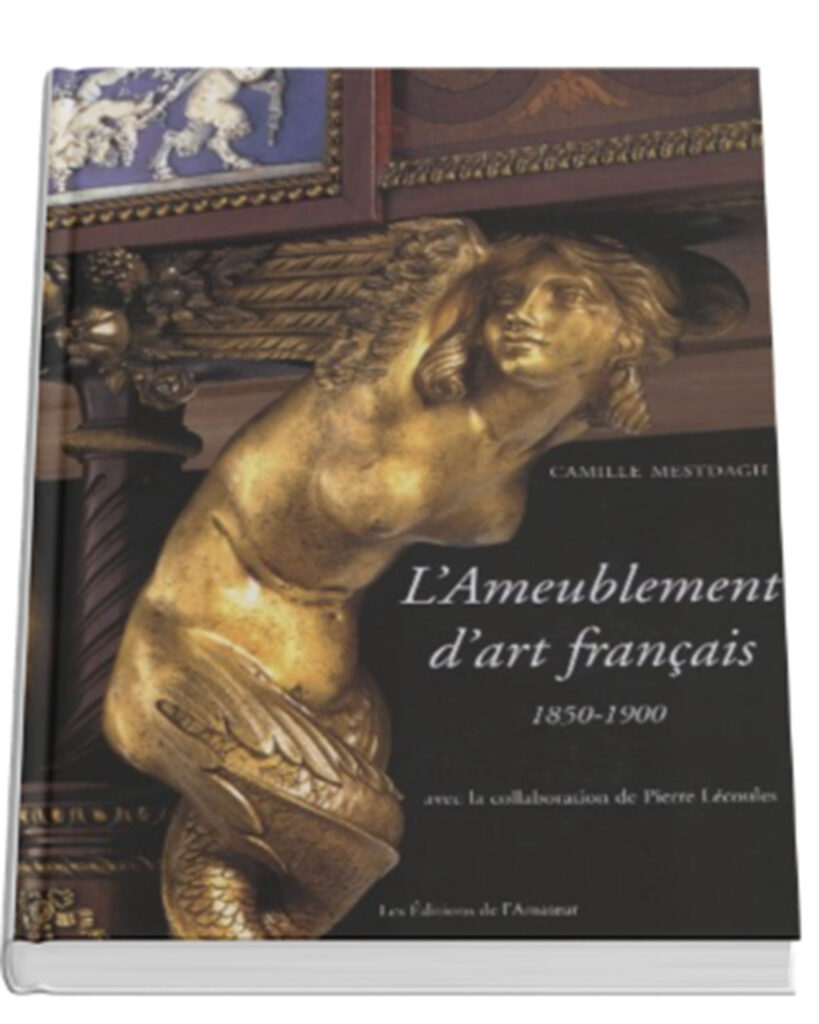 Camille Mestdagh and Pierre Lécoules, authors of L’Ameublement d’Art Français: 1850–1900, place Dasson within the highest level of the French ‘ameublement d’art’ tradition, alongside makers such as Beurdeley, François Linke and Zwiener. Their research demonstrates the importance of these workshops in preserving and reinterpreting eighteenth-century French craftsmanship during the Second Empire and Belle Époque.
How Experts Distinguish Dasson from Other Makers
Henry Dasson
Seen as the successor to the great eighteenth-century metal workers like Pierre Gouthière, known for the refinement of his gilt-bronze work.
Exceptionally fine furniture inspired by Ancien Régime forms, often replicas of famous pieces, but also unique designs, always distinguished by supreme gilt-bronzes.
The most famous of all Belle Epoque cabinetmakers.
Like his contemporaries, Linke made replicas in the French historical styles, but he is most prized for the pieces made for the 1900 Paris Exhibition which are a collaboration with the sculptor Léon Messagé and combine the Rococo with the Art Noveau, are called ‘Le Style Linke’.
Maison Beurdeley
Maker of exhibition furniture particularly appreciated by Gilded Age collectors.
The Beurdeley family, like Henry Dasson, are appreciated by today’s connoisseur collectors for their exceptional quality French royal revival furniture, with a full repertoire including lighting and clocks as well as furniture,
Paul Sormani
Sormani began as a maker of luggage before unveiling furniture at the 1867 Paris Exhibition.
His experience as a malletier is reflected in the high quality of the desks and cartonniers he made. He preferred the Louis XVI style, and his furniture is often lighter and more modern in taste. At his best, Sormani rivals Dasson and Beurdeley, in quality.
Emmanuel Zwiener
Rococo inspired furniture, with sculptural mounts and use of marquetry and Vernis Martin.
German born Zwiener collaborated with the sculptor Léon Messagé before Linke did, meaning to the untrained eye that Zwiener’s highly sculptural furniture can be confused with Linke’s work. Zwiener’s display at the 1889 Paris Exhibition was so successful, that when the German Kaiser saw it, he invited Zwiener to make furniture for the imperial apartments at the Berlin Palace, to make a statement of Prussian prestige in ‘Art Furniture’.
Frequently Asked Questions
Henri or Henry – He is of French nationality but spells his name in the English way?
This is not commented on in literature during Dasson’s lifetime. The distinction was perhaps not as pronounced as we think today, given that Paris is not so far from London, and Dasson counted amongst his clientele major English and American collectors.
How do you identify Henry Dasson furniture?
Invariably signed, but an expert eye should be consulted to determine whether a signature is genuine, as Dasson’s furniture has always been valuable and therefore imitated. Firstly, the quality of the gilt-bronzes must be observed, there must be refined gilding and sharp and lifelike details to the sculptural bronze work. Cabinetry is first rate, with precious timbers on oak construction. Rarer marble specimens for tops are preferred. Use of marquetry, ‘Boulle’, porcelain and lacquerware add luxury and value. A combination and consideration of all of these points plus the overriding self-evident presence of quality and luxury must be apparent.
What is a Henry Dasson signature?
An etched script signature to the gilt-bronze, usually ‘henry Dasson’ with a lowercase ‘h’, invariably followed by a date between 1878 and 1890. By circa 1889 ‘henry Dasson et Cie’ appears.
A cold-stamp to the oak carcass or beneath the marble of ‘HENRY DASSON’ in capitals, and usually followed by a date.
A small ‘HD’ mark stamped to the gilt-bronze.
How can you identify Henry Dasson furniture?
Authentic Dasson furniture is identified through a combination of signature, construction, gilt-bronze quality, design, provenance and comparison with documented examples.
Is Henry Dasson furniture valuable?
The finest Dasson furniture is highly sought after internationally due to its rarity, craftsmanship and historical importance it can achieve high prices especially for his rare exhibition pieces. The world auction price for Henry Dasson was set at Sotheby’s Paris, 30 June 2021, for ‘A pair of Louis XVI style ‘Boulle’ marquetry meubles d’appui’ which realised 448,100 euro. Multiple works by Henry Dasson have sold for in excess of $100,000.
Was Henry Dasson better than François Linke?
Both makers represent the pinnacle of nineteenth-century French furniture, but their styles differ. Dasson’s establishment and success predate Linke. Dasson specialised in perfected interpretations of eighteenth-century designs, while Linke became known for innovation and the fusion of historicism with modern taste.