Ferdinand Barbedienne
A Neo-Grec Gilt and Patinated Bronze Tazza, Designed by Ferdinand Levillain
£5,500
A Neo-Grec Gilt and Patinated Bronze Tazza, Designed by Ferdinand Levillain and Cast By Ferdinand Barbedienne.Marked 'F. Levillain' to the decoration...
Dimensions
Height: 8 cm (4 in)Diameter: 26.5 cm (11 in)

 Print
PrintDescription
A Neo-Grec Gilt and Patinated Bronze Tazza, Designed by Ferdinand Levillain and Cast By Ferdinand Barbedienne.
Marked ‘F. Levillain’ to the decoration and stamped ‘F. Barbedienne’ to the underside.
France, Circa 1879.
This rare tazza is a fine example of the collaboration between the gifted designer Ferdinand Levillain and the highly acclaimed bronzier Ferdinand Barbedienne. It is decorated with a bas-relief in the ‘Neo-Grec’ or ‘Pompeian’ style with classical figures herding animals in a procession.
Designs in the ‘Neo Grec’ style figured prominently in Barbedienne’s submissions to the 1855 Paris Exposition Universelle and throughout the firm’s production.
An identical example, dated 1879, is in the collection of the Musée d’Orsay, Paris (inv. OAO 1503). Like the present tazza, it is signed by Ferdinand Levillain and stamped by Ferdinand Barbedienne. The museum’s example entered the national collections in 2005 as a donation from Madame Antonin Rispal.
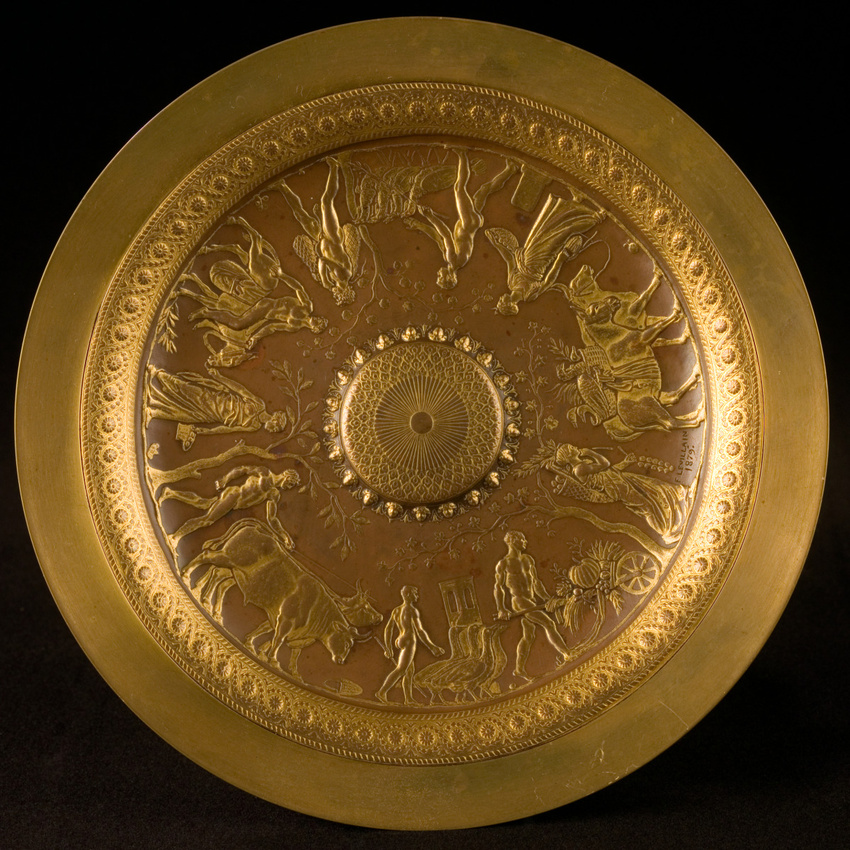
An identical Neo-Grec coupe by Ferdinand Levillain, cast by Ferdinand Barbedienne, dated 1879. Musée d’Orsay, Paris, inv. OAO 1503. Donated by Madame Antonin Rispal 2005. © Musée d’Orsay, Dist. RMN-Grand Palais / Patrice Schmidt.
Ferdinand Levillain
Ferdinand Levillain (1837 – 1905) had his debut at the Paris Salon in 1861 and won recognition through the 1860’s and 1870’s for his work with the highly respected Barbedienne.
In 1878 he ceased his collaboration with Barbedienne and triumphed alone at the Exposition Universelle, where he won the gold medal for his work referencing Antiquity.
In 1884 he was awarded a first class medal at the Salon and in 1889 a silver medal at the Exposition Universelle. In 1892 he was recognised with the highly prestigious Légion d’Honneur. Examples of his work are displayed in many museums including the Musée de Lyon and the Musée d’Art Moderne in Paris.
Levillain also collaborated with the Sèvres manufactory and won several medals, which are still visible today at the Louvre Museum and the Musée des Beaux-Arts in Angers.
Date
Circa 1879.
Origin
France
Medium
Patinated Bronze
Signature
Signed F. Levillain and stamped "F. Barbedienne"
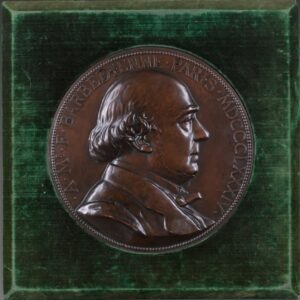
Ferdinand Barbedienne (6 August 1810 – 21 March 1892) was a French metalworker and manufacturer, who was well known as a bronze founder.
The son of a small farmer from Calvados, he started his career as a dealer in wallpaper in Paris. In 1838 he went into partnership with Achille Collas (1795-1859), who had just invented a machine to create miniature bronze replicas of statues. Together they started a business selling miniatures of antique statues from museums all over Europe, thus democratising art and making it more accessible to households. From 1843 they extended their scope by reproducing the work of living artists and also diversified by making enamelled household objects. With the outbreak of the Franco-Prussian war in 1870 the firm briefly had to switch to cannon founding owing to the shortage of metals but resumed business afterwards. Following Barbedienne’s death in 1892, he was buried in the Père-Lachaise cemetery and the firm was carried on by his nephew Gustave Leblanc until 1952.
Among the principal artists reproduced by the firm were Antoine Louis Barye and Auguste Rodin.