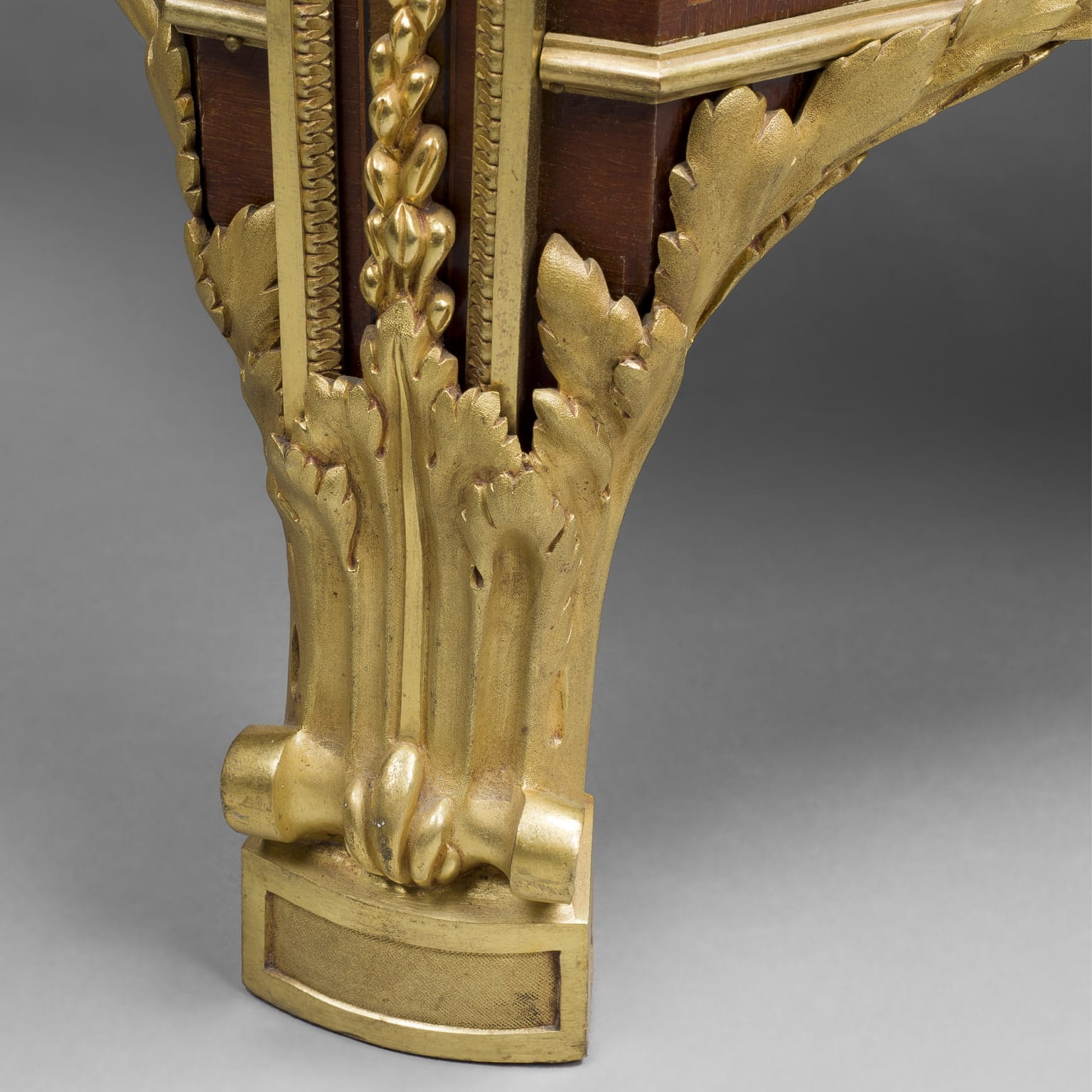
François Linke
A Very Fine Louis XVI Style Gilt-Bronze Mounted Marquetry Commode
£85,000
A Very Fine Louis XVI Style Gilt-Bronze Mounted Marquetry Commode after a model by Jean Henri Riesener, By François Linke.Linke Index No. 10.Signed...
Dimensions
Height: 94 cm (38 in)Width: 167 cm (66 in)
Depth: 65 cm (26 in)

 Print
PrintDescription
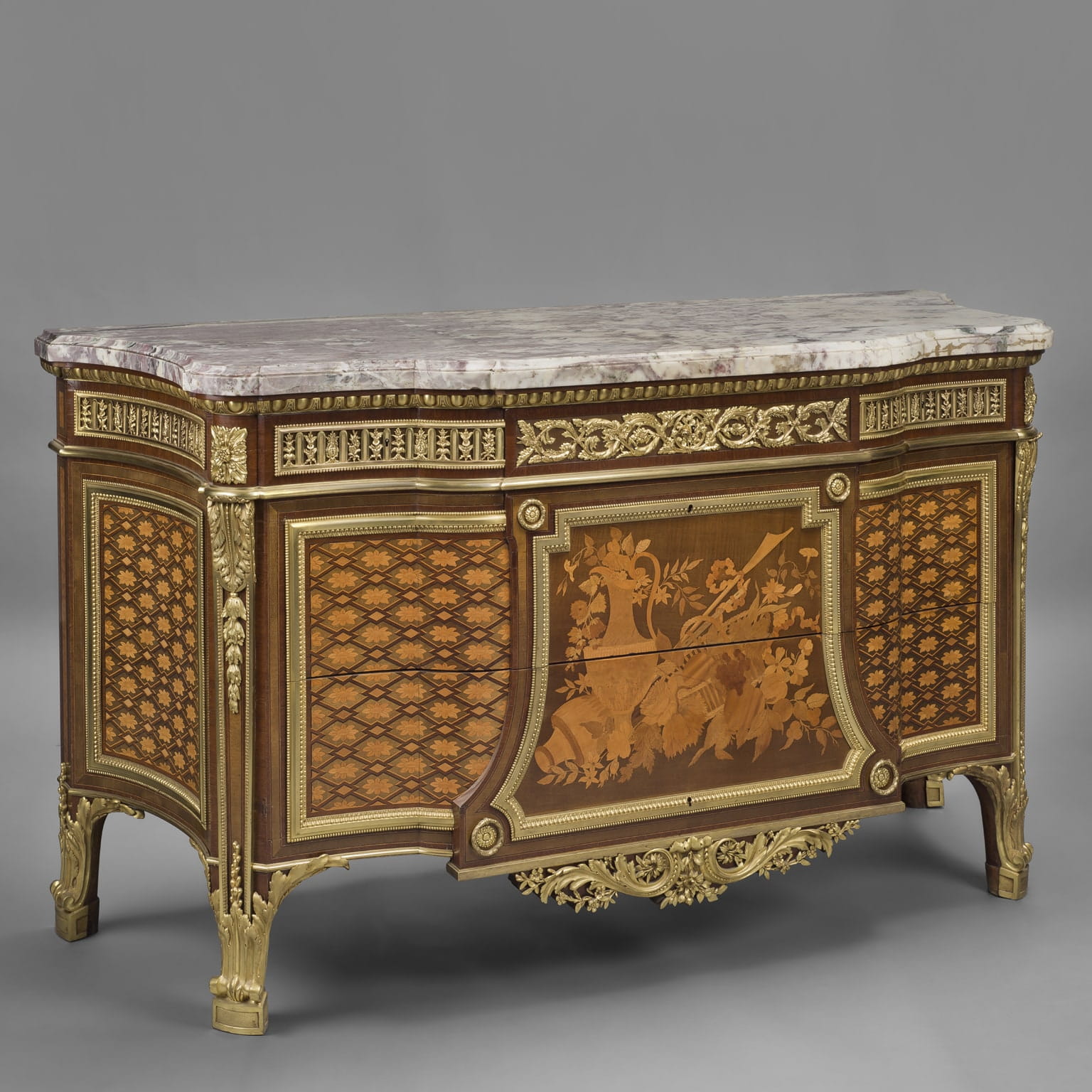
A Very Fine Louis XVI Style Gilt-Bronze Mounted Marquetry Commode after a model by Jean Henri Riesener, By François Linke.
Linke Index No. 10.
Signed ‘F. Linke’ and the lock-plate stamped ‘CT LINKE SERRURERIE/PARIS’.
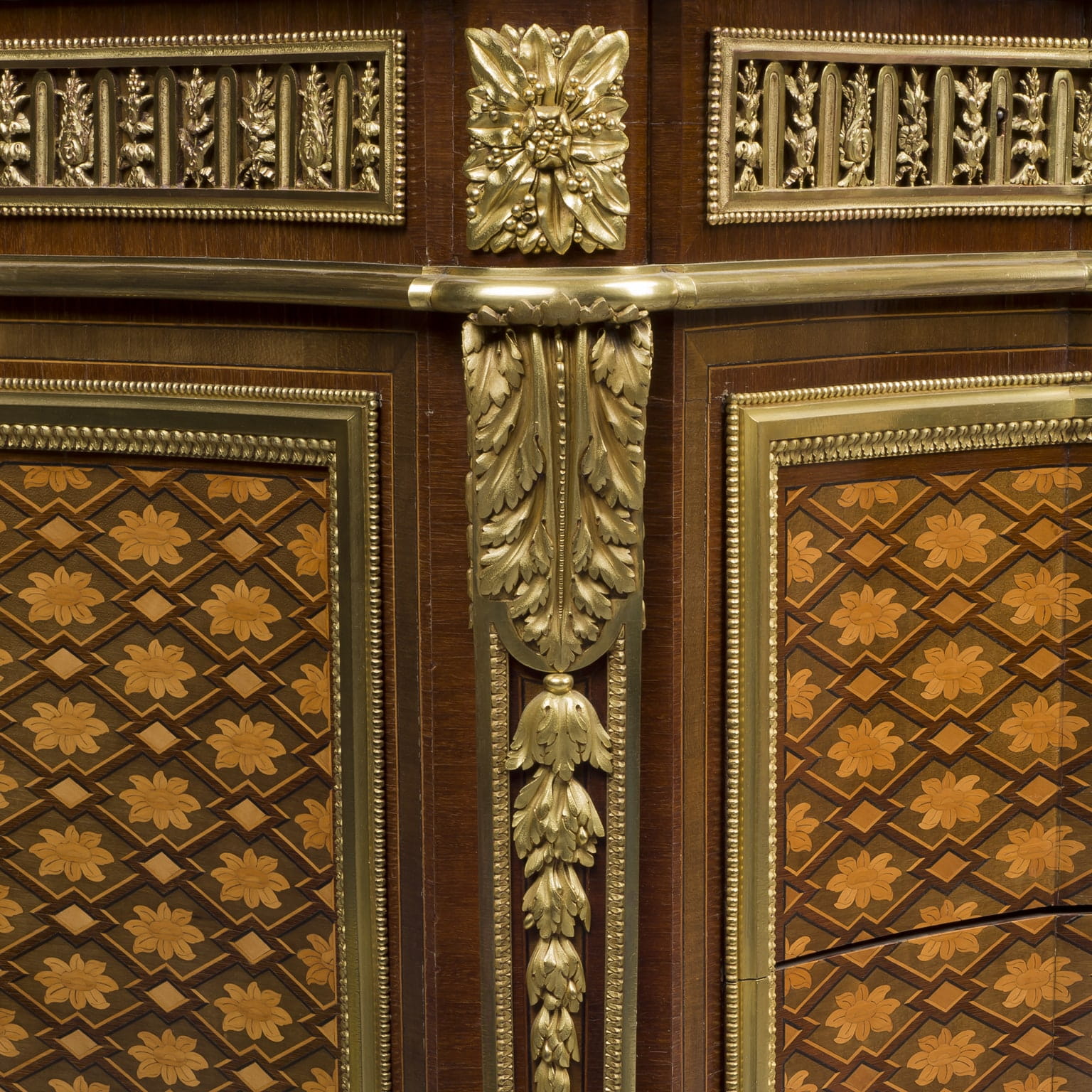
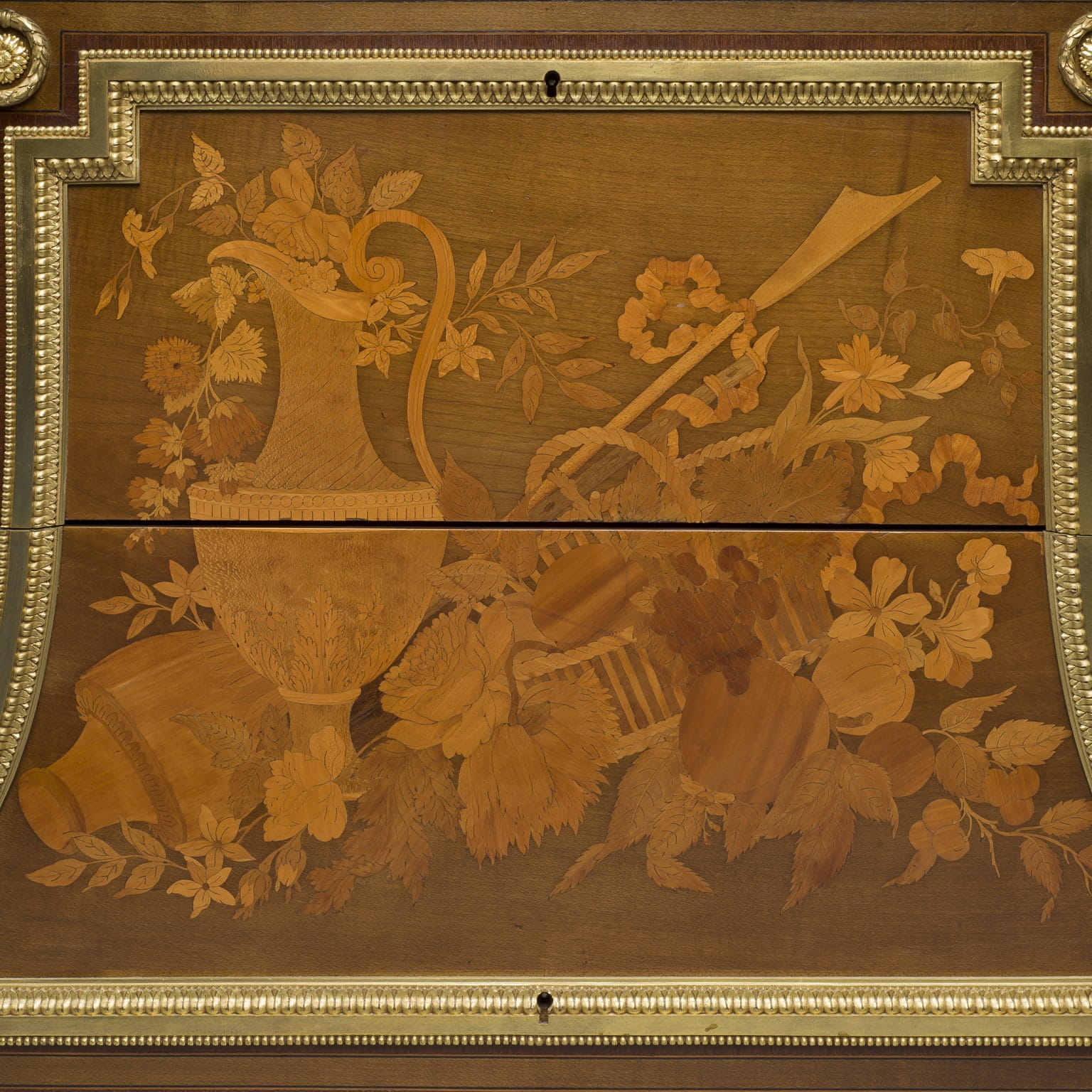
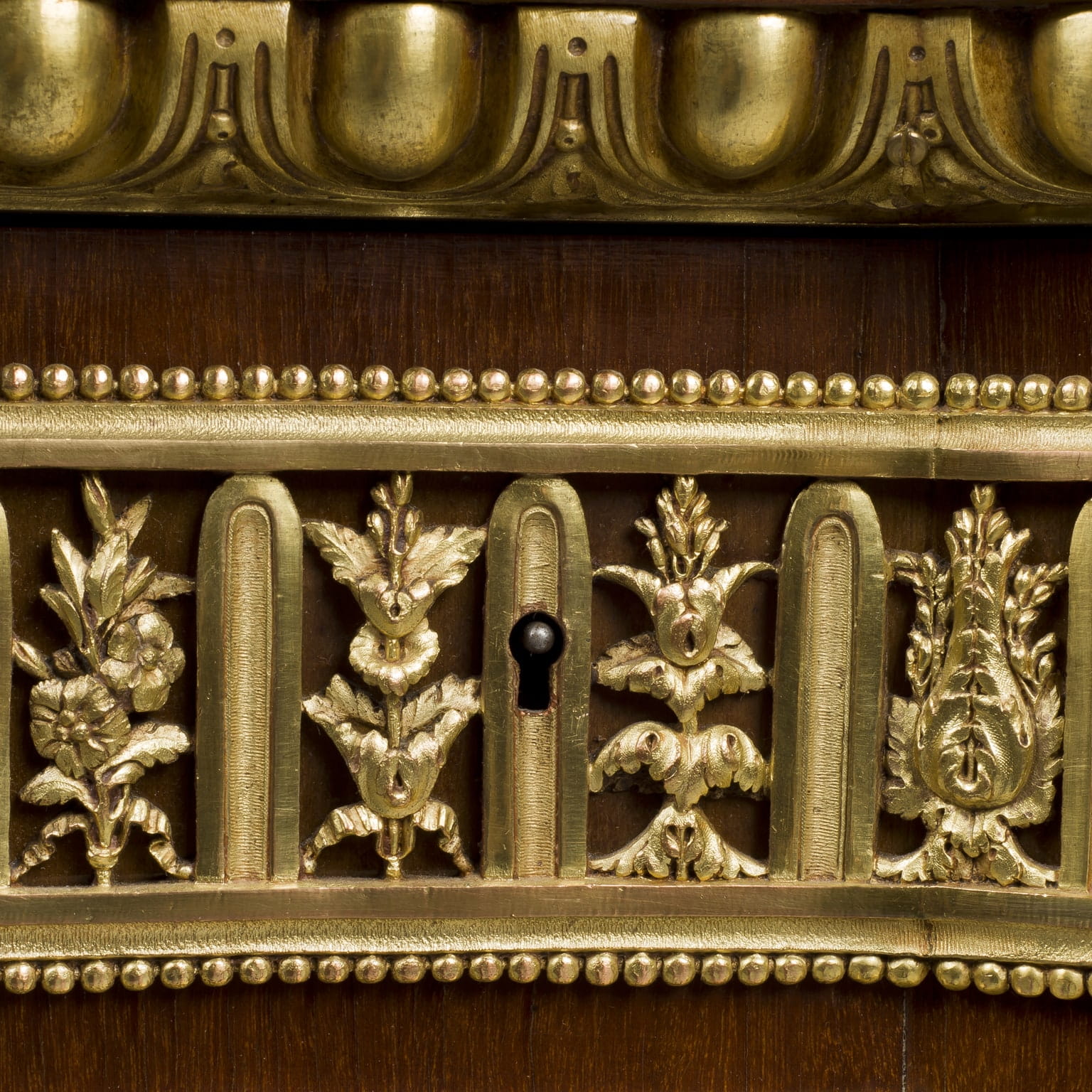
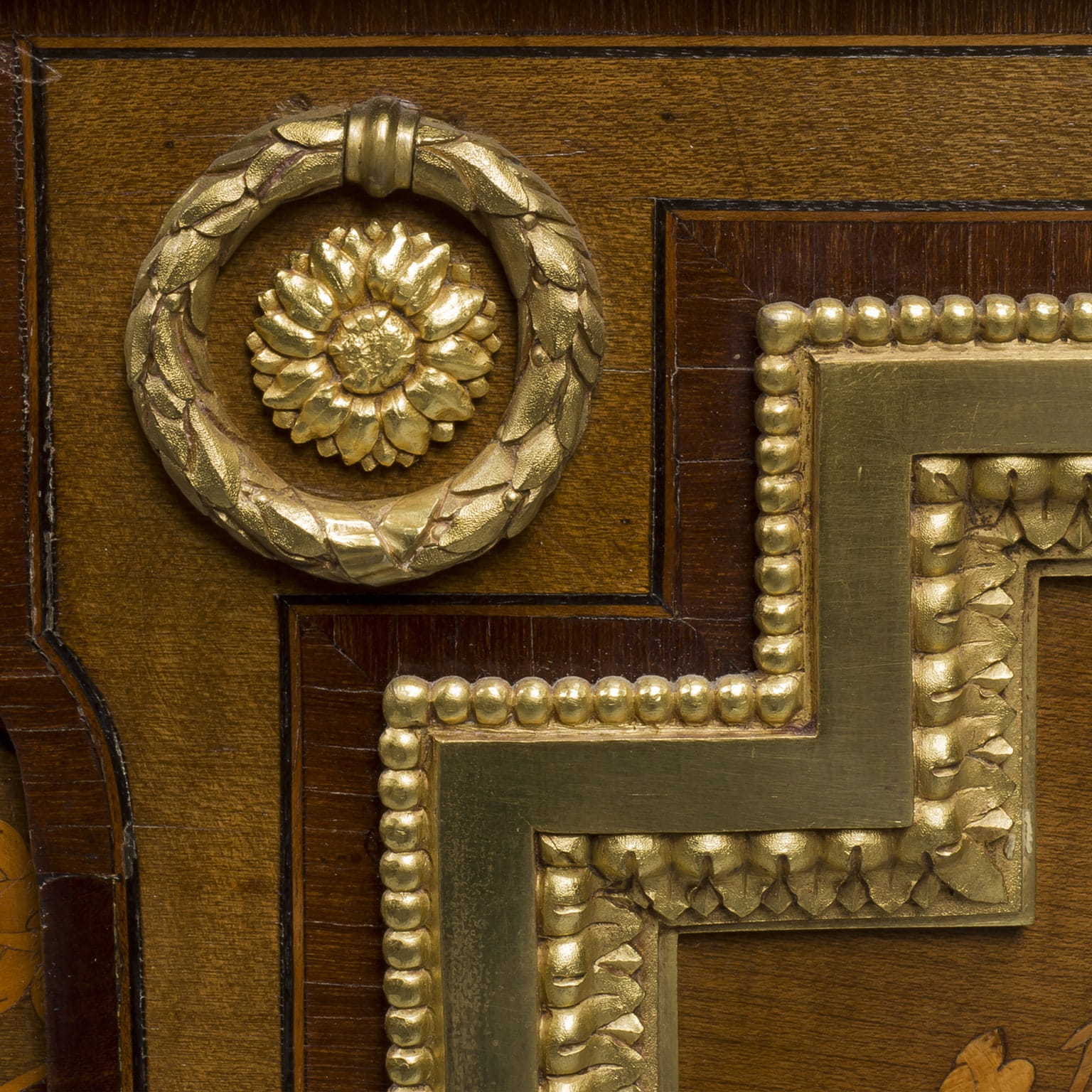
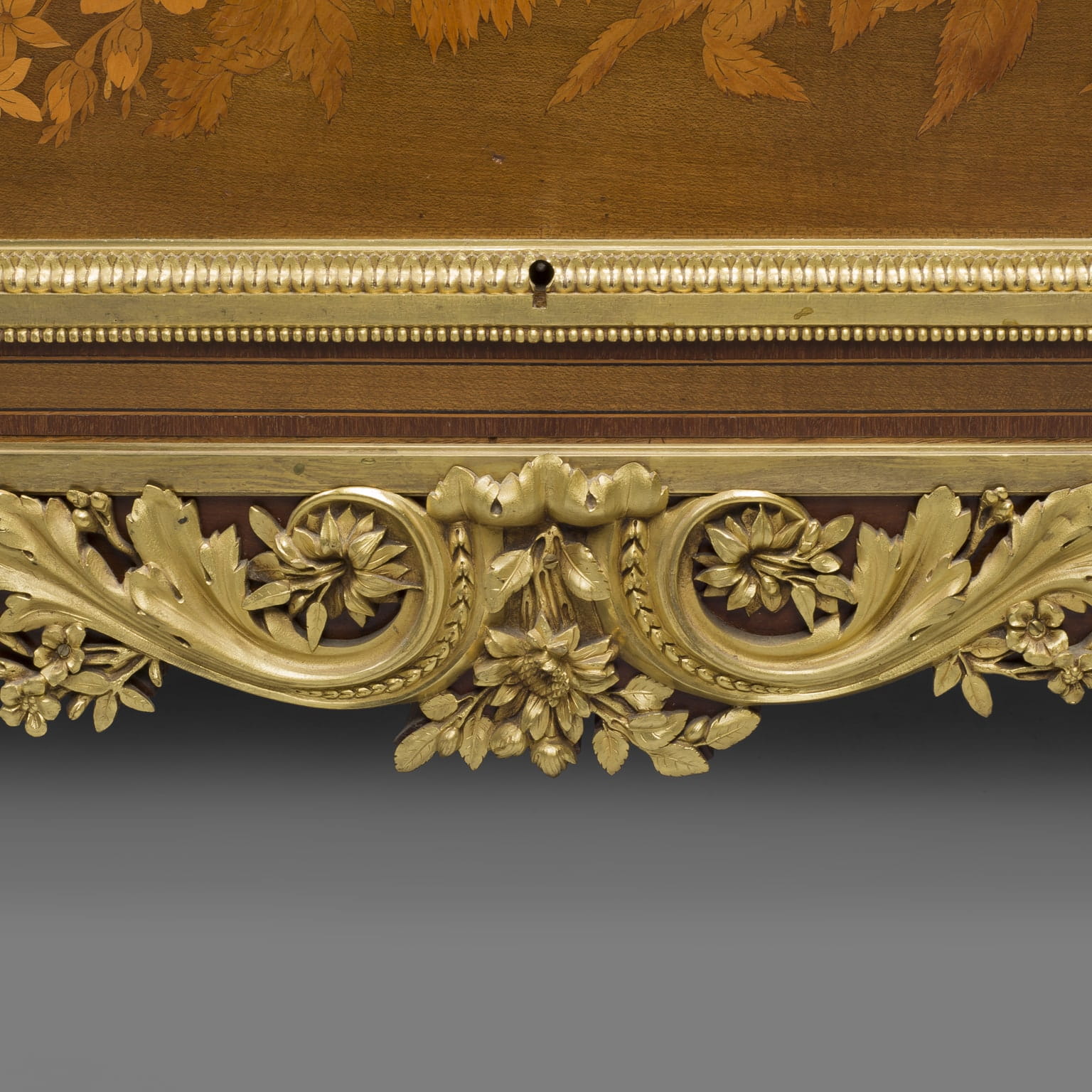
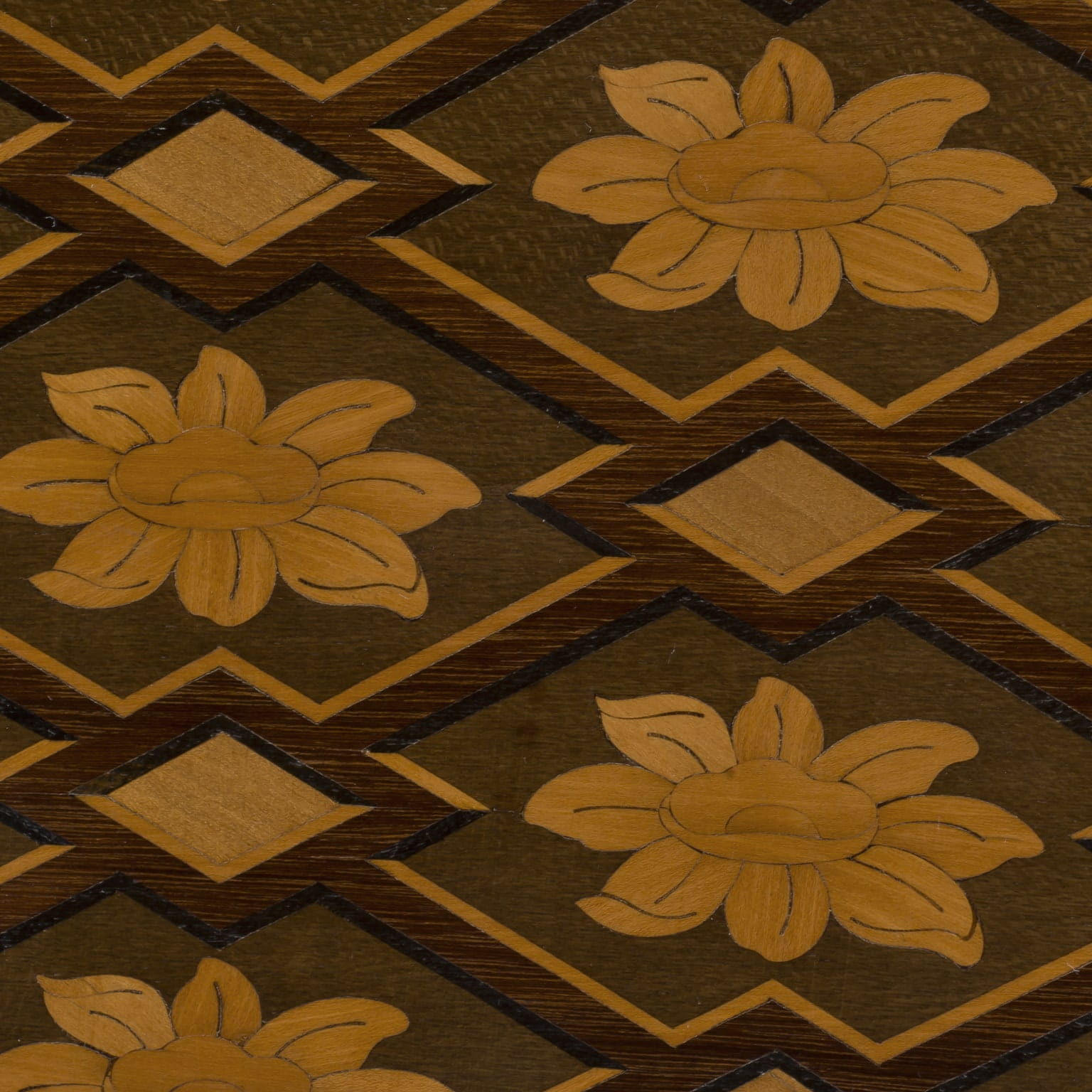
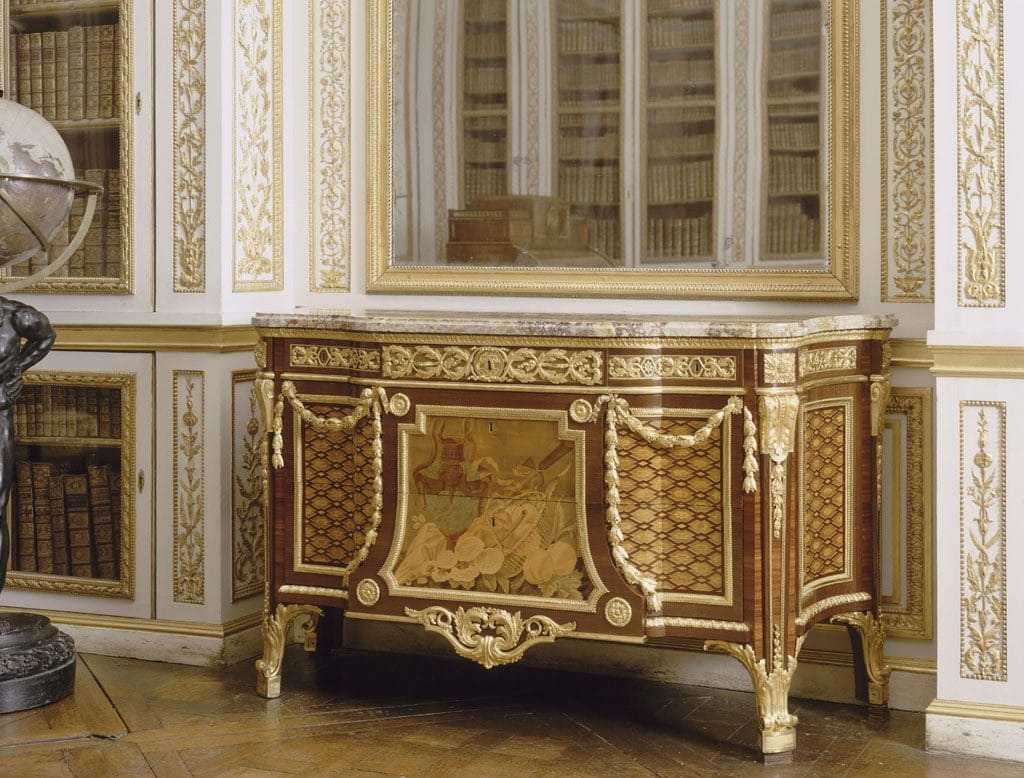
This fine mahogany commode has a fleur de pêcher marble top above a breakfront frieze set with three drawers, over a pair of drawers with a unified central panel of floral marquetry and trophies within a gilt-bronze frame, flanked by panels of foliate parquetry. The apron is mounted with finely cast acanthus and the scroll-mounted legs put down on block feet.
France, Circa 1900.
Defined by its exquisite inlay-work of precious timbers and finely wrought gilt-bronze mountings this commode is exemplary of François Linke’s production. In the tradition of the finest ébénistes of the period Linke derived the model from an eighteenth century forebearer, Jean-Henri Riesener, who was ébéniste de Roi to King Louis XVI of France. Riesener’s commode is preserved in the château de Fontainebleau and part of France’s national art collection.
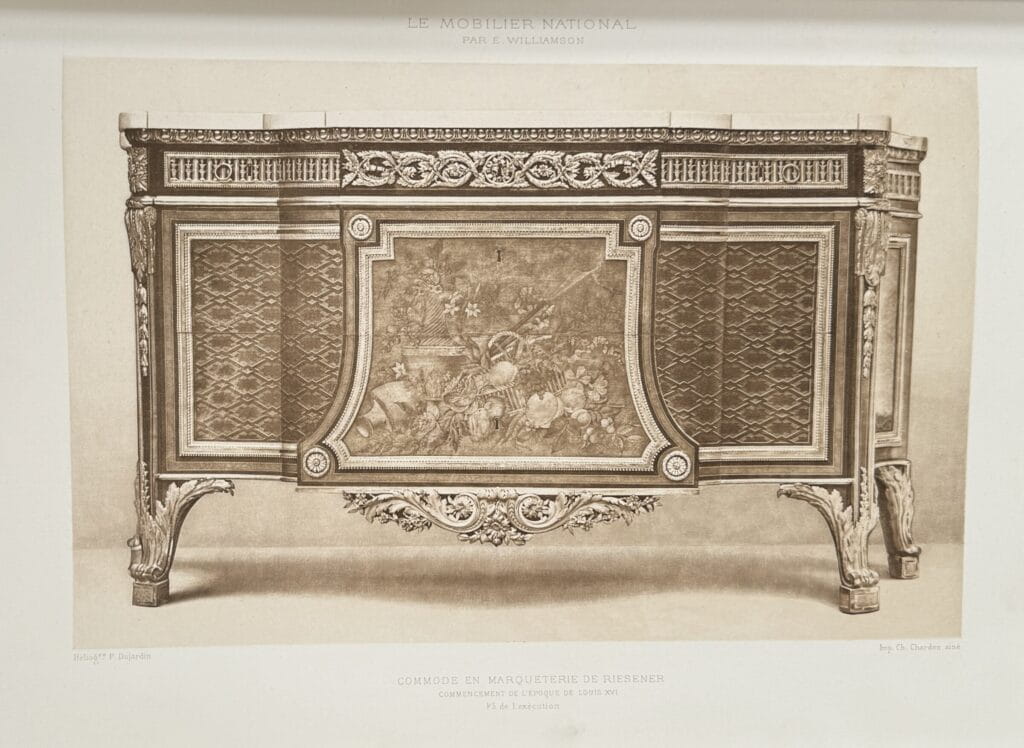
The commode by Riesener at the château de Fontainebleau, illustrated in E. Williamson, Les Meubles D’Art du Mobilier National, Paris, 1880.
Riesener’s commode was so admired and famous in the nineteenth century that the great ébénistes of the day replicated it with phenomenal exactitude. Replicas are recorded firstly by Charles-Guillaume Winckelsen and his successor Henry Dasson, and later in the nineteenth century by Alfred Beurdeley, as in the case of the present example, François Linke.
A popular model in Linke’s oeuvre, he produced a number of variations in different sizes, under index numbers 10, 104, 886, 1036 and 1437. The present example is Index no. 10 which at 170 cm wide is identical to the original Reisener model. Linke had himself acquired the rights to make this commode by purchasing a set of patterns for this model from the workshop sale of the ébéniste Cueunières in November 1902 for 209 francs.
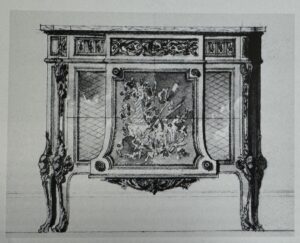
A drawing by François Linke for a smaller variation of the present model (Courtesy Christopher Payne / Linke Archive).
The importance of the model in the canon for French furniture cannot be overstated. The central marquetry panel is a still-life of a vase and ewer beside a basket overflowing with fruit. It is an allusion to the mythological excesses of Bacchus. This is part of the neoclassical design of the whole which has come to characterise what is referred to as ‘the Louis XVI style’. The distinctive repetition of stylised rosette and interlaced lattice work parquetry, punctuated by fine floral marquetry panels and gilt-bronze mounts, is redolent of some of the most celebrated examples of Riesener’s oeuvre.
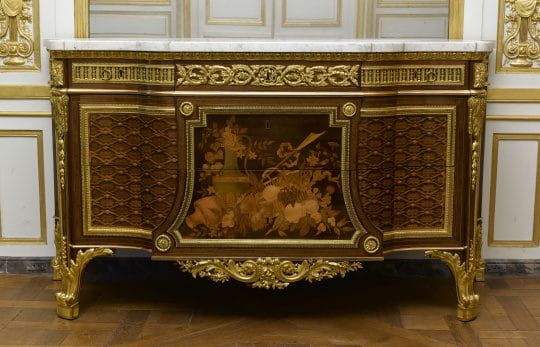
The commode by Riesener is today displayed in Queen Marie Antoinette’s bedroom at the château de Fontainebleau (Image © RMN).
Related commodes by Riesener famously include an example returned to Versailles in 1999 following its acquisition at auction in London for a record price of £7 million.
The related commode by Riesener at the Château de Versailles which was sold following the French revolution, entering the collection of the Duke of Hamilition and then the Rothschild family, before selling at auction in 1999 for £7 million. It was thereafter gifted back to Versailles.{https://amisdeversailles.com/mecenat/projets/46}
With reference to other nineteenth century versions of this important model, this example by François Linke is most highly prized by collectors because Linke’s name, as the most famous ébéniste of the Belle Epoque, adds considerable cachet and therefore value.
Date
Circa 1905
Origin
France
Medium
Gilt-Bronze and Marquetry
Signature
Signed 'F. Linke' and the lock-plate stamped 'CT LINKE SERRURERIE/PARIS'.

François Linke (1855–1946)
François Linke was the most celebrated ébéniste of the late 19th and early 20th-century Belle Époque period. His furniture is highly prized for its exceptional craftsmanship and refined design. Like many of his contemporaries, Linke produced pieces reviving the French historical styles of Louis XIV, Louis XV, and Louis XVI. However, he also pioneered entirely new designs in collaboration with the sculptor Léon Messagé. Described as Le Style Linke, these creations blend Rococo exuberance with the fluidity of Art Nouveau and were unveiled to great acclaim at the 1900 Paris International Exhibition.

François Linke’s gold medal winning stand at the 1900 Paris Exhibition (courtesy Christopher Payne / Linke Archive).
Born on 17 June 1855 in the small village of Pankraz, now in the Czech Republic, Linke served an apprenticeship with the master cabinet maker, Neumann, which he completed in 1877. By the age of eighteen, he was in Vienna, where he likely visited the 1873 International Exhibition. There, he would have admired the luxurious furniture of leading Parisian firms such as Beurdeley, Dasson, Grohé, and Fourdinois.
Linke arrived in Paris in 1875, reportedly on Christmas Day. Though not certain, it is believed he worked for the renowned German cabinetmaker Emmanuel Zwiener, whose innovative designs undoubtedly influenced Linke’s style. In 1878, he would have witnessed the third major International Exhibition in Paris, a symbol of France’s recovery following the Franco-Prussian War.
By 1881, Linke had established his own workshops in the Faubourg Saint-Antoine, supplying furniture to prominent firms such as Jansen and Krieger. The 1889 World’s Fair in Paris, marked by the unveiling of the Eiffel Tower, further fuelled his ambition. He was particularly inspired by Emmanuel Zwiener’s exhibits at the fair, especially a jewel cabinet designed by Léon Messagé and purchased by Empress Maria Feodorovna of Russia (1847-1928).

(Frontispiece to Léon Messagé’s compendium of designs titled ‘Cahier des Dessins & Croquis Style Louis XV’).
Léon Messagé (1842-1901) was the design genius behind Linke’s furniture for the 1900 exhibition. He sculpted the figural bronzes and created a new design vocabulary which fused the rococo with the Art Nouveau which became known as “Le Style Linke”.
As early as 1892, the French government announced plans for another grand exhibition at the century’s end, partly to pre-empt Berlin from staging the last great show of the century. Victor Champier, one of the commissioners for the 1900 Paris Fair appealed “Create in the manner of the masters, do not copy what they have made.” Linke rose to this challenge against mere reproduction with bold originality. His pièce de résistance was Le Grand Bibliothèque, an astonishing bookcase that embodied his new style.

Linke’s masterpiece ‘La Grande Bibliothèque’ illustrated in ‘La Décoration et l’ameublement à l’Exposition de 1900’, v. 1, by Armand Guèrinet, Paris, 1900, page p. 8, pl. 1.

‘La Grande Bibliothèque’ shown on Adrian Alan’s stand at the Olympia Art & Antiques Fair.
Perhaps the most remarkable chapter in Linke’s career was his decision to produce such extravagant and luxurious furniture for the 1900 Exhibition without any commission or guaranteed buyer.

François Linke’s official exhibitor’s pass for the 1900 exhibition (courtesy Christopher Payne / Linke Archive).
While long-established houses like Beurdeley and Dasson were closing, Linke risked everything on this ambitious display. He recognized the need to attract an international clientele, particularly the emerging nouveau riche who were amassing wealth at an unprecedented scale. Had his gamble failed, bankruptcy would have been almost certain. In this sense, Linke was arguably the greatest furniture entrepreneur of the Belle Époque, and perhaps of any era.

The Grand Bureau made for the 1900 Paris Exhibition. The desk represents the “Productivity of France and Man”. Its iconography symbolises the power and confidence of human achievement, the crowning glory of the fin de siècle. As such it reflects the whole ethos of the 1900 exhibition – to look forward to a new age.
Linke’s notebooks record visitors from across the globe to his stand, including royalty, aristocrats, and industrialists: the King of Sweden; the King of Belgium (who visited three times); Prince Radziwill; the Prince d’Arenberg; Comte Alberic du Chastel; American heiress Anna May Gould; distinguished furniture makers; and French President Émile Loubet.

Solly Joel (Solomon Barnato Joel), (1865-1931), financier and ‘King of Diamonds’was reported as the major buyer of Linke’s furniture at the 1900 Exhibition. Linke’s delivery book records four pieces, the Grand Bureau, index number 550, the associated armchair, number 703, the inkwell, number 709 and the Mars and Venus Cabinet, number 701. The following year Joel also bought the Grand Bibliothèque.
His gamble was a resounding success. With his reputation firmly established, Maison Linke became the pre-eminent furniture maker until the outbreak of the Second World War. The technical brilliance of his work and the artistic change that it represented was never to be repeated. Linke expanded his showrooms to prestigious premises in Paris, including the Place Vendôme and the Faubourg Saint-Antoine, where his workshop had been established.

F. Linke signature.
In the years leading up to World War I, Linke undertook many major commissions for leading international industrialists and financiers. He is also reputed to have supplied furniture to the Kaiser. After the war, Linke was commissioned to furnish the Ras al-Tin Palace in Alexandria for King Fuad of Egypt, possibly the largest single furniture commission ever attempted, even eclipsing Versailles.
Linke flourished and remained active well into the 1930s and died in 1946. His legacy endures as a master of his craft and a visionary who reshaped the art of furniture-making for the modern age.

Linke’s life and work are comprehensively documented by Christopher Payne in ‘François Linke 1855-1946: The Belle Epoque of French Furniture’.
View our stock of available items by François Linke
Bibliography:
Ledoux – Lebard, Denise. Les Ébénistes du XIXe siècle, Les Editions de L’Amateur, (Paris), 1984; pp. 440-444.
Payne, Christopher. François Linke 1855-1946: The Belle Epoque of French Furniture. Antique Collectors’ Club, (Woodbridge, UK), 2003.
Meyer, Jonathan. Great Exhibitions – London, New York, Paris, Philadelphia, 1851-1900, Antique Collectors’ Club, (Woodbridge, UK), 2006.
Mestdagh, Camille & Lécoules, Pierre. L’Ameublement d’Art Français, 1850-1900, Les Editions de L’Amateur, (Paris), 2010.
Payne, Christopher. Paris Furniture – the luxury market of the 19th century, Éditions Monelle Hayot (Paris), 2018; pp.436-456
Christopher Payne, François Linke, (1855 – 1946), The Belle Époque of French Furniture, Antique Collectors’ Club, (Woodbridge, UK), 2003. p. 205-206.
Pradère, Alexandre. French Furniture Makers: The Art of the Ebeniste from Louis XVI to the Revolution, Oxford University Press; pages 371 – 388.