Émile-Coriolan-Hippolyte Guillemin
Émile Guillemin, A Fine Orientalist Bronze Bust of a Young Woman, Dated 1882
£28,000
Émile-Coriolan-Hippolyte Guillemin (French, 1841-1907) A Fine Multipatinated Orientalist Bust of A Young Woman.Signed and dated 'Ele. Guillemin /...
Dimensions
Height: 64 cm (26 in)Width: 42 cm (17 in)
Depth: 30 cm (12 in)

 Print
Description
Émile-Coriolan-Hippolyte Guillemin (French, 1841-1907)
A Fine Multipatinated Orientalist Bust of A Young Woman.
Signed and dated ‘Ele. Guillemin / 1882’.
Bronze, polychrome patina, inset with faceted red stones, on a veined red marble socle.
This impressive ‘Orientalist’ bust has a fine multipatinated surface, the young woman dressed in traditional costume and adorned with regional jewels. Dated 1882, is an example of the finely detailed polychrome sculptures for which Guillemin is best known.
Emile Guillemin made his debut at the Salon in 1870, and from 1877 submitted works on exclusively Orientalist themes, receiving an Honorable Mention for sculpture in 1897. Although his oeuvre included a wide range of subjects, Guillemin specialised in ethnographic sculpture and is renowned as a proponent of the Orientalist movement. His approach to his subjects was not simply decorative and, as in the work of Charles Cordier, Guillemin went to great lengths to ensure the accuracy of the costumes and physiognomies of his busts.
France, Dated 1882.
Date
Dated 1882
Origin
France
Medium
Patinated Bronze
Signature
Signed and dated 'Ele. Guillemin / 1882'.
Born in Paris in 1841, Émile-Coriolan-Hippolyte Guillemin was the son of sculptor Émile-Marie-Auguste Guillemin, who worked for the state producing copies of antique sculptures and busts of various aristocrats. After studying with both his father and sculptor Jean-Jules Salmson (1832-1902), Guillemin exhibited at the Salon for the first time in 1870 where he exhibited a pair of Roman Gladiators, Retaire and Mirmillon, drawn from antiquity. Though his output was wide ranging, Guillemin became most well-known for depicting figures from the Middle East and Asia in an Orientalist style. Compared to many of his contemporaries, though, Guillemin’s sculptures lack the overt sensuality and ‘otherness’ found in depictions of non-Europeans, especially women, and instead present seemingly studied depictions of figures representing a certain culture.
Guillemin’s oeuvre is perhaps most adjacent to his contemporary, Charles-Henri-Joseph Cordier (d. 1905), who served as a privileged sculpture of Paris’ Natural History Museum, travelling extensively to Africa, and producing a series of lifelike busts for their Ethnographic Gallery. In his sculpture Guillemin’s was, like Cordier, drawn to use polychrome patinas to reflect the exoticism of his subjects and appeal to the luxurious tastes of his day. Guillemin is considered a fine rather than a purely decorative artist, though his oeuvre was often associated with large-scale works such as his torchères Indienne et Persane by the Barbedienne foundry (1872).
His work will remain valued for the honesty in the portrayal of his sitters. This is most apparent in an equally arresting pair of portrait busts of ‘Janissaire du Sultan Mahmoud II’ and ‘Femme Kabyle d’Algerie’, sold from The Estate of Rochelle Sepenuk, Sotheby’s, New York, 21 October 2008, lot 92 ($1,202,500).
Bibliography:
Kjellberg, Pierre. Les Bronzes du XIX siècle, Dictionnaire des Sculpteurs, Les Editions de l’Amateur, (Paris), 1989; pps. 369-370.
Kjellberg, Pierre. Les Bronzes du XIX siècle, Dictionnaire des Sculpteurs, Les Editions de l’Amateur, (Paris), 1989; pps. 369-370.
YOU MAY ALSO LIKE
- £45,000 Add to cart
 Gaetano Rossi
A Lifesize White Marble Bust of the Capuan Venus After The Antique
- POA Read more
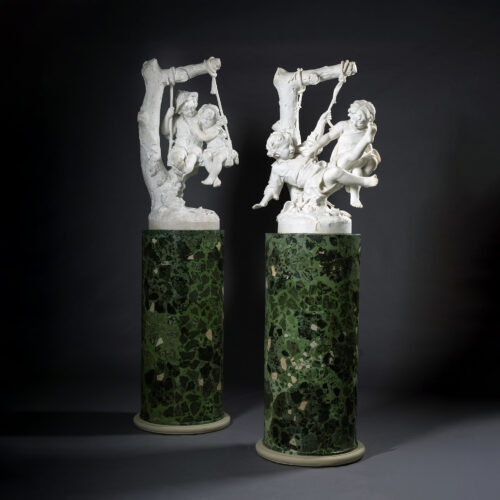 Alessandro Lazzerini
A Pair of Large Carrara Marble Figural Groups Of Children on Swings
- £32,000 Add to cart
 Louis Ernest Barrias
‘La Nature se dévoilant devant la Science’ – A Fine Patinated Bronze Figure