Henry Dasson
‘Table des Arts’ – An Important Gilt-Bronze, Mahogany And Porphyry Table
POA
Table des Arts' - An Important Gilt-Bronze, Mahogany And Porphyry Table. By Henry Dasson. France, Dated 1889.The original and rare Egyptian porphyry...
Dimensions
Height: 81 cm (32 in)Width: 98 cm (39 in)
Depth: 58 cm (23 in)

 Print
PrintDescription
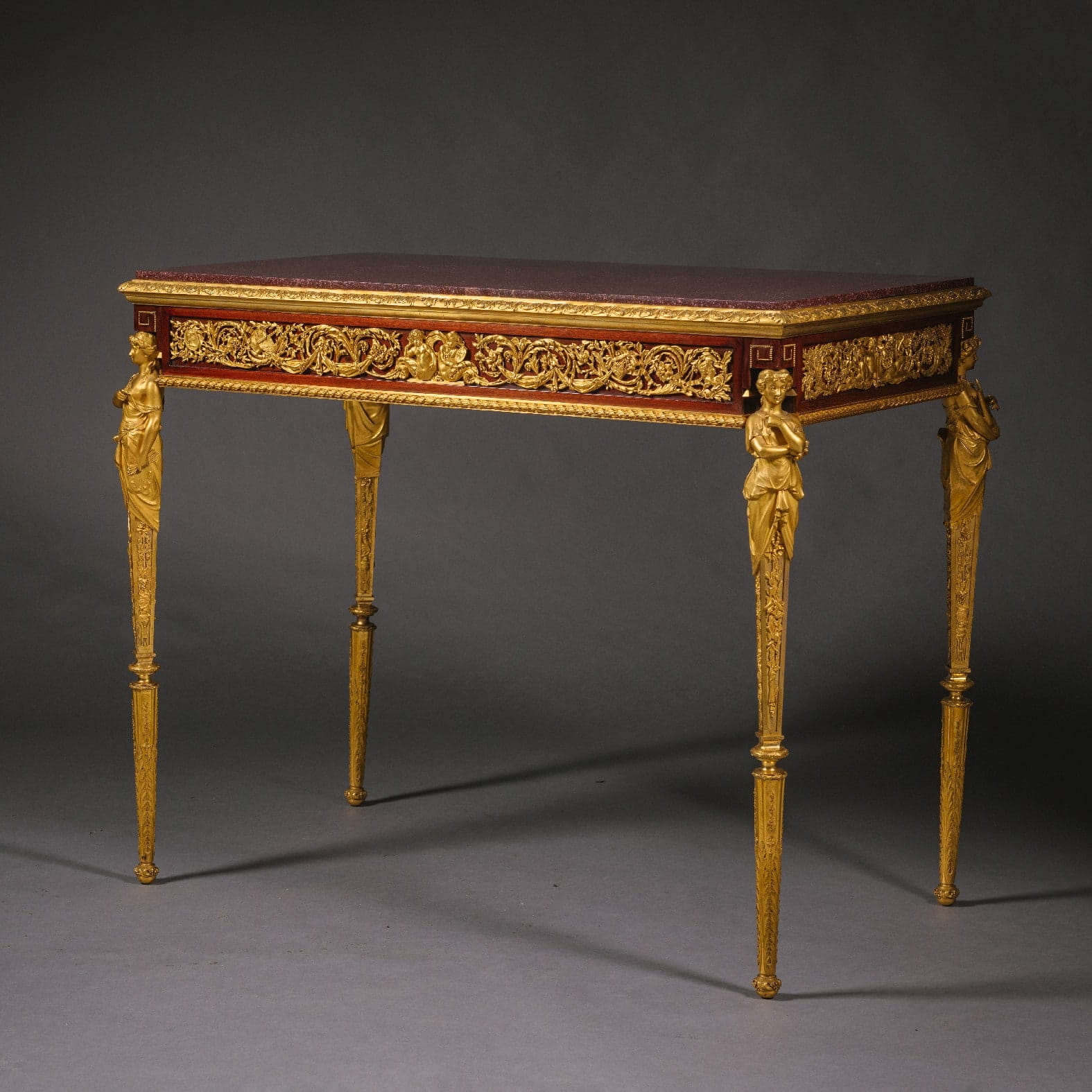
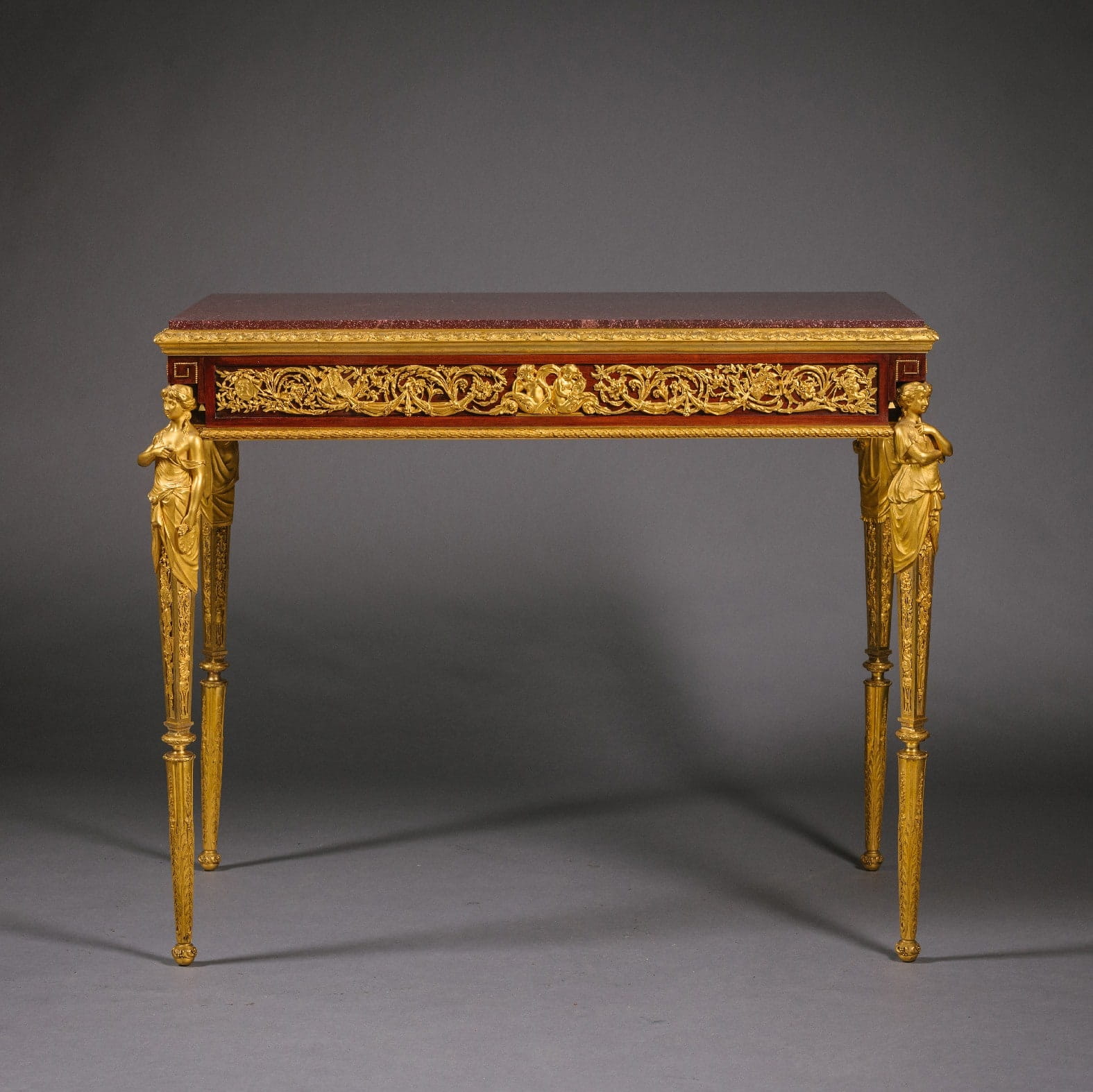
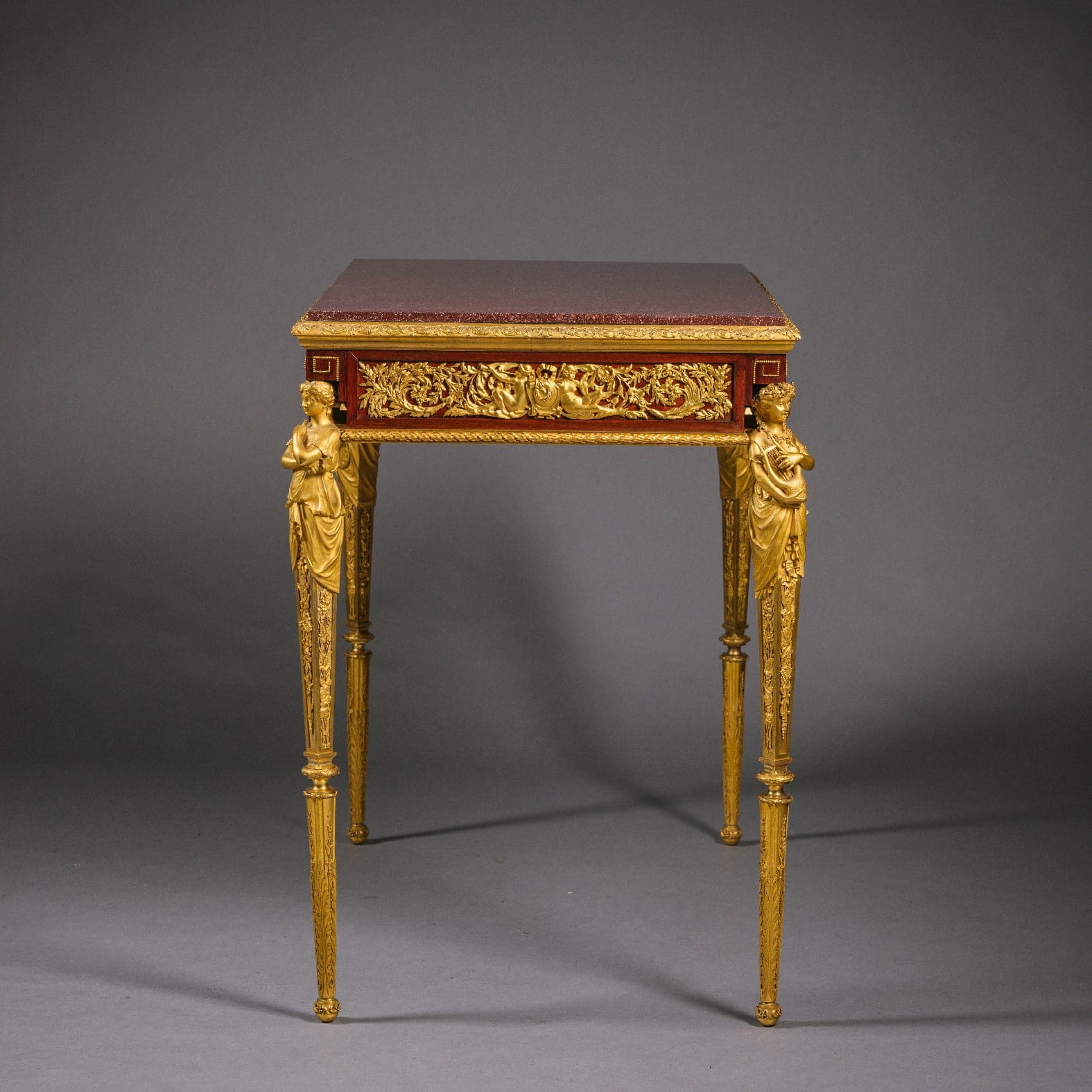
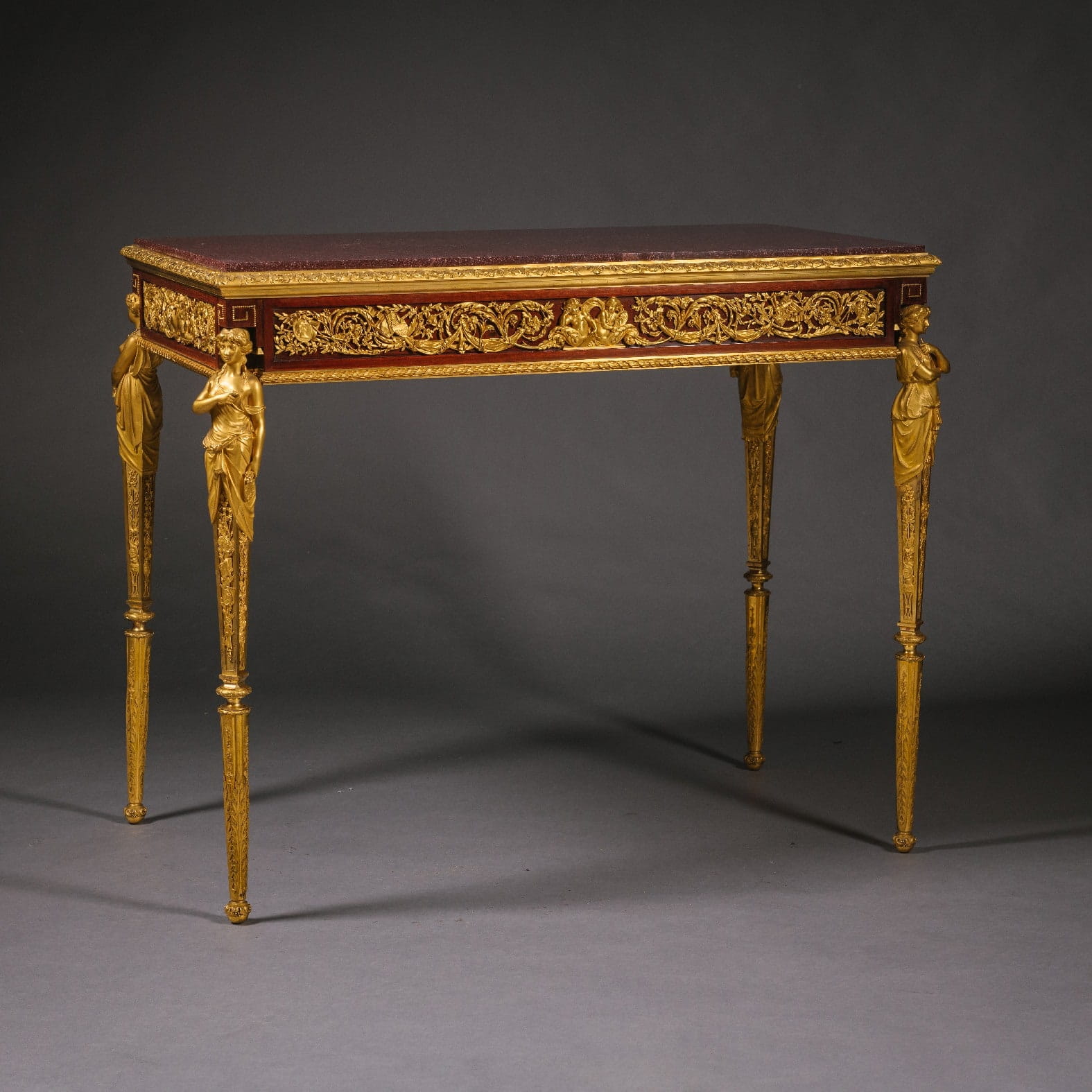
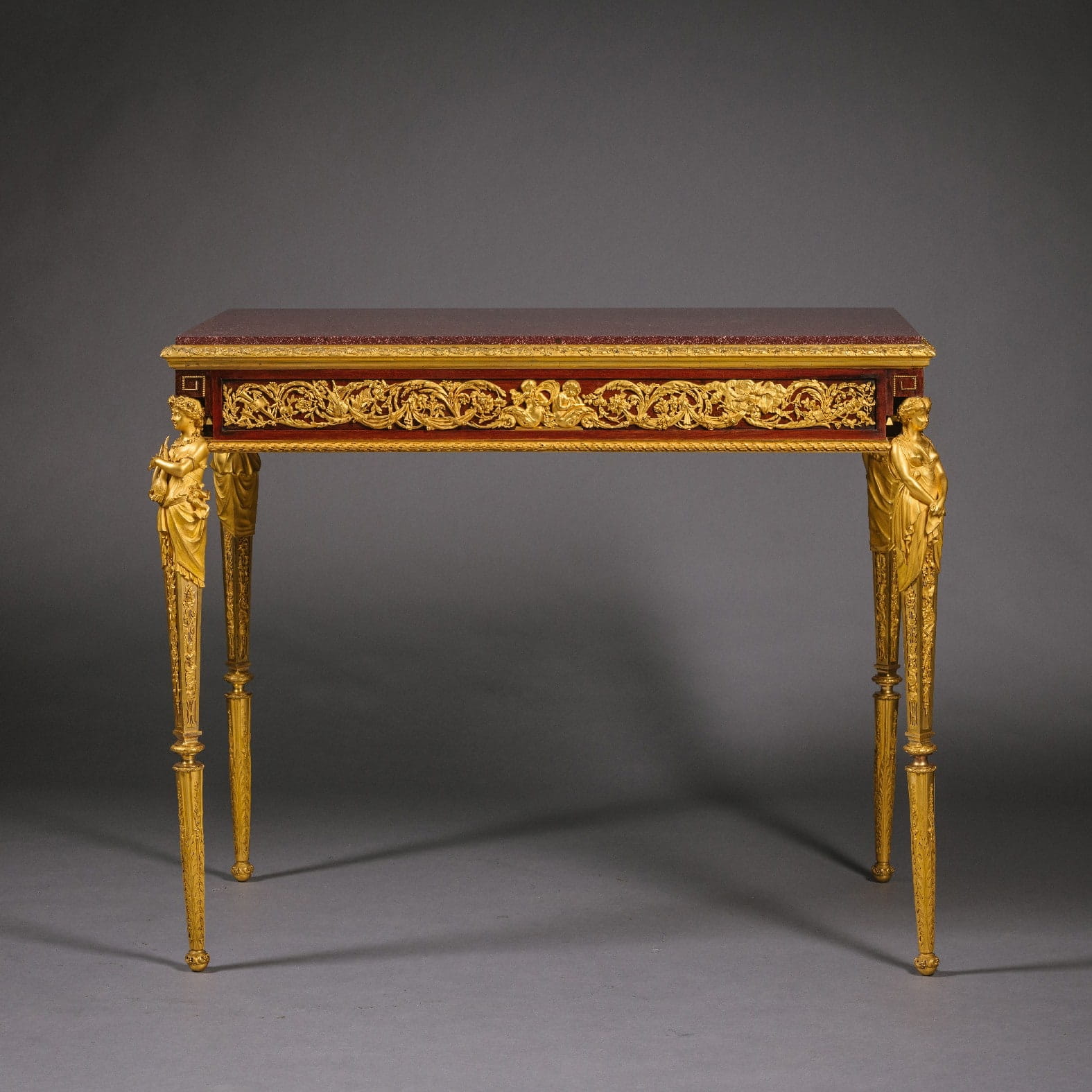
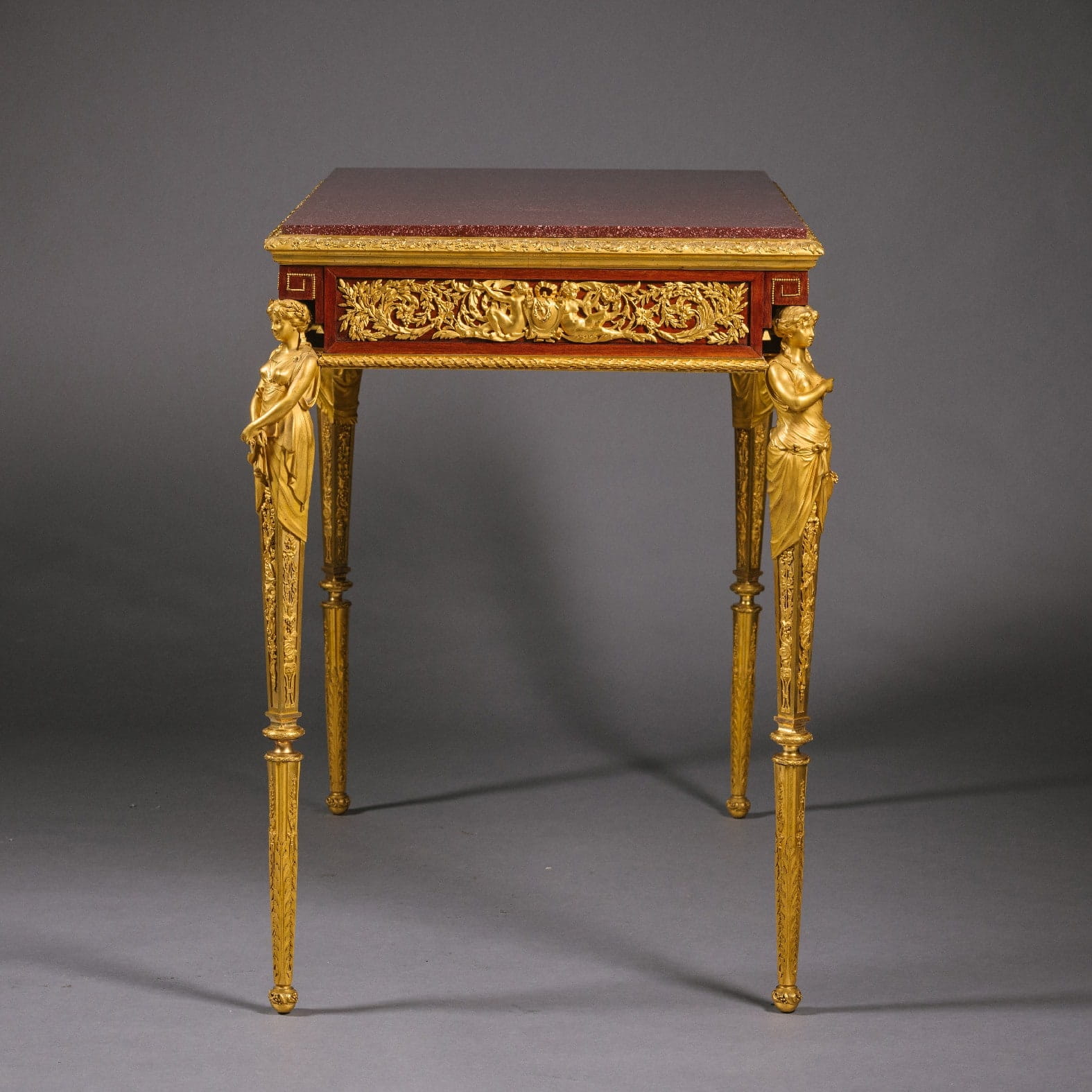
Table des Arts’ – An Important Gilt-Bronze, Mahogany And Porphyry Table. By Henry Dasson. France, Dated 1889.
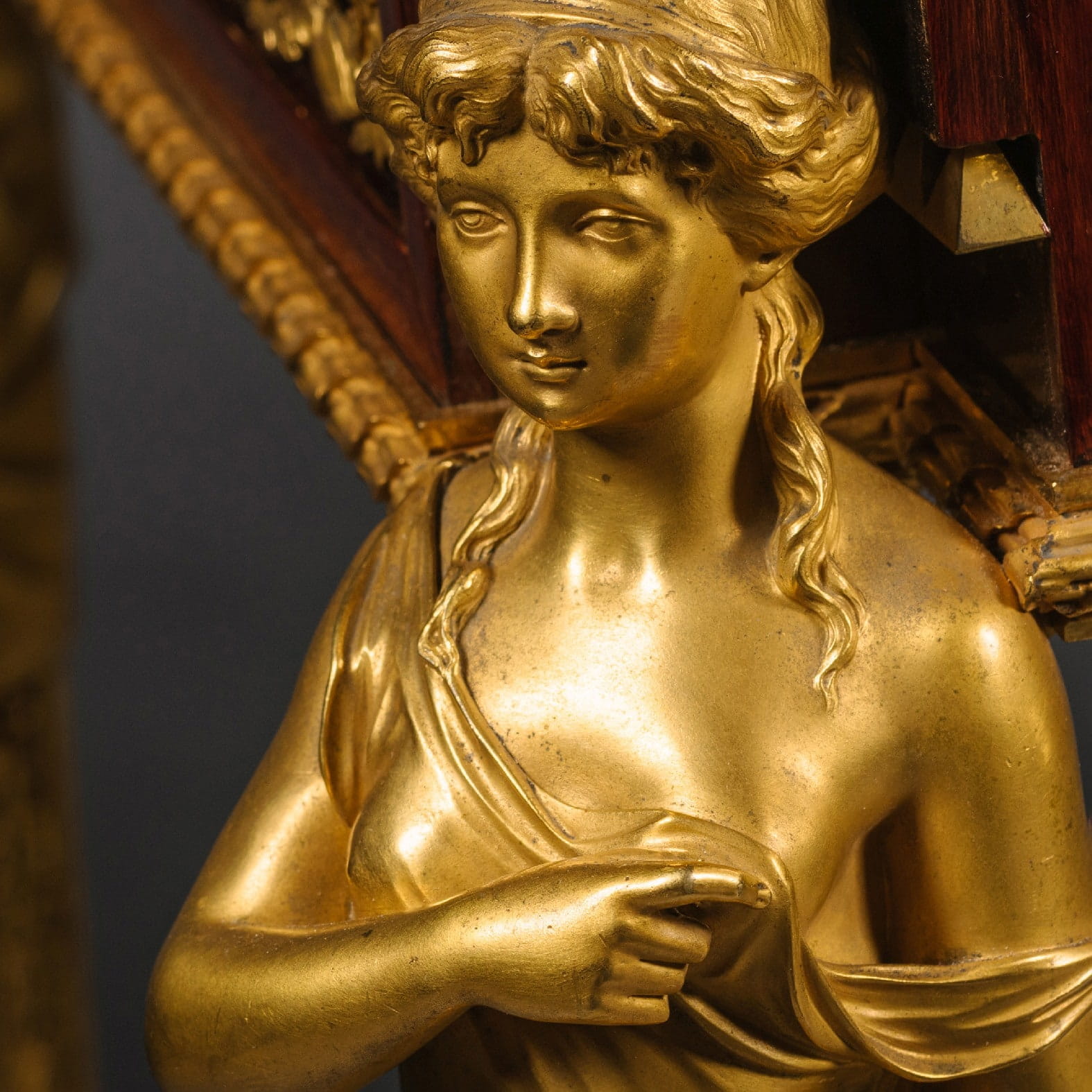
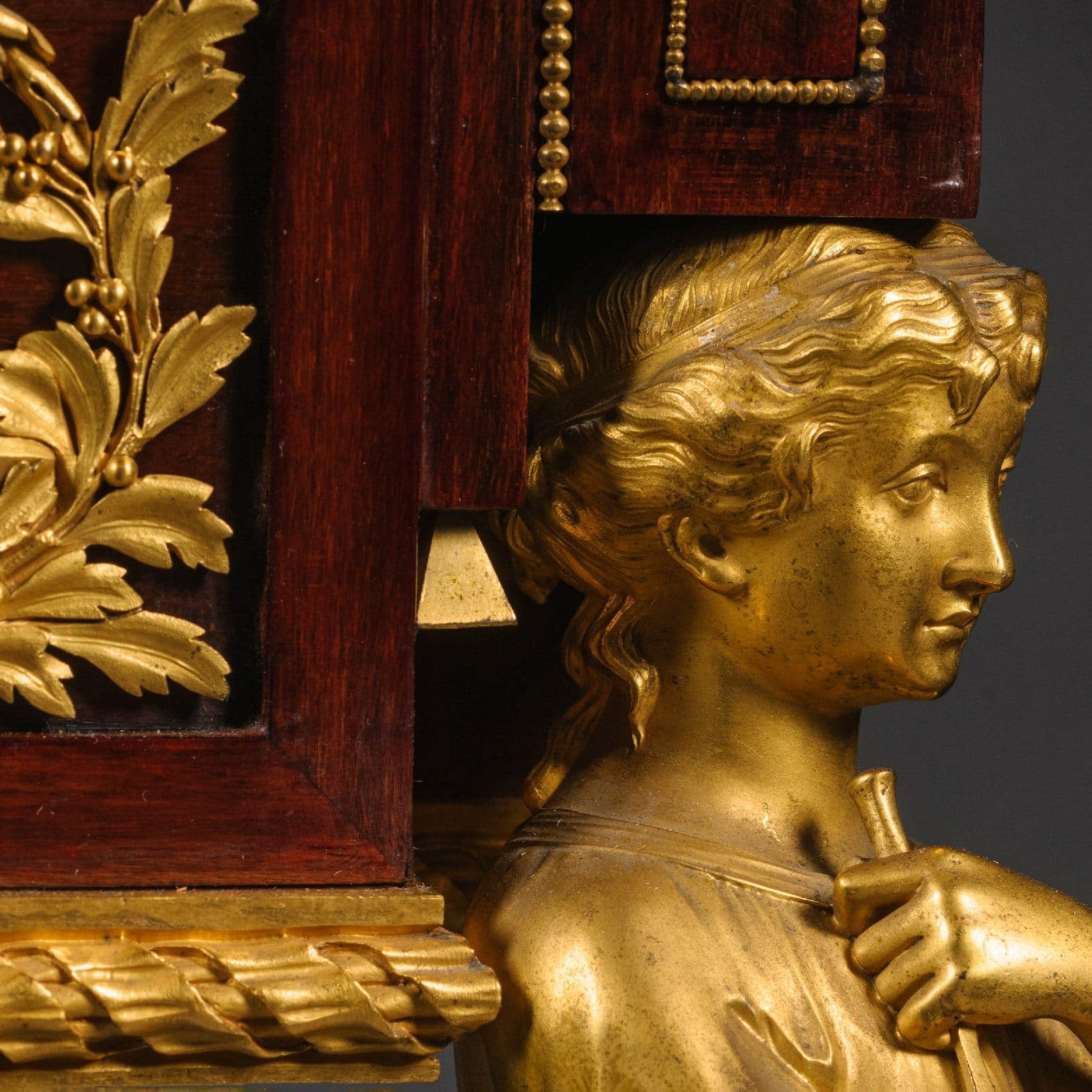
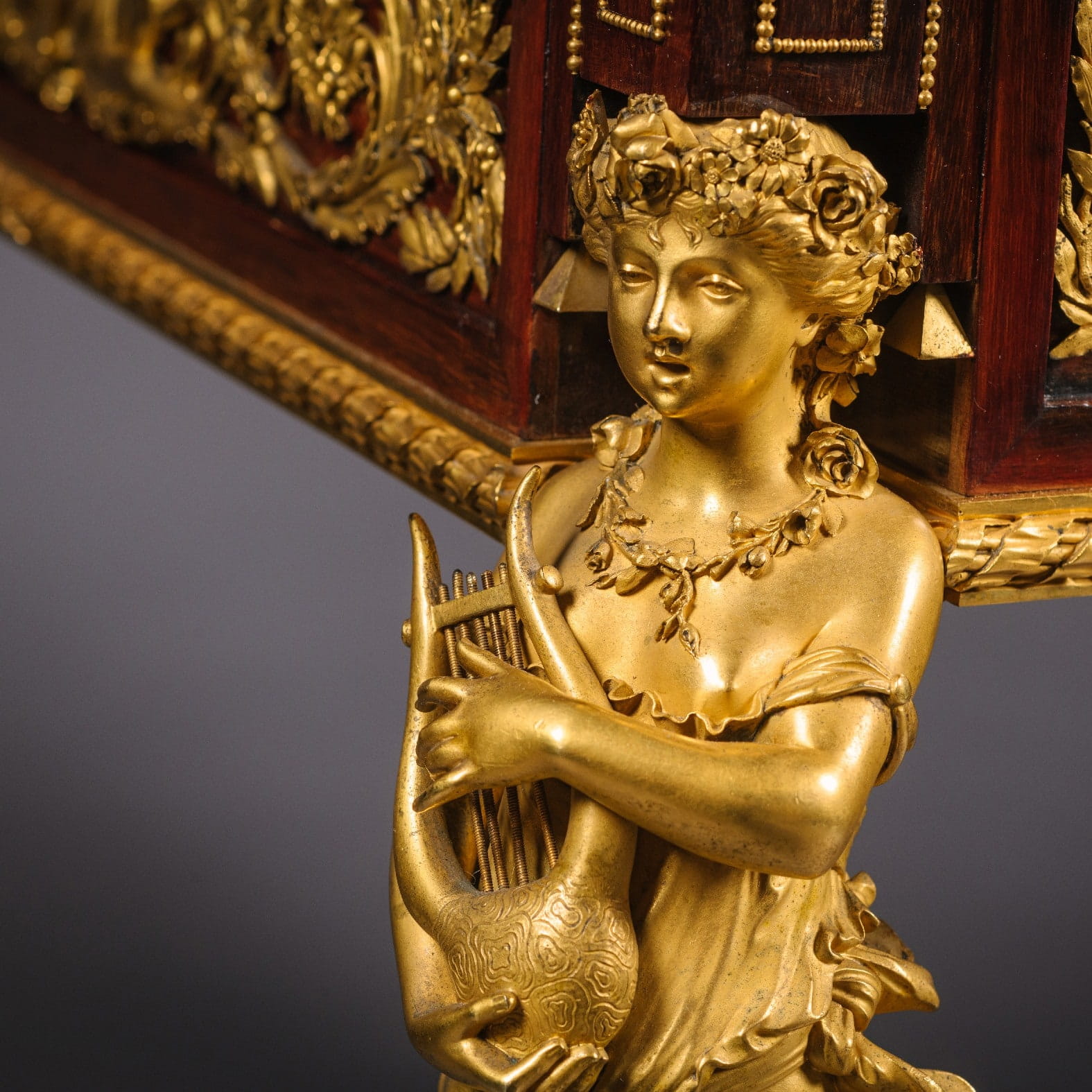
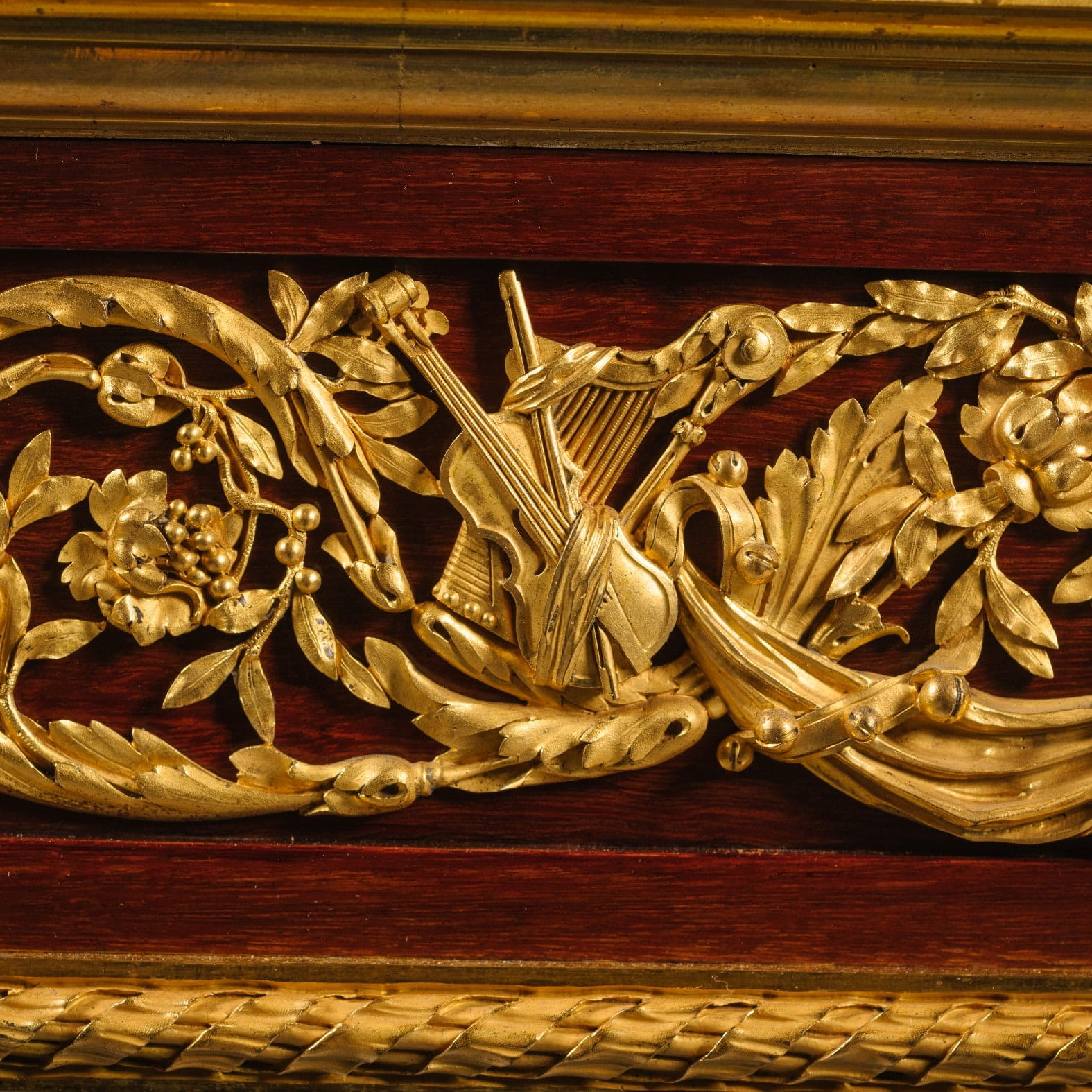
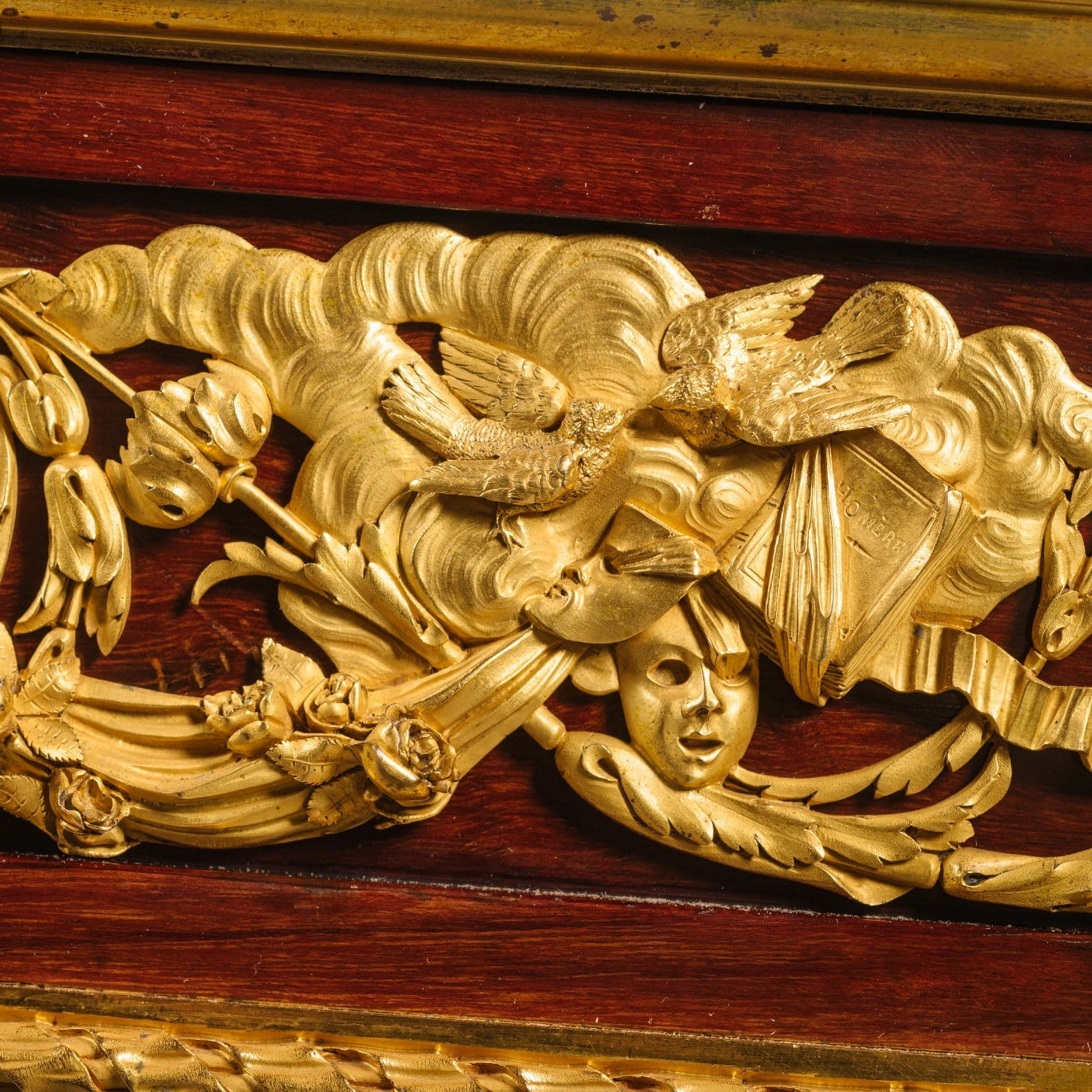
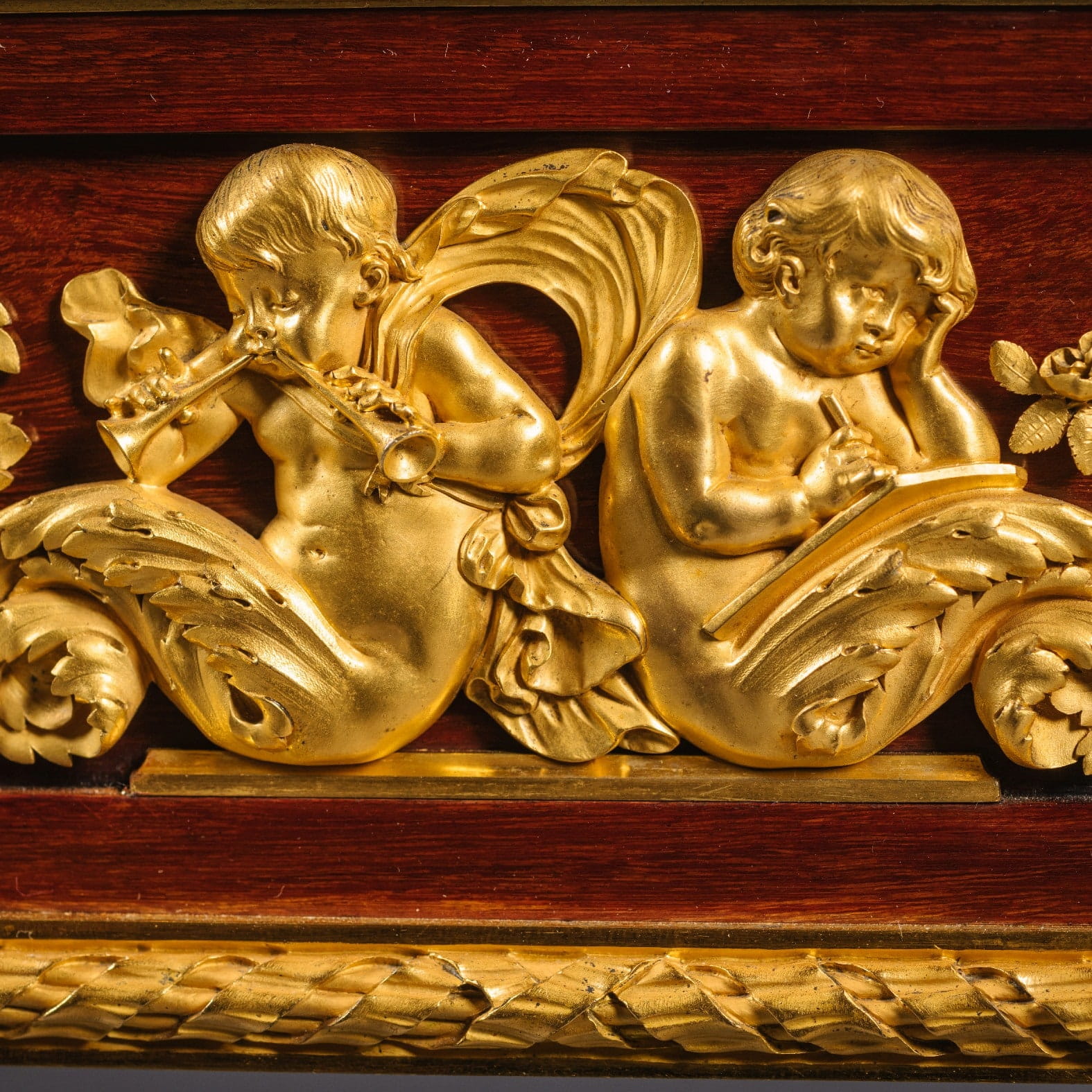
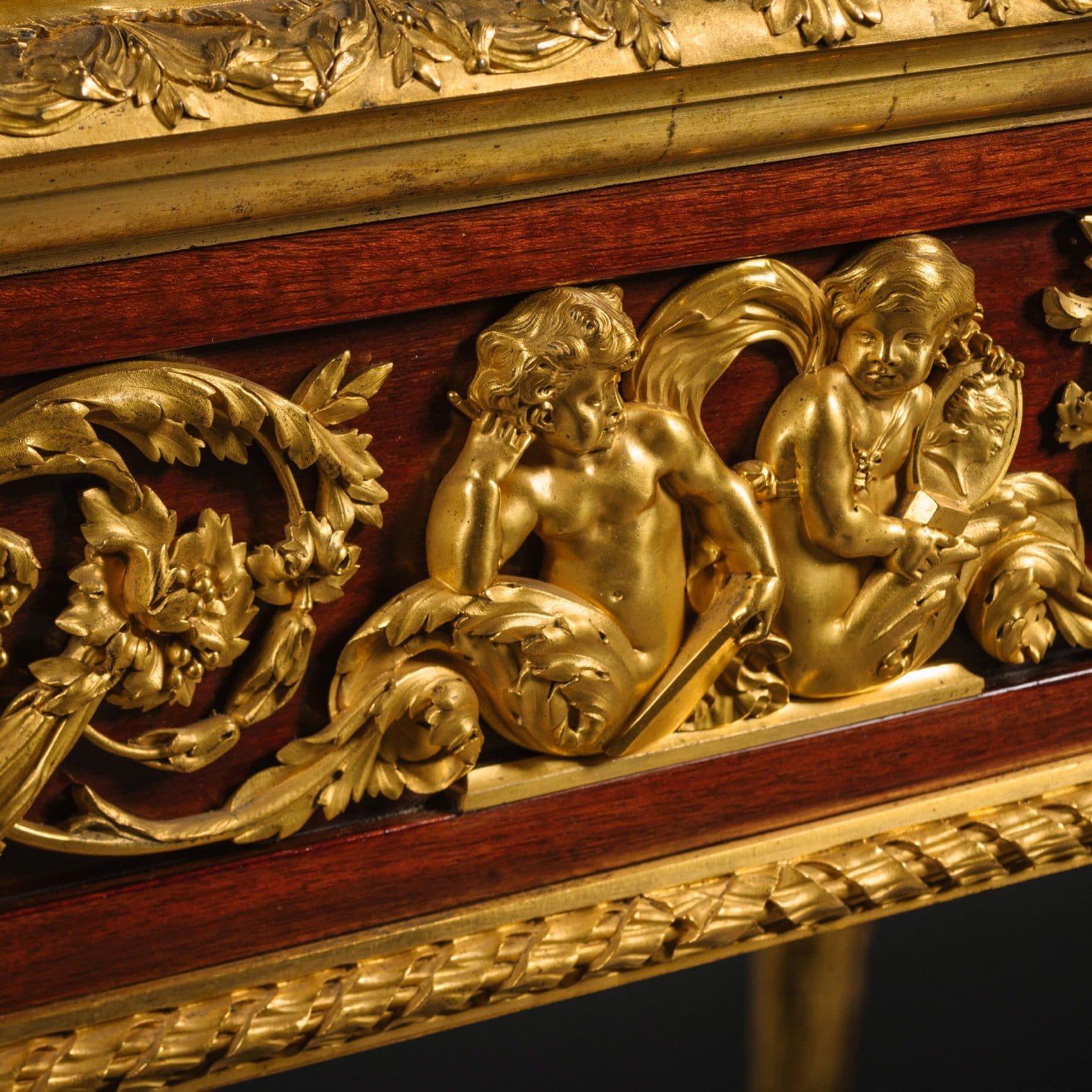
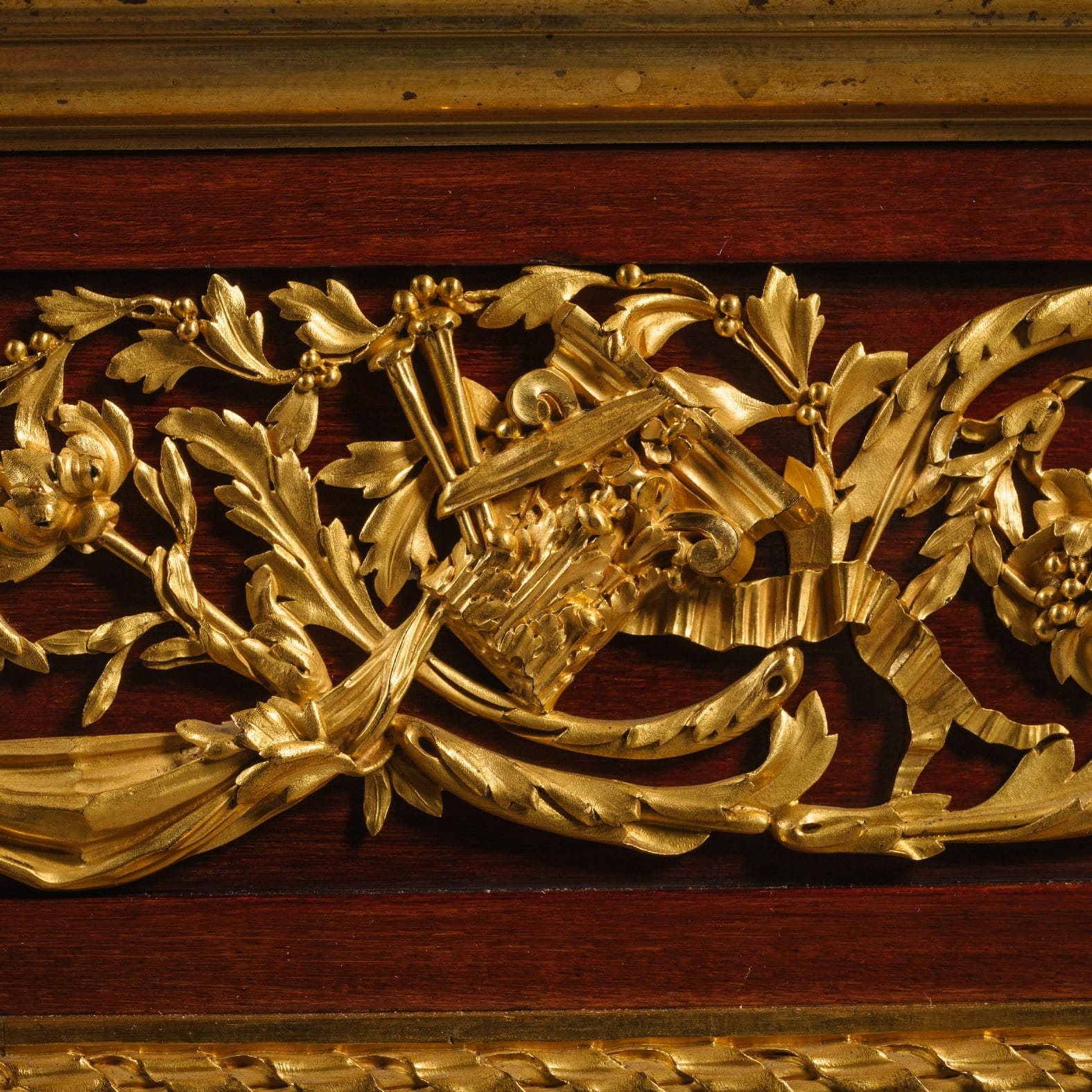
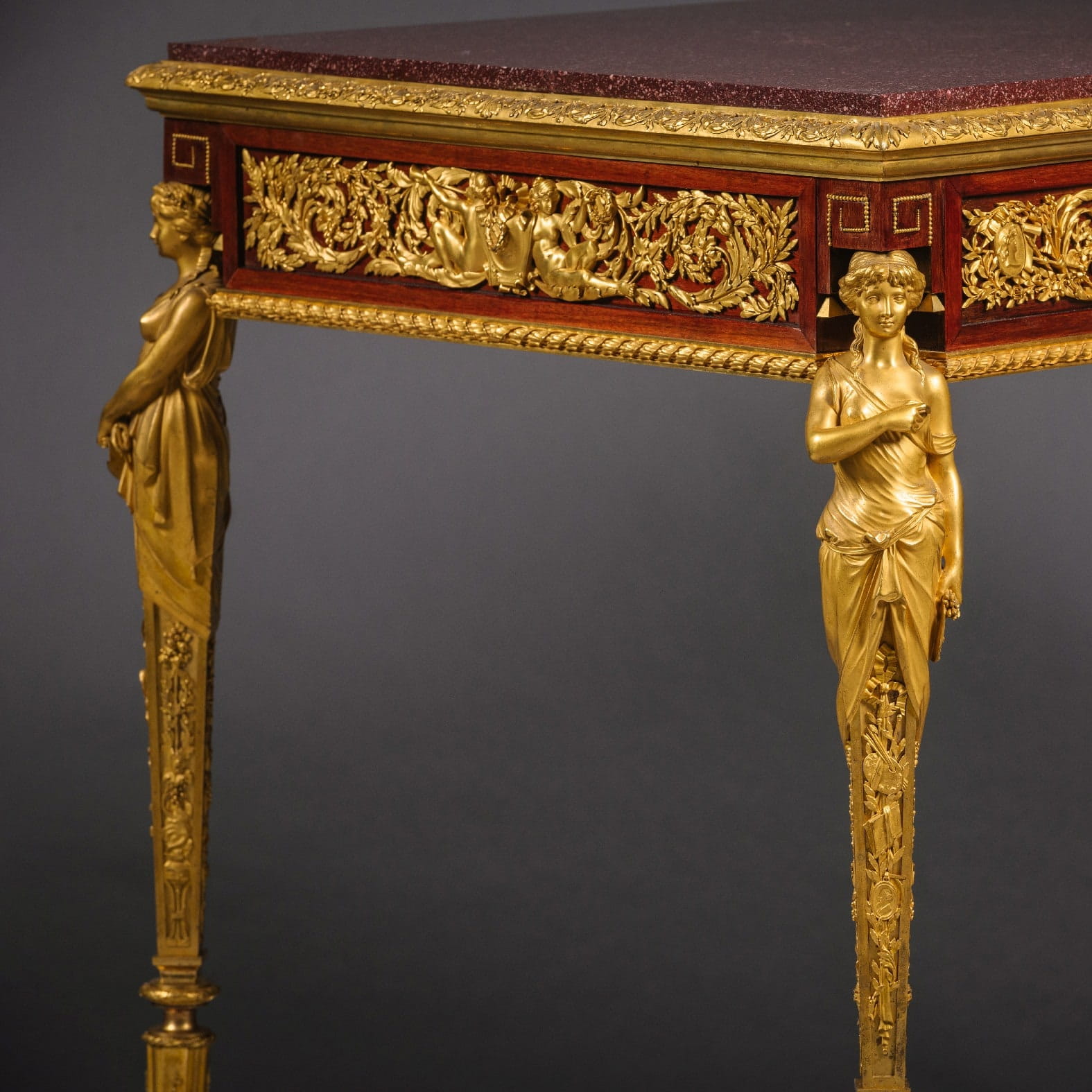
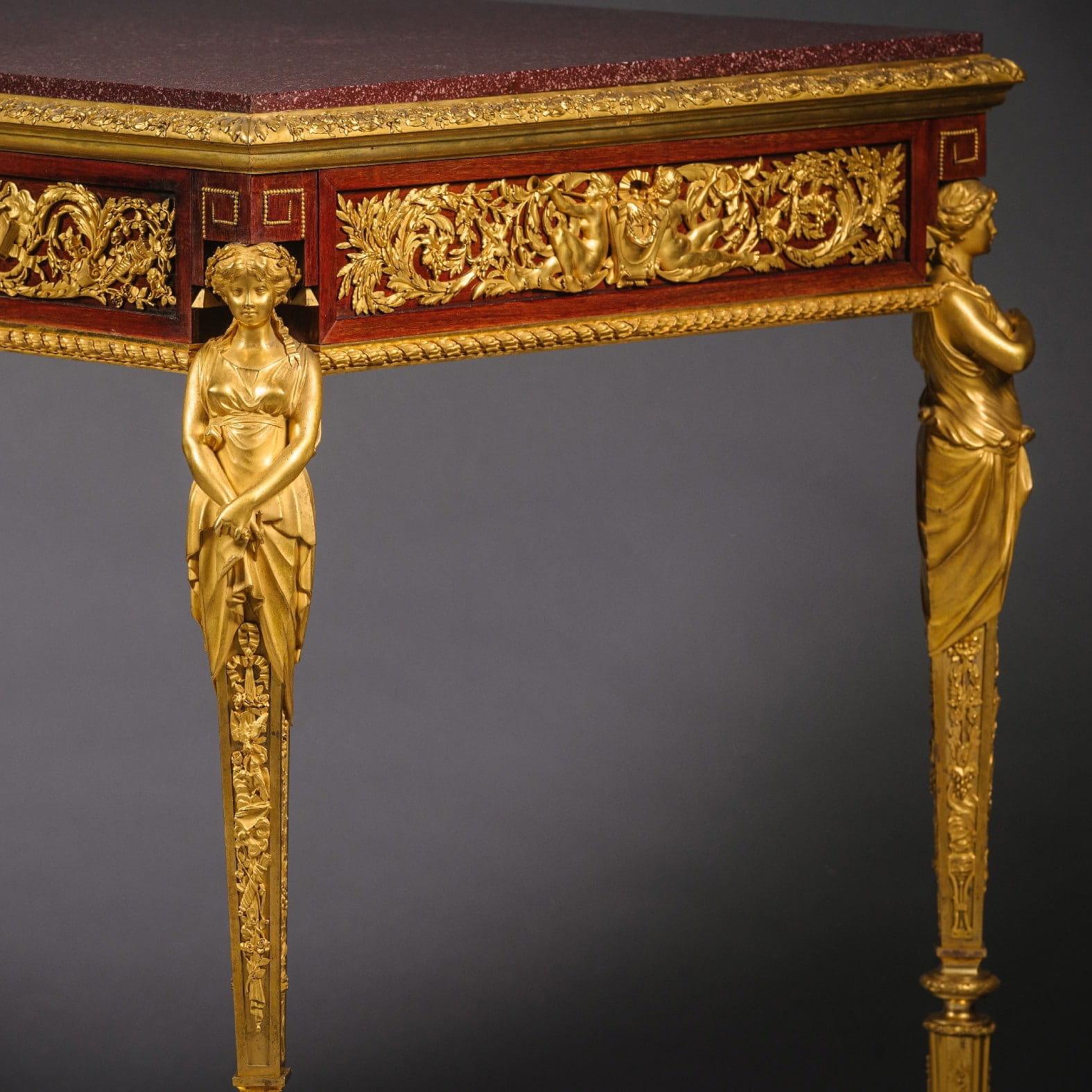
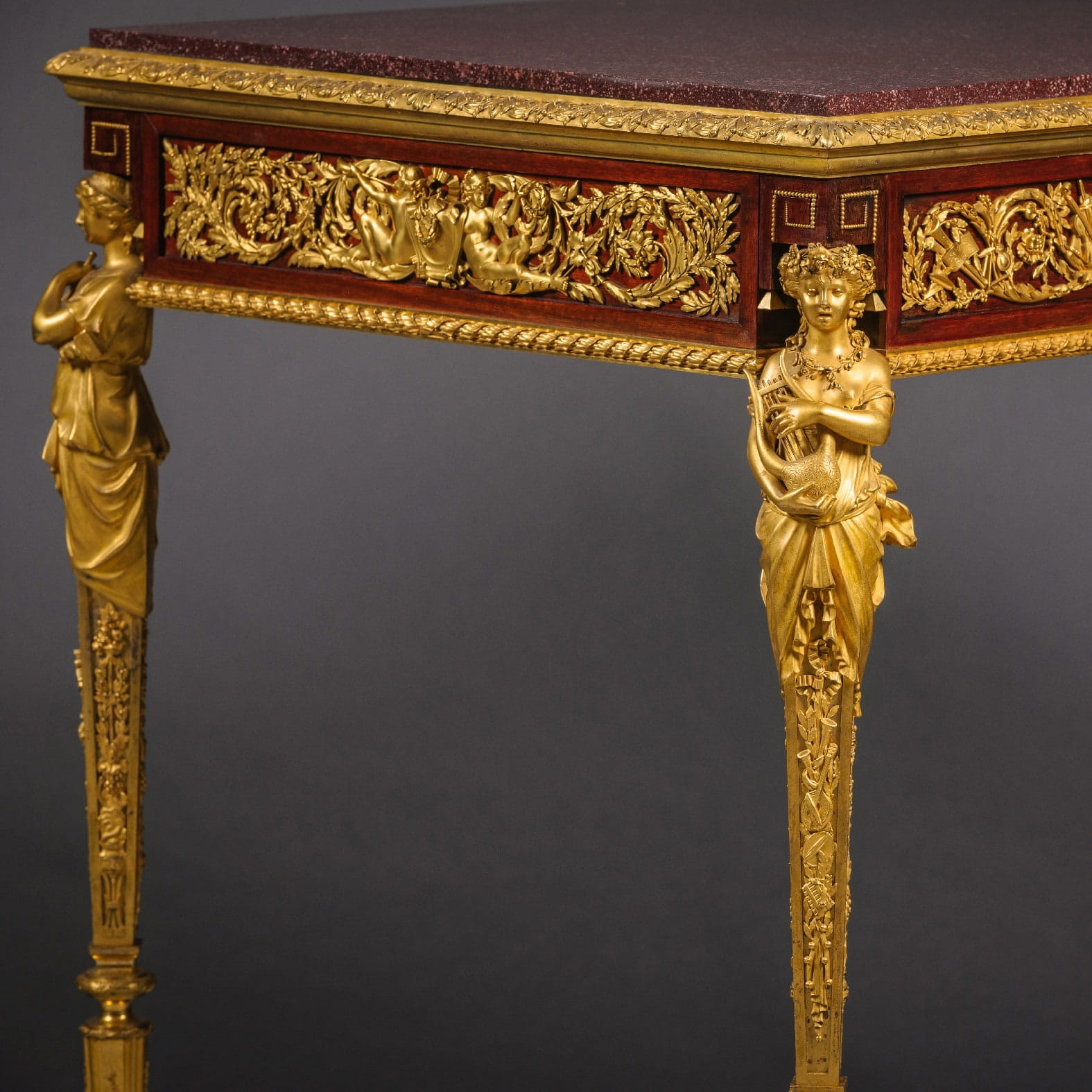
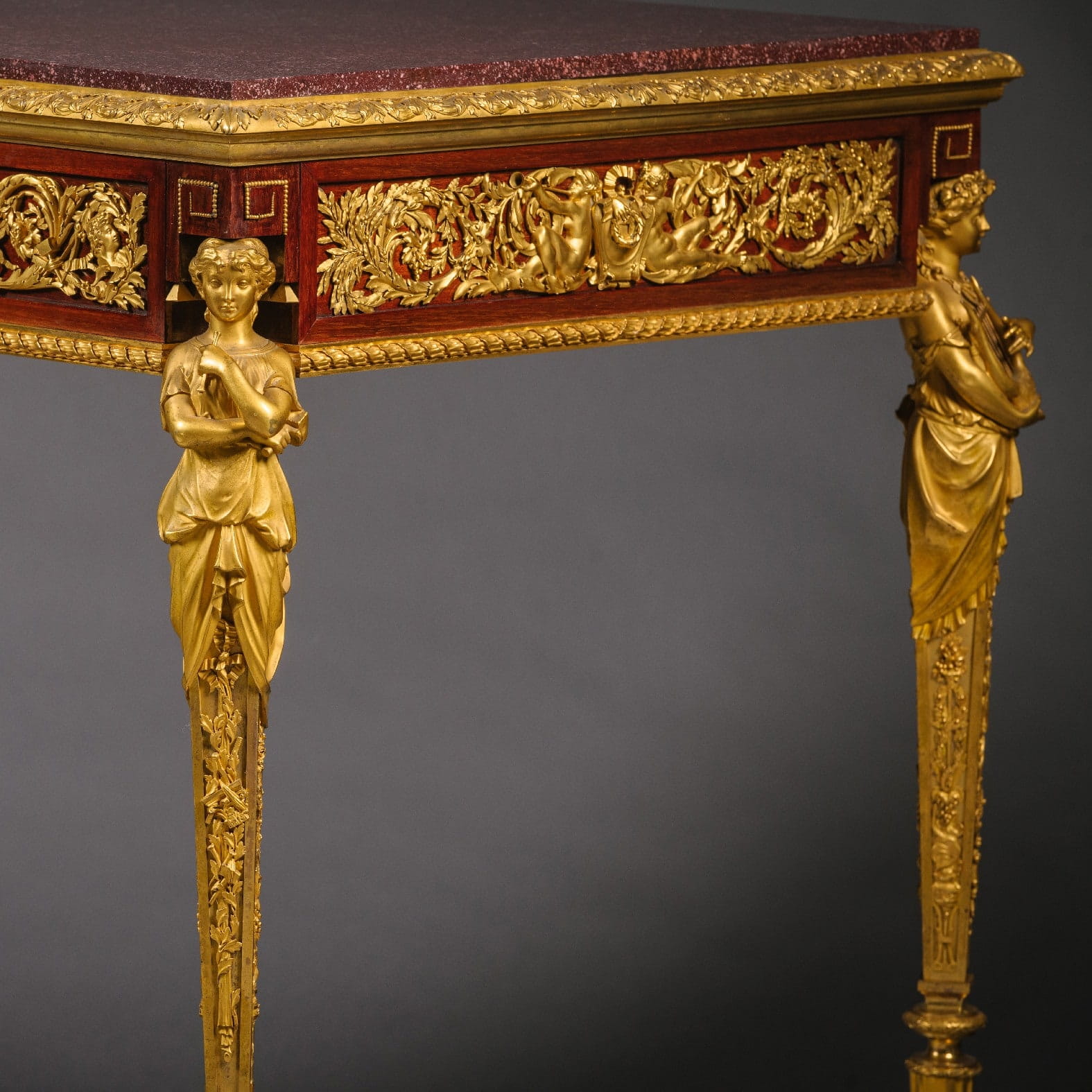
The original and rare Egyptian porphyry top above a frieze inset with gilt-bronze scrolled acanthus finely detailed with all manner of miniature attributes representing the arts. On four gilt-bronze legs modelled as caryatid figures representing painting, sculpture, music and poetry. Beneath the figures, the legs taper and are ornamented with finely cast details which correspond to each figures’ attribute.
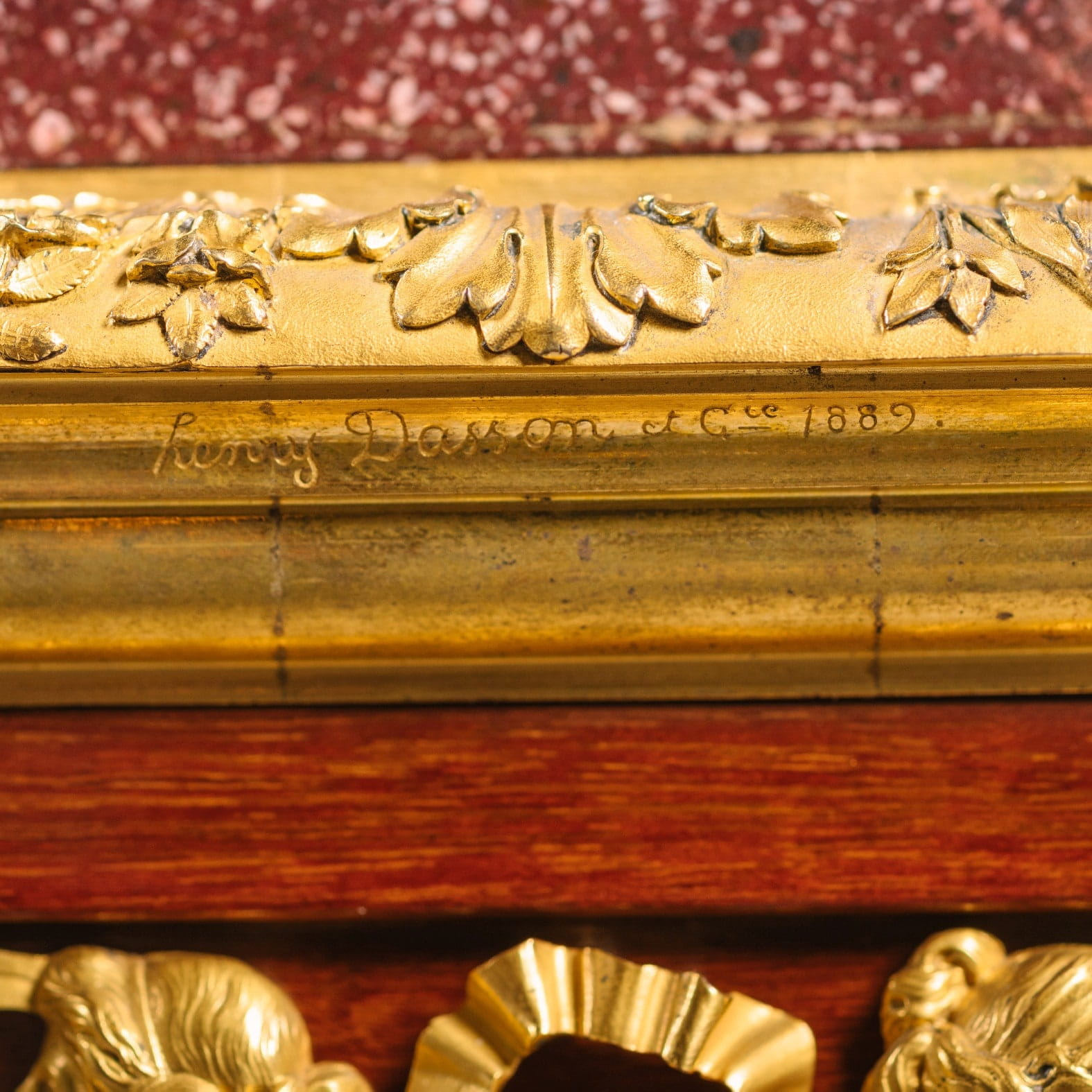
Signed and dated ‘henry Dasson et Cie. 1889’.
France, Dated 1889.
This fine guèridon is known as the ‘Tables des Arts’ in reference to the legs which are sculpted in gilt-bronze as caryatid figures representing painting, sculpture, music and poetry.
This table was conceived as an exhibition piece to show the accomplishment of Henry Dasson’s production in both originality of design and finesse of manufacture. Since its unveiling it has been considered a preeminent example of Dasson’s oeuvre. It has long been prized by collectors, primarily for the phenomenal quality of the sculptural gilt-bronzes.
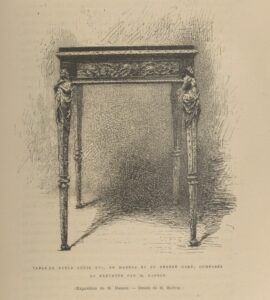
‘Table des Quatre Saisons’ at the 1878 Paris Exhibition
The design is indebted to the Louis XVI style. Specifically, the scrolled frieze mounts and the sculptural half-figures recall the work of the bronziers Pierre Gouthière and François Rémond who supplied gilt-bronze mountings for furniture by Adam Weisweiler and Jean-Henri Riesener, makers to King Louis XVI. However, with great conviction, Dasson on this table does not replicate but modifies these very elements to make them distinctly his own. The figures are individually and exquisitely modelled with phenomenal detail. Under Dasson’s hand these architectural herms are ennobled and personified as graceful muses of the arts.
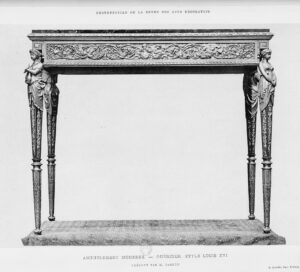
‘Table des Arts’ dated 1880, shown at the 1883 Amsterdam Exhibition. Described as ‘Ameublement Moderne – guèridon, Style Louis XVI, execute par H. Dasson’ (Victor Champier (Ed), Revue des arts décoratifs, Paris, 1883).
This model of table was first shown at the 1878 Paris Exposition universelle with caryatids representing the seasons. The first known example of the ‘Table des Arts’ is dated 1880 and was exhibited at the French Pavilion at the 1883 Amsterdam Exhibition. One other example of the ‘Table des Quatre Saisons’ is known, dated 1886. The present ‘Table des Arts’ dated 1889 was almost certainly shown at the 1889 Paris exhibition, identifiable from the following description: ‘sa petite table Louis XVI, en vieil acajou, dessus en porphyre, avec quatre pieds formés de fines statuettes en bronze ciselé’.
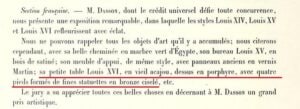
Report of the jury for the 1889 Paris exposition describing this table.
Date
Dated 1889.
Origin
France
Medium
Gilt-Bronze, Mahogany, and Porphyry
Signature
Signed and dated 'henry Dasson et Cie. 1889'.
Henry Dasson

M. Henry Dasson, Fabricant de Bronzes d’Art, in 1883.
In the nineteenth century Henry Dasson was one of the finest makers of gilt-bronze mounted furniture, clocks, candelabra and other works of art. Renowned for the quality of his gilt-bronze, Dasson was no mere foundryman, but an artist in bronze, and his mastery of the medium was such that he was called a nineteenth century Benvenuto Cellini.

Detail showing the exceptional quality of the gilt-bronze to the ‘Table des Arts’ by Henry Dasson (Collection Adrian Alan).
From humble beginnings as the son of a shoemaker, Dasson’s first master was Arnoux, a clockmaker of great merit. Dasson refined the quality in making bronze clock casings, rose to become manager and, by 1858, is listed as a clockmaker in his own right. In 1866 Dasson took over the business of Carl Drechsler who had himself succeeded from Charles Crozatier, who had established a celebrated reputation for casting bronze statuary. Most famously Crozatier cast the statue of Napoleon atop the Vendôme Column.
Crozatier and Drechsler also made furniture, notably for the fourth Marquess of Hertford, for whom, amongst other pieces, they crafted the first copy of Louis XV’s Bureau du Roi (Wallace Collection Inv: F460). Interestingly, Dasson himself made the next replica for the 1878 Paris Expostion Universelle. Dasson’s transition to furniture maker was further facilitated in 1871 when he purchased for 15,000 francs the flourishing business and remaining stock of Charles-Guillaume Winckelsen. Dasson’s ability to master metalwork, furniture and even the intricacies of clocks, means that his output is of the most consistent quality. Only Beurdeley’s production would go on to equal the breadth and quality of Dasson’s craft.
It was said that Dasson was a modern master and more than the equal of Boulle, Caffieri, Risener and Gouthière. Dasson advertised as a ‘sculpteur et bronzier’ making ‘meubles d’art’. With a workshop at 106 rue Vieille-du-Temple, Dasson specialised predominantly in the production of Louis XIV, XV and XVI style furniture using the very finest gilt-bronze mounts.

By 1883 it was recorded that:
“thanks to the talent, inventive spirit and the tireless activity of Mr. Henry Dasson, the establishment on the rue Vieille-du-Temple and rue Thorigny has regained its place of honour at the head of Parisian bronze-making” (Le Panthéon de L’Industrie, Paris, No. 438 9 September 1883).
Dasson cemented his reputation at the 1878 Paris Exposition Universelle where he exhibited a number of pieces in the Louis XV and XVI styles, as well as pieces of his own modified eighteenth-century design, such as the ‘Table des Quatre Saisons’, which was purchased by Lord Dudley. His copy of the celebrated Bureau du Roi sold at the same exhibition sold to Lady Ashburton for 90,000 francs. Dasson went on to exhibit in all the major exhibitions including Paris in 1889 and Moscow in 1891. He was awarded the Légion d’Honneur in 1882 and made an officer in 1889.

The Bureau du Roi by Henry Dasson shown at the 1878 Paris Exhibition. It was copied from the original preserved at the Louvre which is known as “the most beautiful piece of furniture in the world”. So perfect was Dasson’s replica that experts could scarcely distinguish from the original. It was bought by the Scottish art collector and philanthropist Louisa Baring, Lady Ashburton (1827-1903).
Advantaged by his medal winning exhibitions at the World Fairs, Dasson reached a global cliental. In addition to the aforementioned members of the British aristocracy, clients included titans of America’s Gilded Age such as Henry T. Dortic, who was born in Augusta, Georgia and of French descent, and members of the fashionable Parisian elite such as Mademoiselle de Lancey.

Mademoiselle de Lancey painted by Charles Durand in 1876. Her collection was revealed to include many pieces by Henry Dasson when sold at Drouot auctions in Paris in 1889. Alice de Lancey was born in Baltimore in 1851 under the name of Julia Tahl. She was one of the great courtesans of Paris during the Belle Epoque era and infamous for her liaison with Count Nissim de Camondo. Read more: https://www.petitpalais.paris.fr/en/oeuvre/mademoiselle-de-lancey

Henry Dasson (1825–1896), ‘cabinet à colonnes’, from the Russian Imperial collection at the Anitchkov Palace © State Hermitage Museum, St Petersburg
Dasson ceased production in 1894 and sales of his remaining stock and models were held. The sale catalogues list “drawings for art bronzes, style furniture and important decoration with rights of reproduction by Henry Dasson et Cie, manufacturer of art bronzes and cabinetmaker as a result of cessation of production”.
The records from this sale show that Paul Sormani, as well as Emmanuel Zweiner, Maison Millet and Beurdeley acquired certain drawings and models by Dasson. The Art Magazine recorded in 1896 that “M. Henry Dasson, the well-known connoisseur, sculptor, and manufacturer of art-bronzes, has died at the age of seventy-one. He was an officer of the Legion of Honour, and general secretary of the Amis des Arts, of which Society he was one of the founders”.

Dasson marqué au fer (branded mark).

Dasson signature
Related Reading
How to Identify Henry Dasson Furniture | Adrian Alan — our guide to identifying Dasson furniture, including his signatures, gilt-bronze mounts, construction and exhibition history.
Bibliography:
Ledoux-Lebard, Denise. Les Ebénistes du XIXeme siècle, Les Editions de l’Amateur, (Paris), 1984; pp. 146 – 151.
Meyer, Jonathan. Great Exhibitions – London, New York, Paris, Philadelphia, 1851-1900, Antique Collectors’ Club, (Woodbridge, UK), 2006.
Mestdagh, Camille & Lécoules, Pierre. L’Ameublement d’art français : 1850-1900, Les Editions de l’Amateur, (Paris), 2010.
Payne, Christopher. Paris Furniture – the luxury market of the 19th century, Éditions Monelle Hayot, (Paris), 2018; pp.307-317.
Pierre Lécoules Collection, Paris.
Exhibited at the Exposition universelle internationale, 1889, Paris.
Victor Champier (Ed), Revue des arts décoratifs, Paris, 1883 (the Tables des Arts at the 1883 Amsterdam exhibition).
M. Meynard, ‘Classe – 17 Meubles à bon marché et meubles de luxe’,. Rapports du jury international publiés sous la direction de M. Alfred Picard, Exposition universelle internationale de 1889 à Paris. 1891, p. 8 (the present table described).
Camille Mestdagh, L’Ameublement d’art français 1850-1900, Les éditions de l’Amateur, Paris, 2010, pp. 108 and 109 (the present table illustrated figs. 105 and 106).
Christopher Payne, Paris Furniture – The Luxury Market of the 19th Century, Editions Monelle Hayot, Paris, p. 310 (the 1878 Paris ‘Table des Quatre Saisons’ illustrated).