Sir William Hamo Thornycroft
A Patinated Bronze Statue Of Teucer
POA
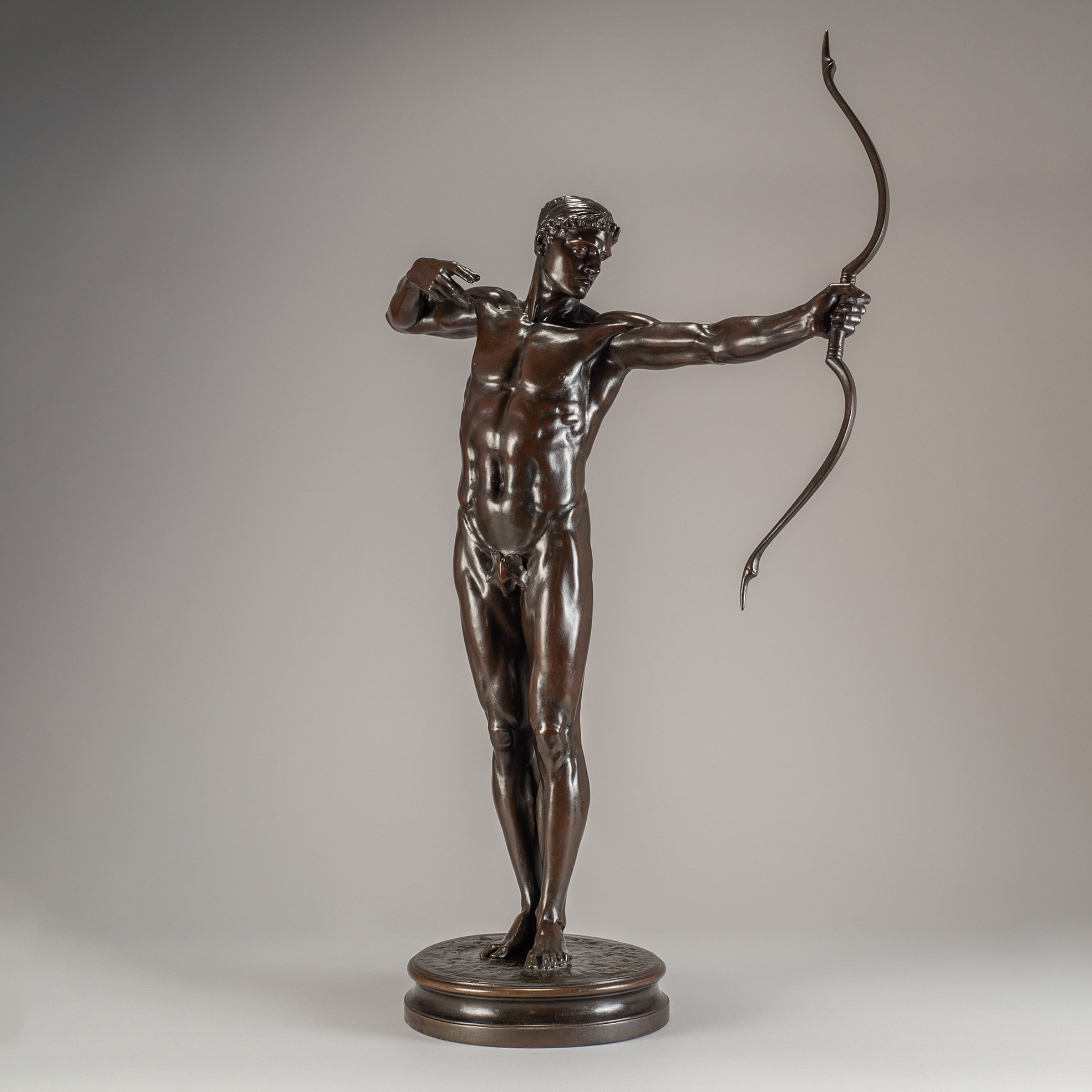
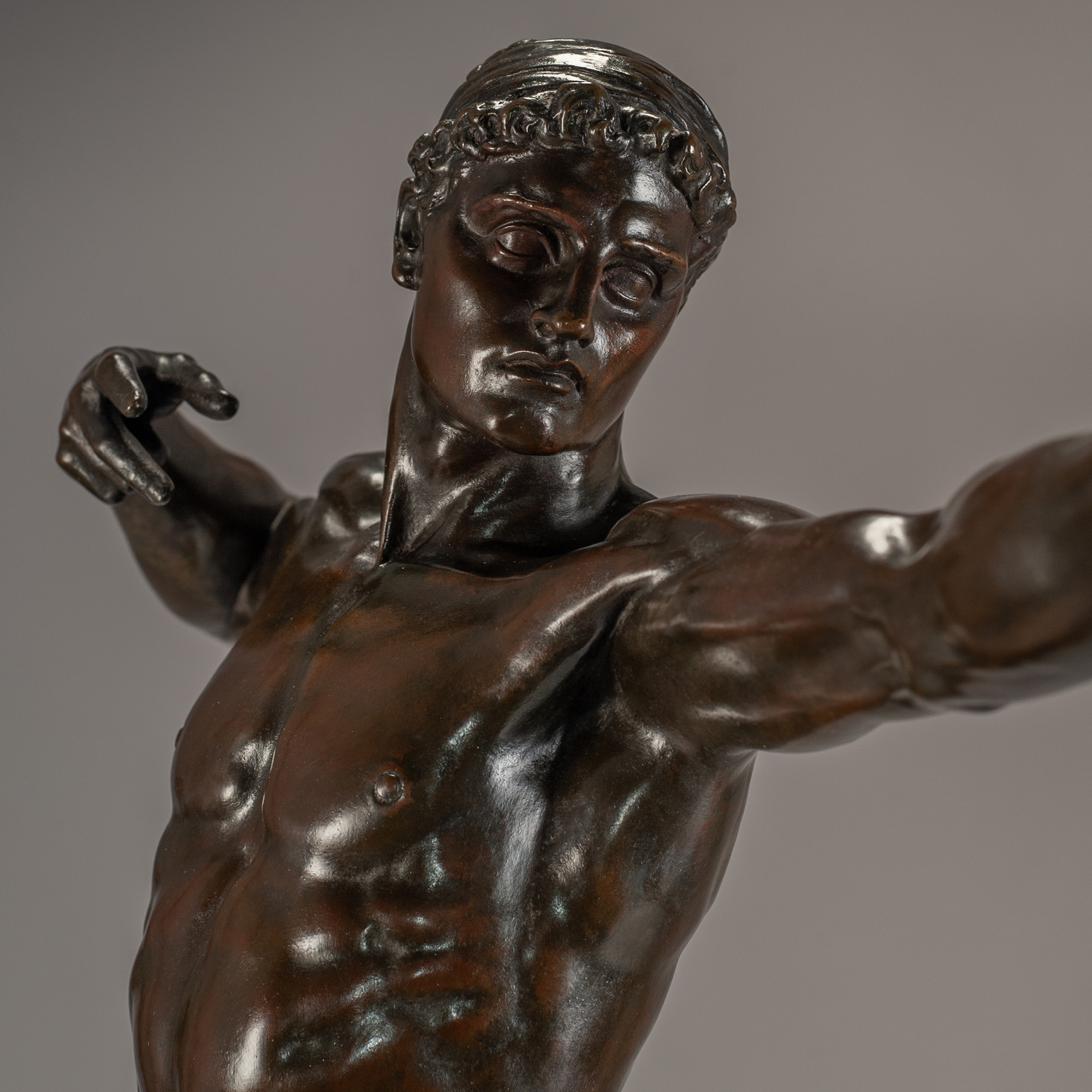
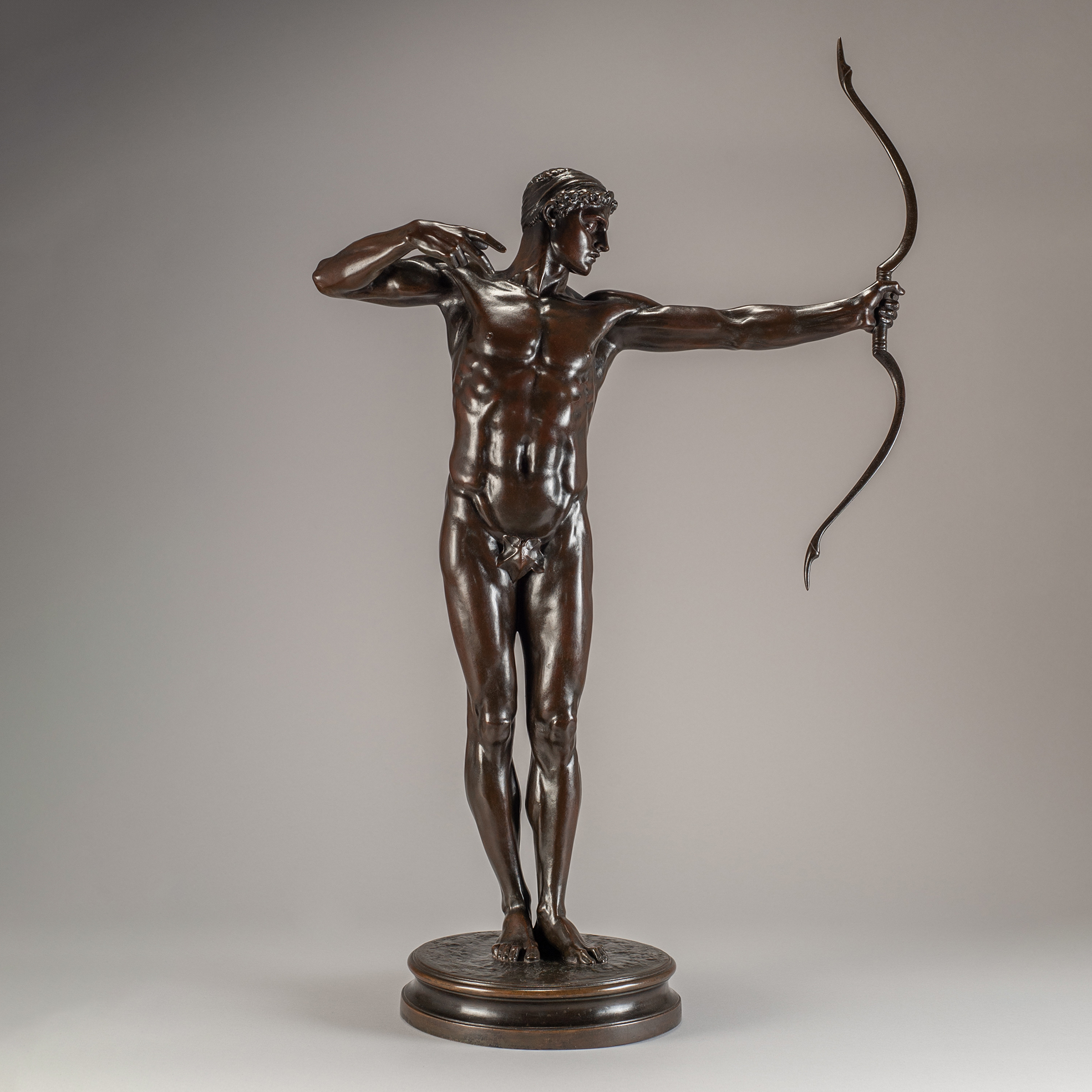
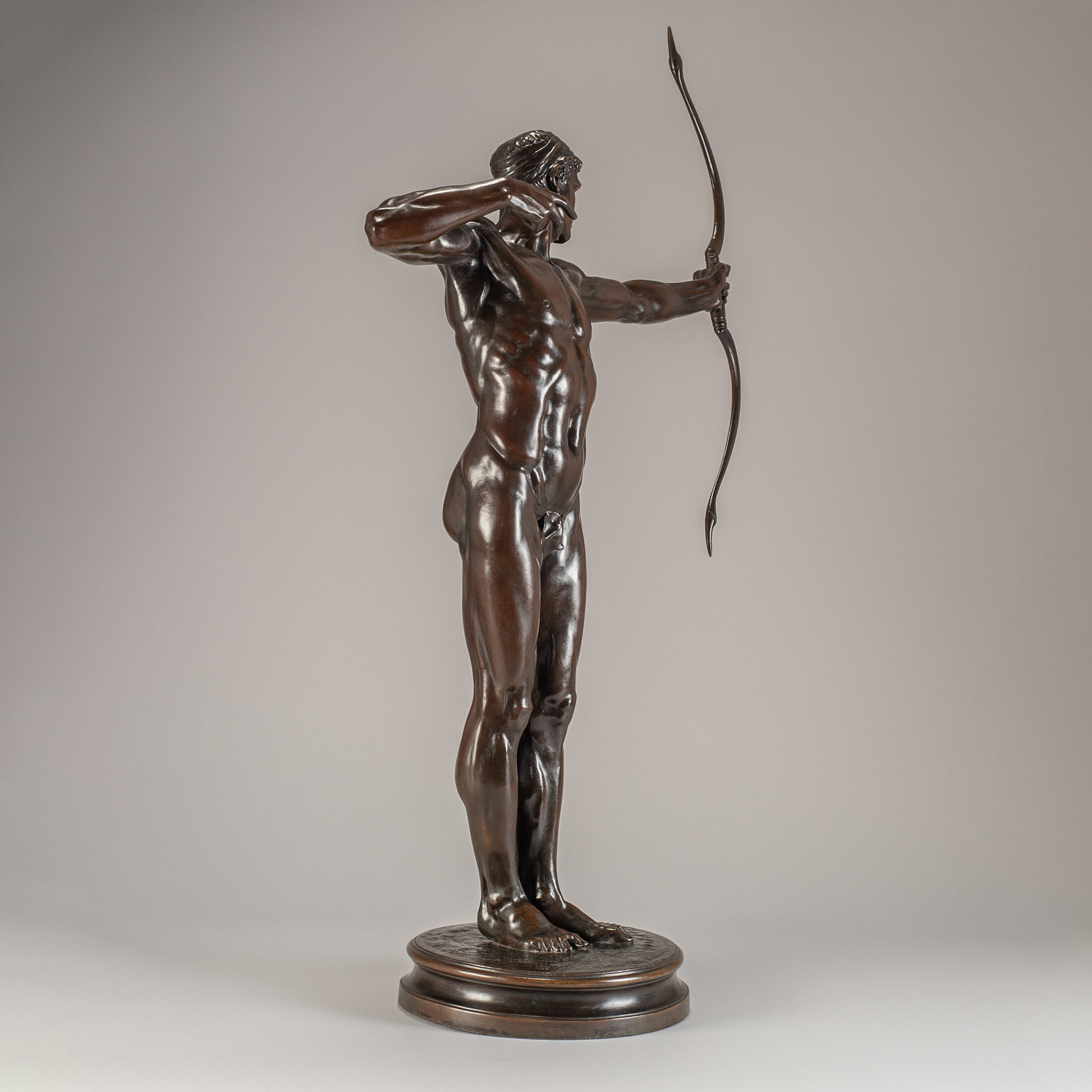
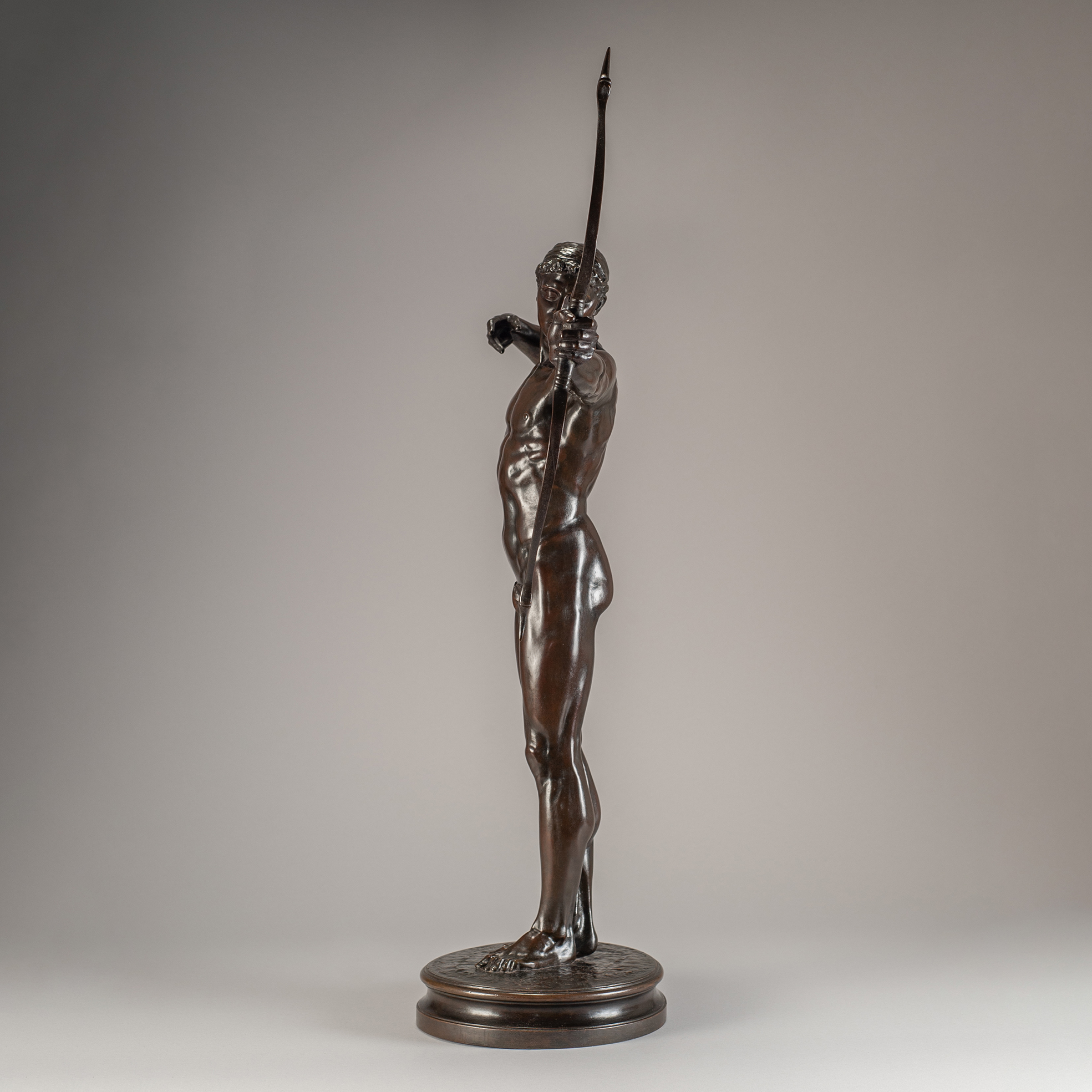
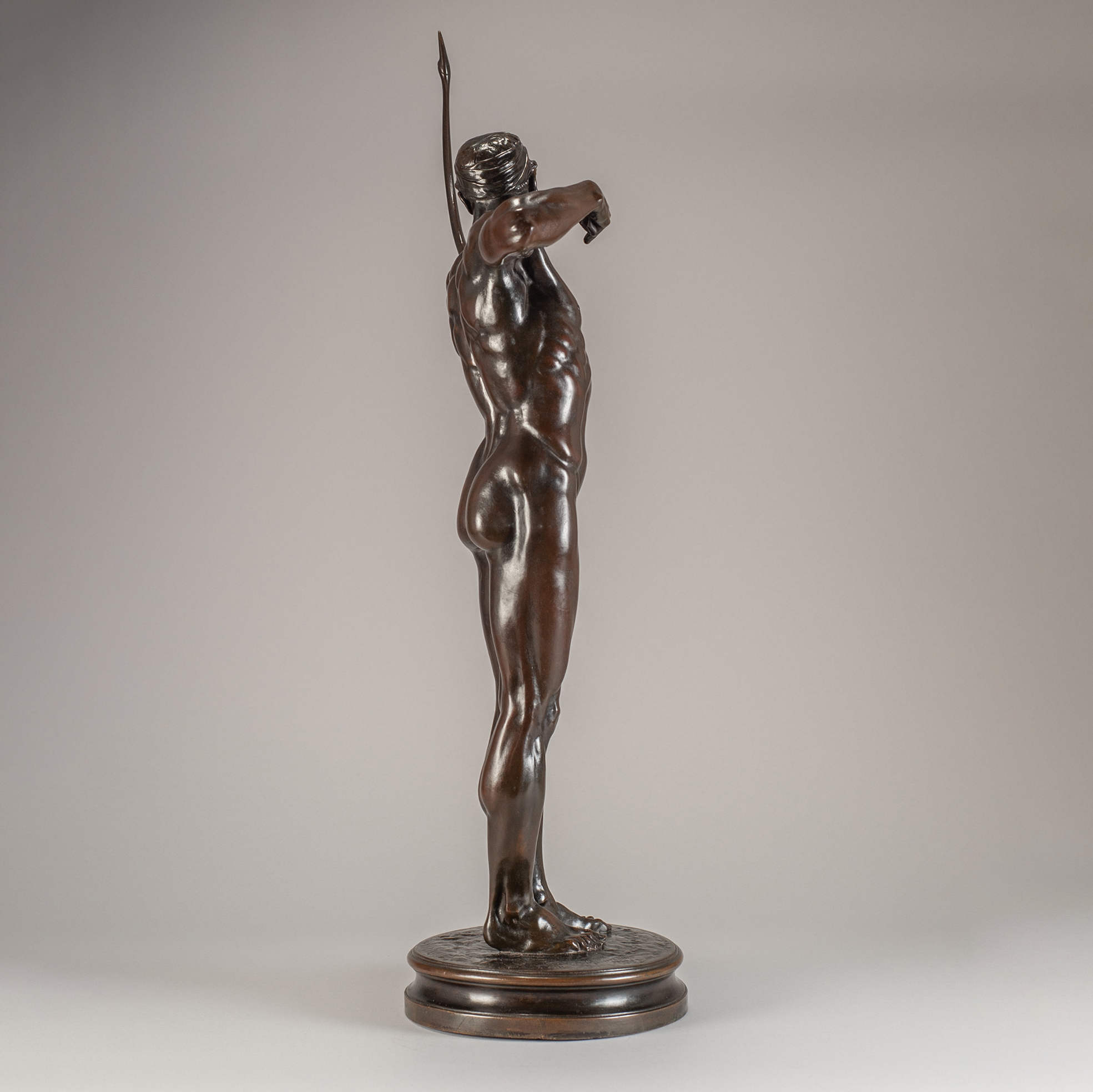
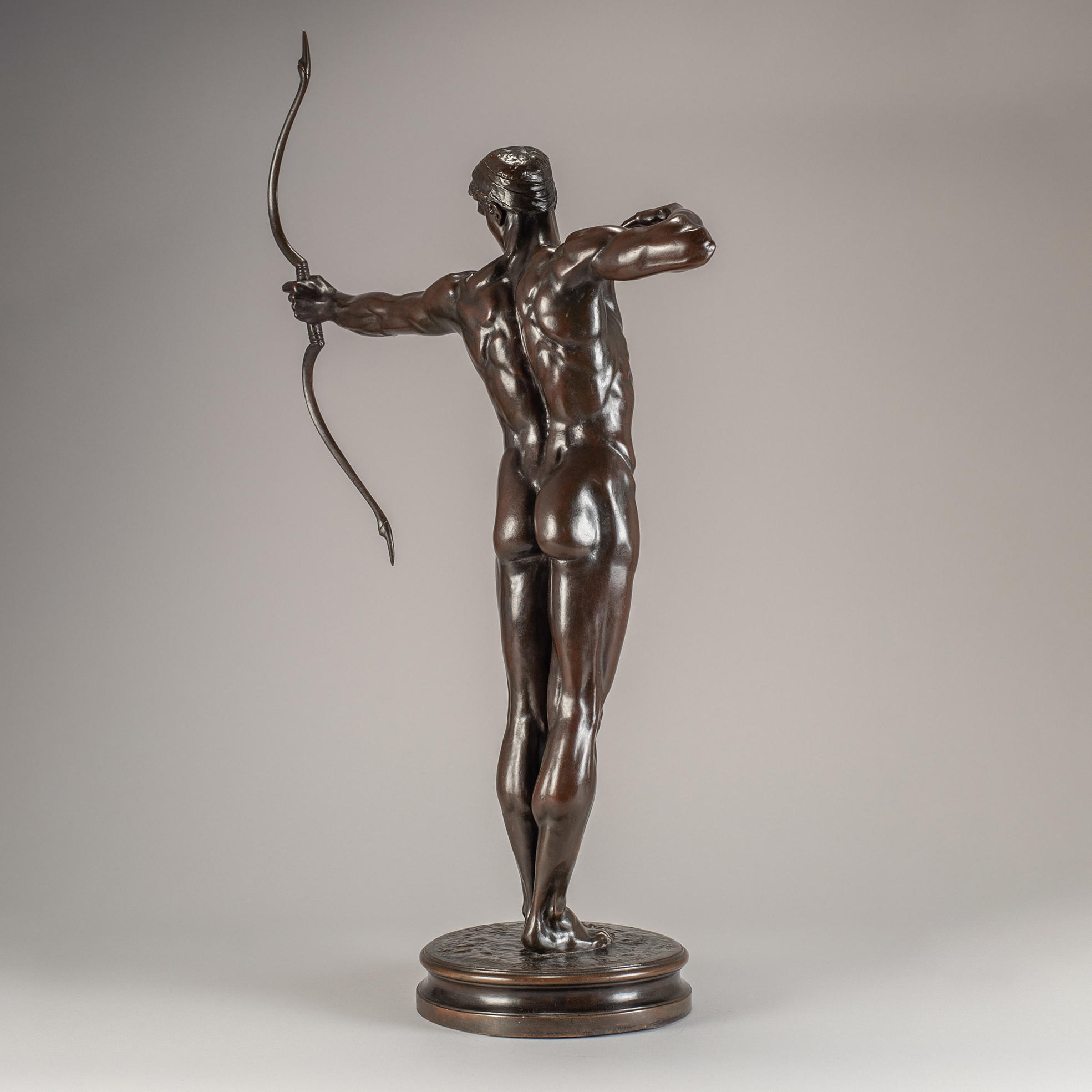
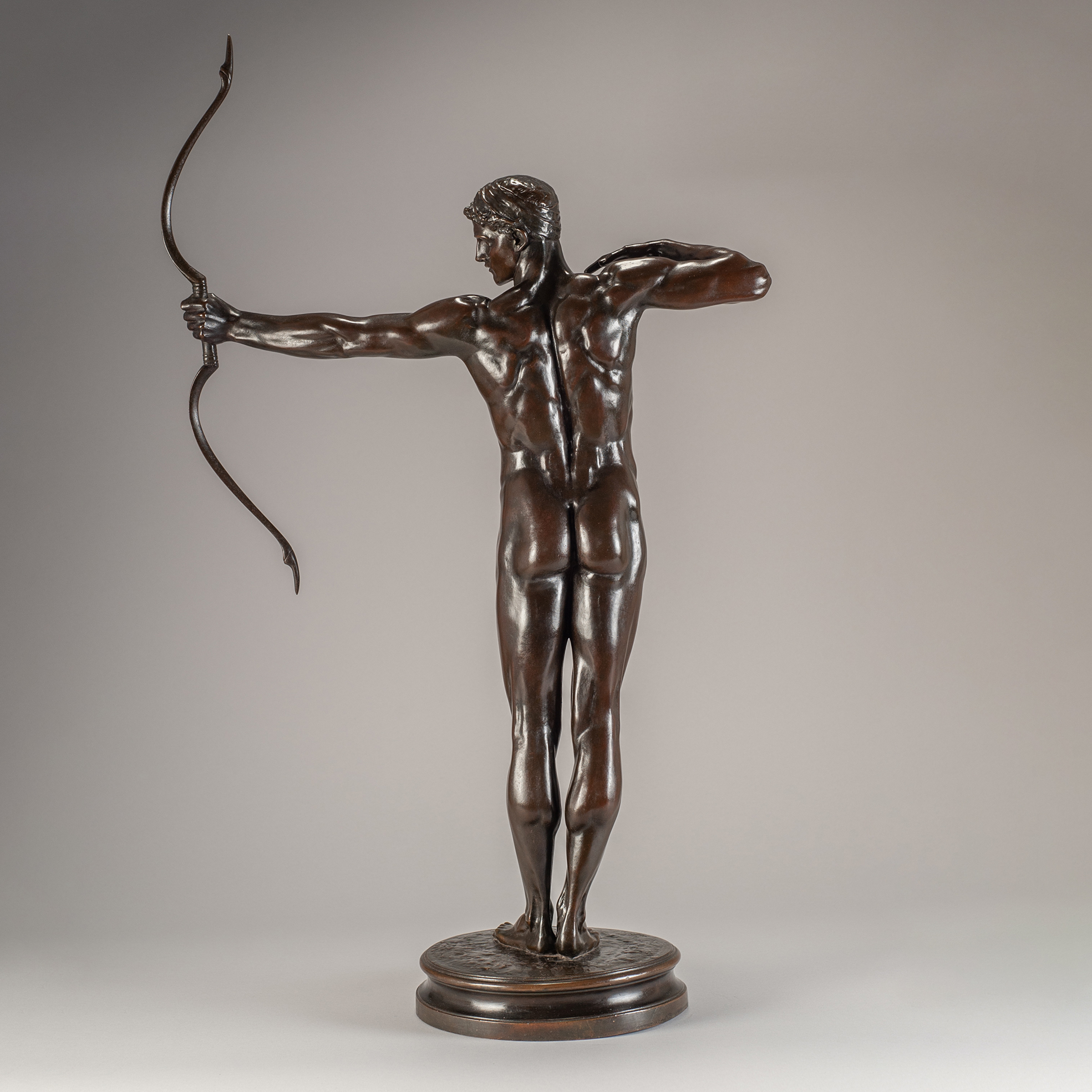
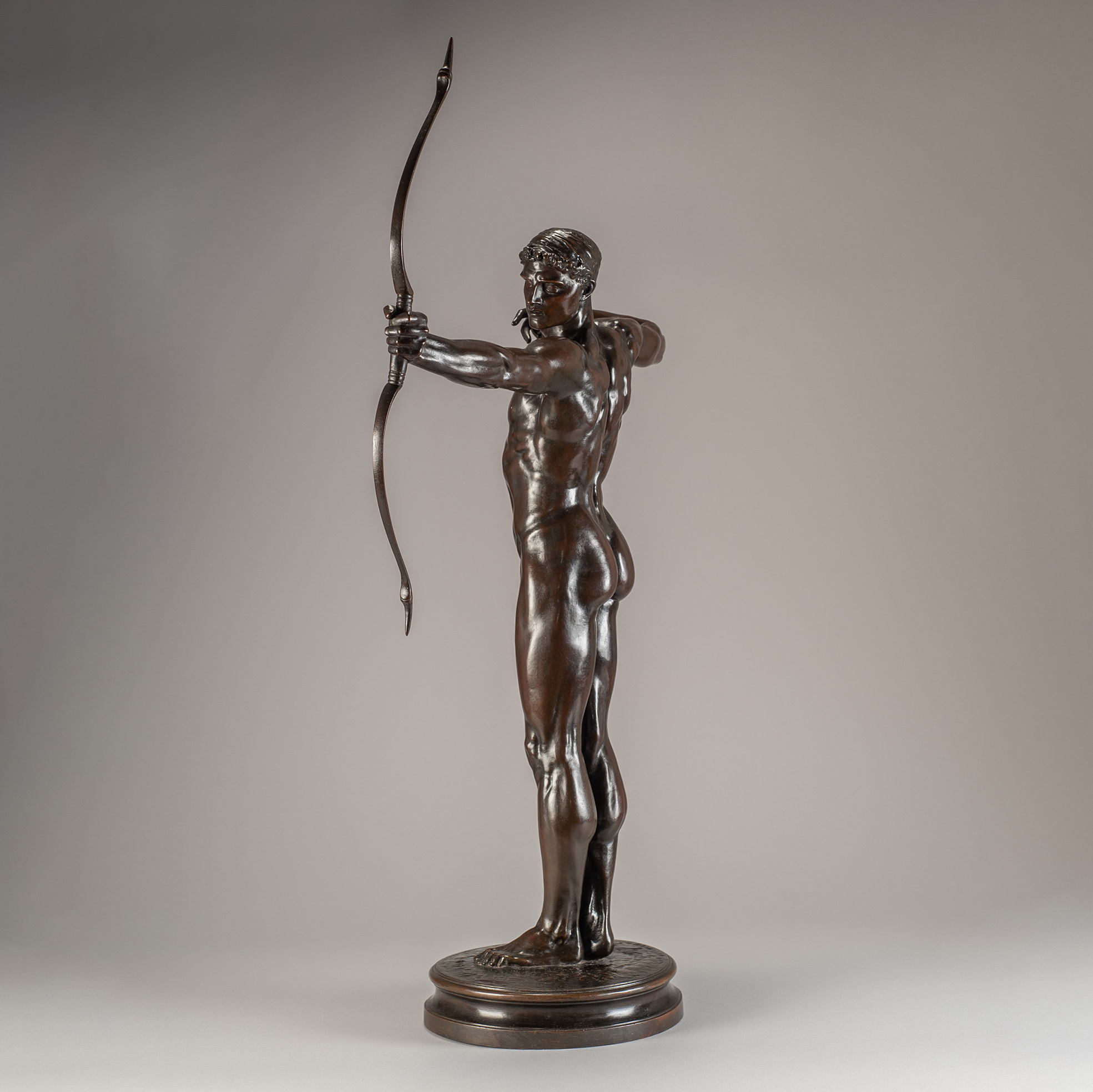
A Patinated Bronze Statue Of Teucer by Sir William Hamo Thornycroft (British, 1850-1925).The standing figure of the male nude holding his bow in his...
Dimensions
Height: 76.5 cm (31 in)
 Print
PrintDescription
A Patinated Bronze Statue Of Teucer by Sir William Hamo Thornycroft (British, 1850-1925).
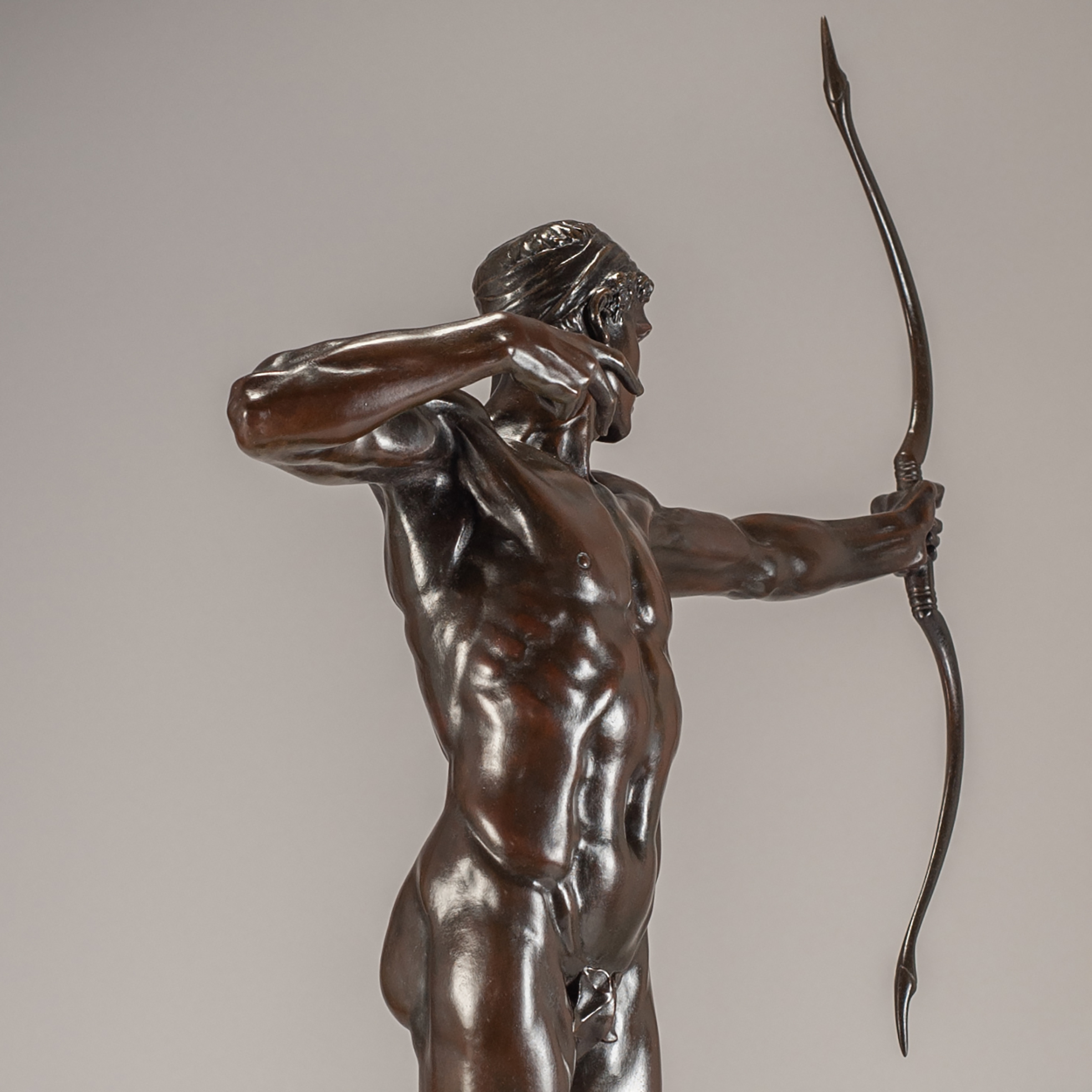
The standing figure of the male nude holding his bow in his outstretched left hand, raised on a circular naturalistic base.
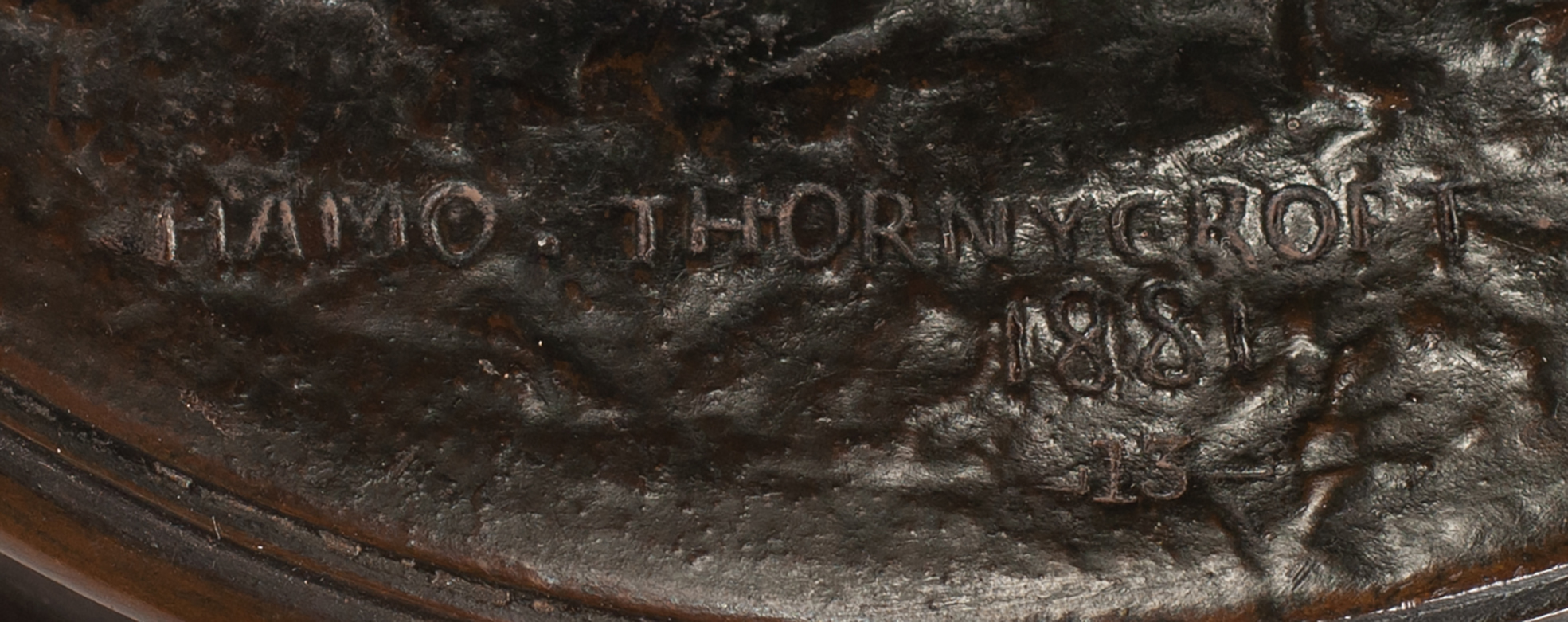
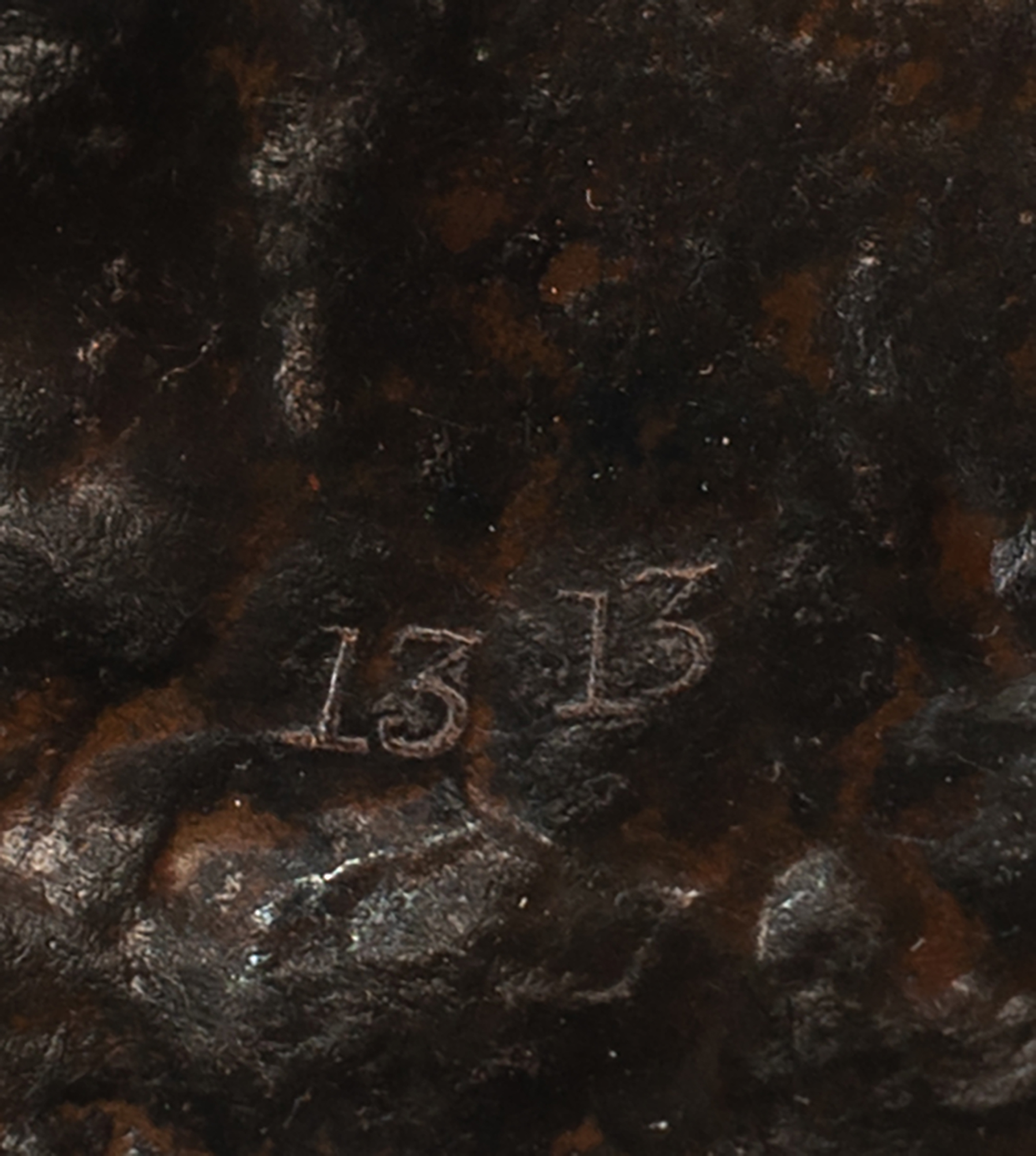
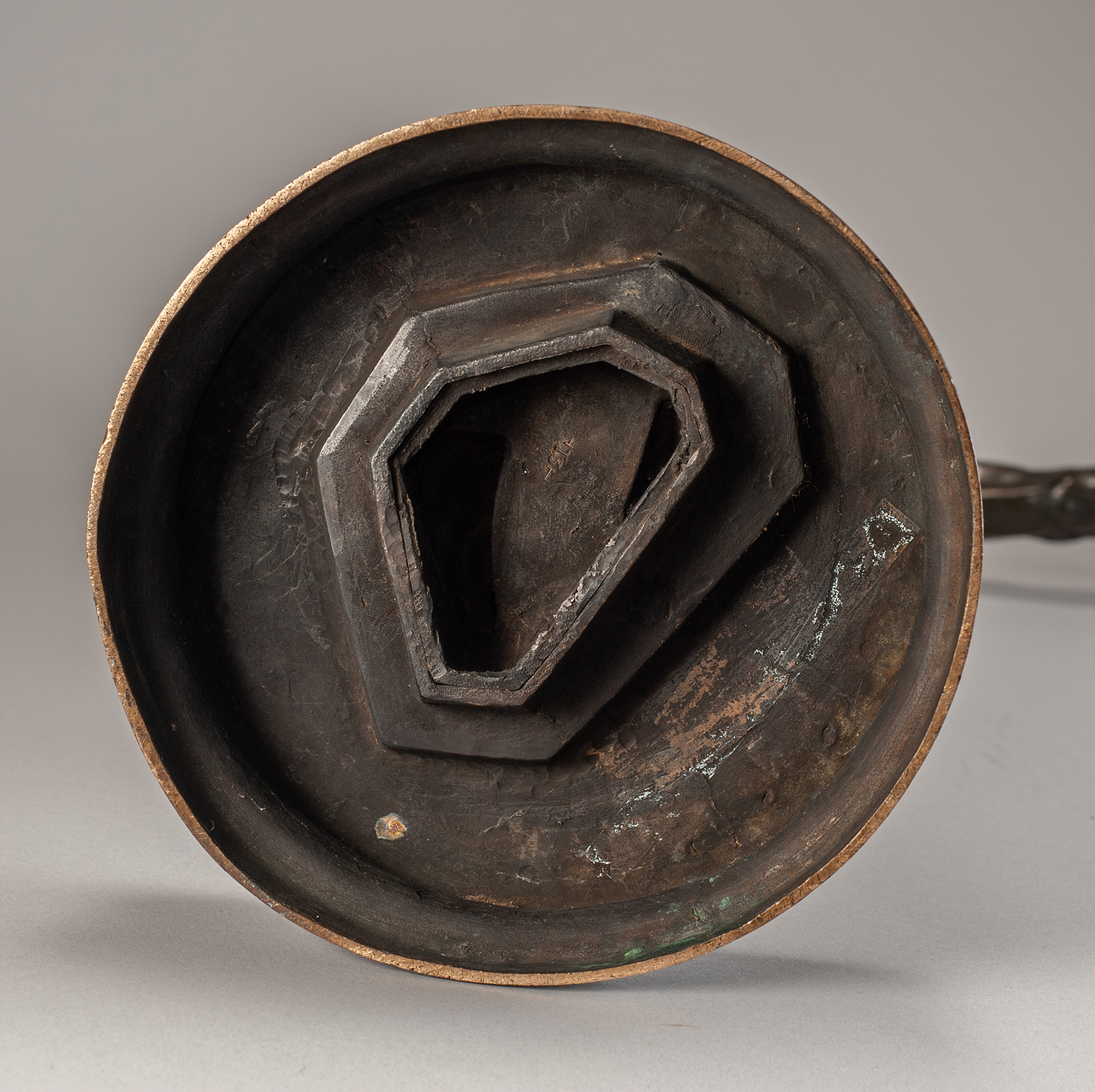
‘HMO. THORNYCROFT. / 1881′, numbered below ’13’ and further stamped twice ’13’ behind feet.
The model conceived in 1881 and this bronze cast by the Singer & Sons Foundry, Frome, Circa 1900. Numbered 13 of an edition of 25.
England, Circa 1900.
Provenance:
Private collection, Cleveland, England.
With Leicester Galleries, London, UK.
Private Collection, UK, until acquired 2025.
When Teucer was first exhibited at the Royal Academy in 1881, as a full-size plaster cast, it became a seminal and inspirational piece for the ‘New Sculpture’ movement. In 1882 a large bronze version was commissioned by the Trustees of the Chantrey Bequest for the Tate Gallery, London.
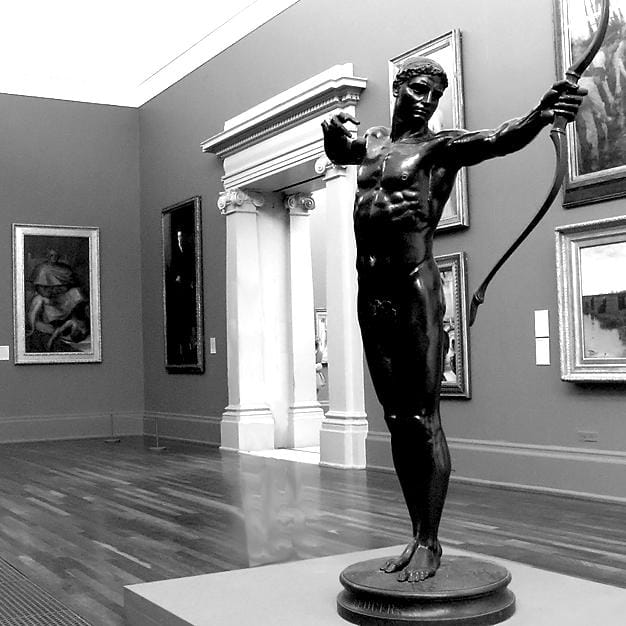
The full scale version of Teucer cast in 1882, Tate Gallery, London, Inv No1751
In view of its success, Thornycroft cast the work as a bronze reduction during his lifetime.
Teucer was cast in two sizes:
30 inches high to top of bow (22 inches to top of head).
17 inches high to top of bow (13 inches to top of head).
The present statue is the larger of the two reduced sized versions that were cast. It was published as a limited edition of 25. Thornycroft was personally involved in the casting process of his bronzes, working with Herbert Singer of Singer & Sons Foundry, Frome.
“The care and attention that he lavished on each individual casting of those works that were made available in limited editions, for example Teucer, not only demonstrates his professional artistic commitment, making each one a unique work of art; but it also testifies, through the multiple nature of these editions, to a desire to bring art into the home”.1
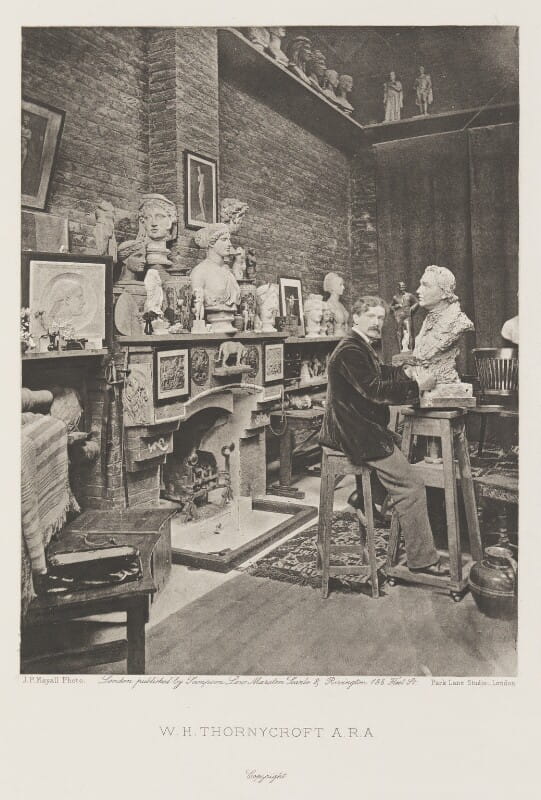
Hamo Thornycroft in his studio, 1883 – © National Portrait Gallery, London
Teucer is a hero from Homer’s The Iliad. A half-brother of the Greek hero Ajax, he was considered the best archer amongst the Greeks fighting at Troy. He fought against his cousins Hector and Paris in the Trojan War, but he failed in his repeated attempts to strike Hector with an arrow, for Hector had the divine protection of Apollo. Thornycroft depicts Teucer in this moment of intense concentration, as he fires one more thwarted arrow after Hector.
When the full-size plaster version was shown at the Royal Academy in 1881 a quotation from Pope’s translation of Homer was printed in the catalogue because the subject was unusual.
Since, rallying, from our wall we forced the foe,
Still aimed at Hector have I bent my bow;
Eight forky arrows from this hand have fled,
And eight bold heroes by their points lie dead:
But sure some god denies me to destroy
This fury of field, this dog of Troy.2
The right-angled position, without precedent in classical or European sculpture, was an innovation which gave Thoryncroft’s archer a freshness of form.
“The typical Homeric bowman, entirely nude, and of heroic size. He stands scarcely relaxed from the rigid position in which he has drawn his great bow, but the arrow has actually started, and he follows its course with an attentive eye. The legs are drawn close together, and are still tense with the effort of resisting the opposite action of the arms, which are almost parallel to the ground. Nothing could be less conventional than this figure, which has something almost archaic about its serenity and rigidity.”3
The Homeric theme dignifies Thoryncroft’s impetus to create a series of statues of Athletes engaged in English sports, primarily focusing on studies of the nude, giving opportunity for a change from hackneyed subjects to which sculpture had hitherto confined itself.
The model for Teucer was Orazio Cervi (Italian, 1854 – 1942), known for his perfectly proportioned physique, who also modelled for Thornycroft’s ‘Athlete Putting the Stone’ (1880) and ‘The Mower’ (1884). Orazio Cervi was part of Thornycroft’s close circle. He was said to walk each year to England from his farm in the Abruzzi which he had managed to build with his savings. It was Cervi who told Thornycroft of his election to the Royal Academy on 20th January 1881 making him the youngest Royal Academician of his time and almost the youngest sculptor ever to have been elected.4
“Teucer is represented in the act of supporting the army of Greece, which otherwise mainly consisted of spearmen, against the ranks of Troy. Secure behind the shield of his brother Ajax, Teucer aimed constantly at Hector, but in vain. Homer could not, however, permit his mighty archer to be stigmatised as a bad shot, and he therefore states that each shaft was directed by the gods to another Trojan heart, since Hector was not to be slain. Mr. Thornycroft has given to the face of his archer an expression of intense malice and of eager expectation. He has aimed once more at Hector, and his fingers scarcely relax as he bends slightly forward, retaining the tense curve of his figure, while he watches the flight of the arrow. The whole statue is tingling with vitality; strength, passion, intelligence, are all there in arrested action; and the warrior, unused to being thwarted in his purpose, can scarcely breathe until he sees that his vengeance is accomplished. The legs are drawn close together, and are still tense with the effort of resisting the opposite action of the arms, which are almost parallel to the ground. Nothing could be less conventional than this figure, which has something almost archaic about its severity and rigidity. This is perhaps the most courageously realistic work that Mr. Thornycroft has produced, but realistic without any loss of that distinction and that harmony of line which are the poetry of sculpture. The spectator is at first puzzled to say in what the singular appropriateness of the attitude consists; his eye soon convinces him that it lies in that firm tension of the whole figure, and that subtle bend from the head to the feet, in answer to the curved line of the bow.”5
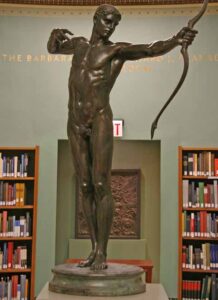
The full scale version of Teucer cast in 1891 in the Library Reading Room
at the Art Institute of Chicago.
Chicago collector and philanthropist George A. Armour, who owned a small cast of the composition, commissioned a full-scale bronze cast from the artist in 1891 and immediately gave it to the Art Institute of Chicago (Teucer, 1881, cast 1891. 80 inches high ref. no. 1891.80).6
Bronze examples recorded, 30 inches high:
- The Harris Museum and Art Gallery, Preston, UK.
- Detroit Institute of Arts, USA (ref. no. 81.703).
- The Huntington Library, Art Museum, San Marino, USA, numbered ‘22’ (ref. no. 2007.6).
- Los Angeles County Museum of Art, USA (re. no. M.87.119.26).
- The present example, numbered 13, is recorded in the Leicester Galleries archive.
Footnotes:
1. E. Manning, Marble & Bronze, The Art and Life of Hamo Thornycroft, London, 1982, p. 14.
2. The Iliad of Homer, Translated by Alexander Pope, Book VIII, 359–64, p. 147.
3. E. Gosse, “Our Living Artists – Hamo Thornycroft A.R.A.” Magazine of Art, (1881), p. 331.
4. E. Manning, ibid, London, 1982, pp. 79-81.
5. W. Meynel, The Modern School of Art, London, 1886, p. 59.
6. https://www.artic.edu/artworks/567/teucer
Date
Circa 1900
Origin
England
Medium
Patinated Bronze
Signature
Signed 'HMO. THORNYCROFT. / 1881', numbered below '13'.
Sir William Hamo Thornycroft
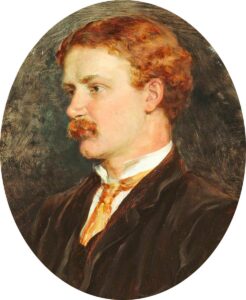
Wirgman, Theodore Blake; Sir William Hamo Thornycroft (1850-1925), RA; Aberdeen Art Gallery & Museums
Sir William Hamo Thornycroft (9 March 1850 – 18 December 1925) was born in London into the Thornycroft family of sculptors. Both his parents, Thomas and Mary, and his grandfather, John, were distinguished sculptors. He trained in his parent’s studio and in 1869 entered the Royal Academy Schools, where he benefited from the teaching of Lord Leighton. In 1872 he travelled via France to Italy. In Paris he was impressed by the work of such nineteenth-century sculptors as Jean-Baptiste Carpeaux, François Rude and Paul Dubois, and in Italy he particularly admired the work of the early Renaissance masters Ghiberti, Donatello and Verrocchio. In 1875 he was awarded the Royal Academy gold medal for his sculpture ‘A Warrior Bearing a Wounded Youth from the Field of Battle’.
He was responsible for some of London’s best-known statues, including the statue of Oliver Cromwell outside the Palace of Westminster. He was a keen student of classical sculpture and was one of the youngest artists to be elected to the Royal Academy, in 1882, the same year the bronze cast of Teucer was purchased for the British nation under the auspices of the Chantrey Bequest. He was a leading figure in the establishment of the New Sculpture movement, which provided a transition between the neoclassical styles of the 19th century and later modernist developments.
Private collection, Cleveland, England.
With Leicester Galleries, London, UK.
Private Collection, UK, until acquired 2025.
- Gosse, “Our Living Artists – Hamo Thornycroft A.R.A.” Magazine of Art, London, 1881, pp. 329-32.
- Wedmore, “Rising Artists.” The Gentleman’s Magazine, London, 1881, pp. 91-100.
- Manning, Marble & Bronze, The Art and Life of Hamo Thornycroft, London, 1982, pp. 14-5, 17-8
- Beattie, The New Sculpture. New Haven: Yale University Press, 1983, pp. 146-9, pl. 140.
British Sculpture 1850-1914. A loan exhibition of sculpture and medals sponsored by The Victorian Society. Exhibition catalogue. The Fine Art Society, London, 1968. no. 163.
Gibson to Gilbert: British Sculpture 1840-1914. Exhibition catalogue. The Fine Art Society, London, 1992. no. 55.