



 My Wishlist


Durand
A Louis XIV Style ‘Boulle’ Marquetry and Ebonised Console Table
£76,000
A Louis XIV Style Gilt-Bronze Mounted Cut-Brass and Cut-Pewter Inlaid 'Boulle' Marquetry and Ebonised Console Table, By Gervais-Maximilien-Eugène Durand.The...
Dimensions
Height: 103 cm (41 in)Width: 147 cm (58 in)
Depth: 51 cm (21 in)

 Print
PrintDescription
A Louis XIV Style Gilt-Bronze Mounted Cut-Brass and Cut-Pewter Inlaid ‘Boulle’ Marquetry and Ebonised Console Table, By Gervais-Maximilien-Eugène Durand.
The original Grand Antique black and white marble top with an outstepped front above a frieze inlaid with arabesques and centred by a bearded mask. Supported on four tapering pilasters with ram’s-mask corbels. The back board divided with three mirror plates above a platform base with central patera. Raised on toupie feet.
Stamped twice ‘G. Durand’.
France, Circa 1870.
This rare console table numbers amongst a handful of Boulle revival pieces made by Gervais Durand in the 1870s. An identical console table, very possibly the pair to the present example, is in the collection of the Musée des Arts Décoratifs, Paris, where it is part of a display curated as a Second Empire drawing room.
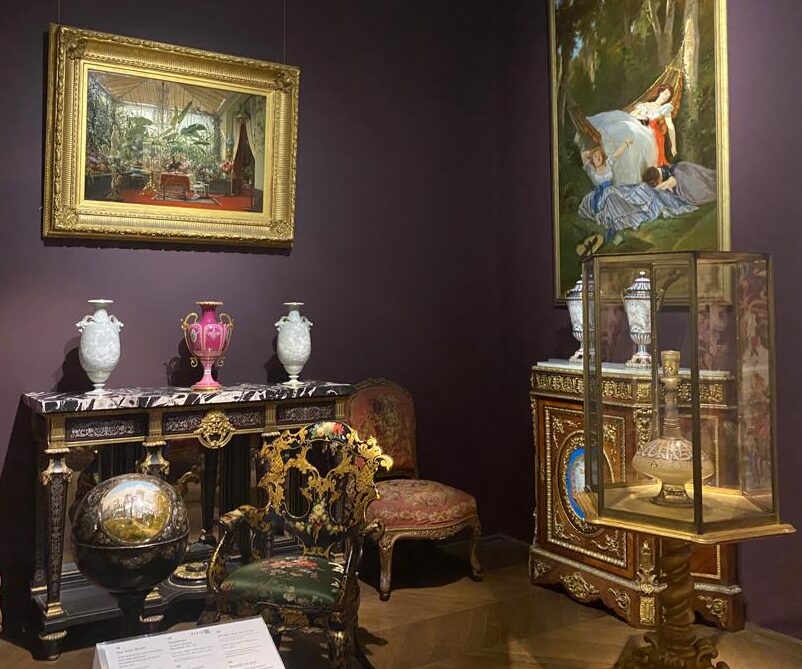
Related table at the Musee des Arts Decoratifs, Paris
Also compare a Boulle bibliothèque basse sold at auction in London in March 2001. Interesting, all three pieces have the same black and white Grand Antique marble slabs, suggesting that they could all have been part of the same commission.
The design of this console table is derived from table stands for cabinets and coffers by Boulle, most famously a pair of ‘cabinets sur piètement’ in the Louvre museum, Paris (inventory number OA 5469).
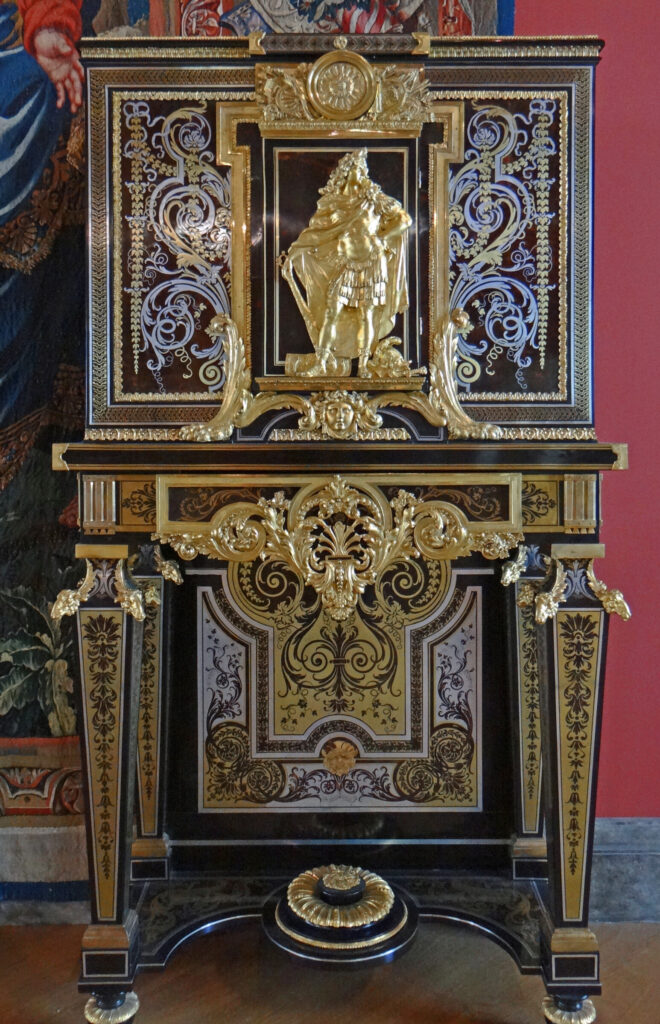
Cabinet sur piètement d’André-Charles Boulle (1690-1710) – Musée du Louvre OA 5469 (Mossot – Wikipedia)
Arguably the greatest cabinetmaker of all time, and certainly the most influential, André-Charles Boulle (1642-1732) is credited with inventing the technique of veneering furniture with marquetry of brass and pewter inlaid into turtle shell, which has become synonymous with his name. Boulle was already a master cabinetmaker by 1666, and was appointed ‘Ebéniste, Ciseleur, Doreur et Sculpteur’ to Louis XIV in 1672. Amongst those employed in Boulle’s atelier was Jean Mariette, whose ‘Nouveaux Deisseins de Meubles et Ouvrages de Bronze et de Marqueterie Inventés et gravés par André-Charles Boulle’, published in 1707, depicts various prime examples of Boulle’s work at that time and helped assure his legacy as a reference work which informed later cabinetmakers. Boulle furniture was made by his sons A-C. Boulle the younger (1685-1745) and Charles-Joseph Boulle (d. 1754) and their pupil Etienne Levasseur (1721-1798) who specialized in copying and repairing Boulle furniture and his stamp appears on many Louis XIV pieces. In the nineteenth century the Boulle technique was employed by English makers such as Robert Blake, ‘cabinet inlayer and buhl manufacturer’, and in France by many celebrated ébénistes, notably Henry Dasson (1825-1896).
Date
Circa 1870
Origin
France
Medium
Boulle Marquetry Inlay
Signature
Stamped twice 'G. Durand'.
Durand
Louis Durand (est. 1787)
Prosper-Guillaume Durand (fl. 1834-1862)
Gervais-Maximilien-Eugène Durand (1839-1920)
Frédéric-Louis Durand (b. 1874)
The Durand dynasty of cabinet makers can be traced to as early as 1787 supplying official commission during the Empire period. Louis Durand had fourteen children, at least one of whom followed his father into the furniture business and helped establish Durand as an important maker during the Restoration and July Monarchy periods, supplying in the 1830s the royal palaces at Versailles, Saint-Cloud and Fontainbleu.
During the Empire their premises at 14 Rue des Fossés-Montmartre had the sign ‘Au désir de la paix’ (To the desire for peace) but Durand’s eldest son was drafted in 1812 and in the face of universal economic difficulties during the Napoleonic wars, was forced to make redundancies. Durand received a few small imperial commissions between 1811 and 1814 which helped establish official recognition for making furniture of quality and elegance. In 1827 at the industrial exhibition of products and industry Durand was awarded for a commode and secretaire in mahogany and maple marquetry purchased by King Charles X. Assisted by his son Prosper-Guillaume who then succeeded him in 1834/38, the business grew with a healthy cliental and under King Louis Philippe received the royal warrant as supplier to the royal court. Prosper-Guillaume Durand was praised for his inlaid furniture at the 1834 and 1839 industrial exhibitions and in 1844 won a silver medal for rosewood furniture adorned with gilt-bronzes. He exhibited a sideboard elaborately carved with hunting trophies at the 1851 London and 1855 Paris International Exhibitions. He died in 1862. He died in 1862.
In the absence of conclusive evidence, it is supposed that the business of Louis and his son Prosper-Guillaume passed to the next generation of Durand cabinetmakers, beginning with Gervais Durand who had workshops at 12 rue de la Cerisaie in 1870, moving to 23 rue Beautreillis from 1878. Gervais was joined by his son Frederic Louis by 1889 and thereafter the firm was known as Durand et Fils. At the international exhibition of that year, the firm was complimented for ‘excellent dans les affectations de l’ébénisterie’ and for furniture of the ‘first order’. For the jury at the 1889 exhibition, Henri Picard wrote “M. Durand ébéniste aussi habile que modeste, expose pour la première fois des meubles de premier ordre, don’t il est à la fois le dessinateur et l’excécutant, il marches sur la voice tracée par les maîtres tells que Beurdeley et Dasson” (op. cit. Ledoux-Lebard, p.182). Durand furniture is made to the highest standards. Earlier pieces have the marque au fer ‘DURAND A PARIS’. For Gervais Durand’s time the cold stamp ‘G. DURAND’ is most common but ‘Durand Fils’ is also recorded.
Bibliography:
Ledoux-Lebard, Denise. Les Ebénistes du XIXeme siècle, Les Editions de l’Amateur, (Paris), 1984; pp. 178-184.
Meyer, Jonathan. Great Exhibitions – London, New York, Paris, Philadelphia, 1851-1900, Antique Collectors’ Club, (Woodbridge, UK), 2006.
Mestdagh, Camille & Lécoules, Pierre. L’Ameublement d’art français : 1850-1900, Les Editions de l’Amateur, (Paris), 2010.
Payne, Christopher. Paris Furniture – the luxury market of the 19th century, Éditions Monelle Hayot, (Paris), 2018; pp. 338-341.