A Fine Louis XVI Style Gilt-Bronze Mounted Mahogany Display Cabinet With Wedgwood Porcelain Plaques
£65,000
A Fine Louis XVI Style Gilt-Bronze Mounted Mahogany Display Cabinet With Wedgwood Porcelain Plaques.The upper section has a shaped cornice with acorn...
Dimensions
Height: 235 cm (93 in)Width: 130 cm (52 in)
Depth: 47 cm (19 in)

 Print
PrintDescription
A Fine Louis XVI Style Gilt-Bronze Mounted Mahogany Display Cabinet With Wedgwood Porcelain Plaques.
The upper section has a shaped cornice with acorn finials and a foliate wreath above a frieze centred by a large oval Wedgwood porcelain plaque. The central glazed door flanked by reeded columns and opening to a mirrored interior with glass shelves. The lower section having a central cupboard door with foliate and ribbon tied gilt-bronze mounts and centred by an allegorical Wedgwood Porcelain plaque, flanked by further cupboards to each side. The cabinet has a shaped frieze with foliate gilt-bronze mounts and is raised on toupie feet with bronze caps.
French, Circa 1880.
Developed in England by Josiah Wedgwood circa 1775, the fashion for furniture mounted with pale jasperware plaques became popular throughout Europe, particularly in France. It was soon imitated by the French royal porcelain manufactory at Sèvres and remained fashionable throughout the nineteenth century as part of the Neoclassical revival.
The Wedgwood firm exhibited at nearly all the international exhibitions held in France during the nineteenth century, displaying plaques specifically designed for use as furniture mounts.
The upper plaque depicts ‘La Marchande d’Amours’ (“The Cupid Seller”), after the composition by Claude Michel, known as Clodion (1738–1814), which was exhibited at the Paris Salon in 1773. Grasping the wings of an eagerly gesturing Cupid, a seated vendor offers love to a Roman matrona attended by a female companion.
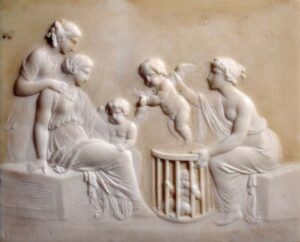
Claude Michel, known as Clodion (1738–1814), ‘La Marchande d’Amours’, marble, 1773, Musée des Beaux-Arts, Nancy, France.
This highly classicised composition, created during Clodion’s formative years at the French Academy in Rome, presents a charming interpretation of a celebrated ancient wall painting discovered in 1759 during excavations at the Villa Arianna in Stabiae, south of Pompeii. Buried by the eruption of Mount Vesuvius in AD 79, the original fresco is now preserved in the National Archaeological Museum in Naples (inv. no. 9180).
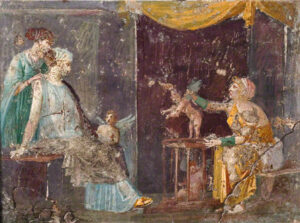
‘The Cupid Seller’, fresco from Villa Arianna in Stabiae, mid-1st century AD, National Archaeological Museum, Naples.
Known to eighteenth-century artists primarily through engravings published by Giovanni Elia Morghen circa 1762, after a drawing by Carlo Nolli, the ancient composition was widely adapted to suit Neoclassical taste. Wedgwood’s manufactory produced jasperware versions from around 1783 onwards.
The lower plaque depicts L’Amour désarmé (“Cupid Disarmed”), in which Cupid is deprived of his weapons by Euphrosyne, one of the Three Graces, symbolising the triumph of joy, beauty, and affection over the disruptive power of desire.
Date
Circa 1880
Origin
France
Medium
Gilt-Bronze