About Madison Colby
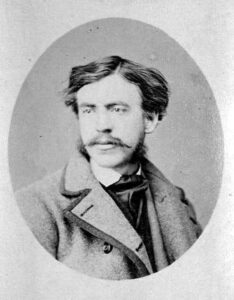
Born of New Hampshire stock in April 1841, Madison Colby enlisted with the 21st Massachusetts Infantry in July 1861, fighting at Antietam. He was critically wounded at Fredericksburg in December 1862 and spent many months in military hospitals in Washington, D.C., and Portsmouth, Rhode Island. After demobbing in 1864, Colby returned to Boston and advertised himself as a portrait painter and sculptor.
By 1867, he was working with fellow American sculptors Thomas Ball, Hiram Powers, and Larkin Mead in Florence, Italy, returning to Boston in early 1869. He married in October that year and for health reasons immediately embarked for San Francisco, where he set up his studio in the Mercantile Library Building.
In November 1869, the Snow & Roos Gallery, San Francisco, exhibited two works by Colby ̶ “Morning” and “Evening, of which the critic Hilda Rosevelt wrote that “they are remarkable for delicacy of finish and pure and clearly-defined conception.”
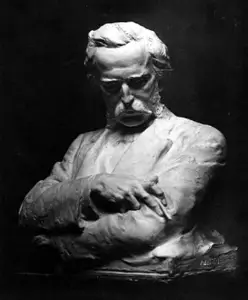
Marble Bust of Bret Harte by Madison Colby 1871
In 1871 Colby turned his attention to a bust of California author Bret Harte, which was described as “one of the best portraits we have ever seen in sculpture.” The editor of The Art Review (January 1871) continued by saying, “Colby has, in this work, cut, in deep letters, upon the obdurate, adamantine rock of fame, his own name at an equal altitude with that of any American sculptor.
Colby was dying from tuberculosis by the time the Harte bust was completed. He succumbed on 17 February 1871 in Oakland. A letter to The Art Review (May 1871) read in part: “Poor Colby has left a widow without anything save the honour of being the relict [sic] of one so rich in genius and gifts which availed him nothing because of his ill health.”