About Frédéric-Eugène Piat
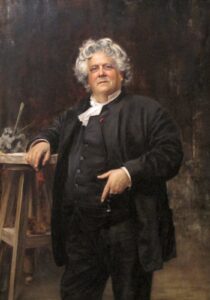
Pierre-Adolphe Huas (French, 1838–1900), Portrait of Frédéric-Eugène Piat (1827–1903). Private Collection
Frédéric-Eugène Piat (1827 – 1903) was one of the most prolific French sculpteurs-ornemanistes of the nineteenth century, whose designs played an important role in the development of the Parisian bronze and decorative arts industry. Born at Montfey, Aube, on 2 June 1827, he was the son of a carpenter and moved with his family to Paris as a child. Initially apprenticed as a carriage painter, he subsequently worked with his father before being encouraged by his brother-in-law, the ornamental sculptor Louis-Étienne Froment, to pursue a career in decorative art.1
Piat trained under several ornamentalists before establishing his own workshop in 1845. His talent for drawing and modelling quickly attracted the leading Parisian bronze manufacturers, including Denière and Graux-Marly, for whom he designed clocks, lighting, firedogs and chimney garnitures.2 His participation in the Exposition Universelle of 1855 marked the beginning of a distinguished exhibition career that continued through the great international exhibitions of the nineteenth century.
A defining feature of Piat’s work was his mastery of historical ornament. He freely interpreted Renaissance, Louis XIV, Louis XVI, Gothic and Neo-Greek vocabularies, transforming them into richly conceived objects suited to contemporary taste. His designs were generally executed by specialist manufacturers, making him an important intermediary between artistic invention and industrial production.3
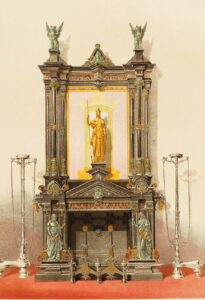
Monumental neo-Greek style fireplace, made by the Marchand company and presented at the Universal Exhibition in London in 1862. Engraving taken from J.B. Waring’s ‘Masterpieces of Industrial Art & Sculpture’ at the International exhibition, 1862. Published by Day & Son, London, 1863.
His collaboration with the bronze manufacturer Louis-Léon Marchand was particularly significant. For the London International Exhibition of 1862, Piat designed a monumental Neo-Greek fireplace in marble and polychrome bronze, while their collaboration continued at the Paris Exposition of 1867. He subsequently worked with several important Parisian firms, including Gagneau, Maison Marnyhac and Lemerle-Charpentier.4
Piat’s reputation reached its height during the later nineteenth century. He received medals at the international exhibitions of 1867 and 1878, and a Grand Prix at the Exposition Universelle of 1889. Among his celebrated designs were the monumental torchères Les Quatre Éléments, L’Amour désarmé and numerous clocks, fountains and lighting fixtures. By this period he had acquired the contemporary sobriquet “Roi du bronze” (King of Bronze).5
His final major exhibition appearance came at the Exposition Universelle of 1900, where La Nature, an imposing illuminated column in gilt bronze, enamel and Algerian onyx, was exhibited. He was subsequently promoted to Officier of the Légion d’honneur.6
Piat’s enduring legacy is particularly well preserved at Troyes, where he founded a museum of decorative arts in 1894 and donated a substantial body of his work. The city’s collections contain numerous plaster models, drawings and finished objects, providing an exceptional record of his practice and of the relationship between the nineteenth-century designer and the industrial bronze manufacturer.7
Piat died in Paris on 29 July 1903. His extraordinary productivity and stylistic versatility place him among the principal ornemanistes of nineteenth-century France, while the surviving Troyes collection provides an important testament to his role in the evolution of French decorative art.
Footnotes:
- 1. Centre historique des Archives, La France savante, “Piat Frédéric Eugène”; see also V. Champier, “Notice biographique sur Frédéric-Eugène Piat,” in L. Le Clert, Musée de Troyes, Art décoratif, Troyes, 1897.
- 2. Ibid.; see also F.-E. Piat, Art décoratif: trente-cinq compositions inédites, Paris, 1897.
- 3. J.-P. Sainte-Marie, Un ornemaniste français du XIXe siècle: Frédéric-Eugène Piat, Les Cahiers des musées de Troyes, no. 2, 1976.
- 4. For Piat’s collaborations with Marchand and the international exhibitions, see the Musée des Beaux-Arts et d’Archéologie de Troyes documentation and Piat, Art décoratif, 1897.
- 5. P. Kjellberg, Les Bronzes du XIXe siècle: Dictionnaire des sculpteurs, Paris, 2005.
- 6. Musée des Beaux-Arts et d’Archéologie de Troyes; see also Piat, Art décoratif, 1897.
- 7. Centre historique des Archives, La France savante; Musée des Beaux-Arts et d’Archéologie de Troyes.