An Important Suite of Six Giltwood Throne Armchairs
£165,000
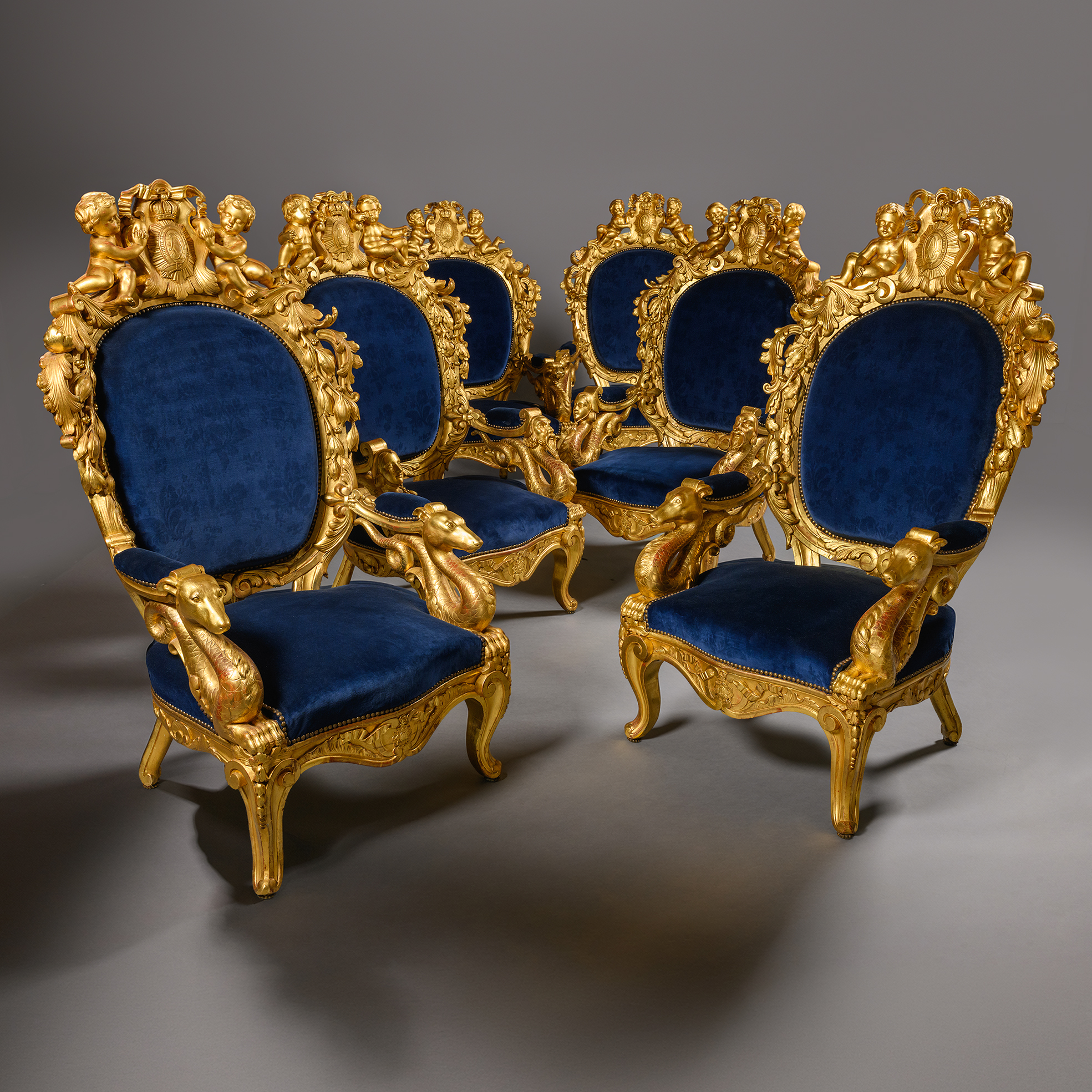
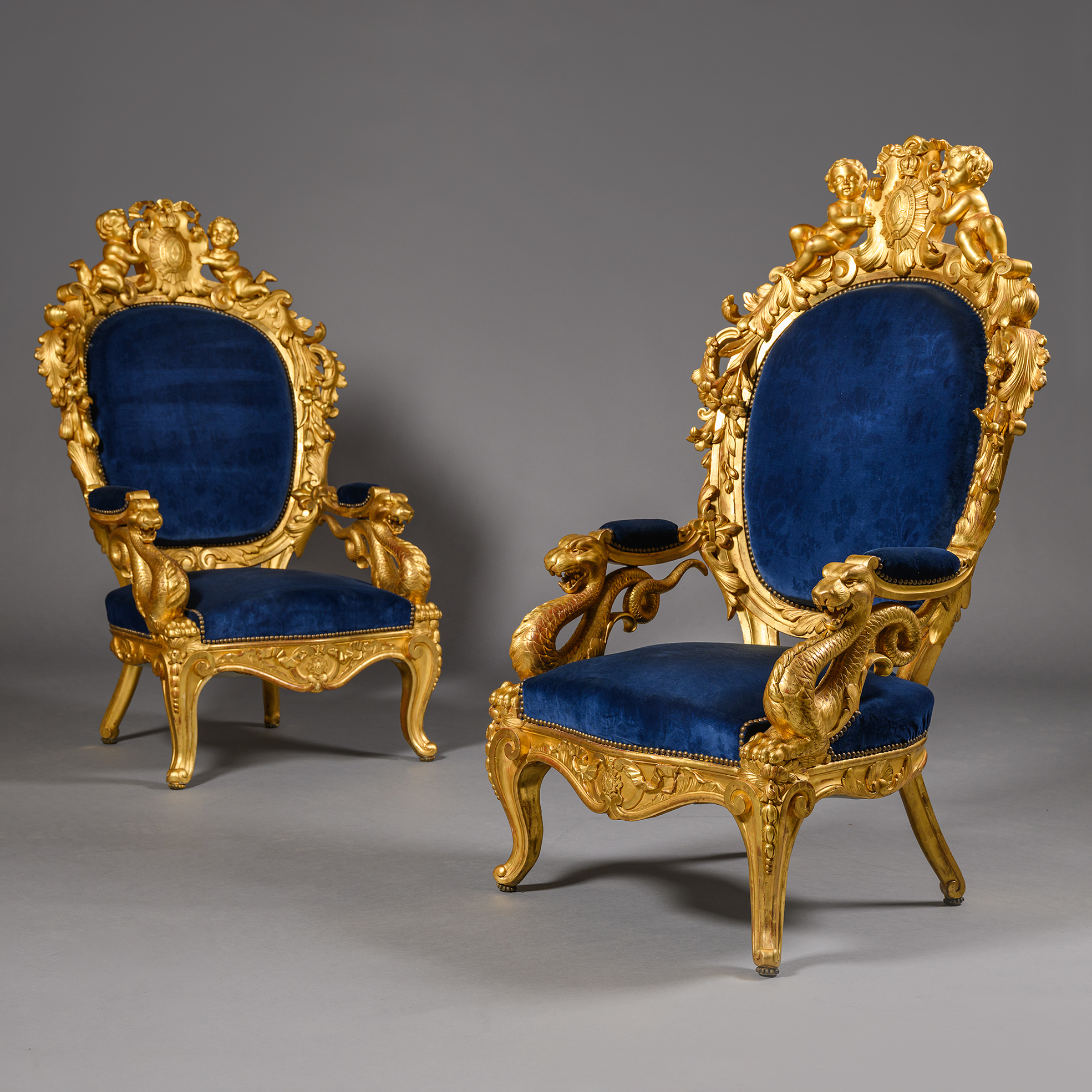
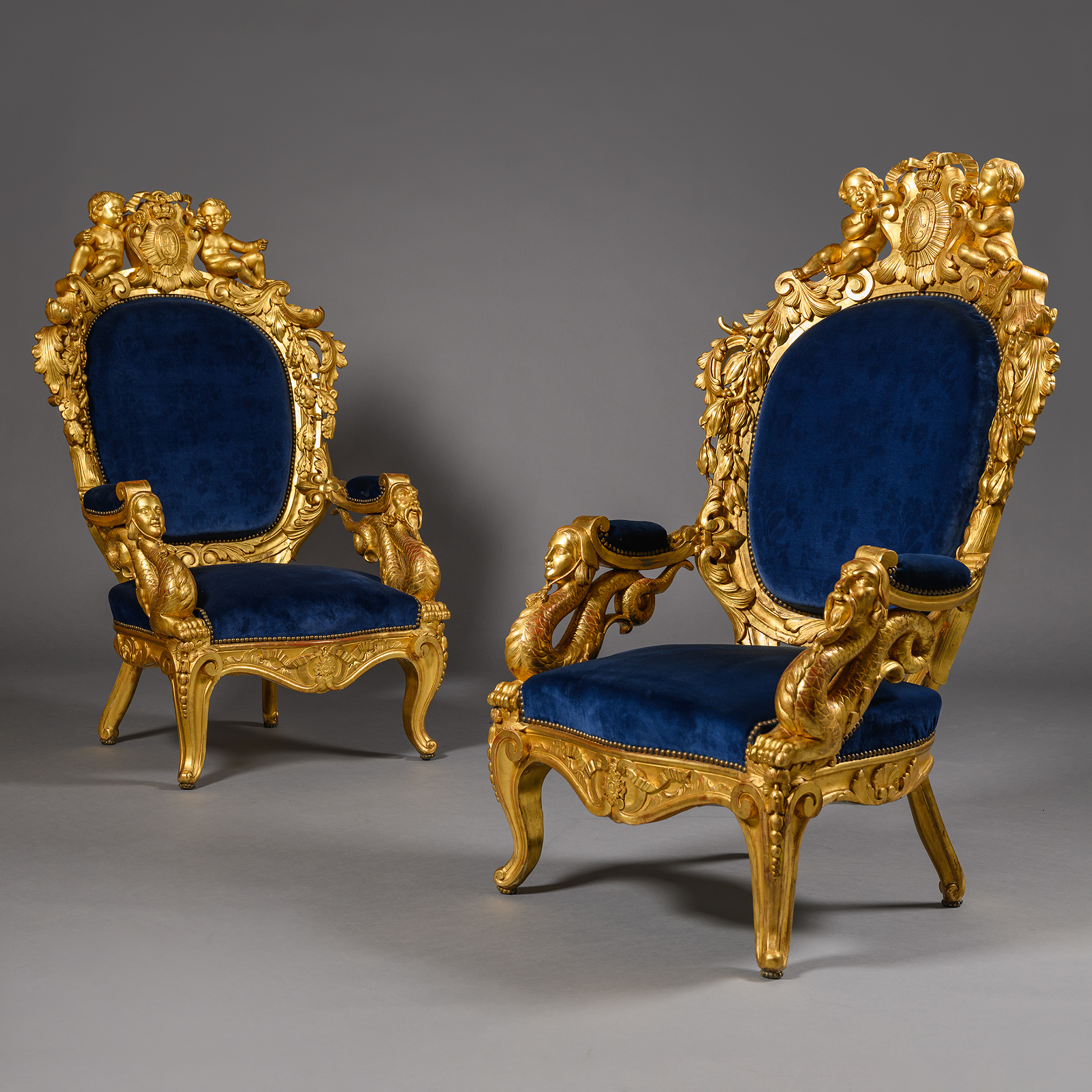
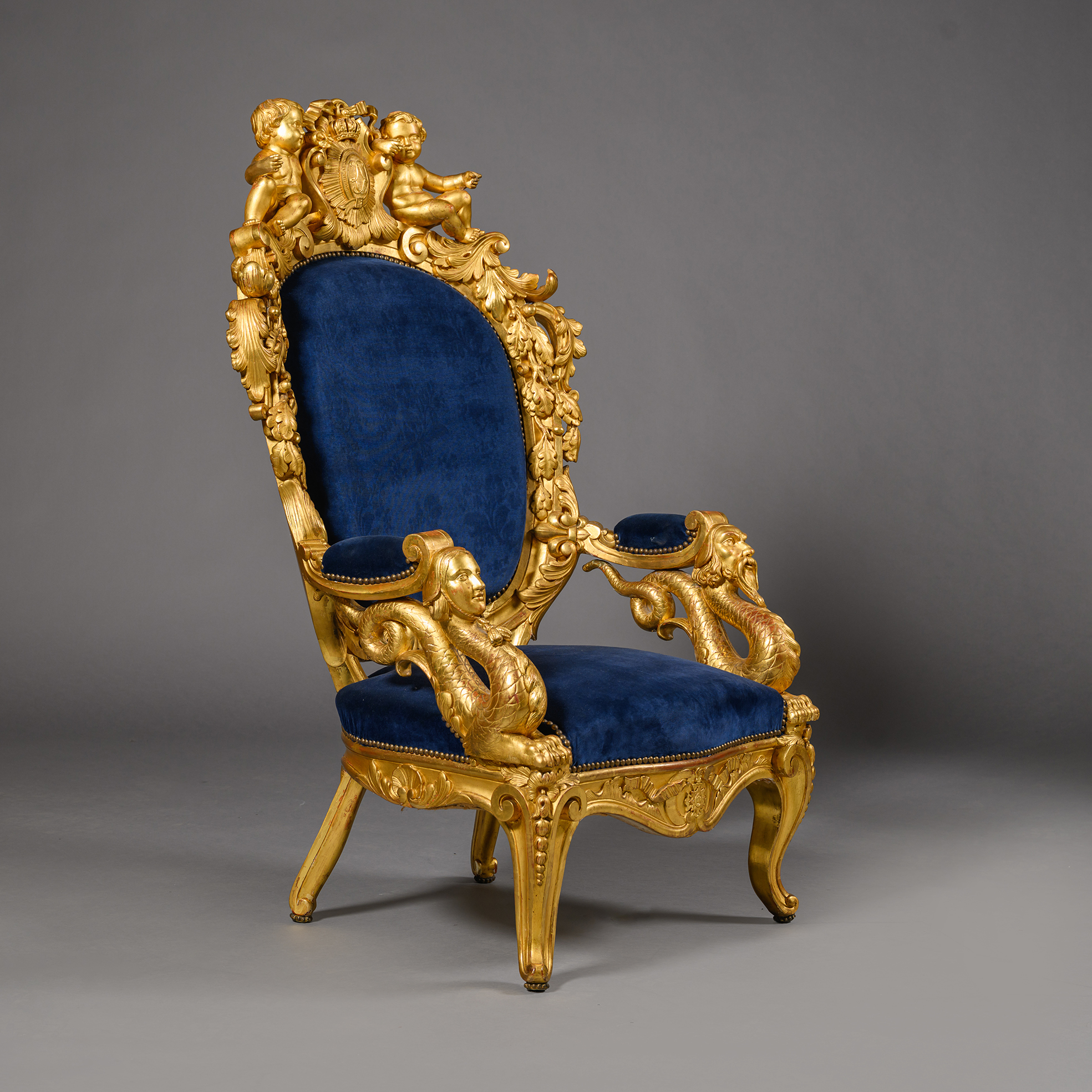
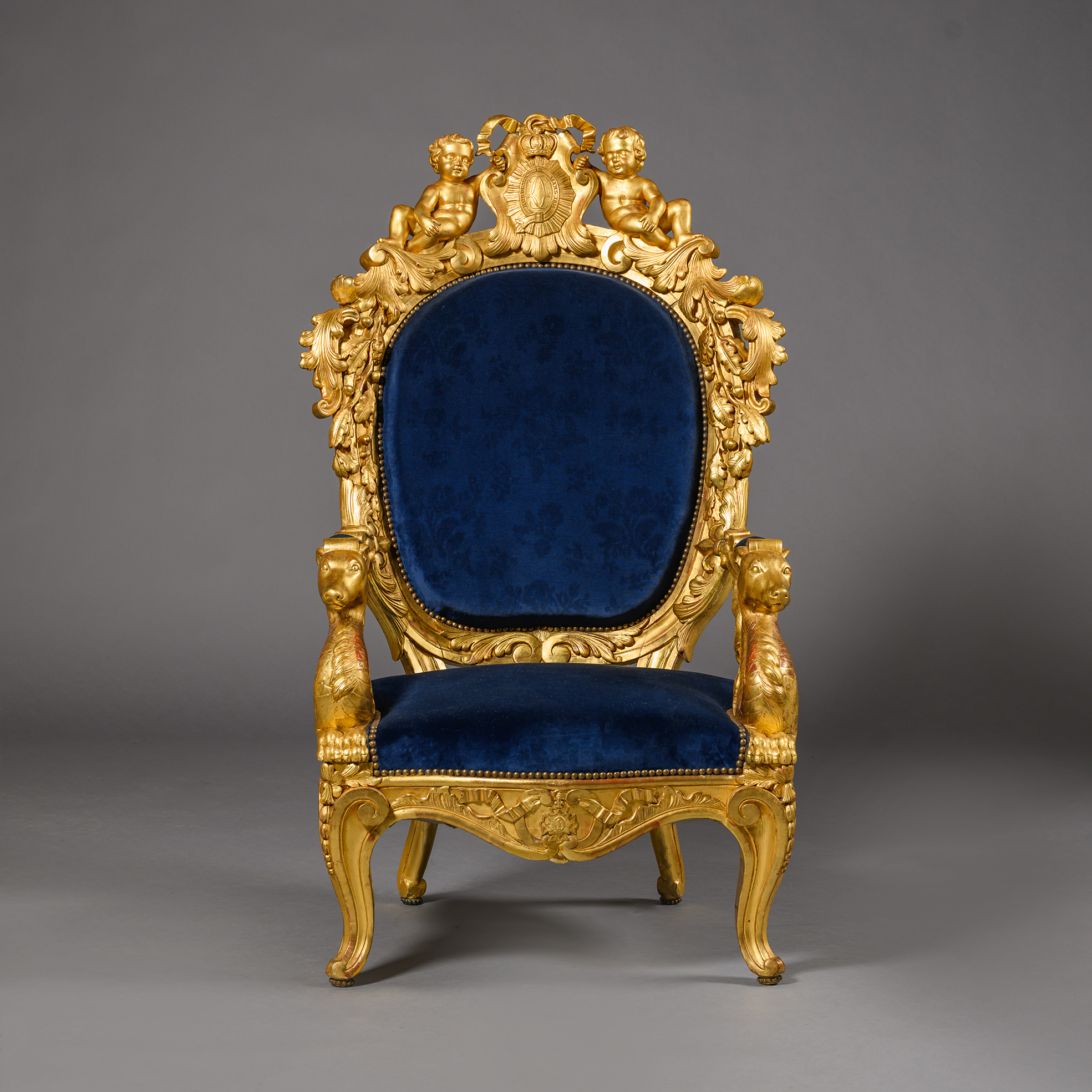
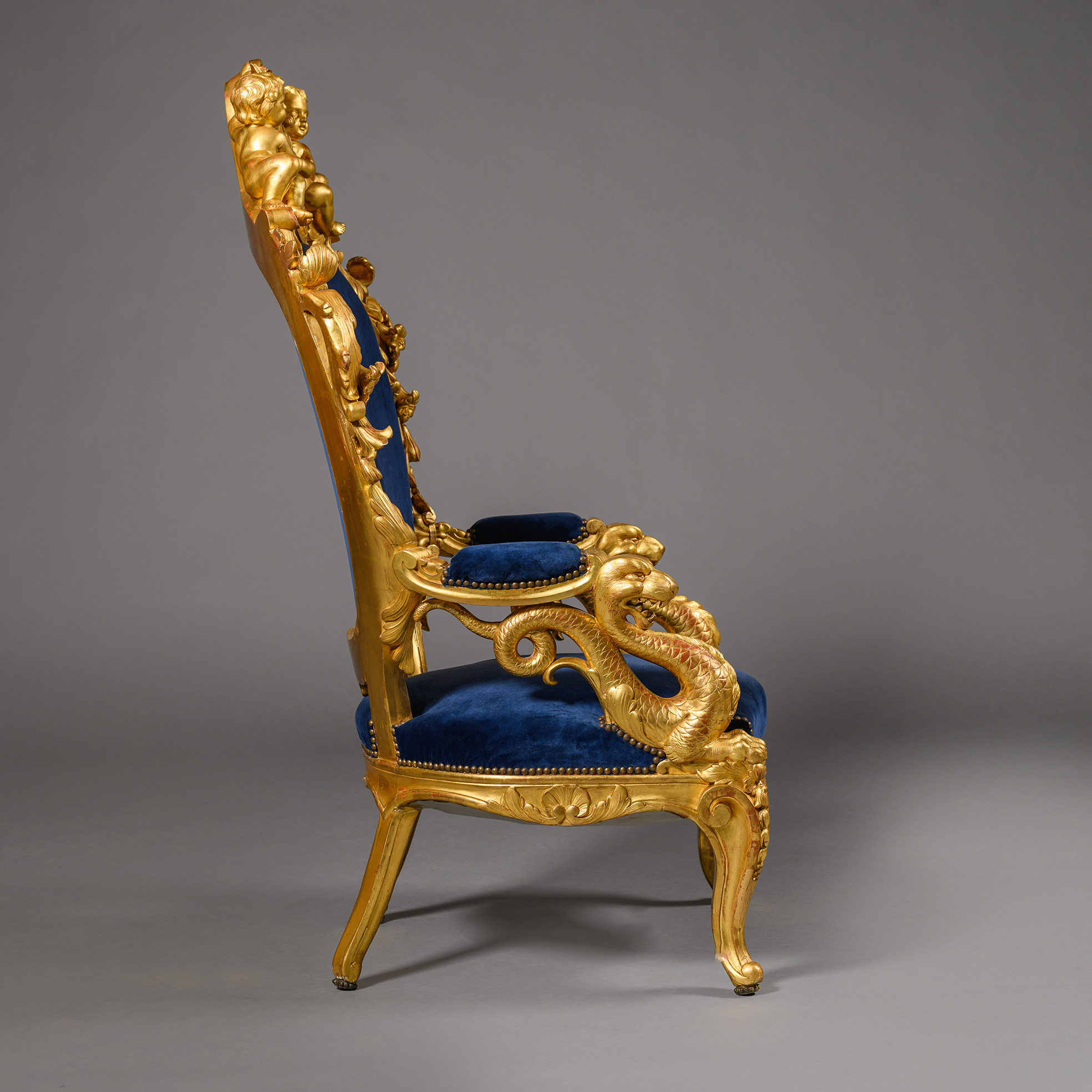
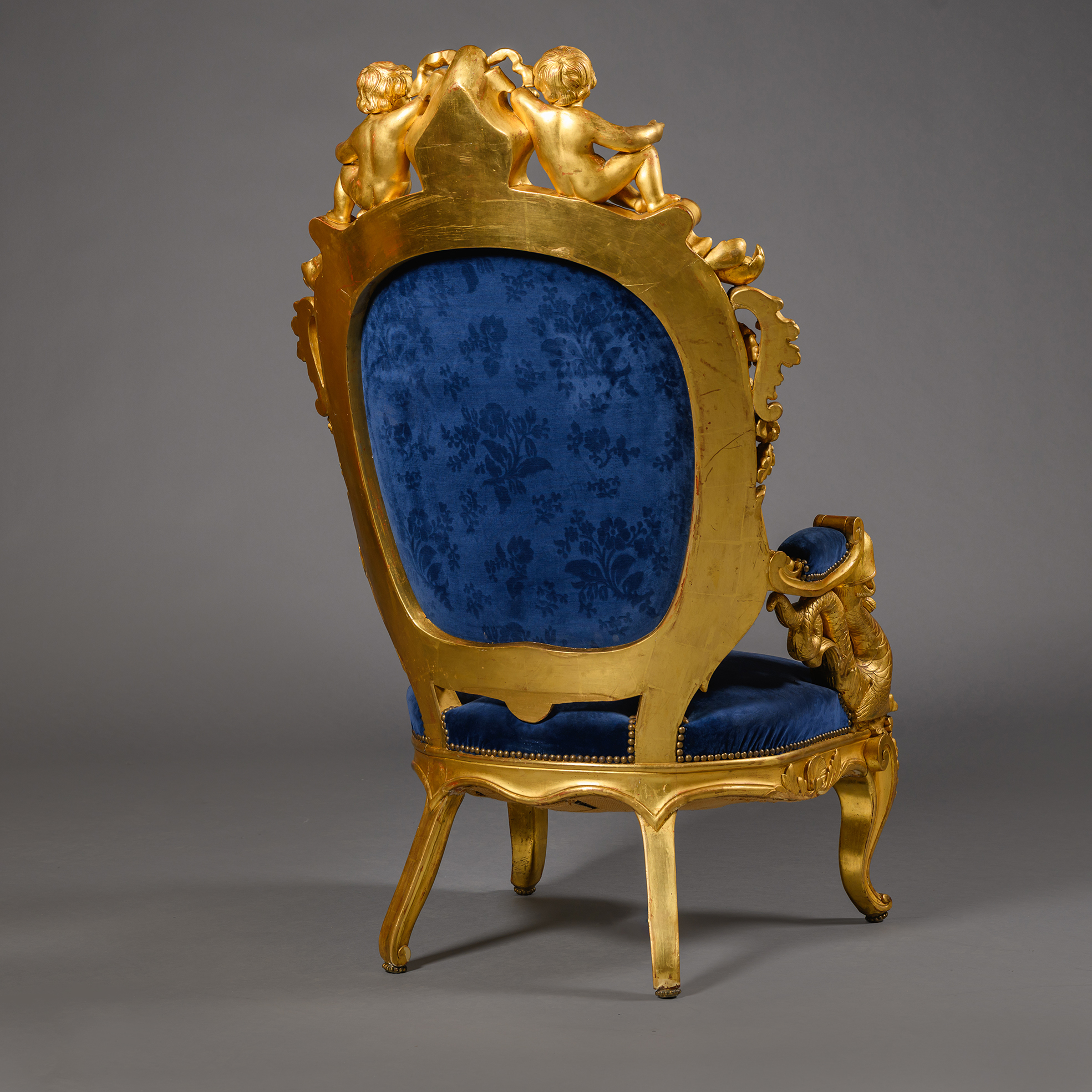
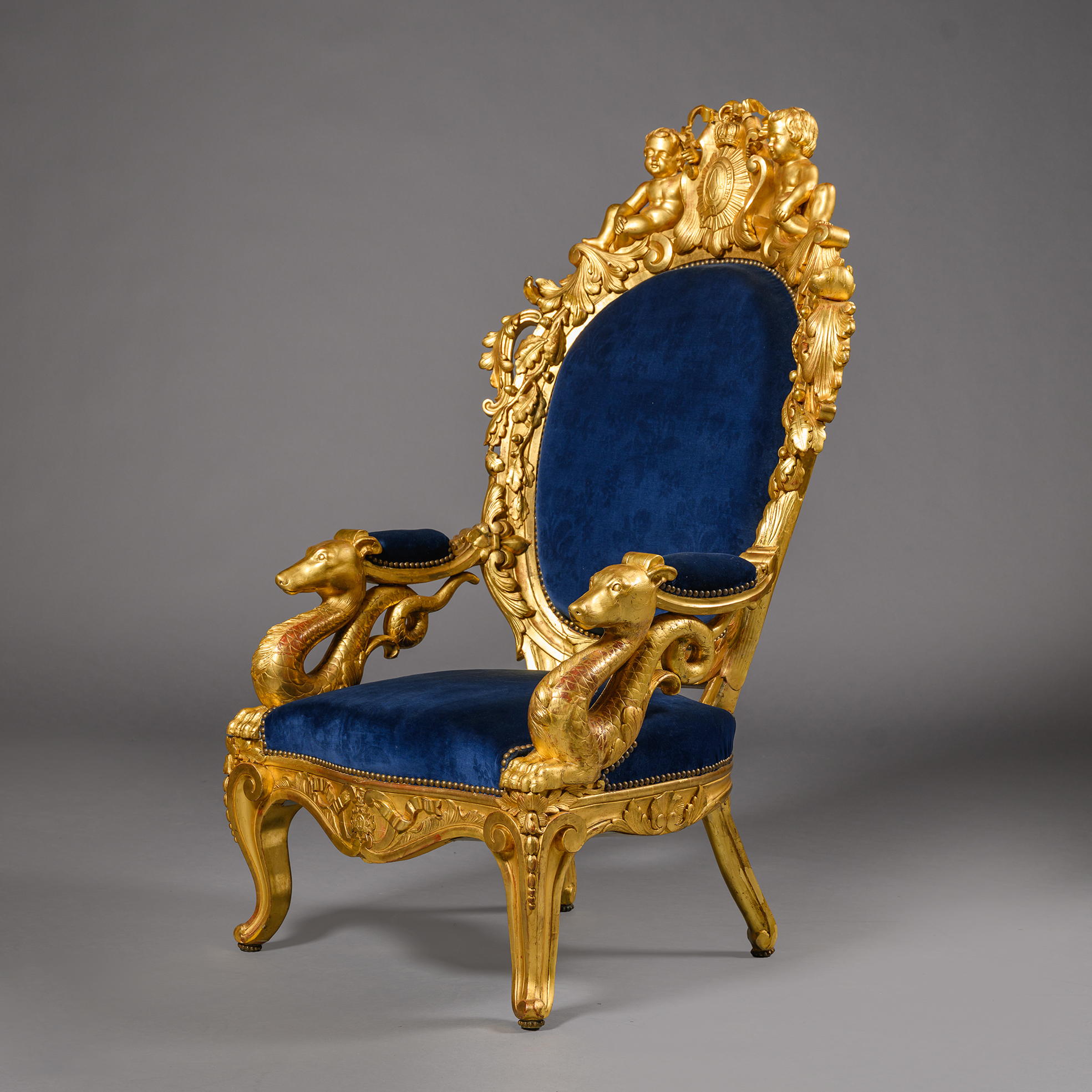
An Important Suite of Six Giltwood Throne Armchairs.Each magnificent chair with oval padded back encircled by an elaborate cresting carved with flowering...
Dimensions
Height: 134 cm (53 in)Width: 83 cm (33 in)
Depth: 80 cm (32 in)

 Print
Description
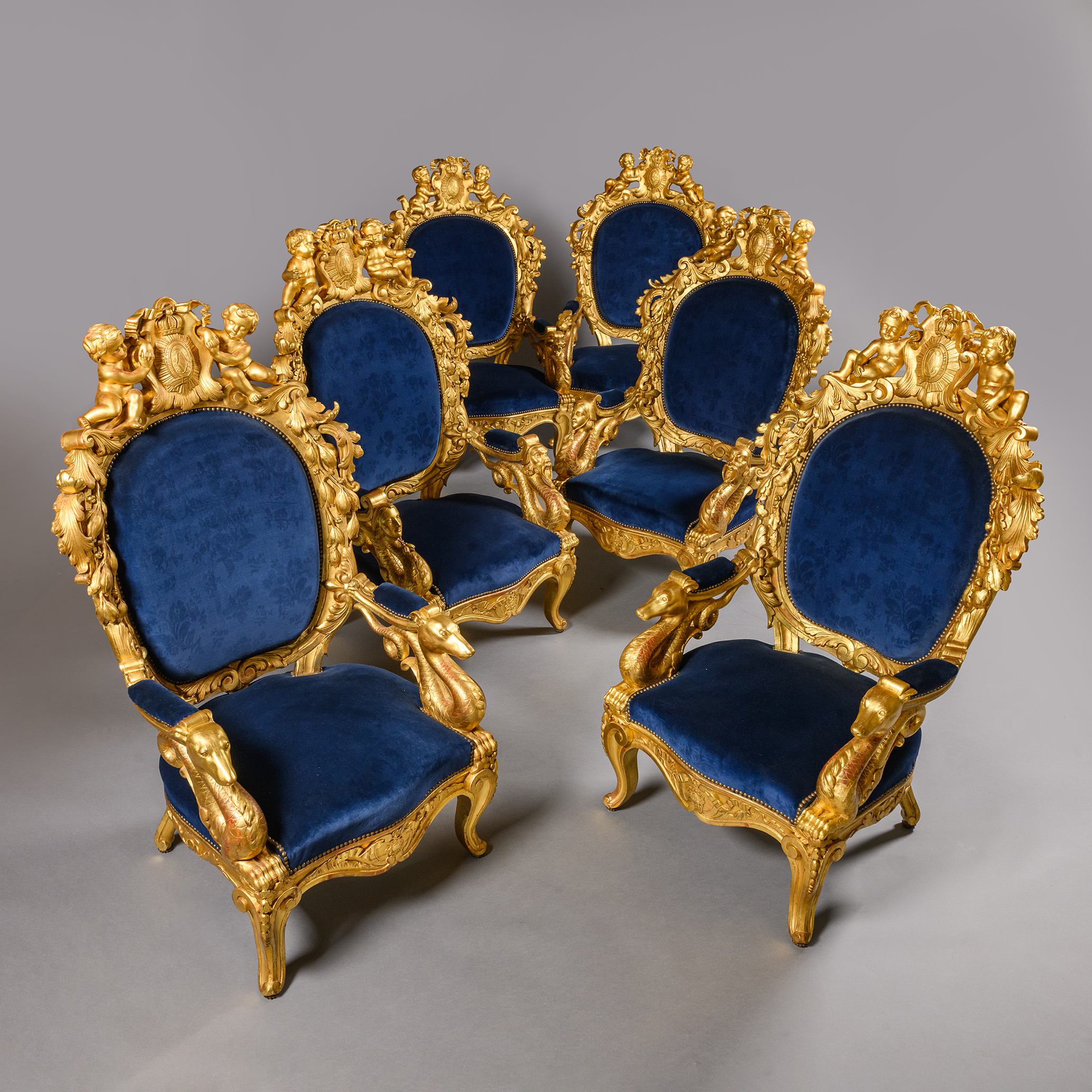
An Important Suite of Six Giltwood Throne Armchairs.
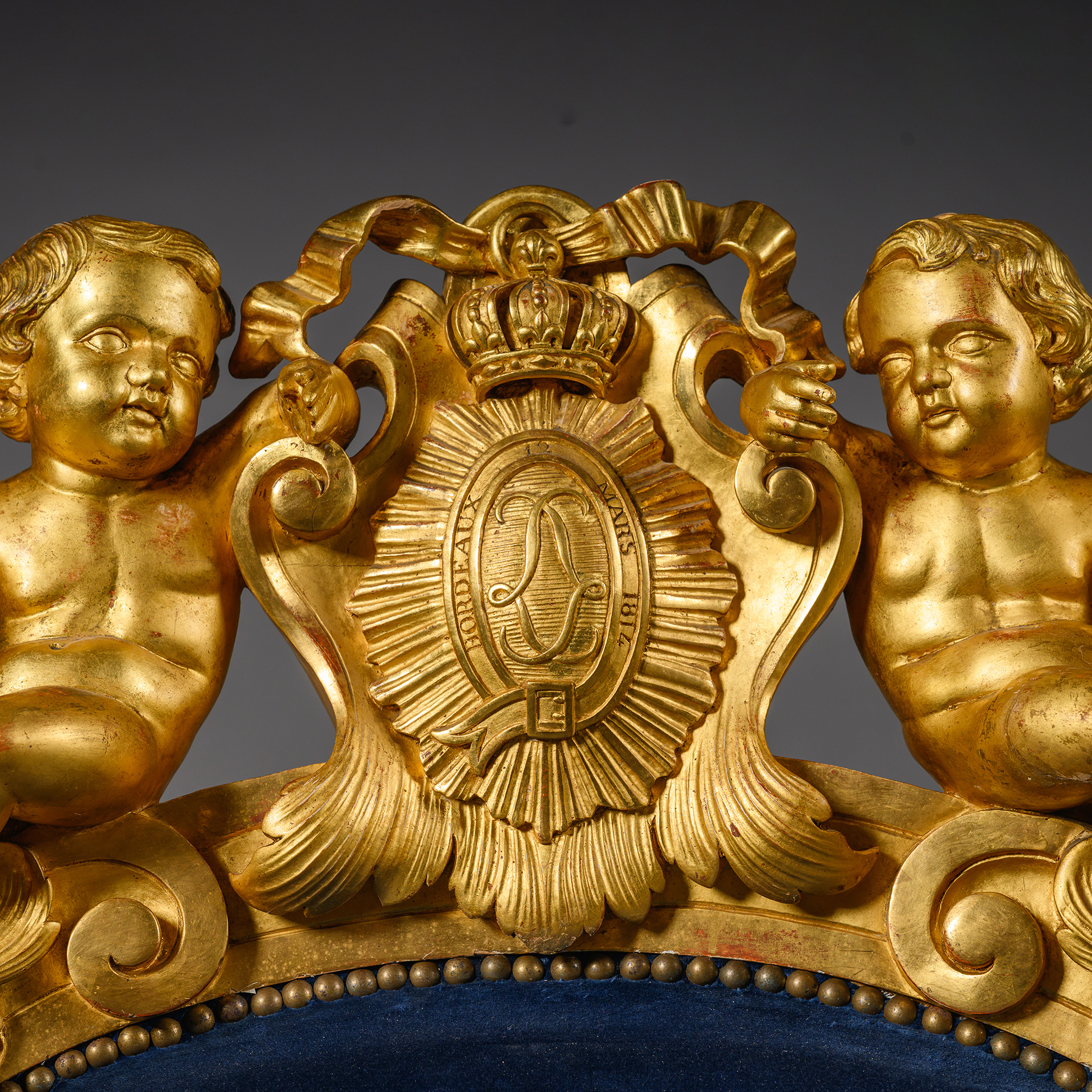
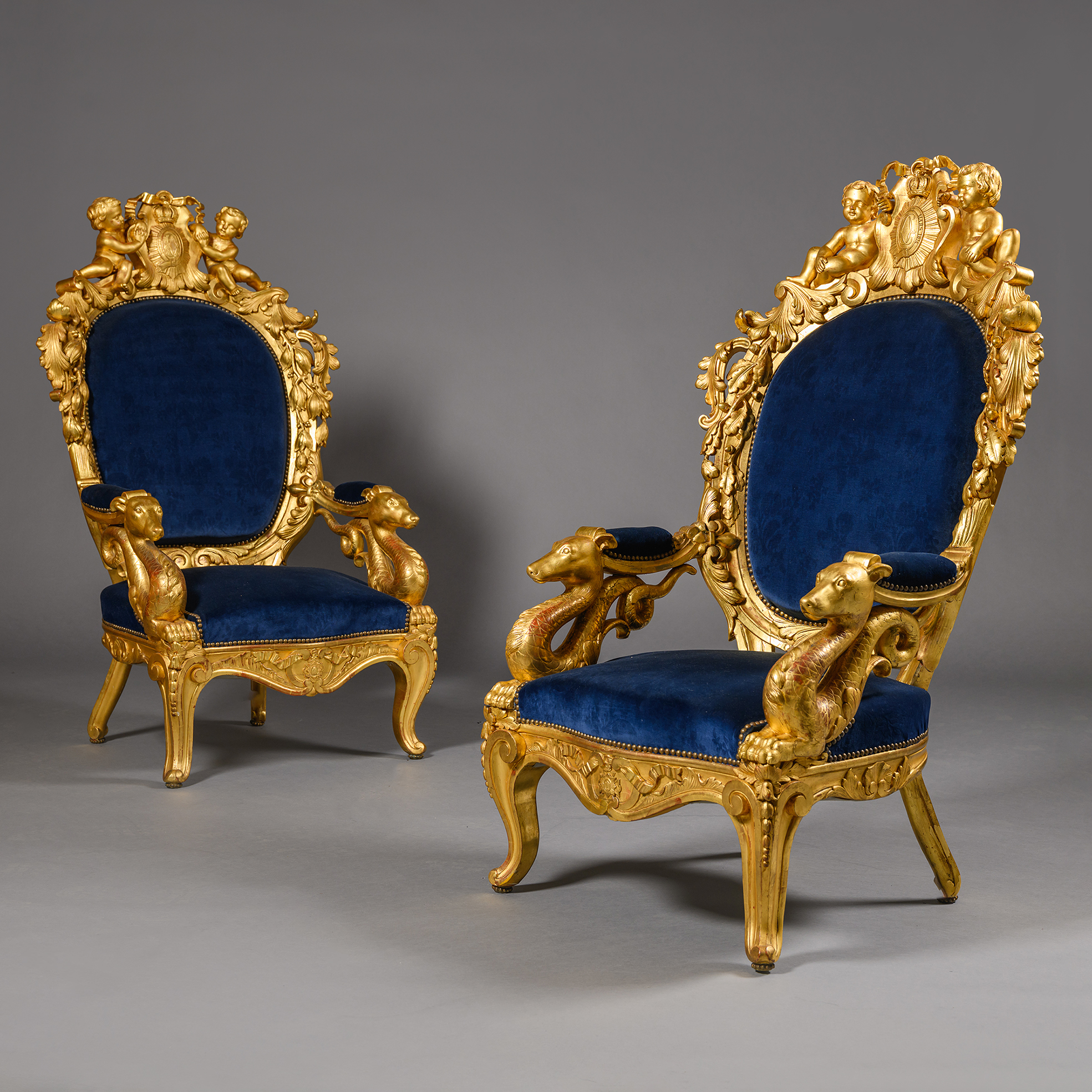
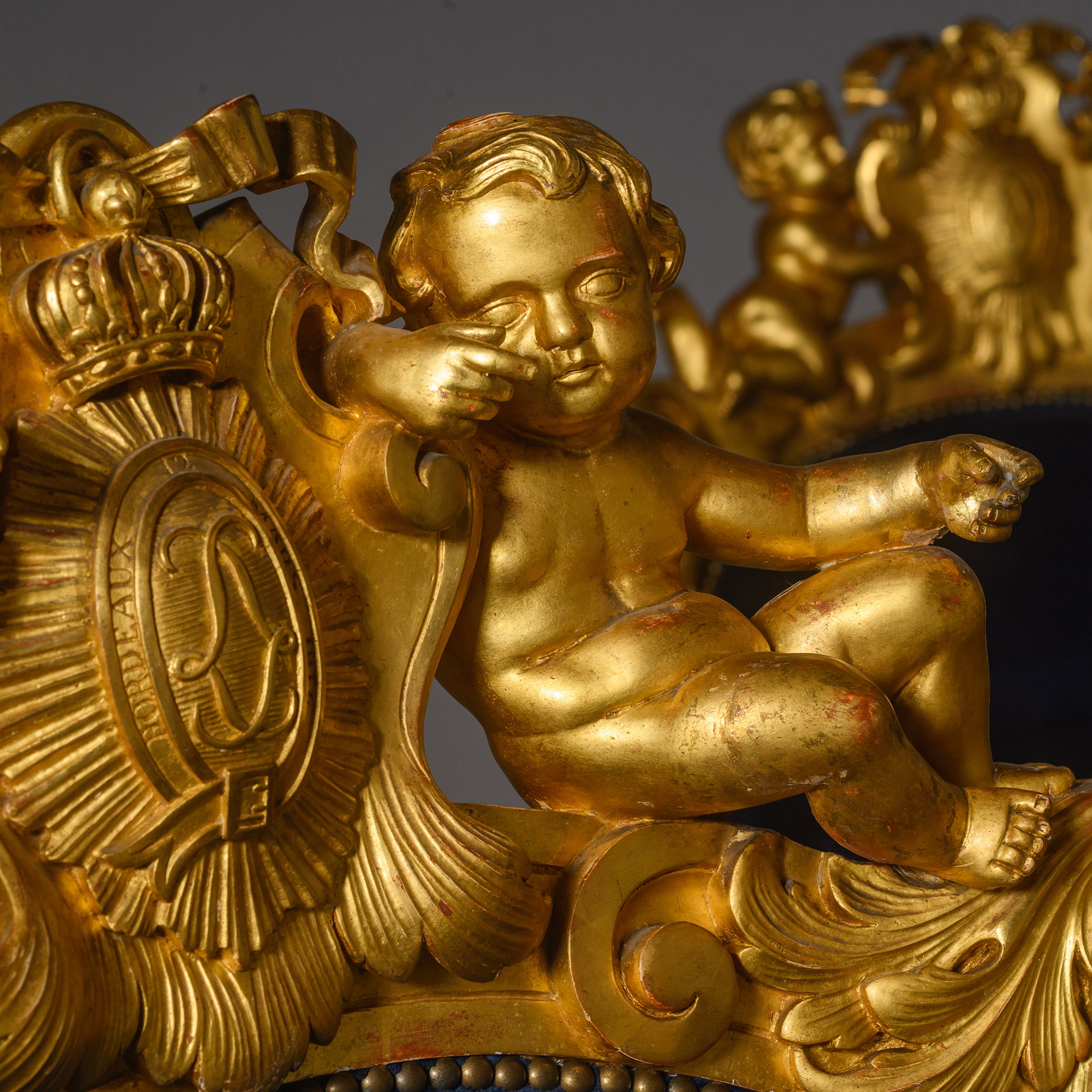
Each magnificent chair with oval padded back encircled by an elaborate cresting carved with flowering acanthus, oak branches, and fleurs-de-lis. The top rail with two putti holding an armorial star-shaped cartouche with the interlaced L’s of Louis XVIII, King of France, and inscribed ‘Bordeaux 12 Mars 1814’, beneath a crown. The armorial cartouche commemorates the ‘Brassard de Bordeaux’, a royalist distinction associated with the events of that date.
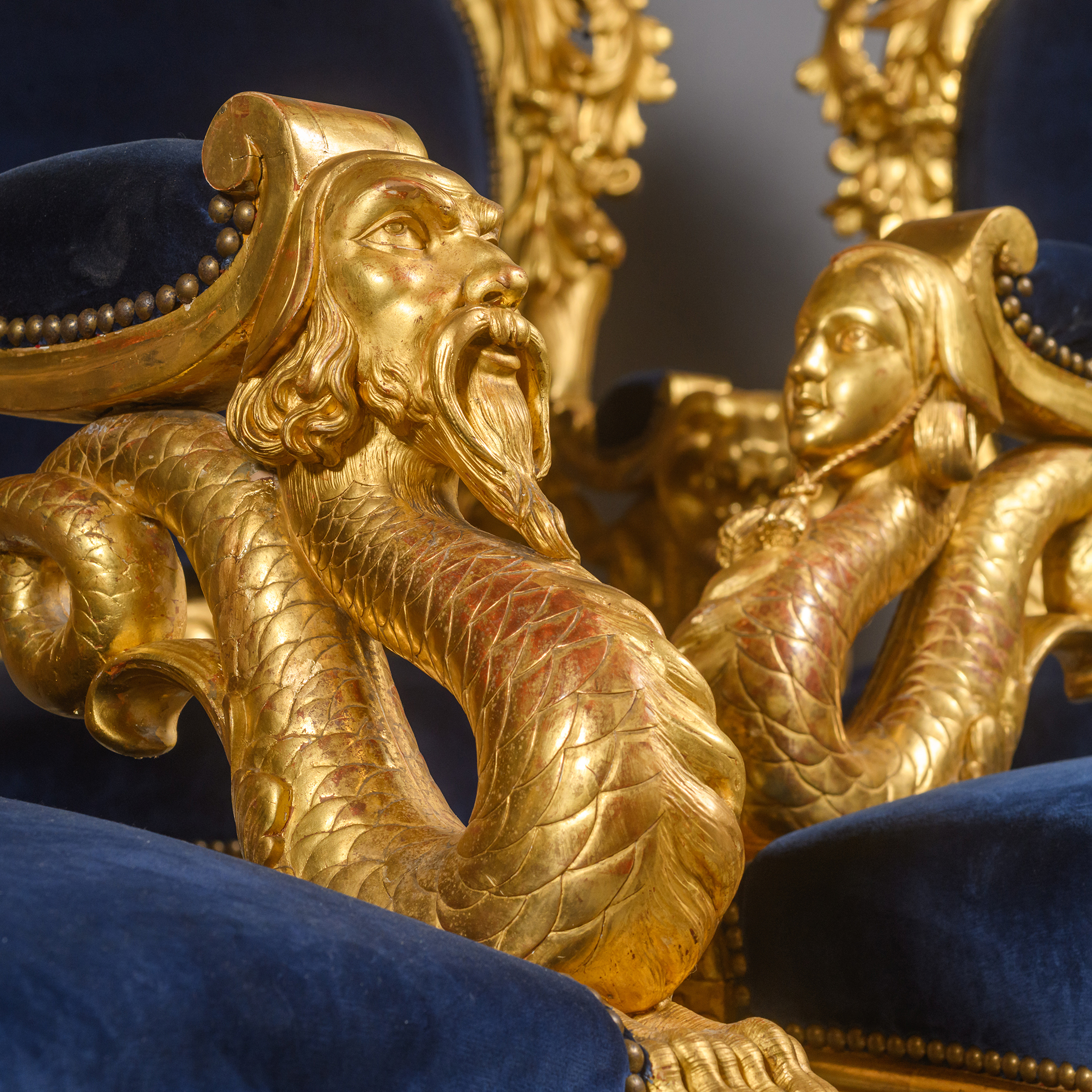
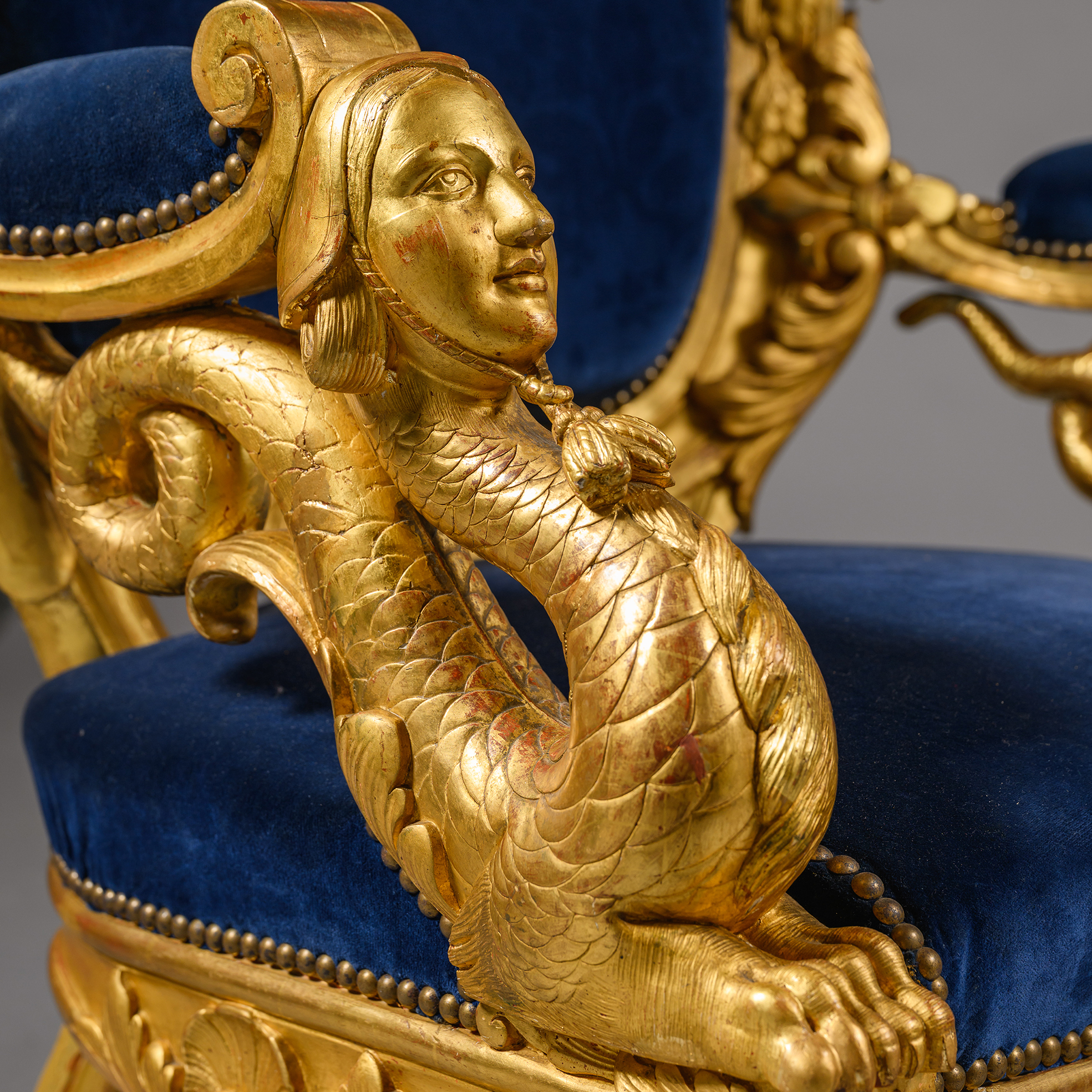
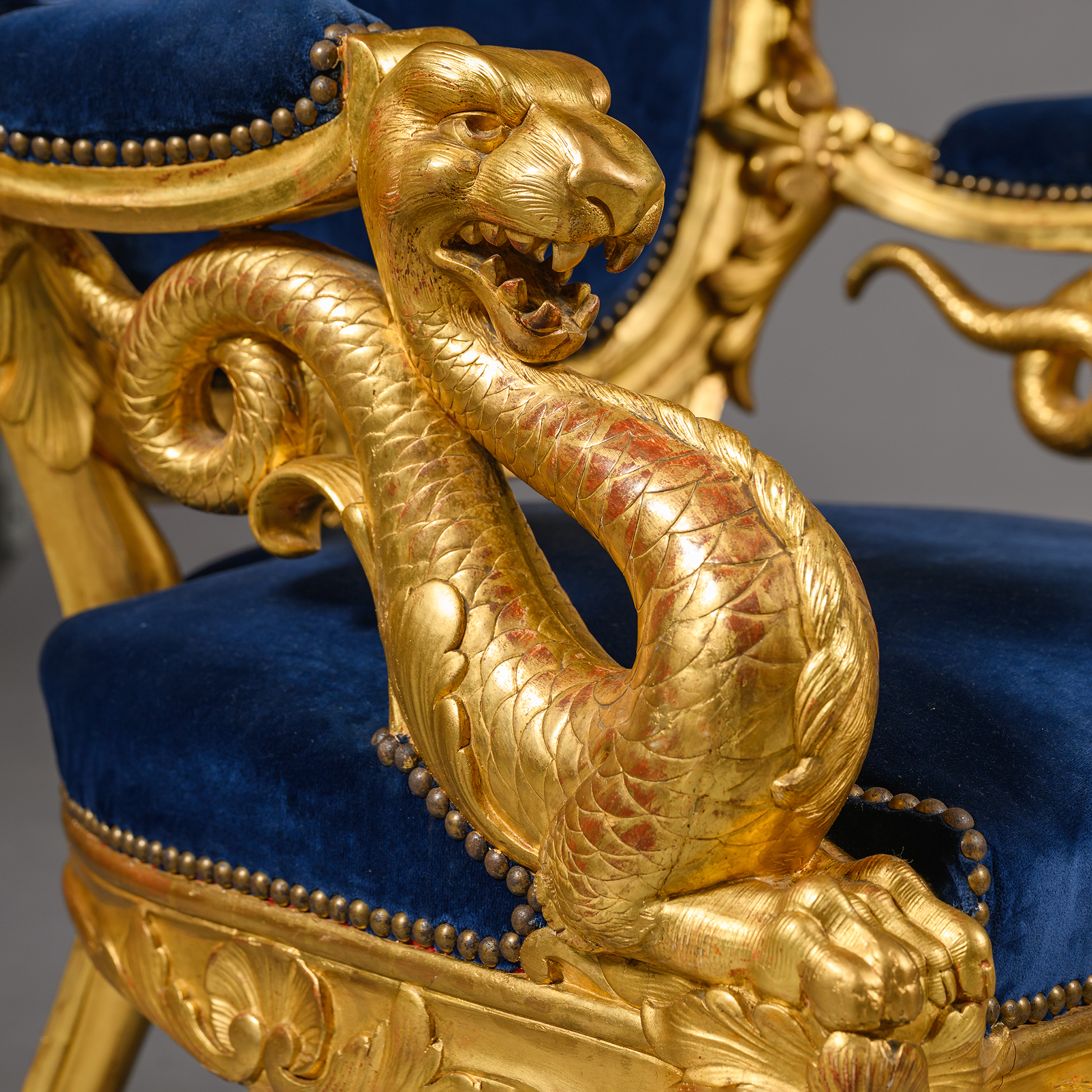
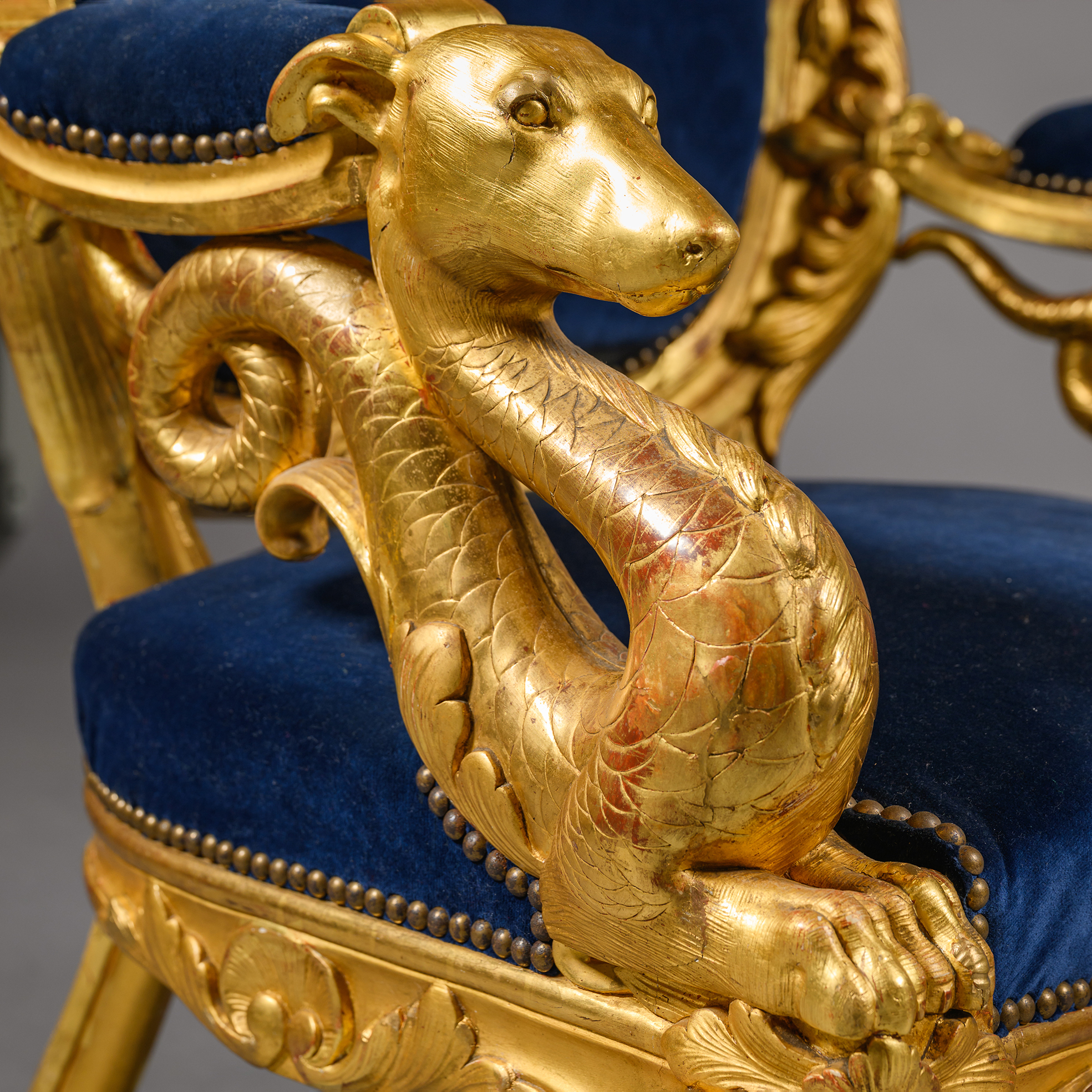
The open arms have padded armrests above exuberantly carved sculptural terminals depicting animal heads and chimera with human faces. The shaped seat rail is enriched with ribbon and rocaille ornament, and centred at the front by a star motif associated with the Décoration du Lys. The chairs stand on cabriole legs and are upholstered in flower-pressed blue velvet.
France, circa 1820–30.
These magnificent throne chairs commemorate an important event in the Bourbon Restoration precipitating the fall of Napoleon I. They celebrate the surrender of the city of Bordeaux to royal power and to King Louis XVIII (1755-1824), heralding the fall of the first Empire (1804-1815). The Duc d’Angoulême (1775-1844), nephew of Louis XVIII and elder son of Charles X, entered the city of Bordeaux to the acclaim of the crowd on 12th March 1814.
These chairs commemorate a pivotal episode in the Bourbon Restoration. On 12 March 1814, the Duc d’Angoulême, nephew of Louis XVIII (1755-1824) and elder son of the future Charles X, entered Bordeaux to a royalist welcome. The city’s declaration for the Bourbons became an important symbol of the weakening of Napoleon’s First Empire.¹
Louis XVIII later described the restoration of royal authority in Bordeaux as ‘the happiest event of my life’. The significance of the city’s support for the Bourbon monarchy was further commemorated on 29 September 1820, when the King bestowed upon his heir the title of Duc de Bordeaux, rather than the traditional Bourbon titles of Duc de Bretagne or Duc de Bourgogne.
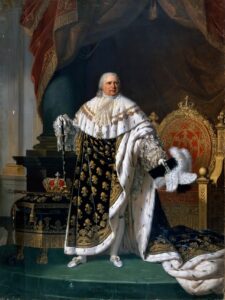
Portrait of Louis XVIII in coronation robes painted in 1822 by Robert Lefèvre (1755–1830).
The armorial cartouche to the top rail of the chairs refers to the ‘Brassard de Bordeaux’, also known as the ‘Brassard vert’. Initially worn as a green armlet edged in white, the distinction was later represented by a medal bearing the royal monogram and the inscription ‘Bordeaux 12 Mars 1814’, beneath a crown. It was awarded to members of the royal guard and volunteers associated with the Duc d’Angoulême’s entry into Bordeaux. It was a commemorative decoration, rather than an order of chivalry; its award and wearing were discontinued following the July Revolution, and abolished by King Louis-Philippe in 1831.²
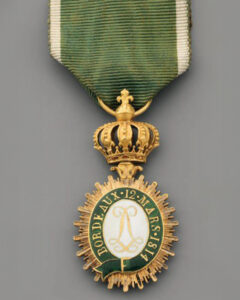
The ‘Brassard de Bordeaux’
The restoration of the Bourbons found particularly strong support in Bordeaux. Before the Revolution, the city had been one of France’s principal commercial ports, with a prosperous mercantile community that included many English and Irish families, and extensive trading connections with the Caribbean, England and the Baltic. Its longstanding commercial ties with Britain made Bordeaux a natural starting point for the restoration of the Bourbon monarchy.
The Napoleonic Wars had severely disrupted European commerce, to the considerable detriment of British as well as French trade. This shared interest in the restoration of commercial relations, alongside sympathy for Louis XVIII during his exile in England, helps explain the significance of the Duc d’Angoulême’s arrival in Bordeaux, an undertaking facilitated by the Duke of Wellington. By the time of his arrival, the French authorities and military forces still loyal to Napoleon had withdrawn, allowing the city to declare its allegiance to the Bourbons without bloodshed. Bordeaux’s largely peaceful change of allegiance demonstrated the strength of royalist sentiment and the widespread desire for political stability and the resumption of trade.
The prominence of the Brassard emblem on these chairs underscores their importance in commemorating Bordeaux as the fulcrum of the Bourbon restoration. Their survival is particularly notable given King Louis-Philippe’s suppression of the decoration.
Louis-Philippe, of the House of Orléans, belonged to a junior branch of the House of Bourbon. Following the July Revolution of 1830, he succeeded his cousin, Charles X, whose abdication on 2 August had been made in favour of his grandson, Henri, Duc de Bordeaux (1820–1883), later known as the Comte de Chambord. Charles X had intended that Henri should succeed him as King, with Louis-Philippe acting as regent during the young prince’s minority. Louis-Philippe, however, did not pursue this arrangement and instead accepted the crown when it was offered to him by the Chamber of Deputies. Proclaimed Louis-Philippe I, King of the French, on 9 August 1830, he established the July Monarchy, presenting himself as a constitutional sovereign whose authority rested upon the nation rather than solely upon hereditary right.
Henri, Duc de Bordeaux, consequently, became the focus of the Legitimist movement, which continued to uphold the claims of the senior Bourbon line. Known subsequently as the Comte de Chambord, he remained the Legitimist claimant to the French throne throughout the July Monarchy, the Second Republic and the Second Empire of Napoléon III, and into the early years of the Third Republic.
In the absence of any firm documentary evidence, it can be speculated that the suite was commissioned by the city of Bordeaux to commemorate the events of 12th March 1814. Another possibility is that they fittingly belonged to the Duc d’Angoulême, or were part of a later Bourbon revival, perhaps commissioned by the Duc de Bordeaux for the colossal Château de Chambord.
Each chair is distinguished with exuberant floral and zoomorphic carving, placing them within the decorative language of the Restoration, when Neoclassical forms were enlivened by a renewed taste for Rococo ornament. The chairs feature scrolling sculptural arms expressively carved with chimeric dragons, animal’s heads and whimsical caricatures.
The chairs’ exuberant floral and zoomorphic carving places them stylistically at the intersection of neoclassicism and the Rococo revival. Their ornamental vocabulary finding a parallel in Jean-Démosthène Dugourc’s theatrical designs for the throne room of Louis XVIII at the Tuileries.³
Footnotes
1. The Duc d’Angoulême’s entry into Bordeaux on 12 March 1814 is treated in Laurent Coste, “Bordeaux et la restauration des Bourbons,” *Annales du Midi* 105, no. 201 (1993): 27–43; and “La mémoire du 12 mars 1814 dans le Mémorandum,” *Revue historique de Bordeaux et du département de la Gironde* 25 (2019): 187–195. The event is more precisely described as Bordeaux’s declaration for the Bourbons than as a military surrender to Louis XVIII.
2. Société des Amis du Musée de la Légion d’honneur et des Ordres de chevalerie, “Ordre du Brassard de Bordeaux” and “Généralités sur le port des décorations.” The sources describe the Brassard’s form, award and later suppression.
3. Daniel Alcouffe et al., ‘Un âge d’or des arts décoratifs : 1814–1848’ (exhibition catalogue, Galeries nationales du Grand Palais, Paris, 1991), 74–81. For Dugourc’s Restoration designs, see the relevant discussion of the Tuileries throne room.
Date
Circa 1830
Origin
France
Medium
Carved Giltwood
Alcouffe, Daniel, et al., ‘Un âge d’or des arts décoratifs : 1814–1848’. Exhibition catalogue, Galeries nationales du Grand Palais, Paris, 1991, pp. 74–81.
Mansel, Philip, ‘The Return of the Émigrés: Bordeaux, 12 March 1814.’ In *French Emigrants in Revolutionised Europe’, pp. 277–296.