 Ref no: B78761
Marius-Jean-Antonin Mercié
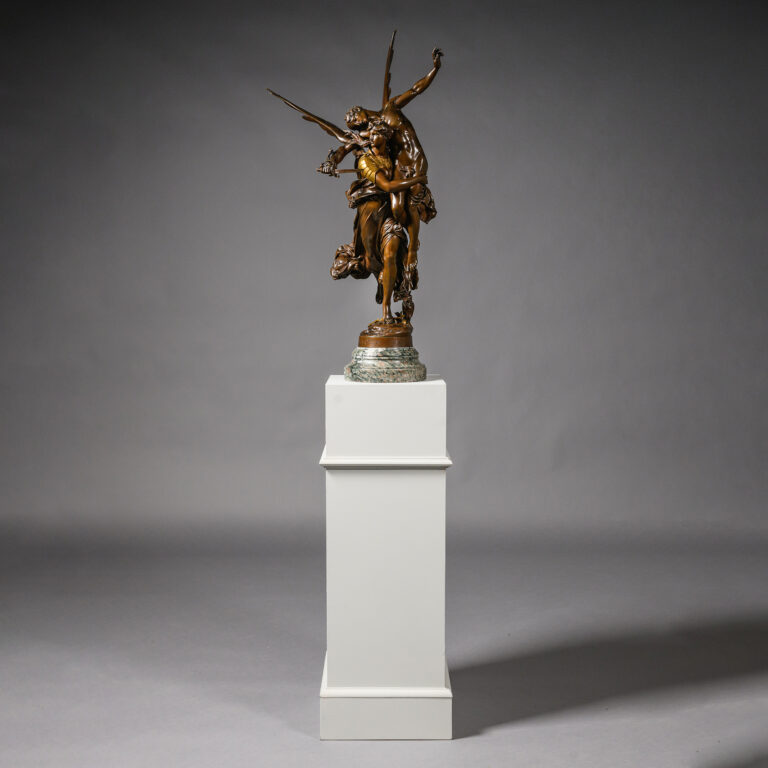
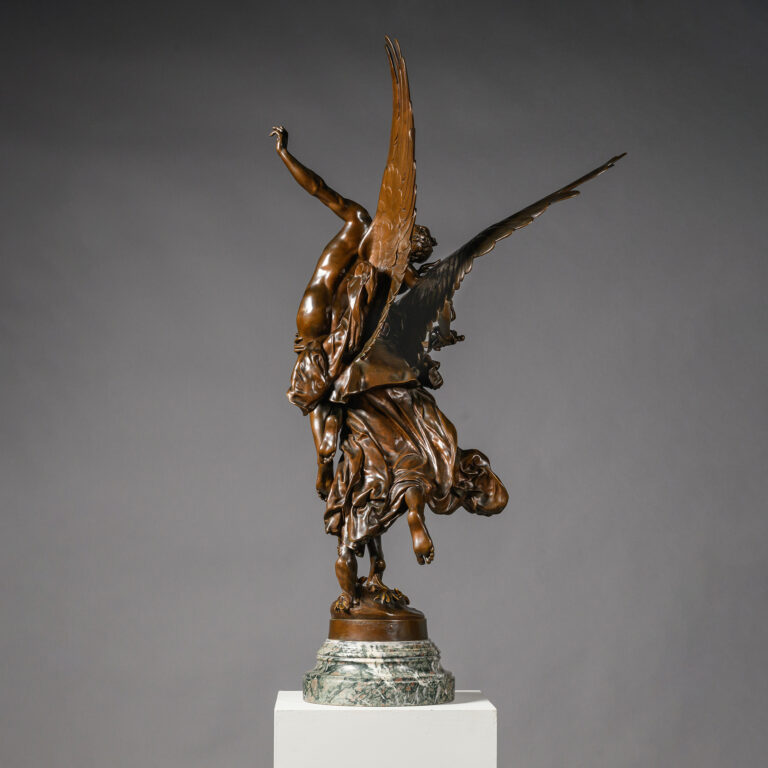
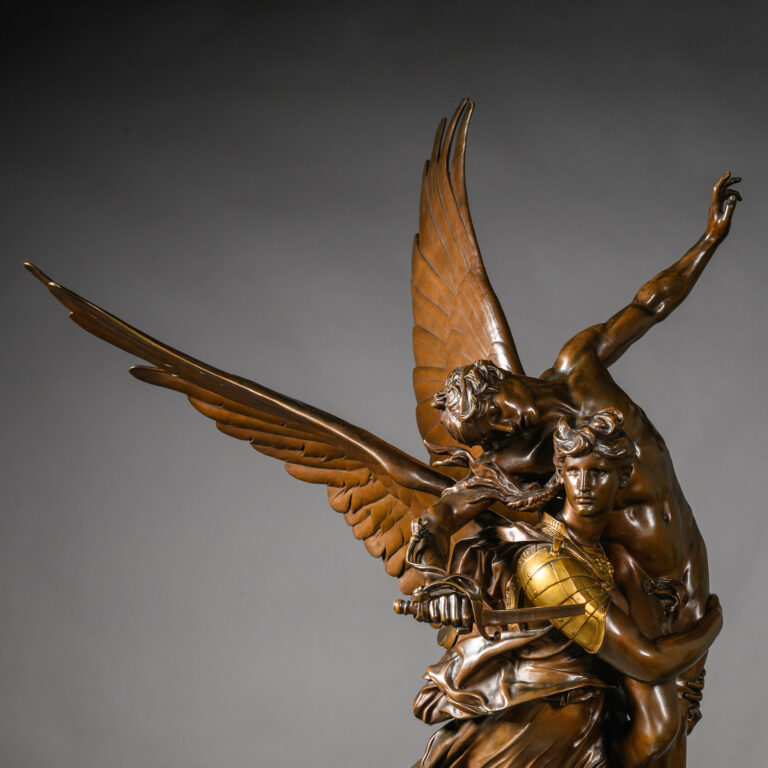
‘Gloria Victis’ – A Fine Gilt and Patinated Bronze Statue
France, Circa 1890
£36,000
- Date
- Circa 1890
- Origin
- France
- Medium
- Gilt and Patinated Bronze
- Signature
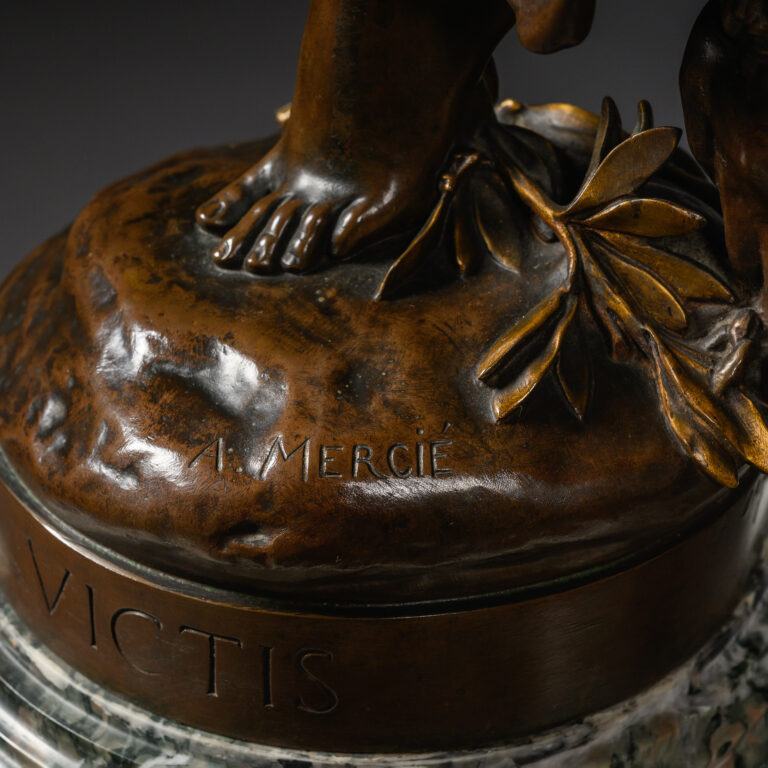
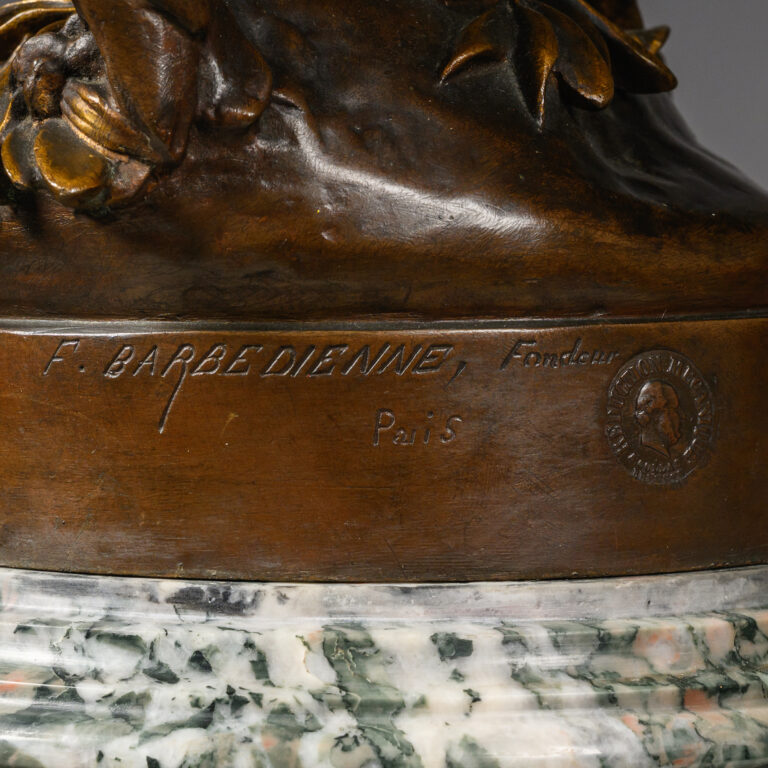
- Signed 'A. Mercié’, with foundry inscription 'F. BARBEDIENNE, Fondeur. Paris.' and stamped with the A. Collas reduction cachet.
- Height
- 105 cm (42 in)
- Width
- 55 cm (22 in)
- Depth
- 40 cm (16 in)
- Weight
- 40.6 kg
Description
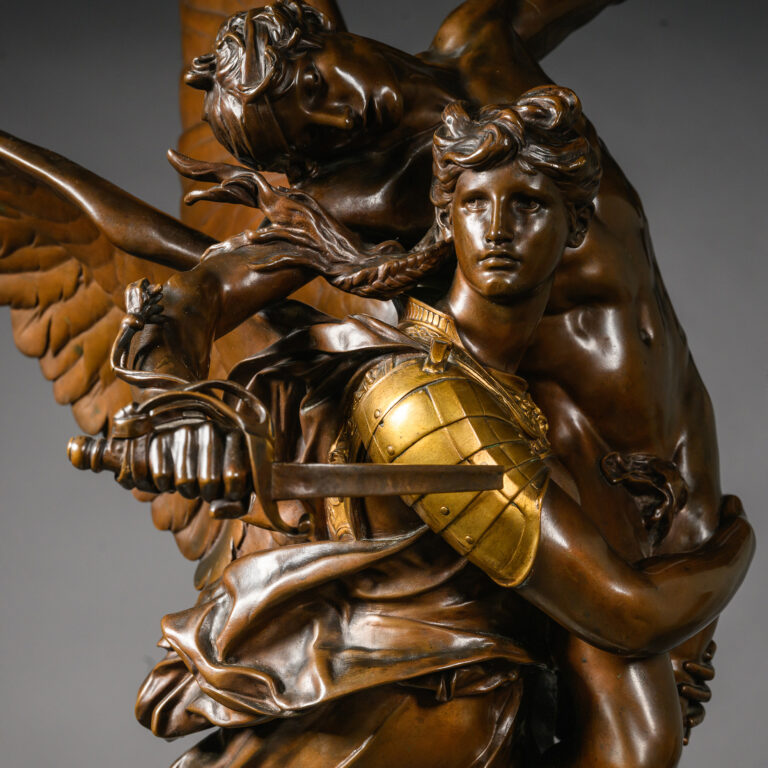
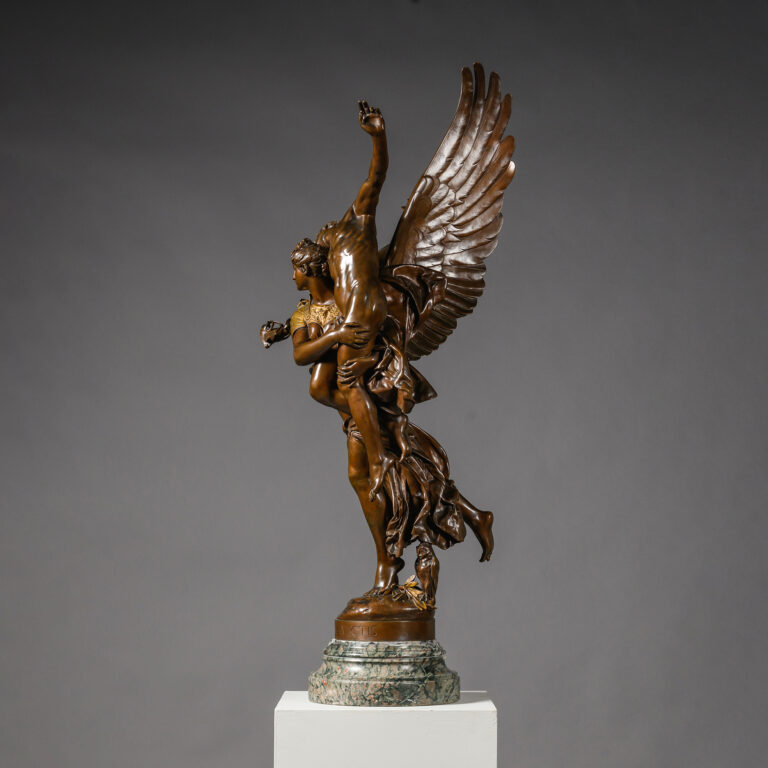
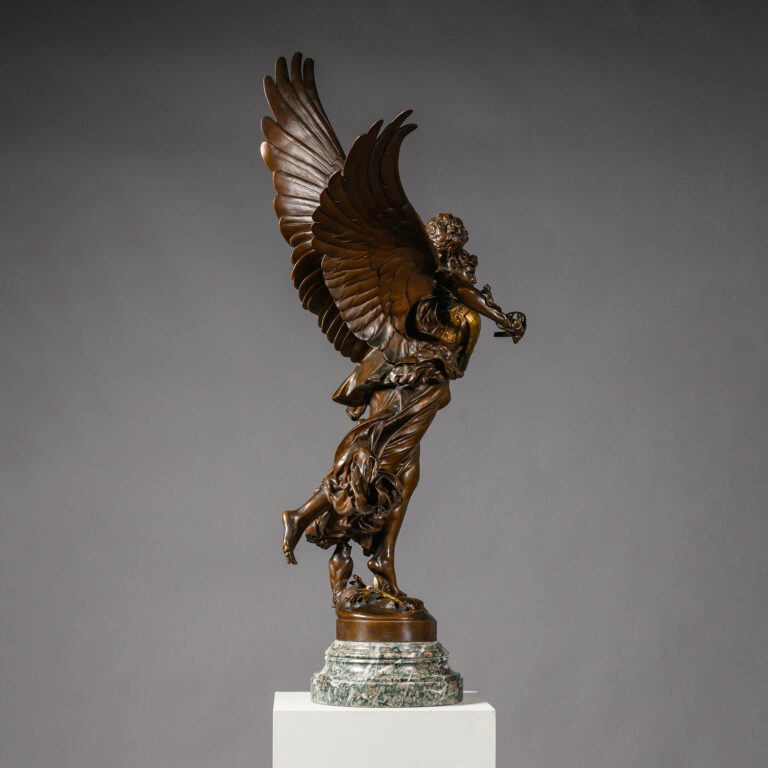
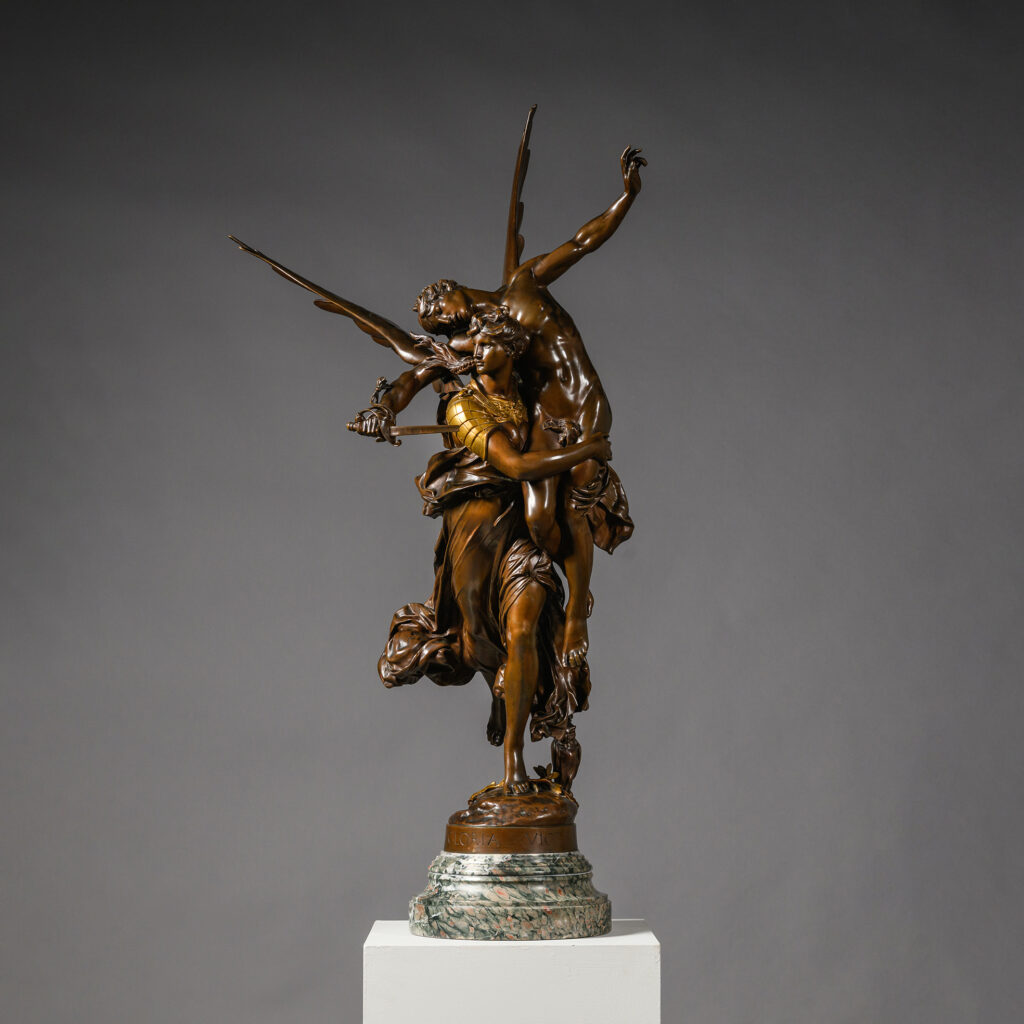
A Fine Gilt and Patinated Bronze Statue, Entitled ‘Gloria Victis’ (‘Glory to the Vanquished’), By Marius-Jean-Antonin Mercié (French, 1845-1916).
Signed ‘A. Mercié’, with foundry inscription ‘F. BARBEDIENNE, Fondeur. Paris.’ and stamped with the A. Collas reduction cachet.
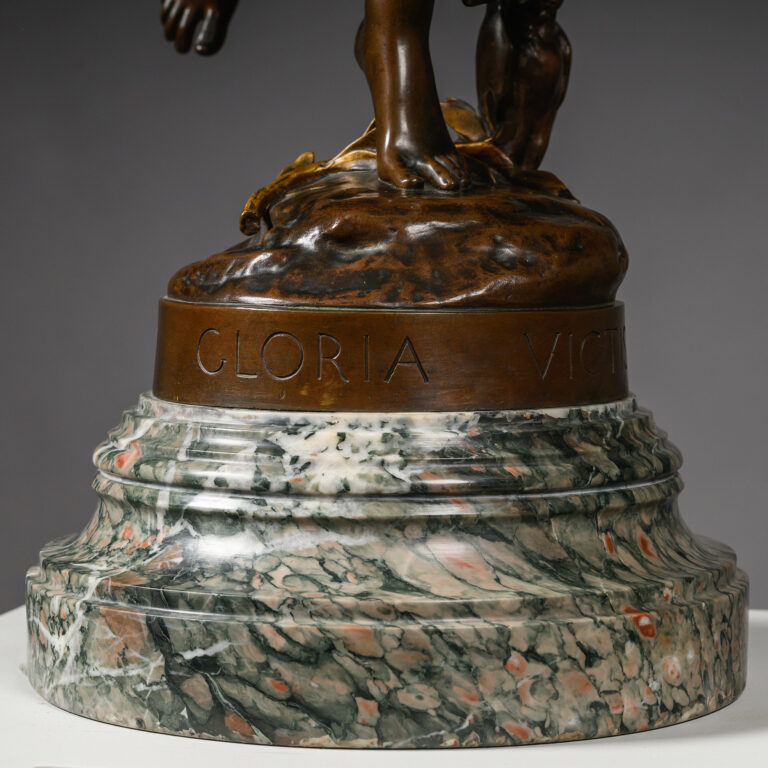
The integral base titled ‘GLORIA VICTIS’.
On a pink and green mottled marble socle.
France, Circa 1890.
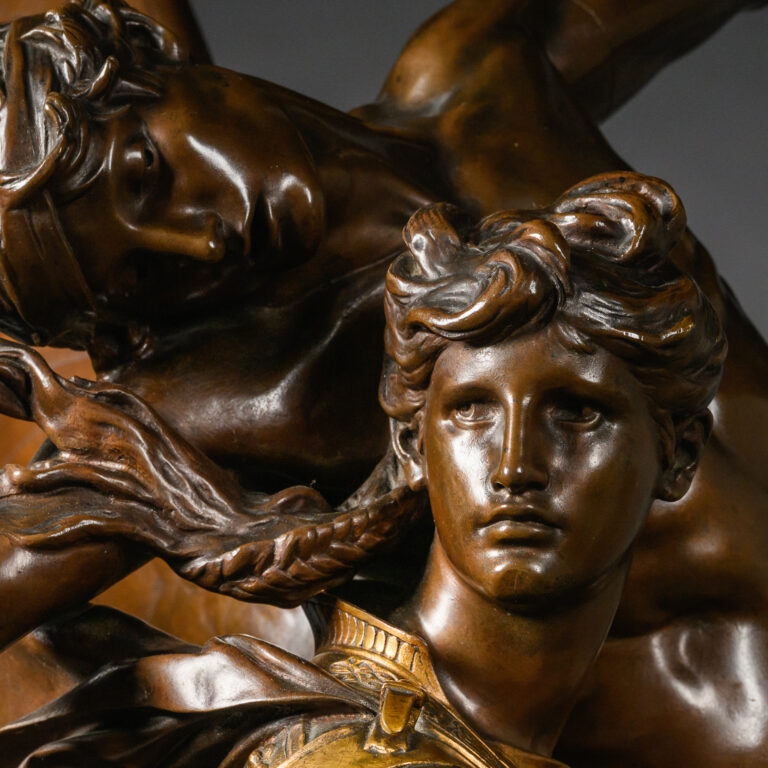
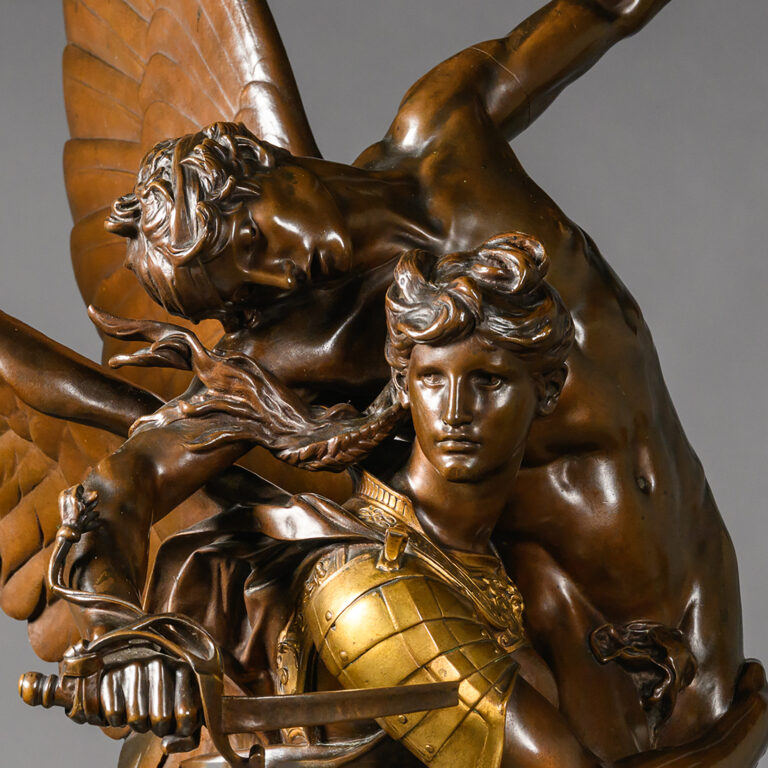
‘Gloria Victis’ is one of the most recognisable and important works of sculpture of the nineteenth century and a definitive image of France’s historic national identity. The figure of glory, winged and wearing armour, carries a dying young warrior heavenwards towards fame and immortality. The compositional daring of the group must be admired for balancing two figures on the minimal support of one foot, wings spread in the moment before taking flight.
Mercié was a student at the French Academy of Rome when the Prussians invaded France in 1870. Shortly after the war had begun, he executed a group depicting the figure of Fame supporting a victorious soldier. When news reached Mercié in Rome that the French had surrendered, he decided to alter his group, replacing the victorious soldier with a defeated casualty, thus transforming an allegory of ‘Glory to the Victors’ into one of ‘Glory to the Vanquished’. Completed in 1872, a year after the defeat of French soldiers against the Prussian army, the statue personifies a defeated but heroic France. The title is also a reversal of the famous formula, ‘Vae Victis’ (Death to the Vanquished), which the Gallic general Brennus exclaimed upon defeating the Romans in 390 BC. The figure of the fallen soldier was thought to represent Henri Regnault, a fellow sculptor of Mercié who was killed on the last day of fighting.
Measuring 317 cm. high the original group of ‘Gloria Victis’ was unveiled in plaster at the Salon of 1872.
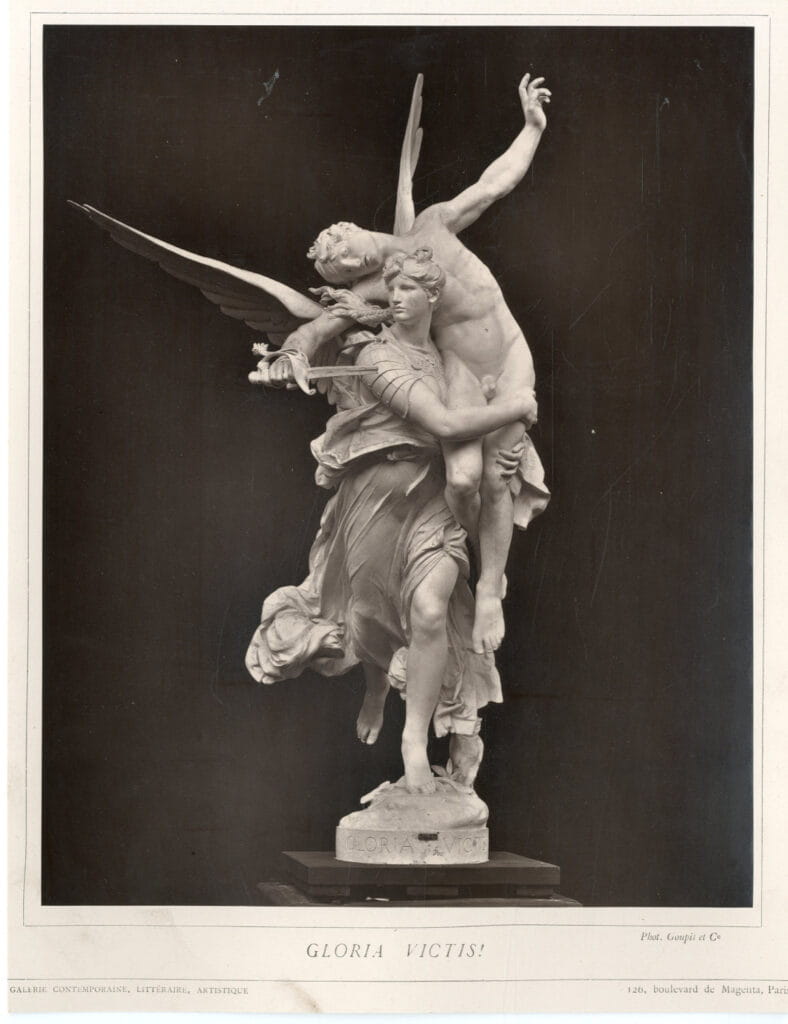
Gloria Victis’, plaster version exhibited at the Paris Salon 1872.
It was bought by the City of Paris for the sum of twelve thousand francs and then cast in bronze by Victor Thiébaut for eight thousand five hundred francs. The bronze was exhibited at the Salon in 1875 and first placed in Montholon Square in the 8th arrondissement. In 1884 it was transferred to the courtyard of the Hôtel de Ville and in 1930, it entered the collection of the Musée du Petit Palais, where it can be seen to this day.
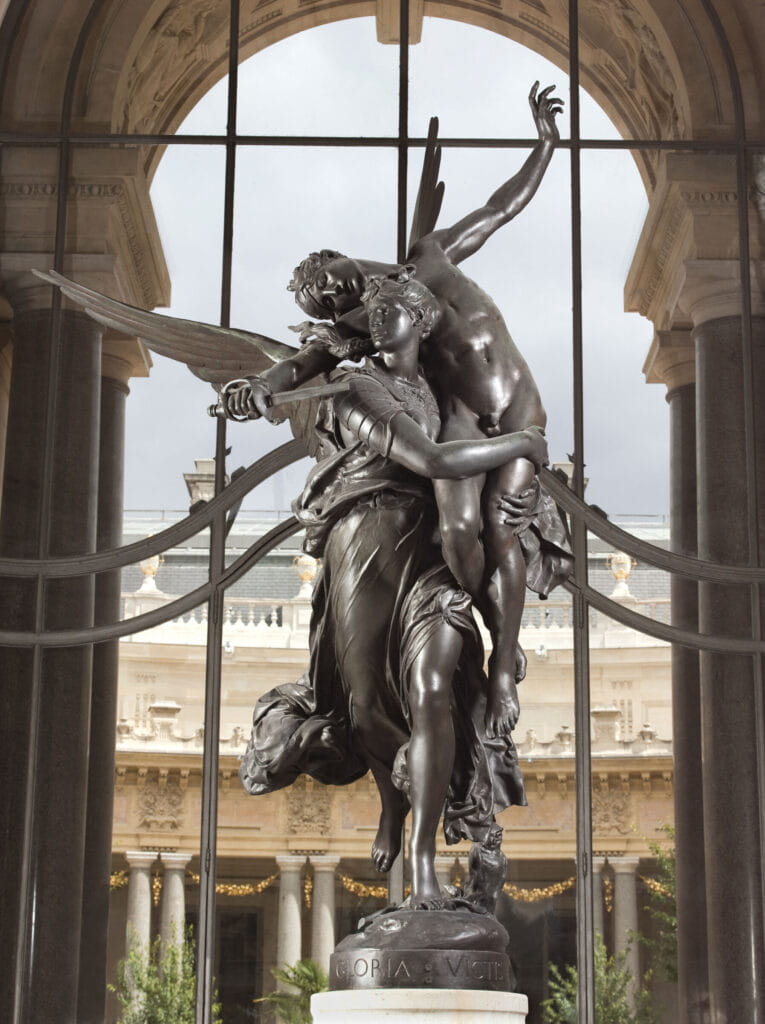
‘Gloria Victis’ in the Musée du Petit Palais, Paris.
The Thiébaut Frères foundry also cast Gloria Victis bronzes for the cities of Niort (requested 1881) Bordeaux (requested 1883), Châlons-sur-Marne (today, Châlons-en-Champagne; requested 1890), and Cholet (requested 1901).
In 1905, the Danish brewer and art collector Carl Jacobsen was permitted to have an exact cast made of the original sculpture in Paris, on condition that the base was made 2 cm lower and bore the inscription “Original tilhører Paris By” (The original belongs to the City of Paris). It too was cast by the Thiébaut Frères foundry. ‘Gloria Victis’ was one of Jacobsen’s most important and his last acquisition. Today it has been returned to its original position in the Winter Garden at Glyptoteket, Copenhagen, Denmark.
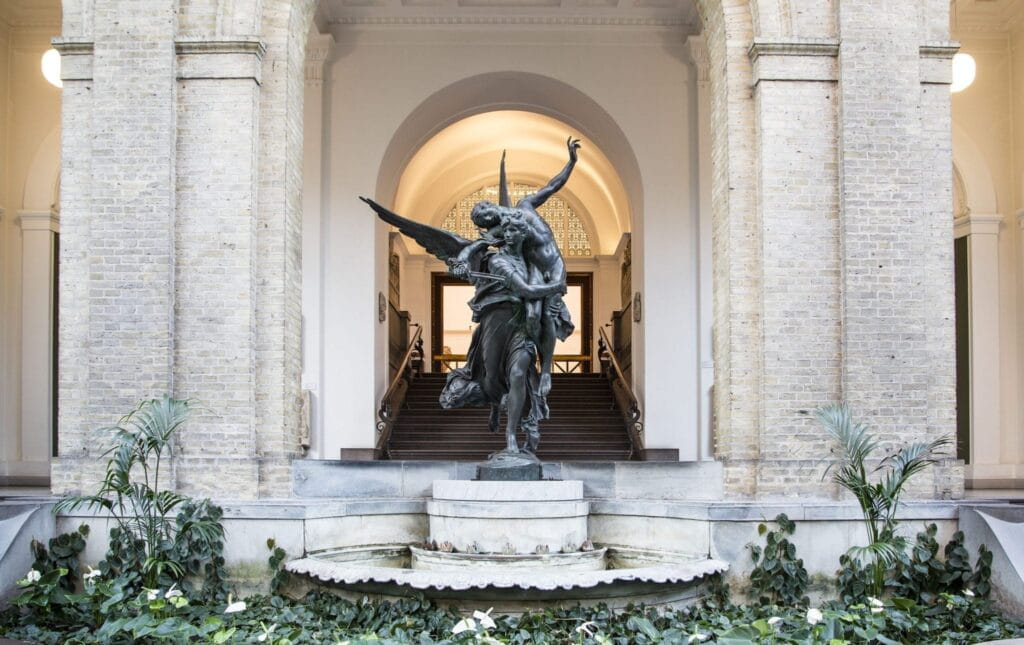
‘Gloria Victis’ in the Winter Garden at Glyptoteket, Copenhagen, Denmark.
The original full-size plaster was shown again at the Paris Expositon universelle of 1878 alongside a bronze reduction by Barbedienne. By this time Antonin Mercié had entered into a commercial edition contract with the Ferdinand Babedienne foundry to produce bronze reductions of ‘Gloria Victis’, his most famous work. Gloria Victis is first recorded in Barbedienne’s Sales Catalogue of 1878 in three sizes measuring 3/5 (190 cm), 9/20 (140 cm) and 3/10 (95 cm).
These reductions were produced by an invention of Barbedienne’s business partner Achille Collas. The Collas reducing machine was a type of complex mechanical pantograph lathe that enabled sculpture to be mathematically measured and transcribed to scale, in the round, thus making a reduced size plaster from which a bronze could be cast.
Mercié’s modern sculpture had become an instant classic, even receiving an entry in the encyclopaedia ‘Nouveau Larousse Illustré’. The success of the group undoubtedly lay in the fact that it was admired not just on an aesthetic level, but also on a patriotic level, particularly in its commemoration of heroism in defeat. Immediately ‘Gloria Victis’ was recognised as a national artwork, capable of arousing patriotism and casts were ordered as local memorials commemorating the war’s dead for cities across France.
This is an example of the 3/10 reduction measuring 95 cm. high which was produced from 1878 until the early 20th century. It is priced at 1,500 francs in 1886 and 3,642 francs by 1901. The Barbedienne foundry used sectional sand casting which was a lengthy and complicated hand worked process. On close observation the casting joints between the sections are visible. The chasing and patination were also completed by hand, to an exceptional standard with great skill and artistry.
A contemporaneous insight recording the complexity and skill of the handmade reduction and casting of ‘Gloria Victis’ is given in: ‘Ferdinand Barbedienne’: Theodore Child; Harper’s new monthly magazine, Volume 73, Issue 436, September 1886.
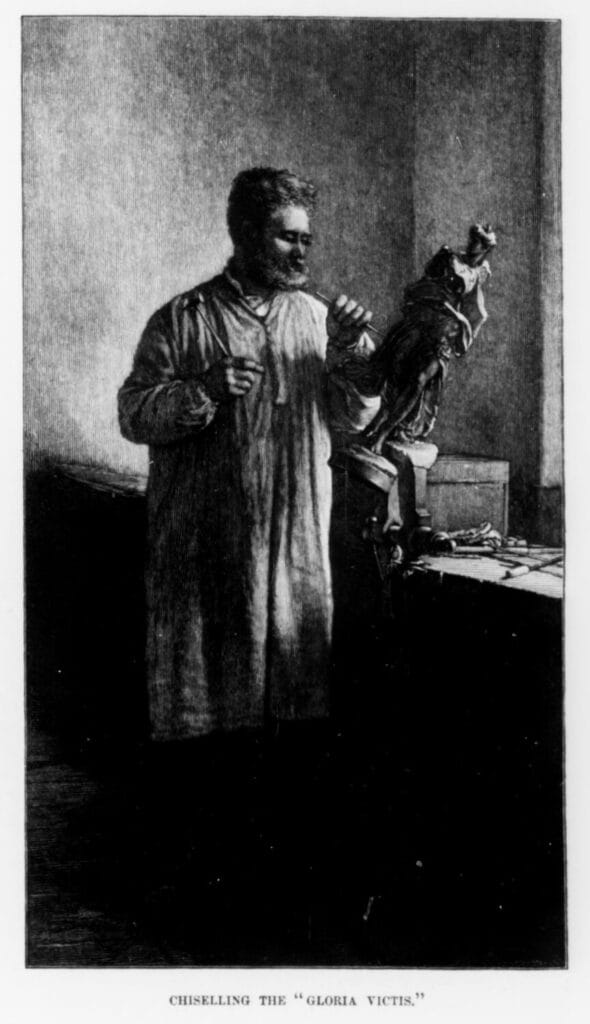
‘Chiselling the Gloria Victis’ from Theodore Child’s article ‘Ferdinand Barbedienne’ published in Harper’s new monthly magazine in September 1886:

Specifications
Height overall : 105 cm / 41 inches
Height : 95 cm / 37 inches
Width : 50 cm / 20 inches
Depth : 40 cm / 16 inches
Marius-Jean-Antonin Mercié
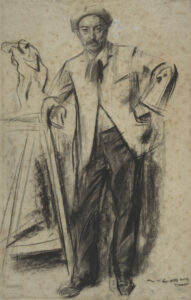
Portrait of Antonin Mercié (circa 1900), by Ramon Casas conserved at MNAC in Barcelona.
Marius-Jean-Antonin Mercié (1845- 1916) was born in Toulouse and studied at the École des Beaux Arts, Paris, under Alexandre Falguière and François Jouffroy, He made his debut at the Salon in 1868 when he won the celebrated Grand Prix de Rome with the group ‘Thesée vainqueur du Minotaure’. This entitled him to study in Rome, and whilst studying in Rome from 1869 to 1873, he already executed the models for his first two popular works, ‘David’ and ‘Gloria Victis’.
In 1870 whilst Mercié was still in Italy, the Prussians invaded France and he began, somewhat prematurely, modelling Gloria Victis to commemorate his country’s imminent victory. Unfortunately the victory never came and Mercié remodelled his sculpture replacing the victorious soldier with one of defeat thereby transforming an allegory of ‚‘Glory to the Victors‚’ into one of ‚‘Glory to the Vanquished‚’. The model for the wounded soldier was reputably based on his friend and fellow sculptor Henri Regnault who was killed on the last day of the war.
The full-size plaster model of Gloria Victis was exhibited at the Salon of 1874, winning the Medaille d’Honneur and critical acclaim. It was then purchased by the City of Paris for the sum of twelve thousand francs and cast in bronze by Victor Thiébaut for a further eight thousand francs. The original bronze is now placed in the central courtyard of the Paris Hôtel de Ville. The plaster version was re-exhibited at the Paris Universal Exhibition of 1878, alongside bronze reductions of the group by Barbedienne.
After Mercié completed the plaster model of his David in Rome, it was also sent to Paris and exhibited at the Salon of 1872, where it was a great success, winning a first class medal. A life-size bronze version of the work was then exhibited at the Exposition Universelle of 1878 and acquired by the Museé du Luxembourg.
In 1873 Mercié was given the Cross of the Legion of Honour – an unprecedented award for a sculptor who was still a student at the French Academy in Rome.
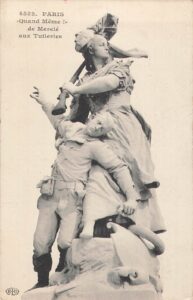
‘Quand Même’ in the garden of the Tuileries.
In 1882 he enjoyed further great success with a group ‚‘Quand Même‚’, replicas of which have been set up at Belfort and in the garden of the Tuileries.
Mercié received many important commissions which included monuments to Jean-Louis-Ernest Meissonier (1895), erected in the Jardin de l’Infante in the Louvre, and Louis Faidherbe (1896) at Lille; a statue of Adolphe Thiers set up at St Germain-en-Laye; the monument to Paul Baudry at Père Lachaise; and that of Louis-Philippe and Queen Amélie for their tomb at Dreux (1885). His stone group of ‚‘Justice‚’ is at the Hôtel de Ville, Paris.
Further to this he also received many international commissions including three monuments in America namely – ‚‘Robert E. Lee’ (1890) an equestrian bronze on Monument Avenue in Richmond, Virginia; a collaboration with his former teacher Alexandre Falguière on the ‚‘Marquis de Lafayette‚’ (1891) in the District of Columbia and for the Francis Scott Key Monument, Baltimore, Maryland in (1911).
Mercié was appointed Professor of Drawing and Sculpture at the École des Beaux Arts, and was elected a member of the Académie Française in 1891, after being awarded the biennial prize of the Institute of 800 in 1887.
He was also one of the few sculptors to be elected to grand officer of the Légion d’Honneur, and in 1913 became the president of the Société des Artistes Français.
As Harpers Magazine was to put it in an article of 1888, on modern French sculpture, Mercié’s genius was characterised by an intensity of feeling and an unerring sentiment of beauty in form.
‚‘M. Mercié is a man who lives outside of contemporary life, reading neither books nor newspapers, taking no part in civic or patriotic business, frequenting but rarely the society of a few friends, and being, in fact, a sort of artistic hermit isolated in the studio. And yet M. Mercié at the opportune moment created that famous group Gloria Victis, which symbolized with thrilling intensity the moral state of patriotic France in 1874, vanquished, but conscious of heroic deeds and noble resolves, grateful to her fallen sons, and more glorious in her defeat than was the Teuton foe in his brutal victory. But how did M. Mercié conceive this group? Why did the clay assume this form? How came the sculptor to express so vividly the latent thought of a whole nation? The simple fact is that the clay which became ultimately the model of Gloria Victis assumed successively the forms of Samson and Delilah and Judith and Holofernes, but being satisfied with neither of these projects, M. Mercié transformed the clay into the group which is called Gloria Victis, and which was conceived and modelled in ten days.‚’
Bibliography
Pierre Kjellberg, ‘Les Bronzes du XIX Siecle, dictionnaire des sculpteurs’, Edition de l’Amateur, (Paris) 1987, pps 488-491.
Lami, Vol 3, p. 433; Romantics to Rodin, pp. 304-6.
‚‘Contemporary French Sculptors‚’: The Century, Volume 33, Issue 3, Jan 1887
‚‘Modern French Sculpture‚’: Harper’s new monthly magazine, Volume 76, Issue 452,
January 1888.
Literature
Peter Fusco and H.W. Janson, ‘The Romantics to Rodin: French Nineteenth Century Sculpture from North American Collections’, Los Angeles, 1980, p. 304-306.
Pierre Kjellberg, ‘Les Bronzes du XIXe Siècle’, Paris, 1989, p. 489.
‘Sculpture: An Illustrated Catalogue’, National Gallery of Art, Washington, 1994, no. 149.
F. Rionnet, ‘Les Bronzes Barbedienne – L’oeuvre d’une dynastie de foundeurs (1834-1954)’, Arthena, Paris, 2016, cat. 1075. (figs. 6; 7; 10; 45; 115; 132).
‘Ferdinand Barbedienne’: Theodore Child; Harper’s new monthly magazine, Volume 73, Issue 436, September 1886.