 Ref no: B30065
Ferdinand Duvinage for Maison Alphonse Giroux
A Rare Gilt-Bronze and Marquetry Inlaid Table Mirror
France, Circa 1880
POA
- Date
- Circa 1880
- Origin
- France
- Signature
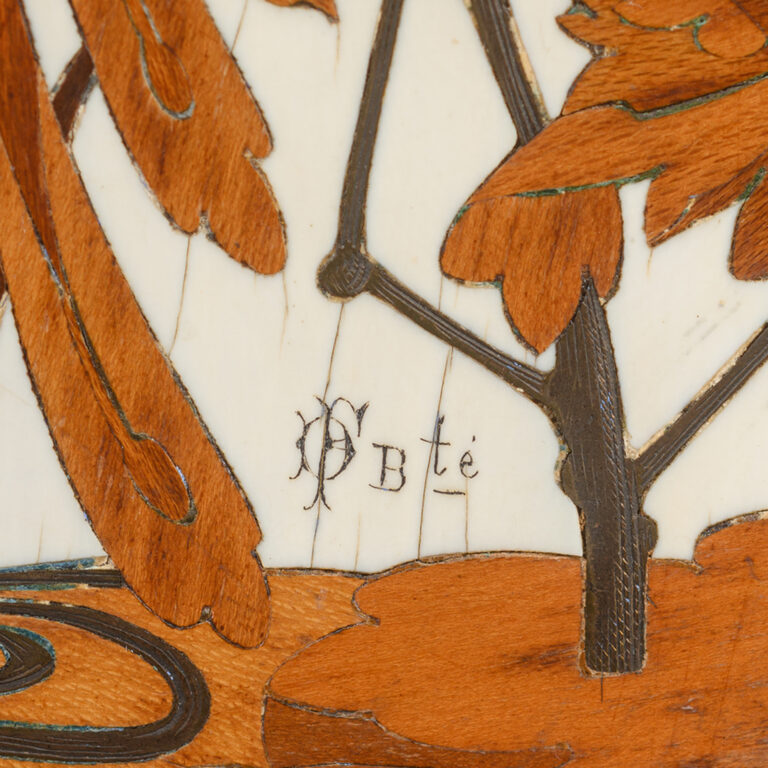
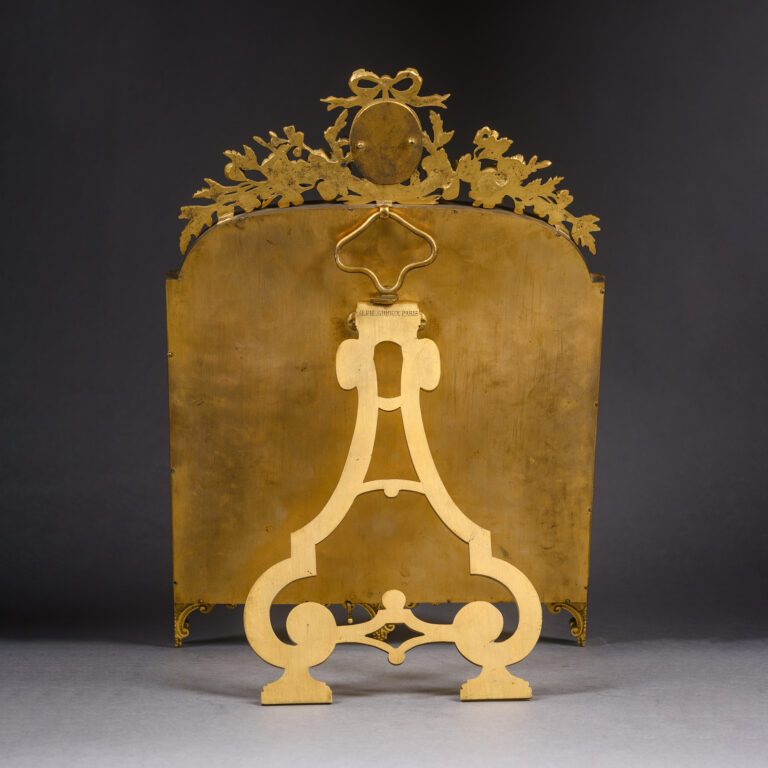
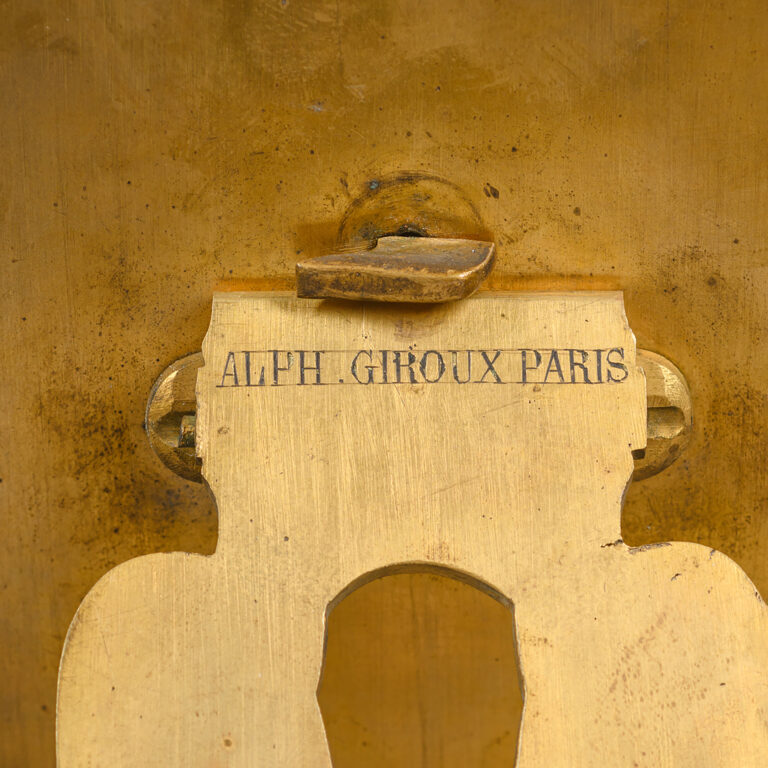
- Signed ‘FD Bté and Alph. Giroux Paris’.
- Height
- 44 cm (18 in)
- Width
- 30 cm (12 in)
- Depth
- 4 cm (2 in)
- Weight
- 5.5 kg
Description
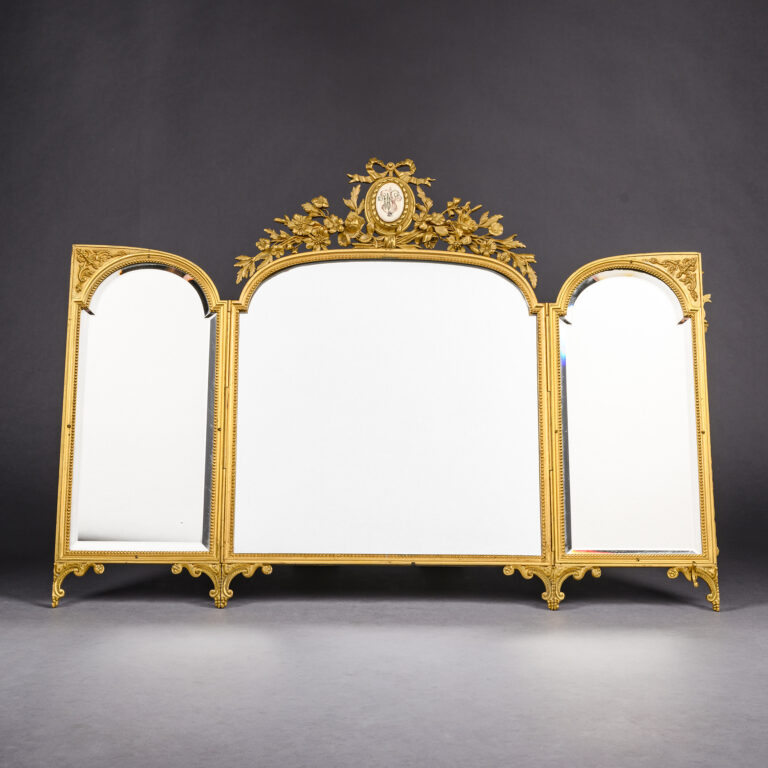
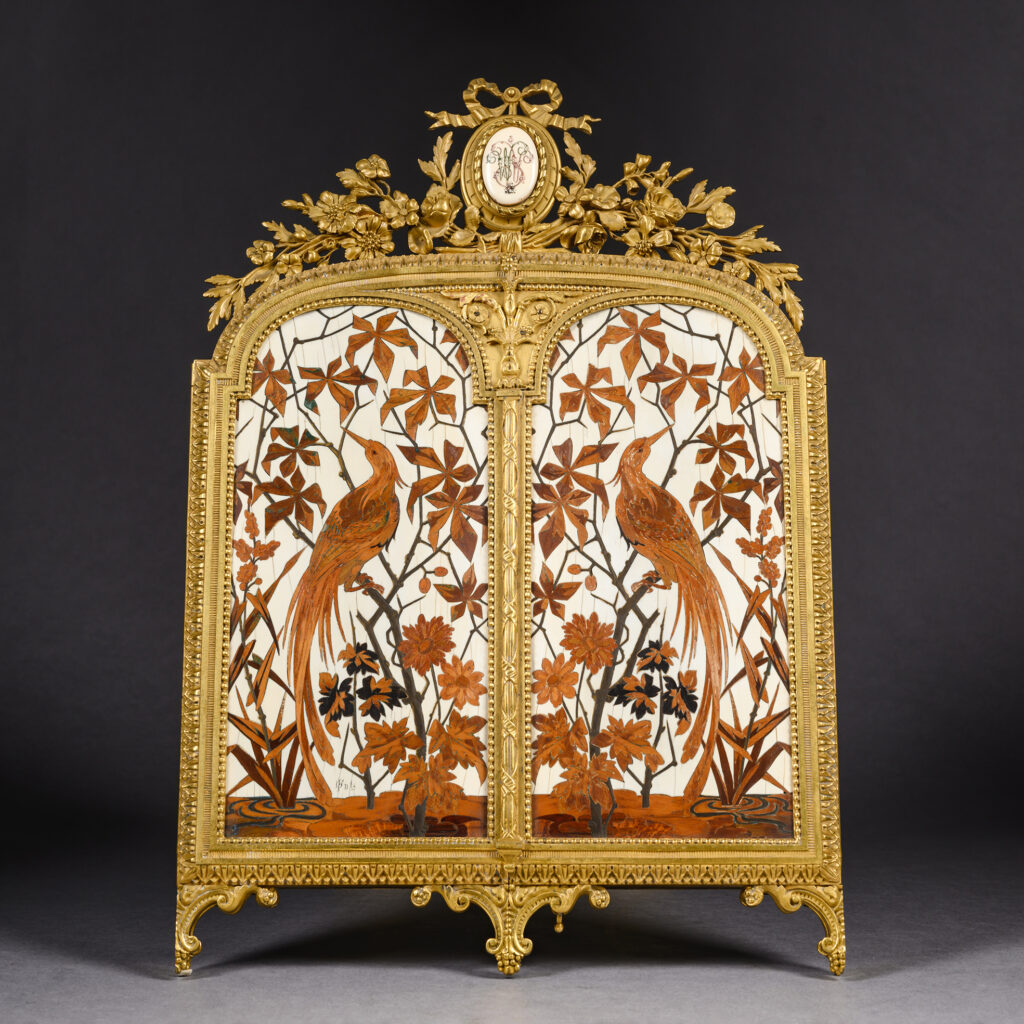
A Rare Gilt-Bronze and Marquetry Inlaid Table Mirror by Duvinage & Maison Giroux.
Signed ‘FD Bté and Alph. Giroux Paris’.
French, Circa 1880.
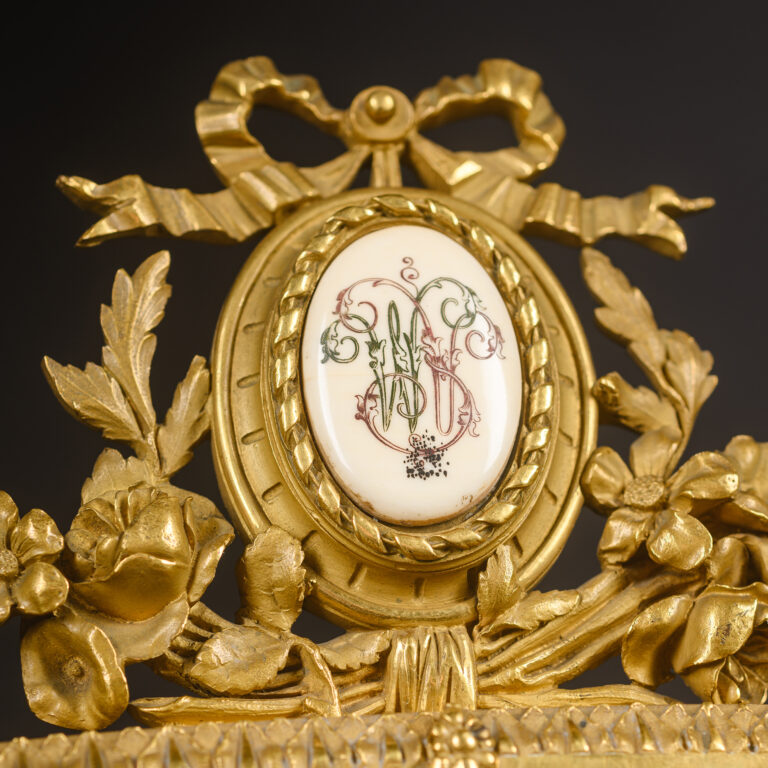
This exceptional dressing mirror, with its rare ivory-ground marquetry, is surmounted by an oval crest, flanked by foliate garlands above two arched doors. Each door is finely inlaid in ivory with a bird amongst flowering plants. The doors open to reveal triple mirrors.
This highly decorative technique of ivory-ground marquetry was probably first shown at the 1878 Paris Exposition Universelle, where Duvinage’s widow exhibited pieces marked ‘Bté’. Luxurious artworks and small items of furniture were produced, incorporating traditional French forms and gilded mounts with the stylised aesthetics of Japonism.
On 4 June 1877, following Duvinages death, his widow had filed a ‘Brevet d’Invention [patent] … pour une mosaique combinée avec cloisonnements métallique, pour objets artistiques et d’ameublement …”.
The patent deed included a descriptive memoir …
“The new kind of mosaic which is the object of this request by Brevet is intended to enhance and decorate artistic furniture in general. It has an ivory foundation appliquéd by a collage or by a panel or a wooden base or other material; the pieces of ivory are separated by bands or metallic grooves, and the decorative subjects are birds, flowers, etc, produced by inlays or mother of pearl appliques or other materials of various nuances. One obtains through this triple combination of ivory, mother-of-pearl and decorative metal and partitioning, more attractive effects”.
This luxury production only lasted a few years, which allows us to precisely place this piece in time. Patented in 1877, this technique was used until 1885, when the Maison Alphonse Giroux closed.
Width mirrors open width: 60 cm / 23.5 inches
Please note Adrian Alan Ltd has applied for a de minimis exemption license for the ivory in this mirror (ref. YLZT5GPC).

Specifications
Width mirrors open: 60 cm / 23.5 inches
Ferdinand Duvinage for Maison Alphonse Giroux
Founded in Paris in 1799 by François-Simon-Alphonse Giroux, Maison Giroux became one of the foremost establishments for luxury furniture, objets d’art and works of vertu in nineteenth-century France. Originally situated at 7 rue du Coq-Saint-Honoré, the firm expanded considerably under the direction of Giroux and subsequently his sons, Alphonse-Gustave and André, establishing an international reputation for the quality and ingenuity of its production.
In 1867, Ferdinand Duvinage, a relative of the Giroux family, assumed the management of the business in partnership with Mr Harinckouck. By 1870, Duvinage was directing the Maison Giroux alone, overseeing a period of considerable artistic and commercial distinction. The firm exhibited at the Paris Exposition Universelle of 1867, receiving a silver medal, and at the Vienna International Exhibition of 1873, where it was awarded two medals of merit.
Among Duvinage’s most significant contributions was the development of an innovative form of decorative marquetry combining ivory, wood and finely engraved metal divisions. He registered his first patent for this technique on 6 May 1874, followed by further additions in February and November 1876. Following his death in December 1876, his widow, Rosalie Duvinage, continued the business and registered a further patent on 4 June 1877 for a development of the technique, entitled une mosaïque combinée avec cloisonnements métalliques, pour objets artistiques et d’ameublement. This extended the original process to incorporate mother-of-pearl and additional decorative materials.
The resulting ivory-ground marquetry, characterised by intricate compositions of birds, flowering branches and foliage, reflects the influence of Japonism upon French decorative arts during the 1870s. The technique was exhibited at the Paris Exposition Universelle of 1878 and employed in a relatively short-lived production of luxury furniture and objets d’art, frequently bearing the interlaced signature ‘FD Bté’, denoting Ferdinand Duvinage and the patented process.
Rosalie Duvinage directed the business until 1882, after which it passed to successive management before the historic Maison Giroux finally closed in 1885. Today, works associated with Duvinage and Maison Giroux are represented in major international collections, including the Musée d’Orsay in Paris, the Metropolitan Museum of Art in New York, the Art Institute of Chicago and the Los Angeles County Museum of Art.
Selected bibliography
1. Ledoux-Lebard, Denise. Les Ébénistes du XIXe Siècle. Paris: Éditions de l’Amateur, 1984, pp. 186, 223–230.
2. Kisluk-Grosheide, Daniëlle. ‘Maison Giroux and its “Oriental” Marquetry Technique’, Furniture History: The Journal of the Furniture History Society, vol. XXXV, 1999, pp. 147–172.
3. Pallot, Bill. ‘Marqueteries en cloisonné de la veuve Duvinage’, L’Estampille – L’Objet d’art, September 2007.
4. Arnauld, Emmanuelle. Marqueteries virtuoses au XIXe siècle: Brevets d’inventions. Paris, 2012.
Documentary and museum references
-
Bard Graduate Center – The Revival of Cloisonné Enamel in France at the End of the Nineteenth Century. Discusses Rosalie Duvinage’s 1877 patent and the technical construction of the marquetry.
-
The Metropolitan Museum of Art – Panel, Firm of Ferdinand Duvinage, circa 1880. An institutional example of the ivory-ground marquetry technique.