 Ref no: B78600
Frédéric-Eugène Piat
A Napoleon III Silvered-Bronze Cartel Clock and Barometer
France, Circa 1870
£65,000
- Date
- Circa 1870
- Origin
- France
- Medium
- Silvered Bronze
- Signature
- The barometer with enamel plaque signed ‘Marchand’
- Height
- 108 cm (43 in)
- Width
- 30 cm (12 in)
- Depth
- 27 cm (11 in)
- Weight
- 16.5 kg
Description
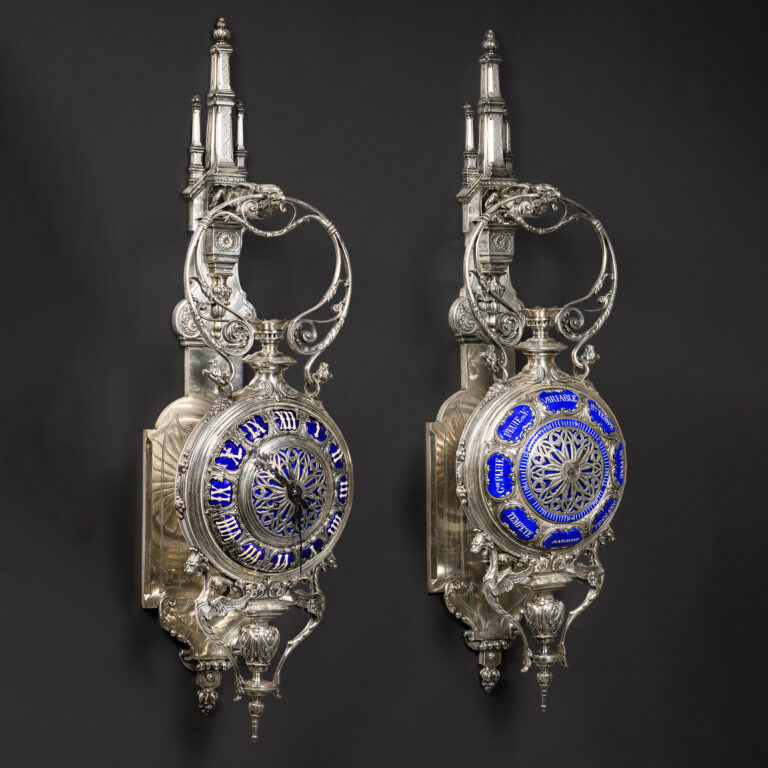
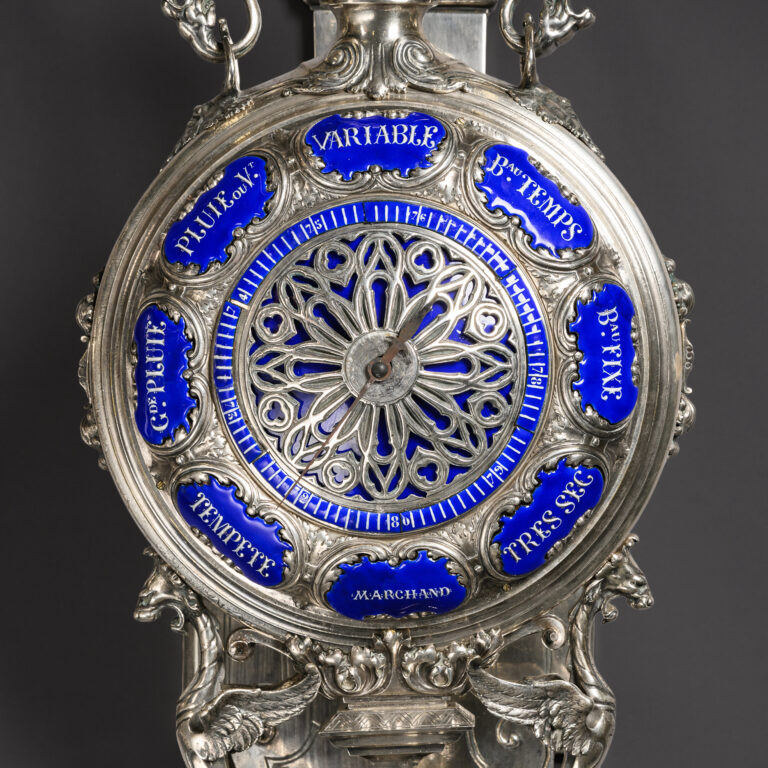
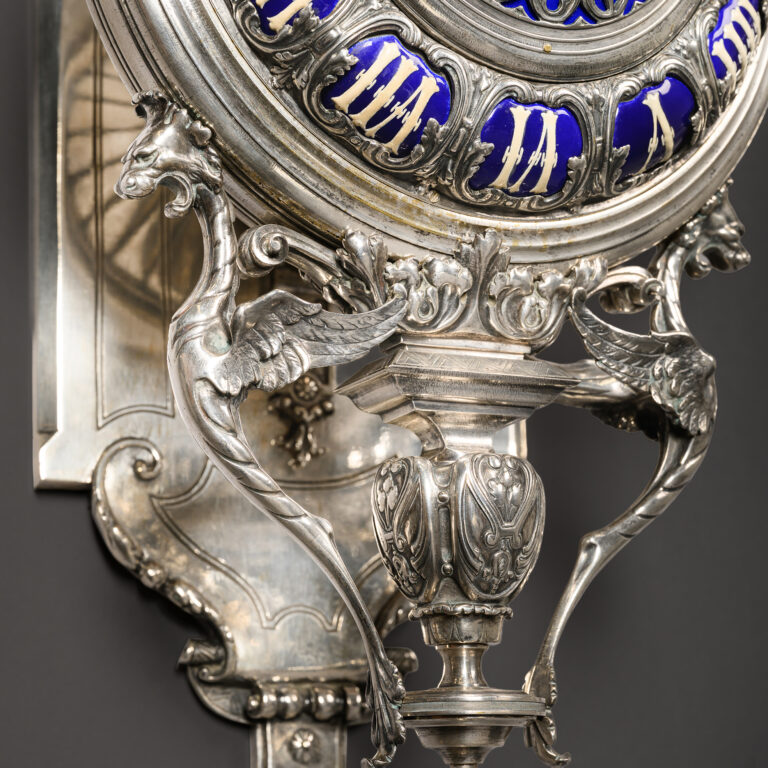
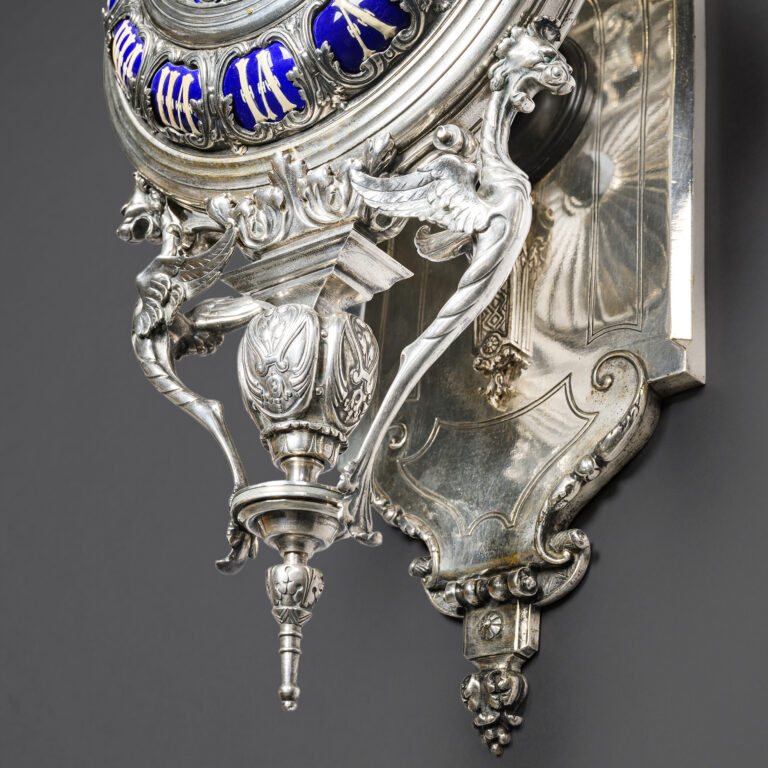
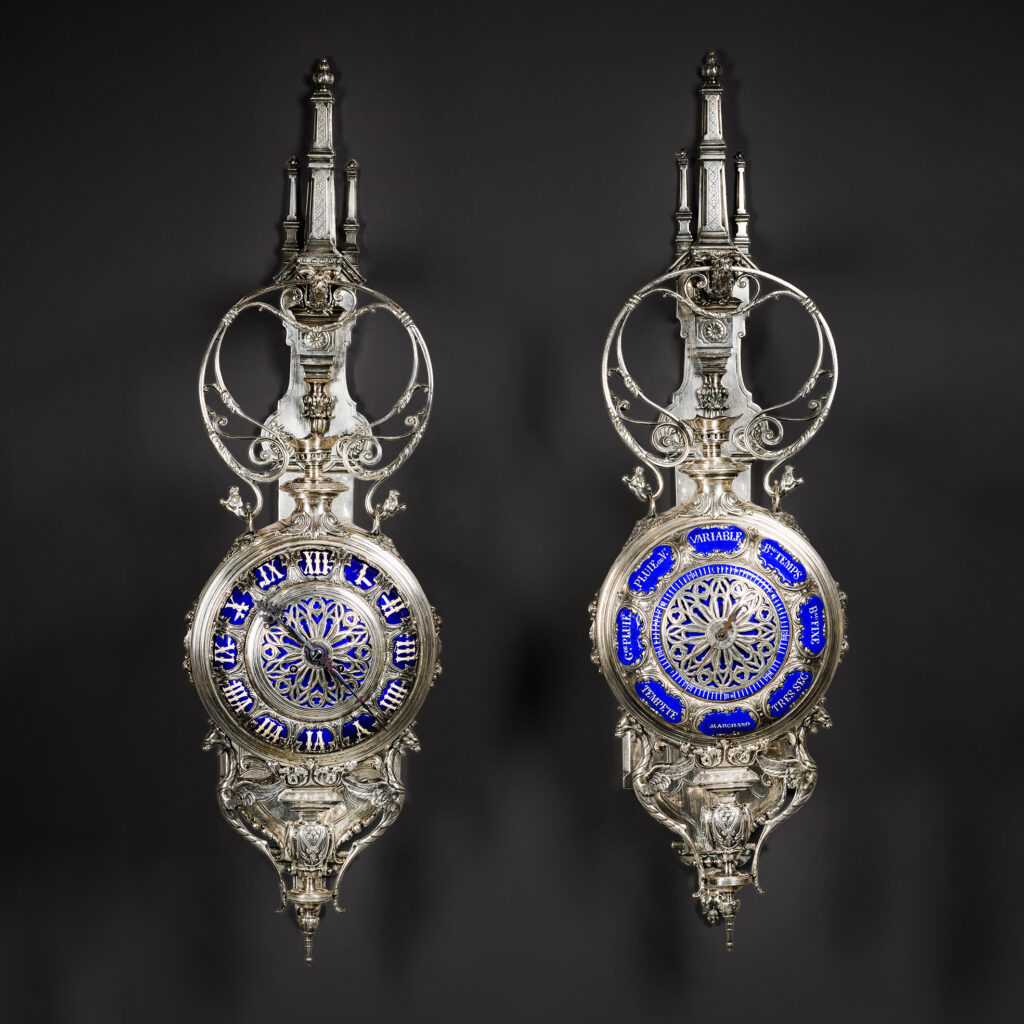
A Napoleon III Silvered-Bronze Cartel Clock and Barometer, By Léon Marchand and Frédéric-Eugène Piat, Paris.
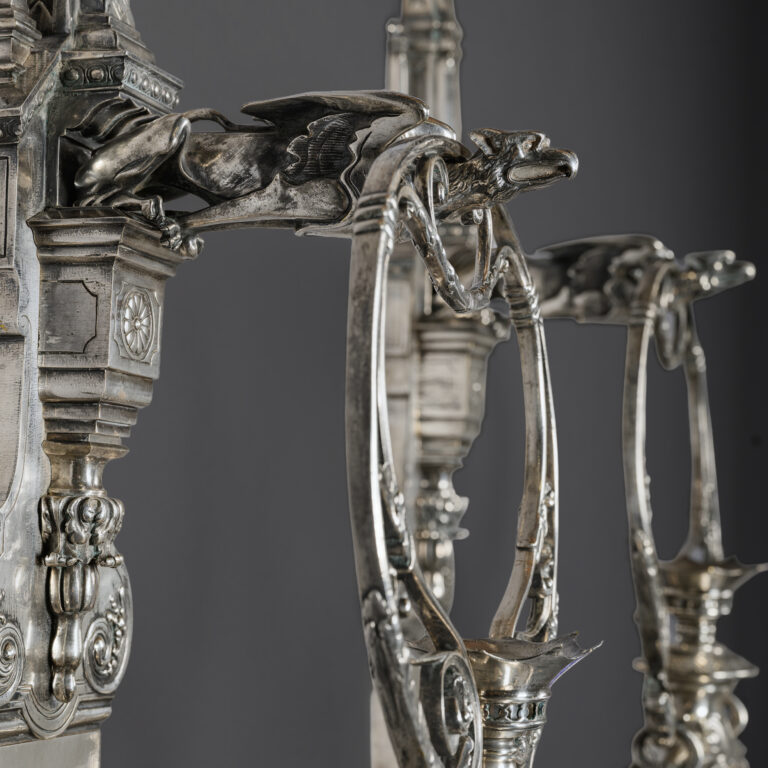
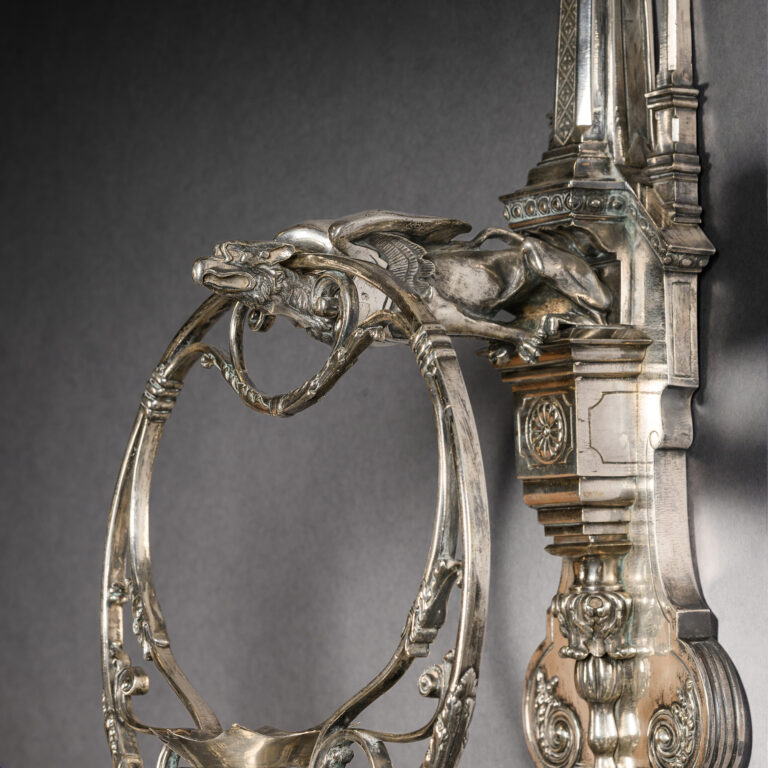
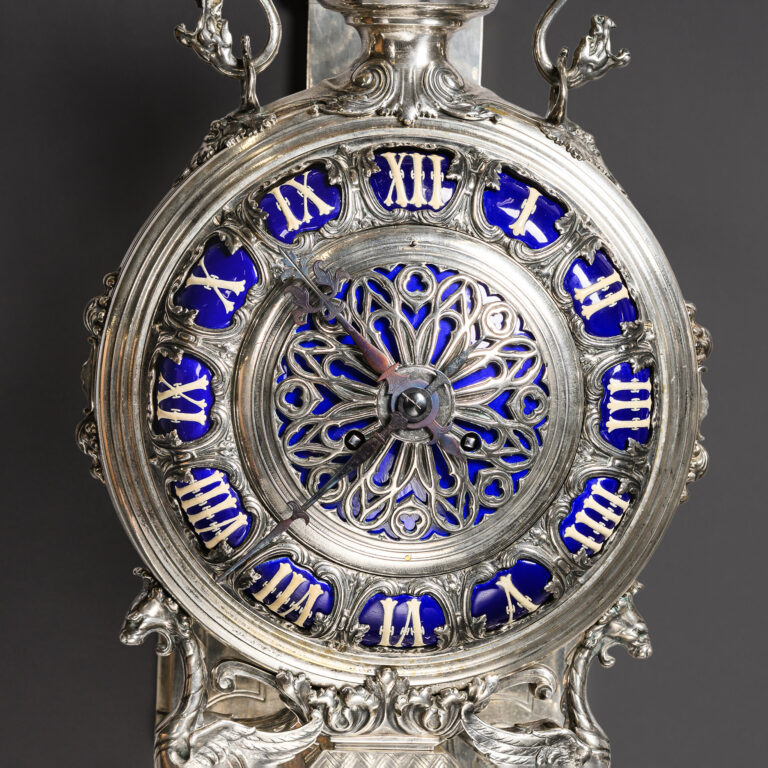
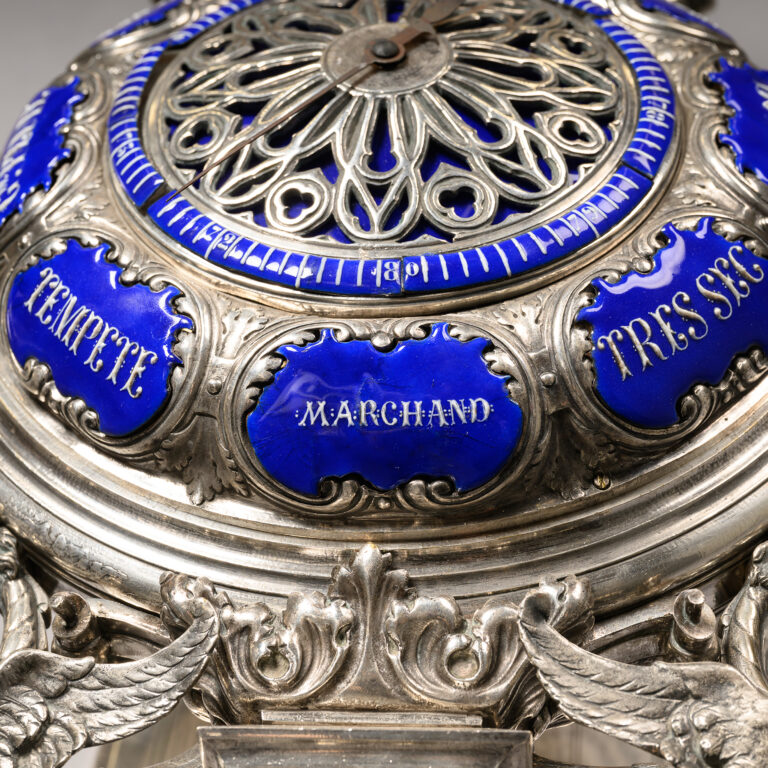
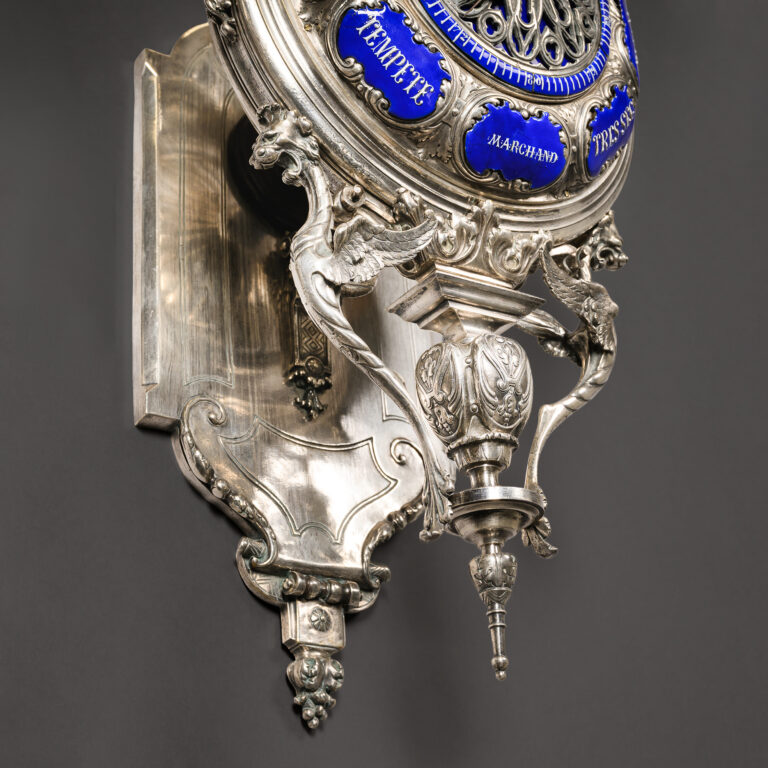
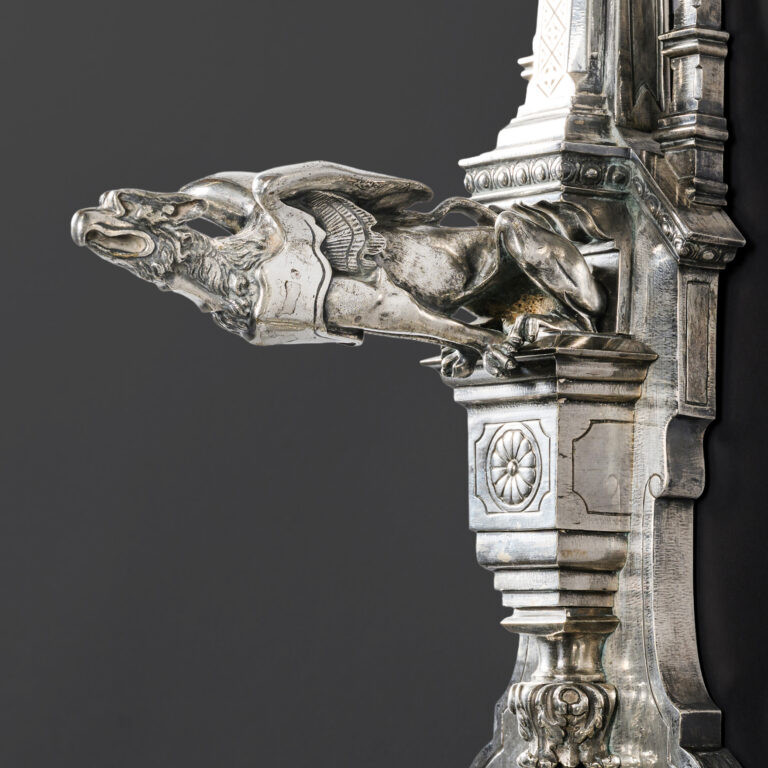
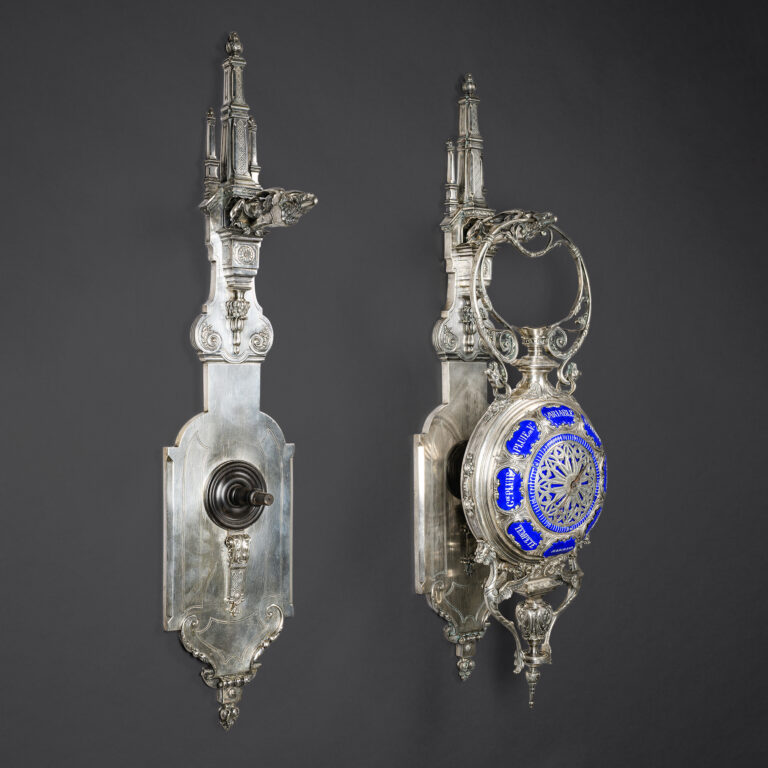
The cartel clock and companion barometer are designed in the neo-Gothic style. Each has a drum-shaped dial suspended by a loop from a gargoyle on a spired backplate. The pierced dial is set with blue and white enamel plaques. The clock with roman numerals and the barometer with a pressure scale surround by plaques titled Tempete (storm); Grande pluie (heavy rain); Pluie ou vent (rain or wind); Variable; Beu temps (good weather); Beau fixe (set fine); Tres sec (very dry).
The barometer with enamel plaque signed ‘Marchand’.
France, Circa 1870.
During the Second Empire period there was in France, like in England, a Gothic revival. It was part of a wider historicist movement in art and architecture that was considered aesthetically superior to classical styles, yet spiritually purer than the industrialised modern world.
This exceptional pair were designed by the ornamental sculptor, Frédéric Eugène Piat (d. 1903) who was artistic director of the art bronze manufacturer, Maison Marchand. Indebted to the neo-Gothic, their design encapsulates the transition from the Middle Ages to the Renaissance. Their ornate decoration and use of silvering identifies them specifically as French examples from the Second Empire period, when the fashion was for opulence and luxury. They are superb examples of Industrial Art, as promoted at the Great Exhibitions of the period, in that they are a collaboration between artist and manufacturer and utilised the newly invented galvanoplastie technique of silverplating. It additionally shows how such architectural compositions could be adapted to serve as the basis for a clock, fountain or receptacle for holy water.
The highly distinctive design was unveiled at the Paris Exposition universelle in 1867, where Piat and Marchand were awarded for their design for a related ‘fontaine à eau parfumée’.1 It was presented by the firm as their foremost exhibit and the propriétaire, Léon Marchand, was awarded a médaille d’or, and Piat, as associate, a médaille d’argent.2 Individual craftsmen who contributed to the work, such as the ciseleur, Pierre Lebeau, the monteur, Bastien and the enamellist, Alfred Meyer, also obtained awards, respectively a médaille d’argent and a mention honorable.3
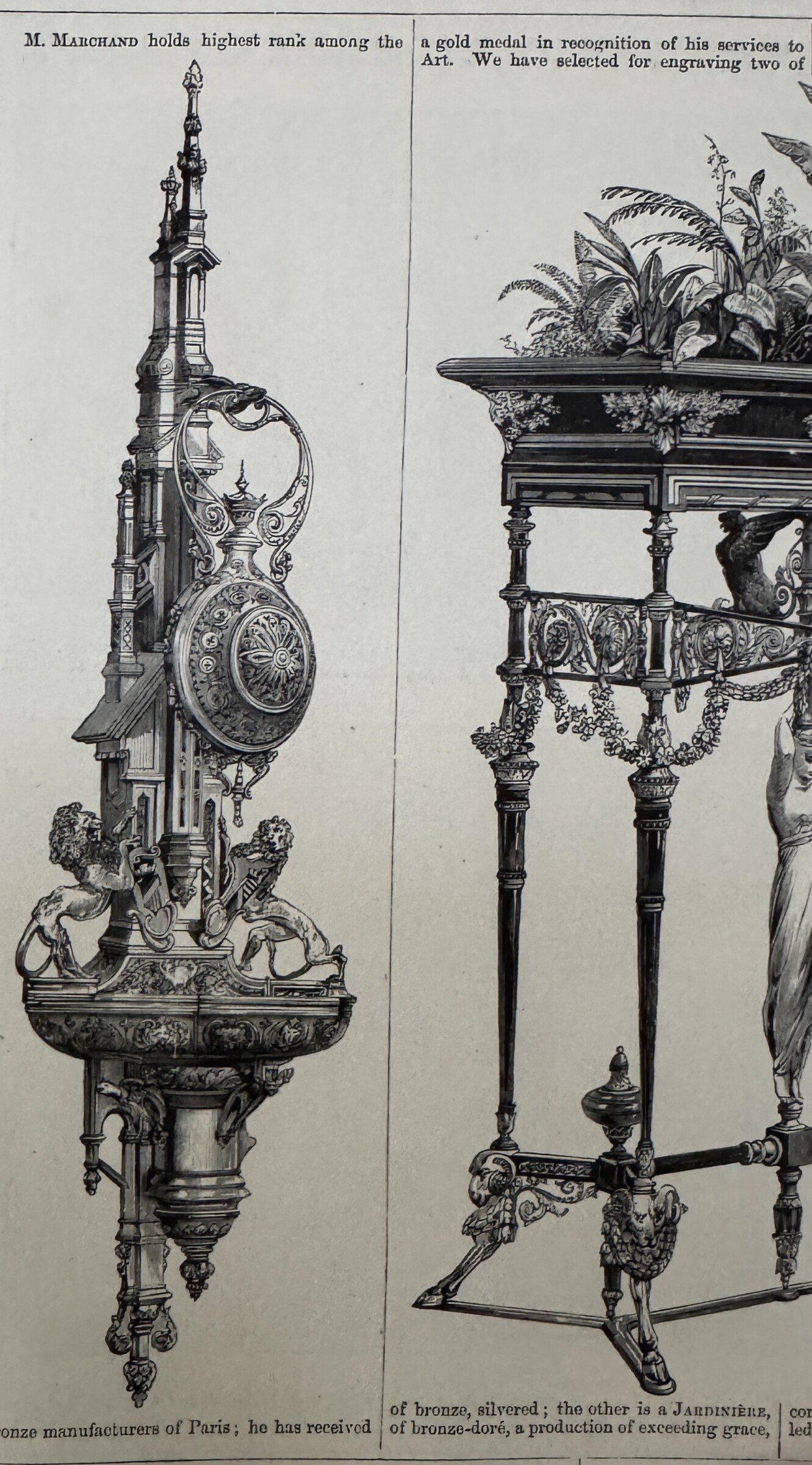
‘Fontaine à eau parfumée’ shown by Marchand and Piat at the 1867 Paris Exhibition (The Art Journal Illustrated Catalogue of the Universal Exhibition, 1867, p. 168).
The design of both the fontaine, and present clock and barometer, demonstrates Piat’s ability to take elements from several historicist styles to create a unique work of art that defines the spirit and taste of the age. In 1869, Jules Mesnard described the fontaine as ‘le passage scabreux du Moyen-âge à la Renaissance… Le clocheton qui la surmonte et le pendentif qui la termine, tiennent autant, il faut le dire, du religeux que du profane: on a dû voir cela dans les manoirs, on a dû le voir dans les chapelles. Ce serait pièce d’oratoire aussi bien que de boudoir, de sainteté que de volupté’.4
The fontaine is preserved in the collection of the Musée des Beaux-Arts, Troyes (inv. no. 894.15.20).5 The museum was founded in 1894 by Frédéric-Eugène Piat and has a large collection of his works.
Footnotes:
- 1. The Art Journal Illustrated Catalogue of the Universal Exhibition, 1867, p. 168.
- 2. Catalogue official des exposants récompensés par le jury international, Paris, 1867, pp. 40, 44-45.
- 3. A.Luchet, L’art industriel français à l’exposition universelle de 1867, mobilier, vêtement, aliments, Paris, 1868, p. 320.
- 4. J. Mesnard, Les merveilles de l’art et de l’Industrie, Antiquité, Moyen-âge, Renaissance, Temps Modernes, Paris, 1869, p. 138.
- 5. The Second Empire 1852-1870, Art in France under Napoleon III, Exhibition Catalogue, Philadelphia Museum of Art/Detroit Institute of Arts/ Grand Palais, Paris, 1978. No. II-38, pp. 119-120.

Frédéric-Eugène Piat
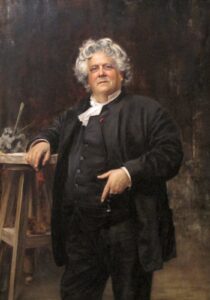
Pierre-Adolphe Huas (French, 1838–1900), Portrait of Frédéric-Eugène Piat (1827–1903). Private Collection
Frédéric-Eugène Piat (1827 – 1903) was one of the most prolific French sculpteurs-ornemanistes of the nineteenth century, whose designs played an important role in the development of the Parisian bronze and decorative arts industry. Born at Montfey, Aube, on 2 June 1827, he was the son of a carpenter and moved with his family to Paris as a child. Initially apprenticed as a carriage painter, he subsequently worked with his father before being encouraged by his brother-in-law, the ornamental sculptor Louis-Étienne Froment, to pursue a career in decorative art.1
Piat trained under several ornamentalists before establishing his own workshop in 1845. His talent for drawing and modelling quickly attracted the leading Parisian bronze manufacturers, including Denière and Graux-Marly, for whom he designed clocks, lighting, firedogs and chimney garnitures.2 His participation in the Exposition Universelle of 1855 marked the beginning of a distinguished exhibition career that continued through the great international exhibitions of the nineteenth century.
A defining feature of Piat’s work was his mastery of historical ornament. He freely interpreted Renaissance, Louis XIV, Louis XVI, Gothic and Neo-Greek vocabularies, transforming them into richly conceived objects suited to contemporary taste. His designs were generally executed by specialist manufacturers, making him an important intermediary between artistic invention and industrial production.3
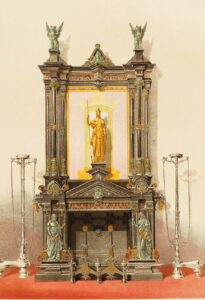
Monumental neo-Greek style fireplace, made by the Marchand company and presented at the Universal Exhibition in London in 1862. Engraving taken from J.B. Waring’s ‘Masterpieces of Industrial Art & Sculpture’ at the International exhibition, 1862. Published by Day & Son, London, 1863.
His collaboration with the bronze manufacturer Louis-Léon Marchand was particularly significant. For the London International Exhibition of 1862, Piat designed a monumental Neo-Greek fireplace in marble and polychrome bronze, while their collaboration continued at the Paris Exposition of 1867. He subsequently worked with several important Parisian firms, including Gagneau, Maison Marnyhac and Lemerle-Charpentier.4
Piat’s reputation reached its height during the later nineteenth century. He received medals at the international exhibitions of 1867 and 1878, and a Grand Prix at the Exposition Universelle of 1889. Among his celebrated designs were the monumental torchères Les Quatre Éléments, L’Amour désarmé and numerous clocks, fountains and lighting fixtures. By this period he had acquired the contemporary sobriquet “Roi du bronze” (King of Bronze).5
His final major exhibition appearance came at the Exposition Universelle of 1900, where La Nature, an imposing illuminated column in gilt bronze, enamel and Algerian onyx, was exhibited. He was subsequently promoted to Officier of the Légion d’honneur.6
Piat’s enduring legacy is particularly well preserved at Troyes, where he founded a museum of decorative arts in 1894 and donated a substantial body of his work. The city’s collections contain numerous plaster models, drawings and finished objects, providing an exceptional record of his practice and of the relationship between the nineteenth-century designer and the industrial bronze manufacturer.7
Piat died in Paris on 29 July 1903. His extraordinary productivity and stylistic versatility place him among the principal ornemanistes of nineteenth-century France, while the surviving Troyes collection provides an important testament to his role in the evolution of French decorative art.
Footnotes:
- 1. Centre historique des Archives, La France savante, “Piat Frédéric Eugène”; see also V. Champier, “Notice biographique sur Frédéric-Eugène Piat,” in L. Le Clert, Musée de Troyes, Art décoratif, Troyes, 1897.
- 2. Ibid.; see also F.-E. Piat, Art décoratif: trente-cinq compositions inédites, Paris, 1897.
- 3. J.-P. Sainte-Marie, Un ornemaniste français du XIXe siècle: Frédéric-Eugène Piat, Les Cahiers des musées de Troyes, no. 2, 1976.
- 4. For Piat’s collaborations with Marchand and the international exhibitions, see the Musée des Beaux-Arts et d’Archéologie de Troyes documentation and Piat, Art décoratif, 1897.
- 5. P. Kjellberg, Les Bronzes du XIXe siècle: Dictionnaire des sculpteurs, Paris, 2005.
- 6. Musée des Beaux-Arts et d’Archéologie de Troyes; see also Piat, Art décoratif, 1897.
- 7. Centre historique des Archives, La France savante; Musée des Beaux-Arts et d’Archéologie de Troyes.
Literature
The Art Journal Illustrated Catalogue of the Universal Exhibition, 1867, p. 168.
Catalogue official des exposants récompensés par le jury international, Paris, 1867, pp. 40, 44-45.
A.Luchet, L’art industriel français à l’exposition universelle de 1867, mobilier, vêtement, aliments, Paris, 1868, p. 320.
J. Mesnard, Les merveilles de l’art et de l’Industrie, Antiquité, Moyen-âge, Renaissance, Temps Modernes, Paris, 1869, p. 138.
The Second Empire 1852-1870, Art in France under Napoleon III, Exhibition Catalogue, Philadelphia Museum of Art/Detroit Institute of Arts/ Grand Palais, Paris, 1978. No. II-38, pp. 119-120.