 Ref no: B78650
Émile-Coriolan-Hippolyte Guillemin
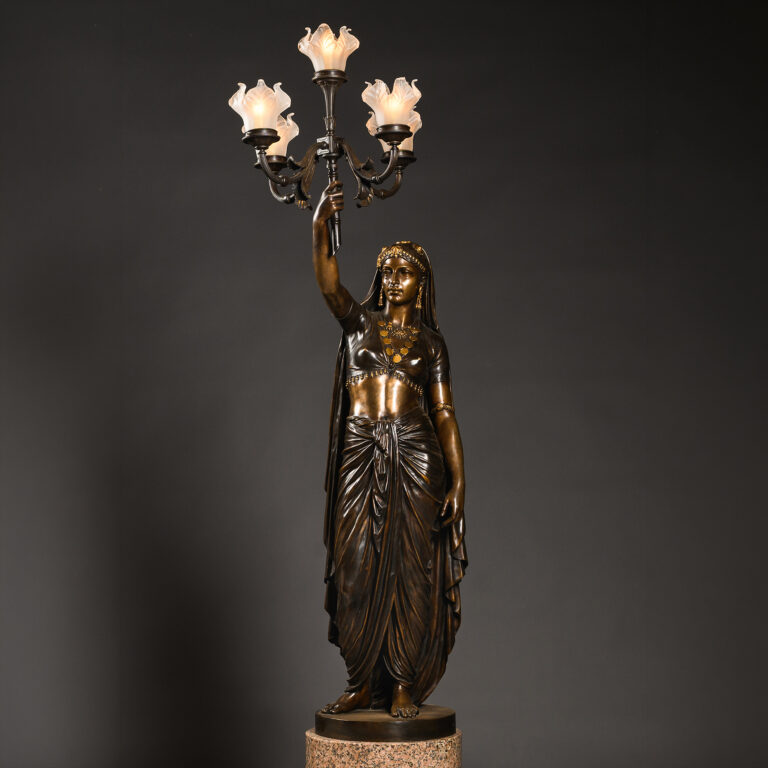
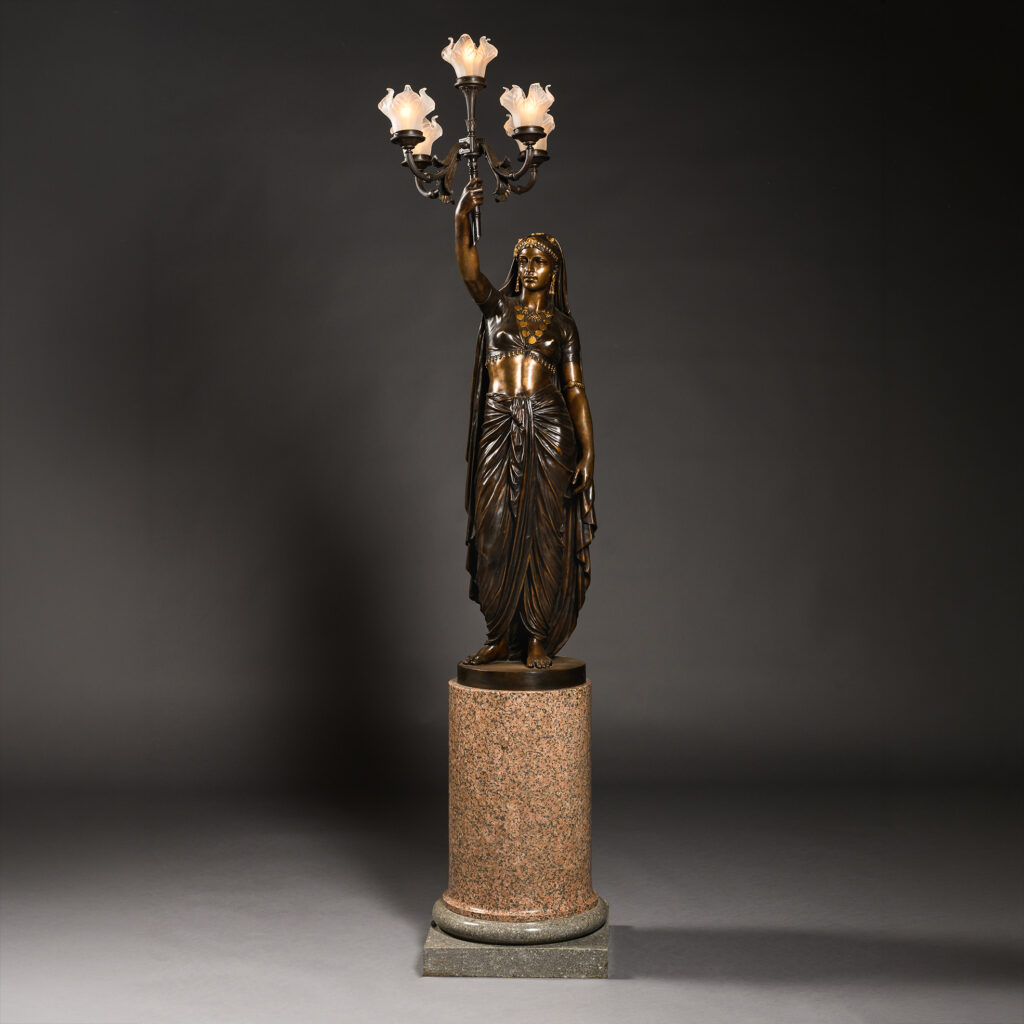
A Large Orientalist Patinated-Bronze Figural Torchère
France, Circa 1875
£38,000
- Date
- Circa 1875
- Origin
- France
- Medium
- Patinated Bronze
- Signature
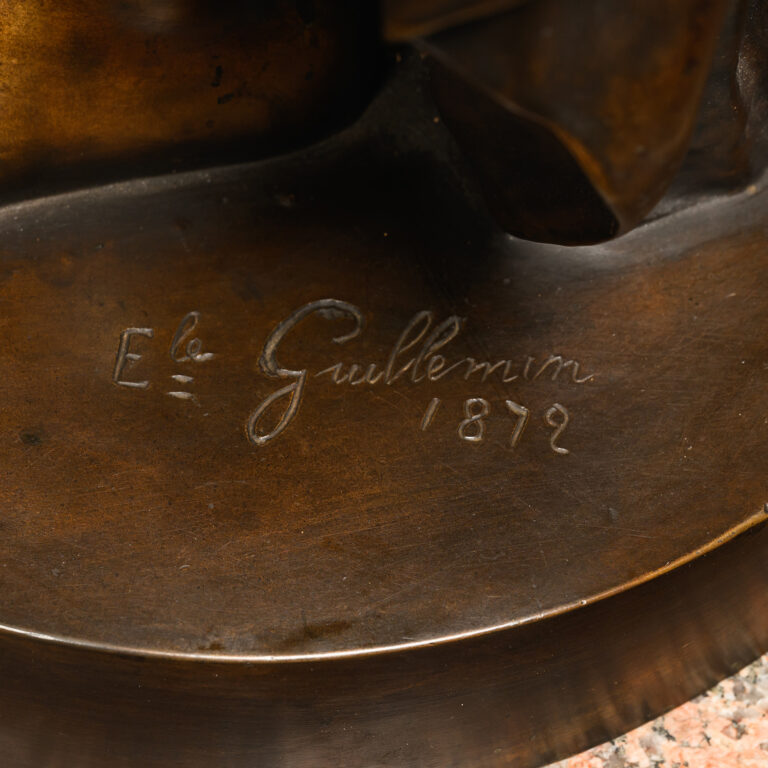
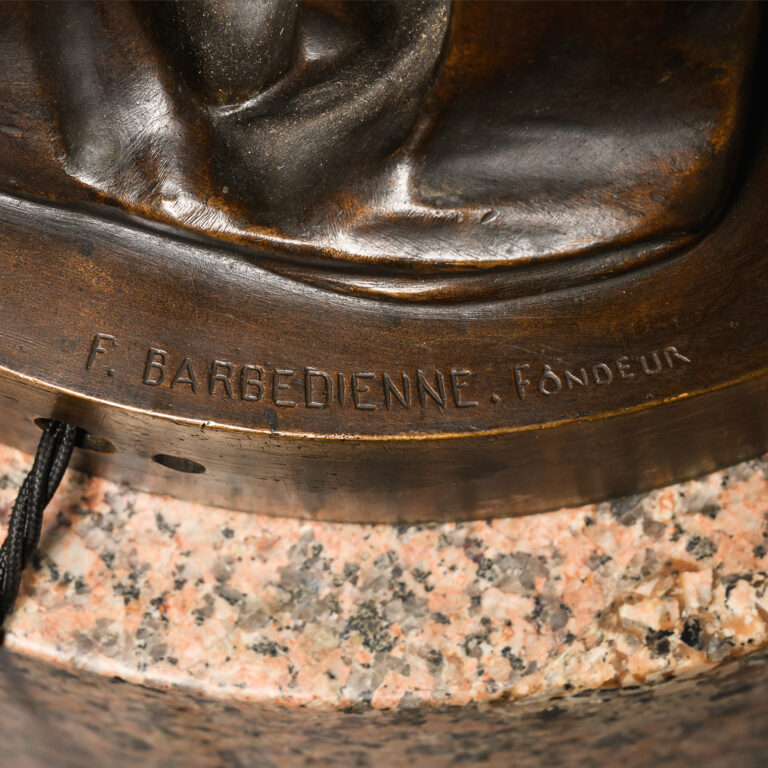
- Signed ‘Ele. Guillemin 1872’ on the base with foundry inscription ‘F. BARBEDIENNE FONDEUR’.
- Height
- 236 cm (93 in)
Description
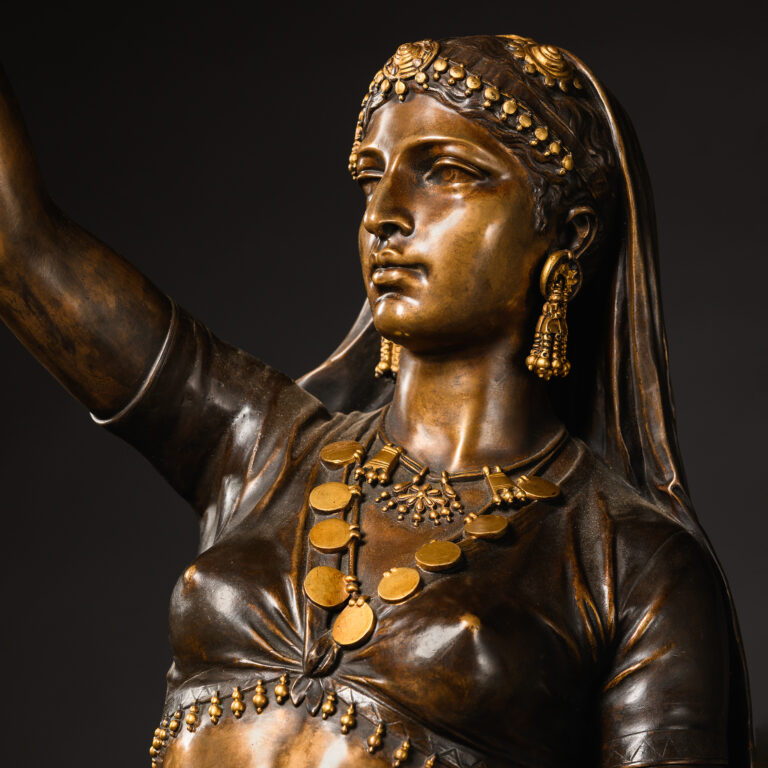
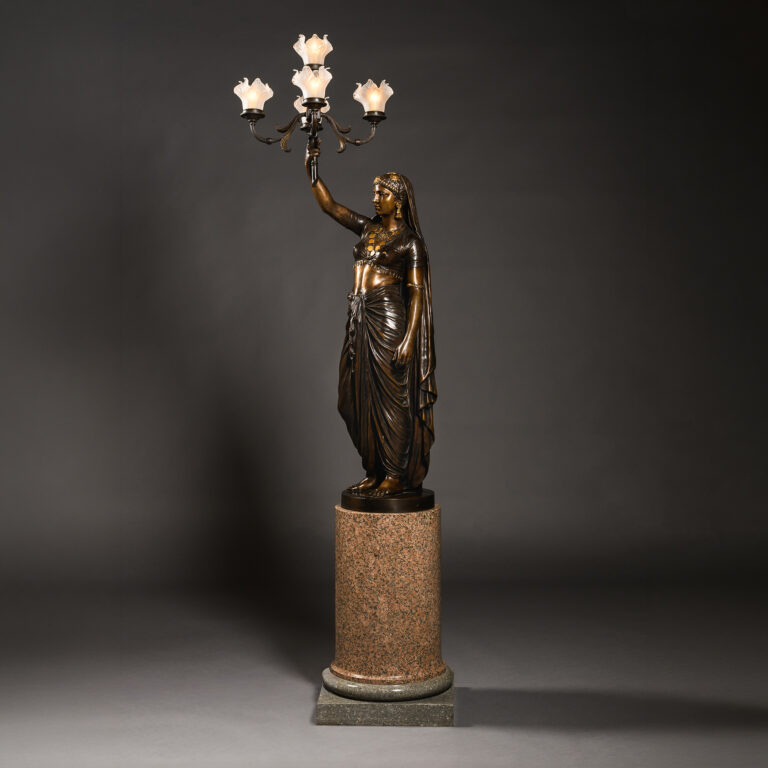
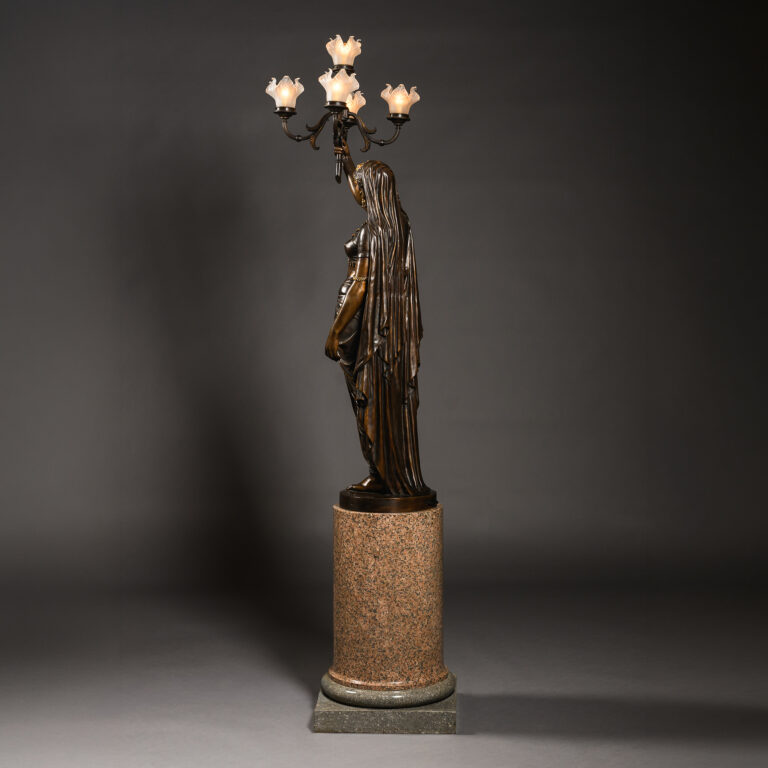
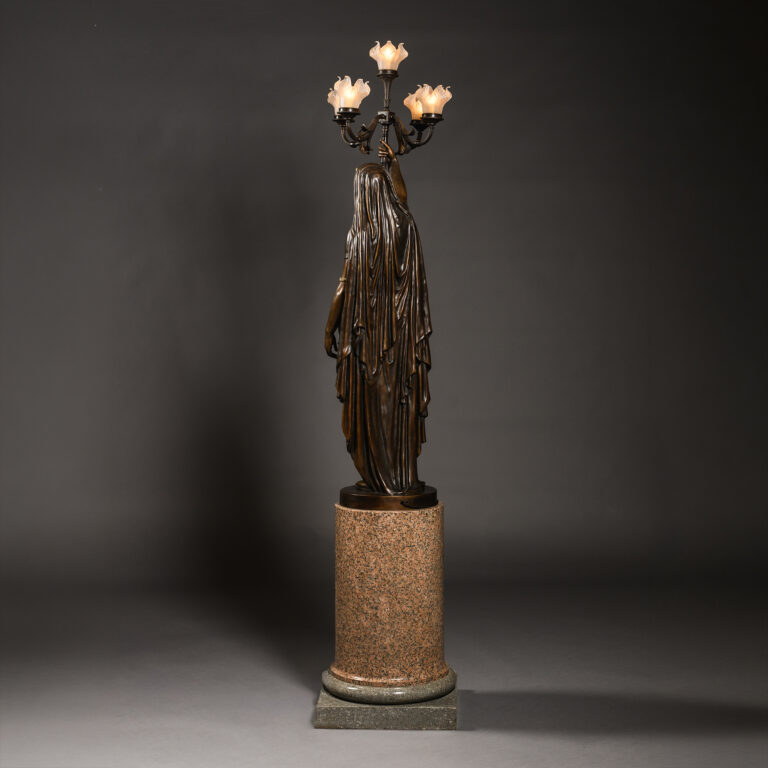
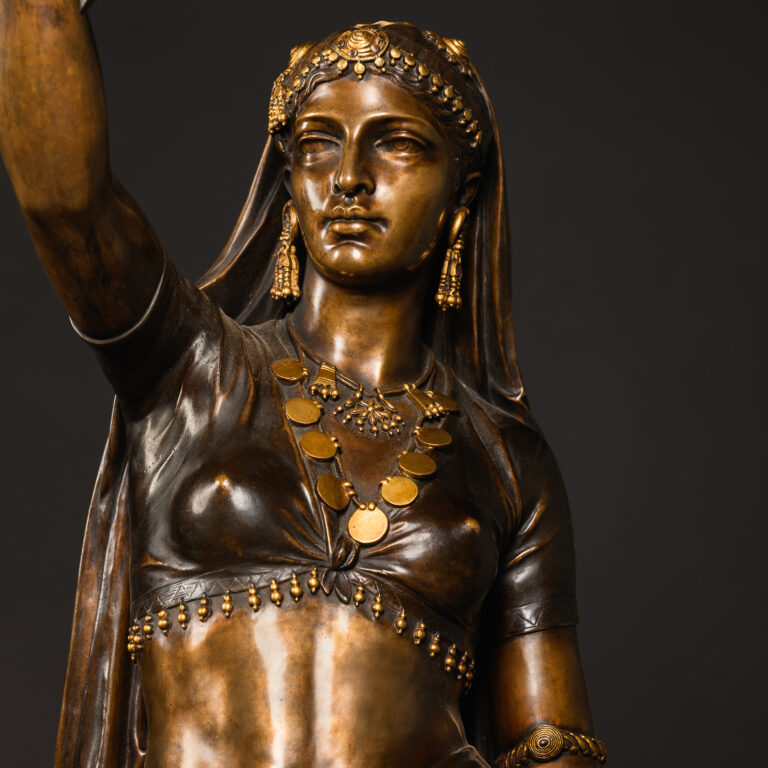
A Large Orientalist Patinated-Bronze Figural Torchère, Entitled ‘Femme Indienne’, By Émile-Coriolan-Hippolyte Guillemin (French, 1841-1907). Cast By Ferdinand Barbedienne Foundry, Paris.
Signed ‘Ele. Guillemin 1872’ on the base with foundry inscription ‘F. BARBEDIENNE FONDEUR’.
On a pink granite pedestal.
France, Circa 1875.
‘Femme Indienne’ was sculpted by Émile Guillemin in 1872 and cast in bronze by Barbedienne who in 1875 offered it in four sizes measuring in height: reduction no. 1 (200 cm); no. 2 (120 cm); no. 3 (95 cm); no. 4 (78 cm).1 This is therefore an example of reduction no. 2, standing at 120 cm. high, plus the candelabrum.
Émile Guillemin was an Orientalist sculptor noted for his use of polychrome patination with applied silver, red and gold tones, employed to capture the exoticism of his subjects. ‘Femme Indienne’ was partnered with a companion figure titled ‘Femme Persane’. Also cast by the Barbedienne foundry were torchère figures by Guillemin titled ‘Deux Femmes Japonaises’ and ‘Deux femmes, Style Renaissance’. All were offered in Barbedienne’s sale catalogues between 1875 and 1905.
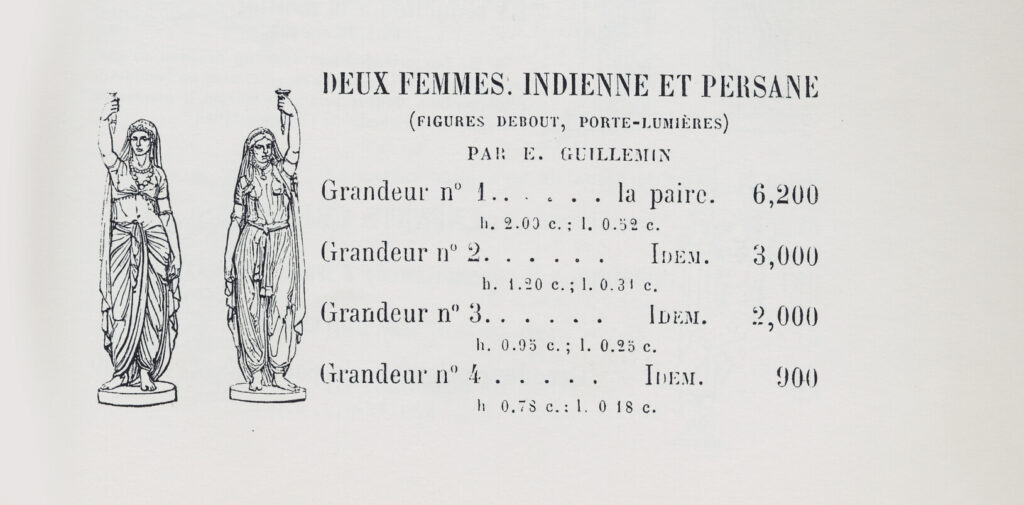
Barbedienne, Ferdinand, ‘Catalogue des Bronzes d’art 1886’.
Such torchères were designed to illuminate an entranceway or staircase and noted examples include pairs of ‘Deux Femmes, Indienne et Persane’ which flanked the entrance of the Barbedienne family residence (sold Hôtel des Ventes, Enghien, 4 March 1984) and in the staircase hall at the Astor Mansion at Fifth Avenue & 65th Street, New York.2
Footnotes:
- F. Rionnet, Les Bronzes Barbedienne: L’oeuvre d’une dynastie de fondeurs, Paris, 2016, Cat. 1627 p. 448.
- https://www.garylawrance.com/blog/2020/9/10/john-jacob-astors-titanic-fifth-avenue-mansion

Specifications
Total Height: 236 cm | 93 inches
Height of Figure including candelabra: 147 cm | 58 inches
Height of Bronze Figure 120 cm | 47 inches
Émile-Coriolan-Hippolyte Guillemin
Born in Paris in 1841, Émile-Coriolan-Hippolyte Guillemin was the son of sculptor Émile-Marie-Auguste Guillemin, who worked for the state producing copies of antique sculptures and busts of various aristocrats. After studying with both his father and sculptor Jean-Jules Salmson (1832-1902), Guillemin exhibited at the Salon for the first time in 1870 where he exhibited a pair of Roman Gladiators, Retaire and Mirmillon, drawn from antiquity. Though his output was wide ranging, Guillemin became most well-known for depicting figures from the Middle East and Asia in an Orientalist style. Compared to many of his contemporaries, though, Guillemin’s sculptures lack the overt sensuality and ‘otherness’ found in depictions of non-Europeans, especially women, and instead present seemingly studied depictions of figures representing a certain culture.
Guillemin’s oeuvre is perhaps most adjacent to his contemporary, Charles-Henri-Joseph Cordier (d. 1905), who served as a privileged sculpture of Paris’ Natural History Museum, travelling extensively to Africa, and producing a series of lifelike busts for their Ethnographic Gallery. In his sculpture Guillemin’s was, like Cordier, drawn to use polychrome patinas to reflect the exoticism of his subjects and appeal to the luxurious tastes of his day. Guillemin is considered a fine rather than a purely decorative artist, though his oeuvre was often associated with large-scale works such as his torchères Indienne et Persane by the Barbedienne foundry (1872).
His work will remain valued for the honesty in the portrayal of his sitters. This is most apparent in an equally arresting pair of portrait busts of ‘Janissaire du Sultan Mahmoud II’ and ‘Femme Kabyle d’Algerie’, sold from The Estate of Rochelle Sepenuk, Sotheby’s, New York, 21 October 2008, lot 92 ($1,202,500).
Bibliography:
Kjellberg, Pierre. Les Bronzes du XIX siècle, Dictionnaire des Sculpteurs, Les Editions de l’Amateur, (Paris), 1989; pps. 369-370.
Literature
F. Rionnet, Les Bronzes Barbedienne: L’oeuvre d’une dynastie de fondeurs, Paris, 2016, Cat. 1627 p. 448.
https://www.garylawrance.com/blog/2020/9/10/john-jacob-astors-titanic-fifth-avenue-mansion