 Ref no: B78820
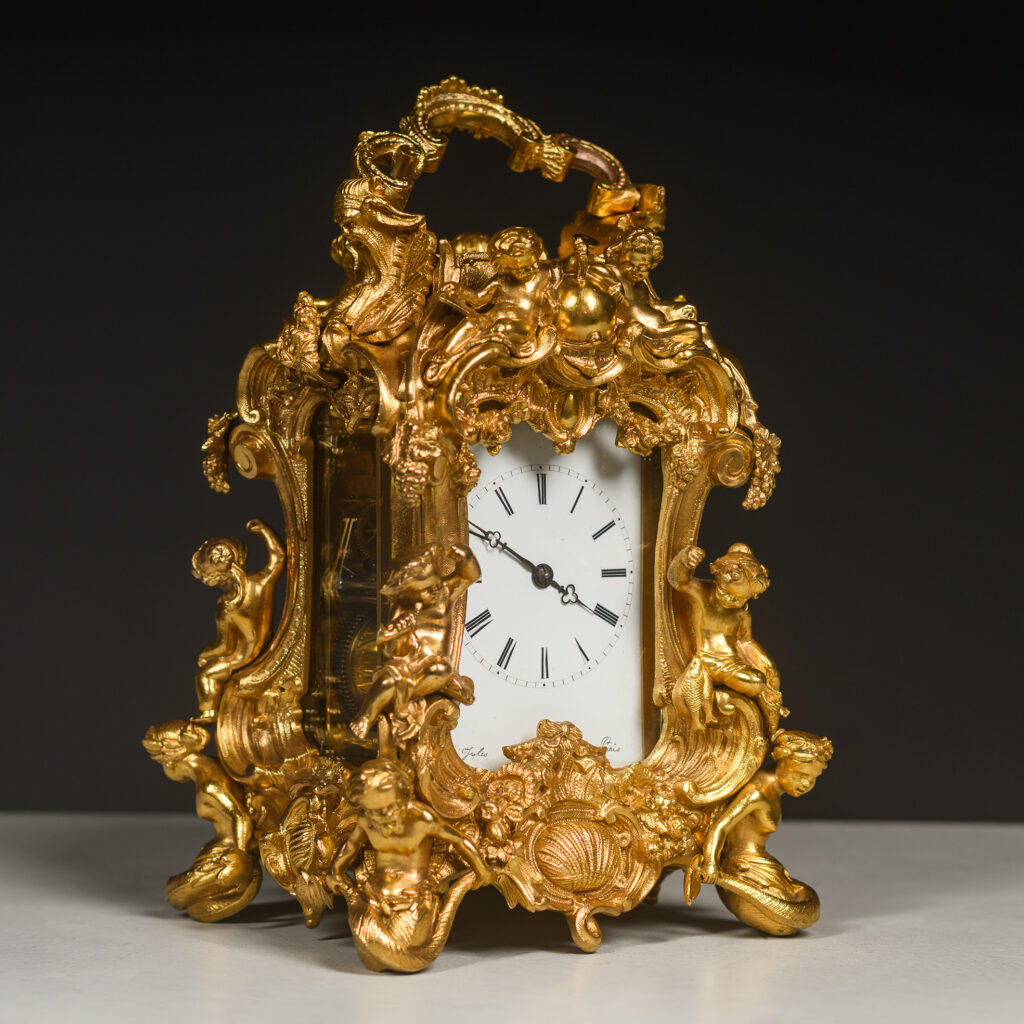
A Fine Louis-Philippe Period Carriage Clock With ‘Push Button Repeat’
France, Circa 1840
£12,000
- Date
- Circa 1840
- Origin
- France
- Medium
- Gilt-Brass
- Signature
- The backplate signed ‘JULES A PARIS’. The dial signed ‘Jules Paris’ and ‘JULES PARIS’.
- Height
- 20 cm (8 in)
- Width
- 14 cm (6 in)
- Depth
- 12 cm (5 in)
Description
A Fine Louis-Philippe Period Gilt-Brass Carriage Clock With ‘Push Button Repeat’, By Jules, Paris.
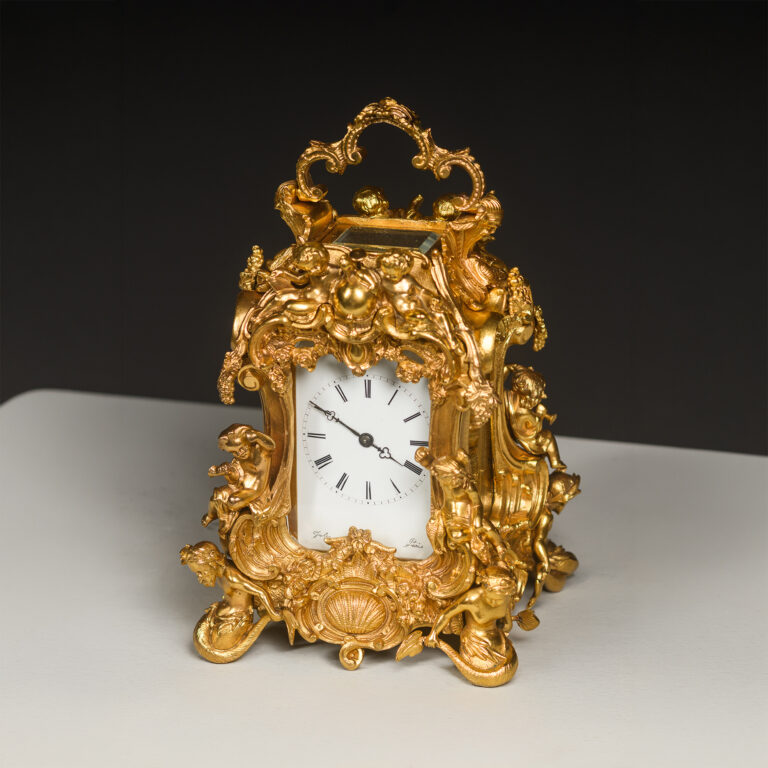
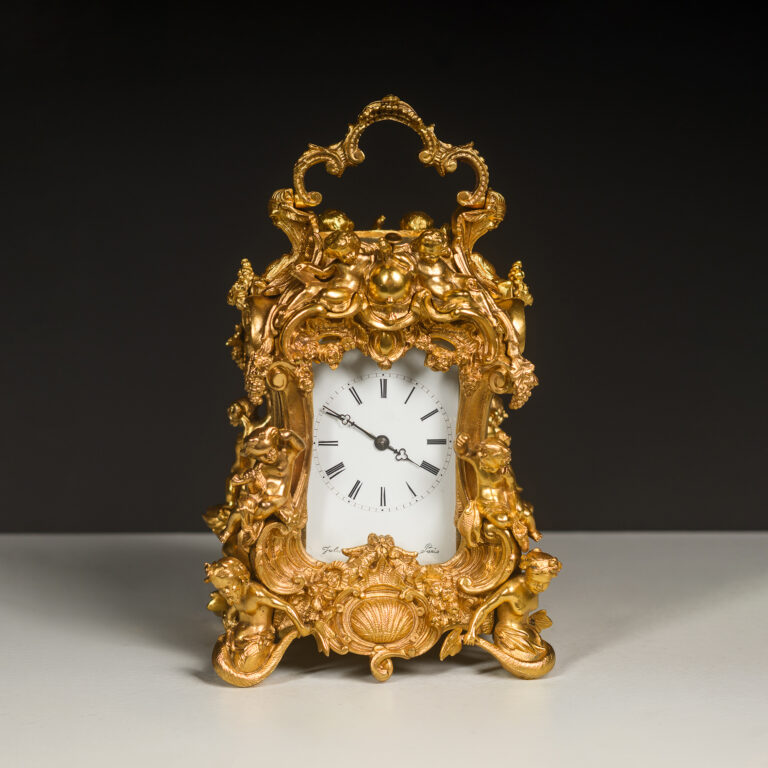
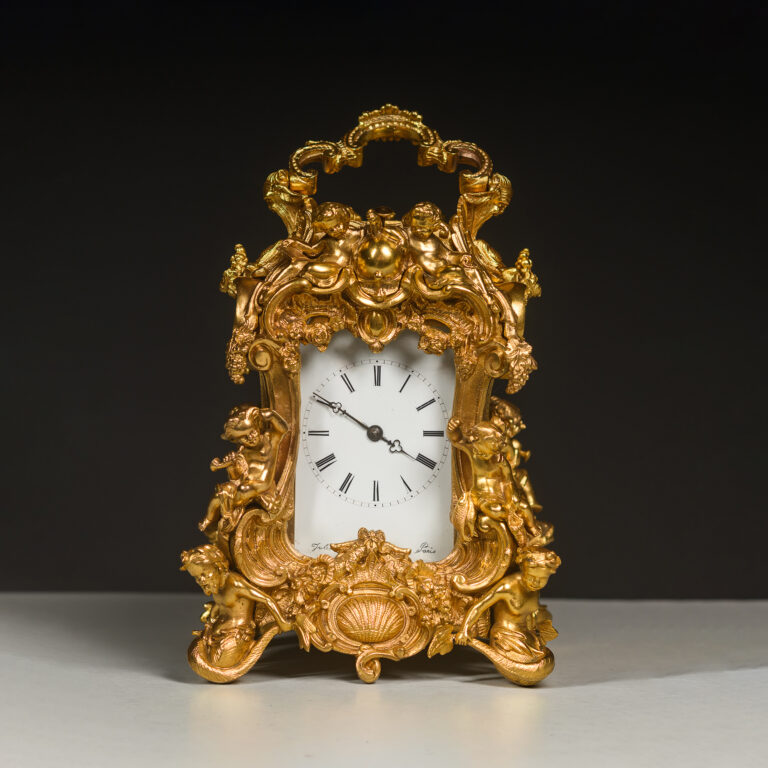
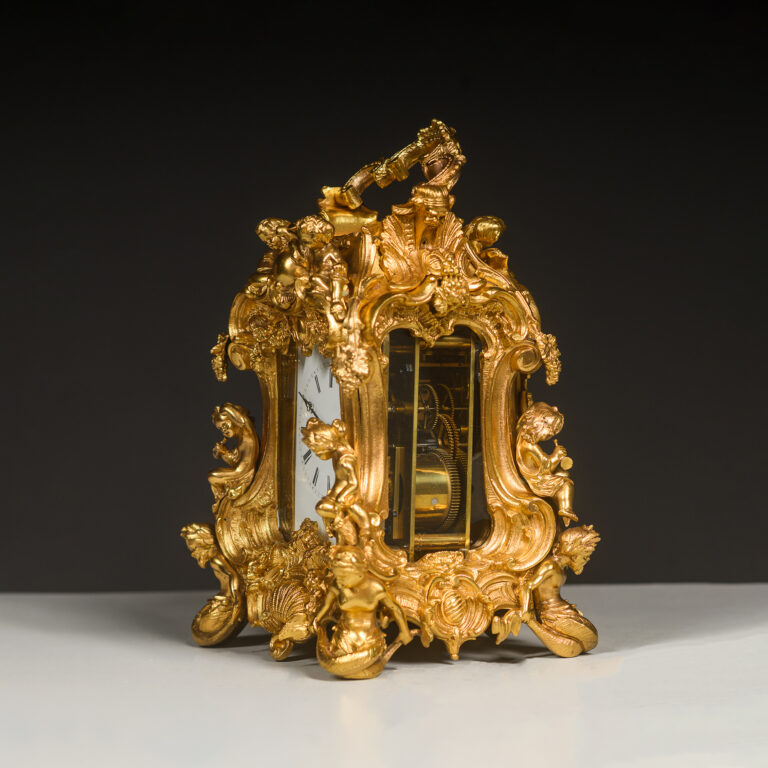
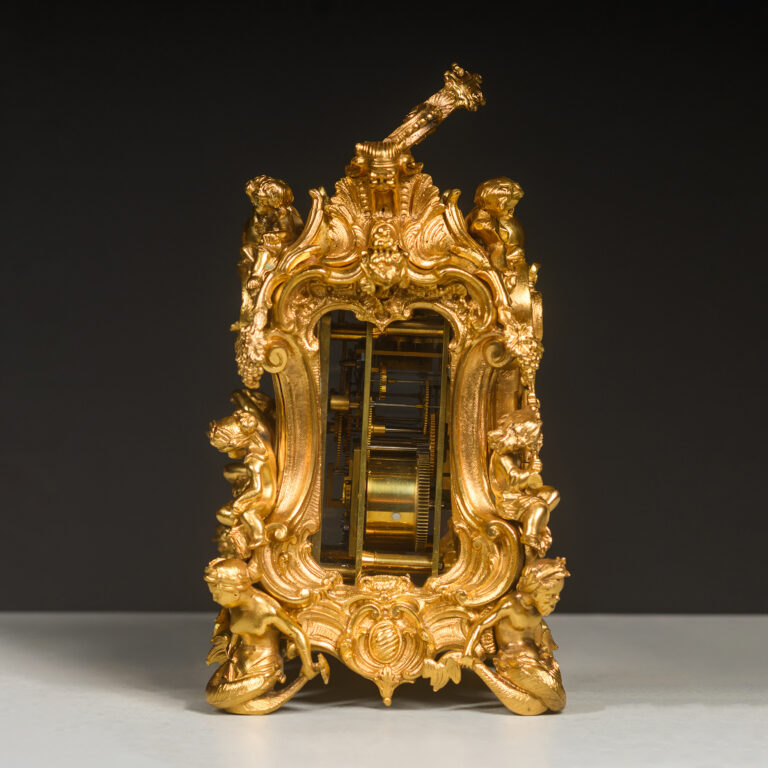
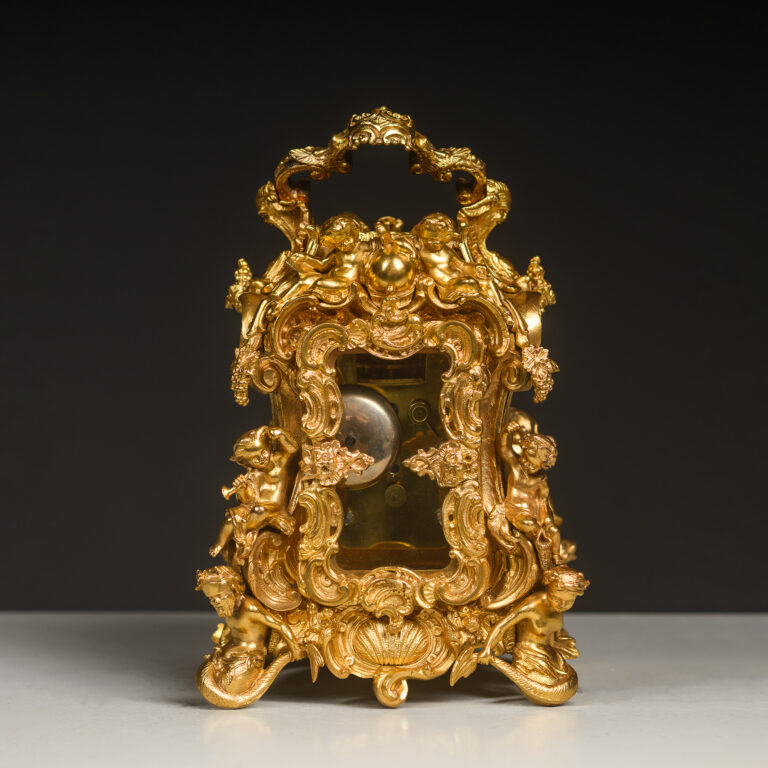
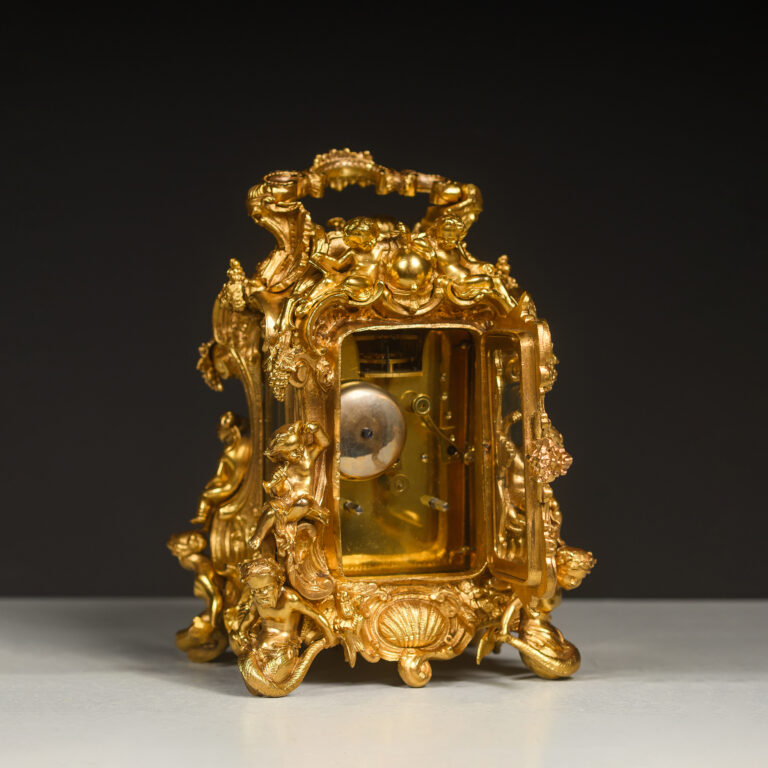
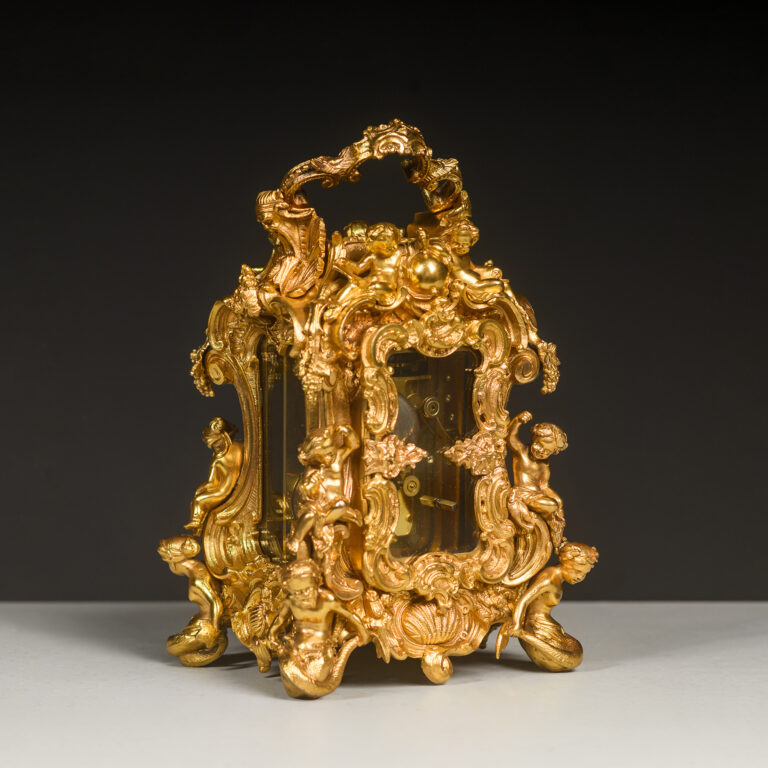
Designed in the Rococo style with hinged triple ‘C’-scroll handle above bevelled top glass with a plunger for the repeat function. The cresting with reclining putti flanking a globe representing Cartography. The ogee scroll-angled shaped case with seated putti representing fishing and hunting. The shell centred scroll panel to the apron flanked by supports finely modelled as a mermaid and her companion. The cartouche-shaped glazed sides with conforming scrolls. The rear matching the front but with elaborated scroll cast door with hinged clasp.
The glazed front with white enamel dial with Roman numerals and pierced blued steel trefoil hands.
The rectangular eight-day two train bell striking movement with ‘Jules’ type platform lever escapement regulated by helical sprung bimetallic balance incorporating screws, wedge-shaped timing weights and pivoting within a circular sub-carriage.
The backplate signed ‘JULES A PARIS’.
The dial signed ‘Jules Paris’ and ‘JULES PARIS’.
France, Circa 1840.
Little is recorded about Jules but he is thought to have been active in Paris around 1840 to 1850 and specialized in high-quality brass carriage clocks. He is famous for pioneering or popularizing a distinct platform escapement known as the “Jules-type platform”. This design features a split/compensated balance on a blued steel helical hairspring with a jewelled lever or anchor escapement housed in a recessed subframe with a high bridge. Similar platforms were also used by contemporary Parisian makers like Auguste, Bolviller, and Séguin.
The refinement of the Jules-type platform escapement means that it is found in premium French carriage clocks from that era. It is however usually partnered with a plain brass case. The highly elaborate neo-rococo case to this example distinguishes it greatly.
The clockmaker would have collaborated with an orfèvre bronzier to complete the design and the finished clock would be sold in the fashionable shops of the Palais Royal, just above the Louvre. Similar cases were made with clock movements by Drocourt who is also historically associated with the Palais Royal.

Literature
An almost identical escapement to the one fitted in this clock is illustrated in Charles Allix, and Peter Bonnert, CARRIAGE CLOCKS Their History and Development, Woodbridge, 1974, pl. II/47, p. 73.
The Rococo style case can be directly compared to that for a clock by Lucien, Paris, illustrated in Derek Roberts, CARRIAGE and Other Travelling CLOCKS, Atglen, 1974, p. 101.