 Ref no: B66850
Charles-Guillaume Winckelsen
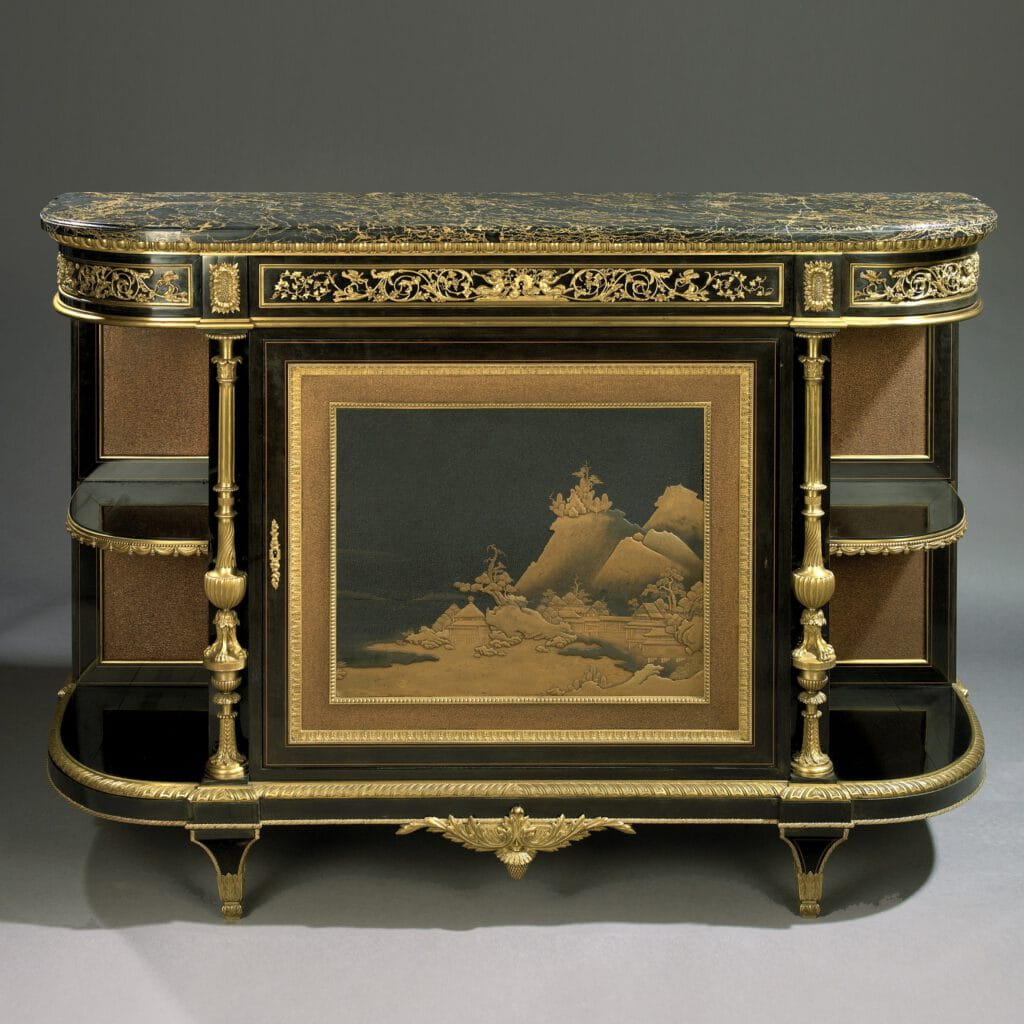
An Important Louis XVI Style Gilt-Bronze Mounted Cabinet
France, Circa 1860
£140,000
- Date
- Circa 1860
- Origin
- France
- Medium
- Gilt-Bronze Mounted
- Signature
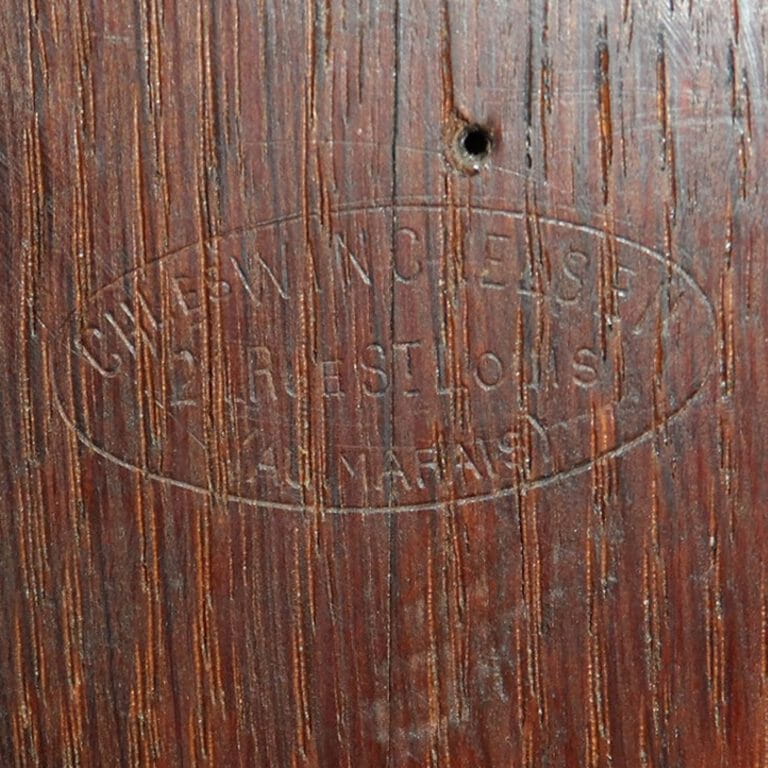
- Stamped to the back of the carcass 'CHLES. WINCKELSEN - 21 RUE ST. LOUIS - (AU MARAIS)'.
- Height
- 105 cm (42 in)
- Width
- 150 cm (60 in)
- Depth
- 54 cm (22 in)
Description
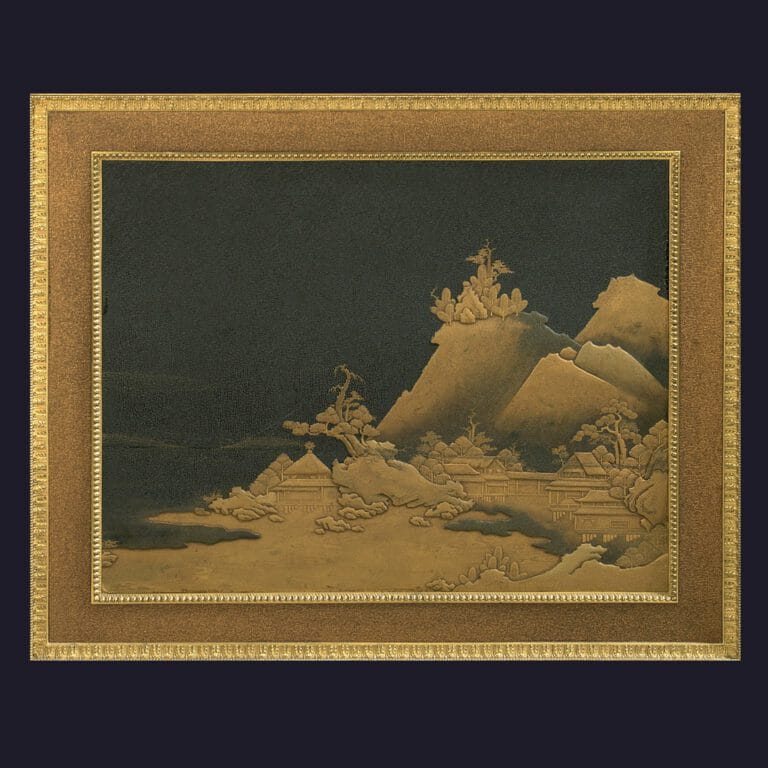
This Important Louis XVI Style Cabinet by Winckelsen has a shaped Portor marble top above a frieze drawer and two concealed demi-lune drawers above a lacquer panel door. Executed in gold hiramaki-e and takamaki-e technique against a black ground, the lacquer work door depicts a mountainous landscape in classical Yamato-e style and is of exceptional quality.
This important lacquer cabinet with open quadrant shelves ‘a l’anglaise’ is illustrated by Christopher Payne in his book ‘Paris Furniture: The Luxury Market of the 19th Century’; p. 552.

Charles-Guillaume Winckelsen
The atelier of Charles-Guillaume Winckelsen is one of the undiscovered secrets of the Second Empire exhibition period. Established at 23 Val-Sainte-Catherine, Paris in 1854, it flourished until his death in 1871. As a result of his comparatively short career very little of his work is available today.
Born in 1817, at the new dawn of the Bourbon dynasty, Winckelsen died in 1871 as the Third republic was being formed. Thus his whole philosophy of design, alongside his contemporaries, was one of maintaining the emblems of the ancien regime. In re-using motifs from the eighteenth century Winckelsen favoured the Louis XVI style without reverting to simple pastiche.
Winckelsen’s bronze casting was of the highest quality, easily on a level with the celebrated Thomiere in the early years of the century. He re-created all of his moulds, never re-using or simply copying existing models.
His business was sold by his widow in July 1871 to the celebrated Henri Dasson, who thus was able to use the exquisite collection of master patterns built up by Winckelsen to great effect.
Bibliography:
Ledoux-Lebard, Denise. Les Ebenistes du XIX siècle, Les Editions de l’Amateur (Paris), 1984; pps 635-8.
Literature
Denise Ledoux-Lebard, ‘Les Ebenistes du XIX Siecle’, pps 635-8.Payne, Christopher. Paris Furniture: The Luxury Market of the 19th Century, Editions Monelle Hayot (Saint-Remy-en-l’Eau), 2018; p. 552.